The Grey Parlour
Jack sits in his makeshift living room, trapped by his own mind and body, observing the minute details of his decay while his wife, Martha, tends to the house with unnerving energy.
The dust in this room has a geology to it. I have mapped the strata of it from this chair, layer upon delicate layer of grey silt that settles on the mahogany sideboard, the spines of the unread encyclopaedias, and the ridges of my own knuckles. It is a slow accumulation, a quiet burying of the world that mirrors the snow drifting against the boarded-up windows outside. The light today is struggling, a bruised purple filtering through the cracks in the plywood, weak and unconvincing. It is afternoon, I suppose. The grandfather clock in the hall stopped ticking three years ago, its pendulum frozen in a permanent hesitation, much like myself.
My legs are under the quilt. The quilt is heavy, a patchwork of wool and velvet scrounged from the wreckage of the neighbours' houses back when we still had neighbours, back before the silence stretched out to the horizon. It smells of damp dog, though we haven't owned a dog in a decade, and of camphor. Beneath it, my legs feel distant, like acquaintances I haven't spoken to in years. They are not broken. There is no fracture, no severing of the nerve. I could move them, in theory. The mechanics are intact. But the signal from the brain to the muscle is lost in the static of a profound, suffocating lethargy. It is a gravity distinct from the earth’s pull, a personal magnetism that binds me to this velvet armchair.
I watched a spider navigate the ceiling corner for an hour. It moved with a jittery, desperate purpose. I envied it. I envied its mindless drive to spin, to trap, to survive. I simply sat. The air in the room was stale, recycled through the lungs of this house a thousand times, tasting of wet plaster and the metallic tang of the kerosene heater sputtering in the corner.
Martha came in then. She didn't walk; she marched. Martha has treated the apocalypse like a particularly difficult stain on a rug—something to be scrubbed at with vigour until it submits. She was wearing her layers: the oversized cable-knit sweater that used to be mine, the fishing vest with the pockets full of mysterious scavenging tools, the fingerless gloves.
"Still holding court, are we?" she asked. Her voice was too loud for the room, a jagged tear in the fabric of the silence. She carried a tray.
"The subjects are unruly today," I said, my voice sounding rusty in my own ears. "The dust mites are planning a revolution."
"Well, tell them to wait until Tuesday. I'm not sweeping until Tuesday." She set the tray down on the precarious stack of magazines beside me. A mug of something steaming. A bowl of something grey.
"What is the vintage this afternoon?" I asked, eyeing the bowl.
"Chicken and stars. Vintage 2024. A fine year for sodium." She adjusted the quilt around my knees, her movements brisk, almost aggressive. She tucked the fabric in tight, swaddling me. Binding me.
"You’re too kind to me, Martha. Really. I should be up. I should be checking the vents."
"You should be," she agreed, straightening up and wiping her hands on her trousers. "But you aren't. So eat your stars."
She walked over to the window—the one with the small gap in the boards where we could see the driveway. She peered out, her body tense. A coil of wire ready to snap. I watched her back. I watched the way her hand rested near the knife she kept on her belt. She was capable. Terrifyingly capable. And I was... furniture.
"Anything?" I asked.
"Nothing. Just the wind. And a fox, maybe. Tracks near the old shed."
"A fox. Meat."
"Mange," she corrected. "Scrawny thing. Wouldn't feed a cat, let alone two relics like us."
She turned back to me, her face shadowed. Her eyes were sharp, scanning me, assessing me. Sometimes I felt like a patient. Sometimes I felt like a specimen. Sometimes I felt like a liability she hadn't quite figured out how to liquidate.
"Eat," she commanded.
I picked up the spoon. It was heavy. The soup was lukewarm. I took a sip. Salty, yes. But beneath the salt, something bitter. A chemical aftertaste that coated the back of my tongue like dissolved aspirin. I paused, the spoon hovering halfway to my mouth.
"Problem?" Martha asked. She was watching me closely. Too closely.
"It's... robust," I said. "Did you add herbs?"
"Found some dried sage in the pantry. Thought you'd like the variety." She smiled. It was a tight smile, stretching the skin over her cheekbones. It didn't reach her eyes.
"Sage," I repeated. "Right. Sage."
I took another spoonful. The bitterness was distinct. It didn't taste like sage. It tasted like the sleeping pills we had raided from the pharmacy in the village four winters ago. The blue ones. The ones that made the world go soft and fuzzy at the edges.
Why would she drug me? I wasn't going anywhere. I was already trapped in this chair by the weight of my own despair. Unless she wanted me deeper. Unless she wanted me asleep so she could do something she didn't want me to see.
"I need to go check the generator," she said suddenly. "It was coughing earlier. Sounded like it had a lung infection."
"I can come with you," I lied. "Hold the torch."
"Don't be daft, Jack. You haven't stood up in three days. You'll freeze before we get to the porch." She moved to the door, buttoning her heavy canvas coat. "Stay. Eat. I'll be back in twenty minutes."
"Martha," I said.
She paused, hand on the doorknob.
"Be careful."
"Always am." She winked, a quick, incongruous flash of the woman she used to be, and then she was gone. The heavy oak door clicked shut. Then, the distinct, metallic slide of the deadbolt. From the outside.
---
She locked it. She never locked it from the outside. The inner latch was enough to keep the wind—and anything else—out. Locking it from the outside was to keep something in.
I stared at the door. The indignation should have been enough to propel me out of the chair. It should have been a fire under my ribs. But the cold in the room was insidious; it had seeped into the marrow. I looked at the bowl of soup. The little stars floated in the grey broth, constellations in a dead sky.
Sage. Bullshit.
I needed to know. The tin can. She would have thrown the empty tin in the bin in the kitchen area. If she had crushed pills into it, there might be residue. Or maybe the bottle of pills itself was on the counter, forgotten.
I placed the bowl on the floor. I gripped the arms of the velvet chair. The fabric was worn smooth, bald patches where my hands had rested for months. I pushed.
My arms trembled. The triceps burned with a pathetic, atrophied heat. I heaved my weight forward, shifting my centre of gravity over my feet. My knees popped, a sound like dry twigs snapping in a winter forest. I rose. An inch. Two inches.
The room spun. A wash of grey vertigo tilted the floor, sliding the walls sideways. My heart hammered a frantic, irregular rhythm against my ribs, a bird trapped in a shoebox.
"Up," I whispered. "Get up, you old fool."
I stood. Swaying. The quilt pooled around my ankles, a heavy woollen shackle. The air at this altitude—six feet off the floor—seemed thinner, colder. I took a breath, and it rattled in my chest.
The kitchen counter was five metres away. It might as well have been across the frozen lake. I took a step. My foot dragged, catching on the edge of the rug. I stumbled, catching myself on the sideboard. A porcelain figurine of a shepherdess, one of the few things Martha had insisted on saving, wobbled but didn't fall. I stared at her painted ceramic face. She looked terrified.
"I know," I told her. "I know."
I pushed off the sideboard. Step two. Step three. The silence of the house was judgmental. It watched me lurch like a drunkard across the floorboards. I was sweating, a cold, clammy sheen that felt like ice water on my skin. The effort was astronomical. Why was it so hard? It wasn't just muscle. It was the sheer, crushing pointlessness of movement. Why walk to the kitchen? Why walk anywhere? The world ended. We are just the credits rolling in an empty theatre.
But the lock. The click of the lock gnawed at me.
I reached the kitchen island. I leaned heavily against the butcher block, breathing hard. The bin was under the sink. I crouched. Or rather, I let gravity win a partial victory and collapsed into a controlled kneel.
I opened the cabinet. The smell of rotting compost hit me—potato peels, coffee grounds, the sweet stench of decay. I pulled the plastic bin out. There, on top. The tin can.
I picked it up. Campbell's Chicken & Stars. I sniffed it. Tin and chicken fat. Nothing unusual. I dug deeper, ignoring the slime of a decomposing tea bag.
Nothing. No empty pill bottle. No pestle for grinding. Just refuse.
I sat back on my heels, holding the empty soup can. Was I losing my mind? Had the isolation finally rotted the logic centres of my brain? Maybe she just added sage. Maybe the lock was habit. Maybe the bitterness was just... age. Everything tastes bitter when you've been swallowing disappointment for four years.
Then I saw it. Not in the bin, but behind it. Tucked into the shadow of the pipe.
A wrapper. Foil. Shiny and jagged.
I reached for it, my fingers stiff and clumsy. I pinched the corner and pulled it into the light. It wasn't a pill wrapper. It was a foil packet for a chocolate bar. Cadbury. A whole bar. The wrapper was fresh, the smell of chocolate still clinging to the silver.
Chocolate. We hadn't seen chocolate since the second winter. She said there was none left. She said the scavengers had taken it all.
She had been eating chocolate. Alone. In the kitchen. While I sat in the chair eating grey starch.
It wasn't poison. It was betrayal. It was a secret hoard. It was the fact that she had something sweet, something vibrant and rich, and she chose not to share it. Because I wasn't worth it? Because I was a dead weight? Or because she needed the sugar for energy, for the work she did, while I did nothing but produce carbon dioxide?
I crushed the wrapper in my hand. The crinkle sounded like a gunshot in the quiet room.
The front door handle rattled.
She was back.
Panic, cold and sharp, pierced the lethargy. If she found me here, on the floor, holding the evidence of her selfishness, what would happen? The fragile truce of our existence would shatter. And I didn't have the energy to fight a war. I didn't have the energy to scream. I barely had the energy to hate her.
I shoved the wrapper into my pocket. I grabbed the edge of the counter. The return journey. I had to get back. I had to be the furniture again.
I hauled myself up. My vision blackened at the edges. I scrambled, a crab-like shuffle, back towards the armchair. The quilt was a tangled mess on the floor. I kicked it aside, fell into the chair, and dragged the heavy fabric up to my chin just as the deadbolt slid back.
The door opened. A gust of freezing wind, smelling of pine and snow, swirled into the room, chasing the dust.
Martha stomped in, cheeks flushed red, bringing the cold with her.
"Generator's fine," she announced, unwinding her scarf. "Just a clogged filter. Cleared it out." She looked at me. Then she looked at the soup bowl on the floor. Then at the rug, which was rucked up where I had dragged my foot.
She paused. Her eyes narrowed. She looked at the shepherdess on the sideboard, which was turned slightly, facing the wall now.
"Did you move?" she asked. Her voice was flat.
"Move?" I let out a dry, rattling laugh. "I thought about it. I thought about doing a mazurka. But then I remembered I lack the footwear."
She stared at me. She knew. She had to know. She looked at my chest, heaving slightly under the quilt. She looked at the sweat on my forehead.
"You look flushed," she said.
"It's the soup," I said. "The sage. It's very... warming."
"Right," she said. "Good."
She walked over to the sideboard and adjusted the shepherdess, turning her back to face the room. Correcting the world. Putting things back in their place. Including me.
"I found something else outside," she said, not looking at me.
"Oh? A nugget of gold? A map to the promised land?"
"No," she said. She turned, and for a second, I thought she looked afraid. But it was gone, replaced by that steely, survivalist mask. "Footprints. Fresh ones. Not a fox. Boots."
My hand tightened on the foil wrapper in my pocket. The chocolate didn't matter anymore. The betrayal didn't matter. The paralysis was a luxury we could no longer afford, and yet, it was the only armour I had.
"Boots," I echoed.
"Someone was watching the house, Jack. Standing by the window. Looking in."
"Did they see us?"
"They saw you," she said. "They saw an old man sleeping in a chair. An easy mark."
She walked into the kitchen. I heard the tap squeak as she washed her hands. The water pipes groaned in the walls.
"You need to finish your soup," she called out. "You need your strength."
I looked at the grey bowl. I looked at the dark window. The reflection of the room stared back at me—a hollow man in a hollow house, holding a piece of trash like a talisman.
"Martha?" I asked.
"Yeah?"
"Why did you lock the door?"
The water stopped running. The silence stretched, tight and humming, like a wire under tension.
"Habit," she said finally. Her voice was soft, too soft. "Just habit, Jack."
She didn't come back into the room. I sat there, listening to the wind ply the siding of the house, looking for a way in. I could feel the wrapper sharp against my hip. I realised then that the paralysis wasn't just about depression. It was about waiting. I was waiting for the other shoe to drop. I was waiting for her to decide I was too heavy to carry.
Or maybe, just maybe, I was waiting for the moment when I would have to stand up and kill whatever came through that door, to save the woman who was eating chocolate while the world burned.
The Night Watch
Evening collapsed into night with no fanfare, just a deepening of the shadows until the room was a cave. Martha lit the kerosene lamp. The smell was nostalgic and nauseating. The golden light threw our shadows against the wall, elongated and distorted, like spectres mocking our stillness.
She sat in the chair opposite me, mending a tear in her coat. The needle flashed in the lamplight. In, out. In, out. A rhythmic stabbing.
"We should board up the gap," I said. "If someone was looking in."
"I will. In the morning. Need to find the hammer." She didn't look up.
"I can hold the nails," I offered. The lie tasted like ash.
"Sure," she said. "You can hold the nails."
We sat in silence. The domesticity of it was grotesque. Two people in a dying house, pretending that mending a coat and drinking tea mattered. But the air was charged. The wrapper in my pocket felt radioactive. The lock on the door. The footprints. The sage that wasn't sage.
"Do you remember that trip to Halifax?" she asked suddenly.
I blinked. "Halifax? That was twenty years ago."
"The air B&B. The one with the draughty windows. You complained the whole time about the noise from the harbour."
"The foghorn," I recalled. "It sounded like a dying cow."
"I loved that sound," she said. She bit the thread, snapping it. "It sounded like... something was out there. Something big. Safe."
"Safe," I scoffed. "It was a warning. That's what foghorns are. Warnings."
"Maybe," she said. She put the coat down. She looked at me, her eyes reflecting the single flame of the lamp. "Maybe I'm tired of warnings, Jack. Maybe I just want to hear something that isn't the wind or you breathing."
"I can stop breathing if it helps," I muttered.
"Don't be dramatic. It doesn't suit your complexion."
She stood up and walked to the window again. She pressed her hand against the boards. She was vibrating with energy, with fear, with something I couldn't read. Was she signaling someone? Was the chocolate a trade? Had she bought safety with the last of our luxuries?
"They'll come back," she whispered. "Whoever it was. They'll come back tonight."
"And what do we do?" I asked. "Do we hide? Do we fight? I can trip them with my cane. It's a solid plan."
She turned to me. Her face was hard. "I have the gun, Jack. The pistol. From the safe."
"The safe? You opened the safe?"
"Months ago." She reached under the cushion of her chair and pulled it out. A Glock. Ugly, black, utilitarian. She held it comfortably. Too comfortably.
"You didn't tell me."
"You were busy staring at the wall. I didn't want to disturb your meditation."
She checked the magazine. The click was loud. "Seven rounds. That's it."
"Seven," I said. "Lucky number."
"For one of us," she said.
She placed the gun on the small table between us. It sat there, a third participant in our conversation. An arbiter.
"Get some sleep, Jack," she said. "I'll take the first watch."
"I'm not tired."
"You're always tired. That's your whole thing now. You're the tired man in the chair. Go to sleep."
She blew out the lamp. The room plunged into darkness, save for the faint grey light from the cracks in the window. I could hear her breathing in the dark. I could hear the house settling, the timbers groaning under the weight of the snow.
I closed my eyes, but the darkness behind my lids was full of shapes. The footprints. The chocolate wrapper. The gun. The look on her face when she saw I had moved.
I wasn't going to sleep. I couldn't. I had to watch her. I had to see who she was waiting for. Was she guarding me, or was she waiting for the delivery crew to take out the trash?
My hand crept to my pocket, touching the foil again. A sharp edge cut my finger. A tiny sting of pain. It was the most real thing I had felt in months.
I focused on the pain. I let it anchor me. I wouldn't drift away tonight. I would wait. And when the door opened, I would know.
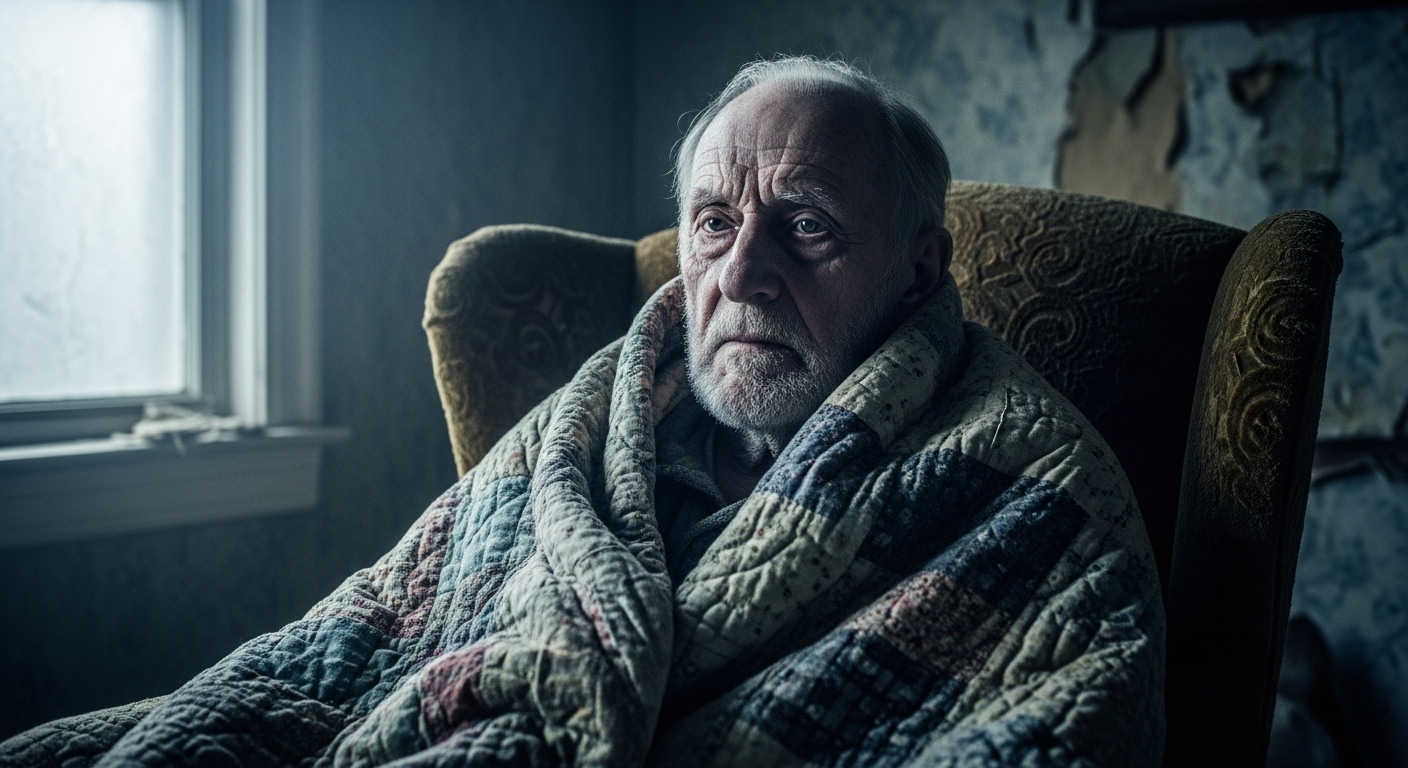
I watched the steam rise from the mug, curling like a beckoning finger, and I wondered if tonight would be the night I finally slept through the cold, or if I’d wake up to find the door bolted from the outside.
Share This Story


