The Hum of Fallen Leaves
The air hung heavy and still, smelling of damp earth and something indefinable, metallic, as John pushed aside a curtain of skeletal branches. The forest, once a vibrant green blur, now wore the muted, bruised colours of a perpetual autumn, even as the real autumn began its slow, inevitable crawl. Every fallen leaf, every shadow, seemed to hold a breath of warning, a silent testament to the invisible shift that had permanently scarred their world.
The ground was a riot of spent leaves – maple, oak, birch – that crunched under John’s boots with a sound too loud for the oppressive quiet. Not the crisp, dry snap of a normal autumn, but a dampened, yielding thud, as if the forest floor itself was holding its breath. He stopped, holding a hand up, a signal to Ben behind him, whose breath was already coming a little short, a dry cough catching in his throat.
“Hear that?” John murmured, his voice a low rasp. He’d been trying to lower his own voice for months, ever since the quiet began. There was no birdsong here, not anymore. Only the wind, and sometimes, the rustle of something scuttling unseen in the undergrowth – something small, something that moved too fast to be quite right.
Ben leaned against a grey, lichen-dusted pine, his face pale beneath the brim of his worn cap. His eyes, usually quick, were shadowed, scanning the canopy above. “Just the wind, John. Always the wind.” He shivered, pulling the collar of his faded anorak tighter around his neck. The limp he’d carried since the long walk back from the exclusion zone flared with every step, a constant, nagging rhythm.
John took another slow, deliberate step, testing the soil. The Geiger counter, a battered old model he’d salvaged, hung from his belt, mostly for reassurance, a dull, insistent clicker in the pervasive silence. They knew the hot spots, the deep-seated areas, but the wind… the wind was the unpredictable variable, a fickle hand carrying invisible ash and dust, redistributing the particles like a cruel, indifferent gardener.
The tree line was denser here, the path little more than a deer trail, overgrown with thorny brambles that snatched at their trousers. He remembered this place, vaguely, from before. Before everything. There had been a small stream, clean and cold, where they’d skipped rocks, and the sun had actually dappled the path in cheerful patches of gold. Now, the light struggled through a dense, sickly-looking canopy, rendering everything in shades of grey and muted brown, a perpetual twilight.
He lifted his eyes to the upper branches. Some of the leaves were misshapen, curling in on themselves like burnt paper, others bore an unnatural, almost iridescent sheen. Ben cleared his throat, a dry, rattling sound that made John flinch. “You okay?”
“Fine,” Ben rasped, pushing off the tree. He pulled a bandana, already damp with sweat, over his nose and mouth. They both wore them, mostly for the dust, but also, a futile barrier against the constant anxiety that gnawed at them. “Just… dry air.”
John didn’t press. They didn’t talk much about it, not really. The accident. The Repository. The way the river had swelled, an impossible torrent, then receded, leaving behind a slick, iridescent film and a taste in the air that never quite went away. The watershed had been poisoned, the land around it forever changed. They were just… living in it, now. Surviving.
They walked on, their boots crushing the brittle leaves, each step a conscious act of not looking down, not examining the anomalies too closely. There was a weird resilience to the forest, a grotesque adaptation. New fungal growths, strange, bulbous things like grey brains, clung to the bark of trees. Patches of moss glowed with an unnerving, faint luminescence in the deeper shadows, a soft, biological hum that didn't feel natural.
The Ghost of Running Water
After what felt like an hour, pushing through dense undergrowth that clawed at their clothes, they heard it: a faint, gurgling murmur. The creek. John froze, raising his hand again. Ben stopped, his breathing harsh, but his eyes were fixed on John, expectant.
“The creek,” John whispered, confirming what they both already knew, dreaded. The sound was wrong. Not the cheerful rush of clear water, but a sluggish, almost viscous-sounding movement. “Stay back.”
He moved forward, careful, planting each foot as if expecting the earth to give way. The foliage thinned, giving way to a small clearing. And there it was: what used to be a lively, babbling creek, now a sluggish ribbon of murky, ochre-tinted water, barely moving over a bed of dark, silted stones. The surface was still, oily in places, catching the dull light in unsettling patterns. No visible life, no darting fish, no insects buzzing over its surface. Only the low gurgle.
John unclipped the counter from his belt, his thumb finding the worn toggle. He held it out, just above the water. A soft, regular clicking began, then intensified, a rapid, almost agitated staccato. It wasn’t a scream, not like the readings from the exclusion zone, but it was enough. Enough to keep them away. Enough to remind them.
“Still hot,” Ben muttered, his voice flat. He kept his distance, hands shoved deep in his pockets, staring at the corrupted water with a look of profound weariness. “Always hot.”
John let his arm drop, the counter still chirping its silent warning. He remembered summer days, cannonballing into that creek with Ben, splashing each other until their lungs ached from laughter. He remembered the taste of the cold water, the grit of fine sand between his teeth. Now, even the thought of touching it made his skin crawl. It was a wound in the earth, a poisoned vein.
“We need to circle wide,” John said, his voice heavier than he’d intended. “Further up. There might be a crossing, but… safer not to risk it.”
Ben nodded, already turning, his movements stiff. The frustration was a palpable thing between them, a silent hum beneath the counter’s insistent click. What was the point? They spent their days avoiding, surviving, never quite living. He should be scared. He was scared. But it was also kind of… boring? Stupidly boring. God, why did they even bother?
---
They moved east, pushing through even thicker brush, the terrain sloping gently upwards. The silence of the forest pressed in, broken only by the continuous rustle of their passage, Ben’s laboured breathing, and the steady, low thrum of the Geiger counter – John hadn's bothered to turn it off. He felt a bead of sweat trickle down his temple, itching. He resisted the urge to swipe it away, unwilling to move his hand from the axe he clutched, more for balance than defence.
Suddenly, John caught a flash of something unnatural through the grey-brown thicket. Not the stark, metallic glint of scrap, but a faded, almost camouflaged patch of dull, rust-coloured sheet metal, half-swallowed by a mound of earth and tangled roots.
“Hold up,” he whispered, his grip tightening on the axe handle. Ben, already lagging, bumped into him, nearly stumbling. “Look.” John pointed with the blunt end of his axe.
Ben squinted, pushing aside a branch. His eyes widened slightly. “What the… an old monitoring station? I didn’t know there was one out here.”
It was dilapidated, a small, square structure, mostly buried, with a sagging, corrugated tin roof almost completely covered in moss and dead vines. The single, small window was shattered, a jagged, empty eye staring out into the muted woods. A rusted sign, barely legible, hung crookedly from a hinge, the faded letters suggesting something about ‘Environmental Survey’.
“Must have been from before the repository was even built, or maybe just after,” John speculated, moving cautiously towards it. “Long forgotten.” The counter on his belt remained steady, its clicking at a background level. No immediate spikes, which was a small relief. They’d learned to appreciate small reliefs.
As they drew closer, a faint, almost imperceptible hum reached John’s ears, not the counter, but something deeper, resonant, a sound that seemed to vibrate in the very air. Ben, leaning heavily on a tree trunk, shifted uncomfortably. “You hear that?”
“Yeah,” John said, frowning. He circled the structure, pushing away vines and loose soil. The back of the station was partially collapsed, revealing a cramped, dark interior filled with rubble and mouldering equipment. But it was the ground beside it that truly caught his attention.
A section of earth, slightly raised, looked disturbed. Not recently, but decades ago. And from beneath this mound, the subtle hum emanated, a low, continuous vibration. He knelt, scraping away layers of matted leaves and loose soil with his free hand. The earth was soft, yielding. And then, his fingers brushed against something hard, smooth, and distinctly unnatural.
A corner of grey, reinforced concrete. And embedded within it, a circular metal plate, approximately a metre across, almost entirely buried. It had a faint, almost invisible seam running around its circumference. It looked like a lid, or a hatch. The hum was definitely stronger here, a low, deep pulse that seemed to reverberate through the very ground. John pressed the Geiger counter against the metal plate.
The clicking stopped. For a heart-stopping moment, John thought the device had failed. Then, a low, drawn-out groan issued from the counter, a sound he'd only heard once before, near the original blast site. A warning. The device's internal alarm began to chirp, not a rapid click, but a slow, urgent, pulsing beat, growing louder with each passing second, a rhythm of pure, unadulterated danger. He stared at the buried plate, his heart thudding a frantic counterpoint to the counter’s rising shriek. He didn't know if this was supposed to feel… anything. Warm? Comforting? He just… didn’t feel alone, not for a second.
“John?” Ben’s voice was a strained whisper from behind him. “What is it?”
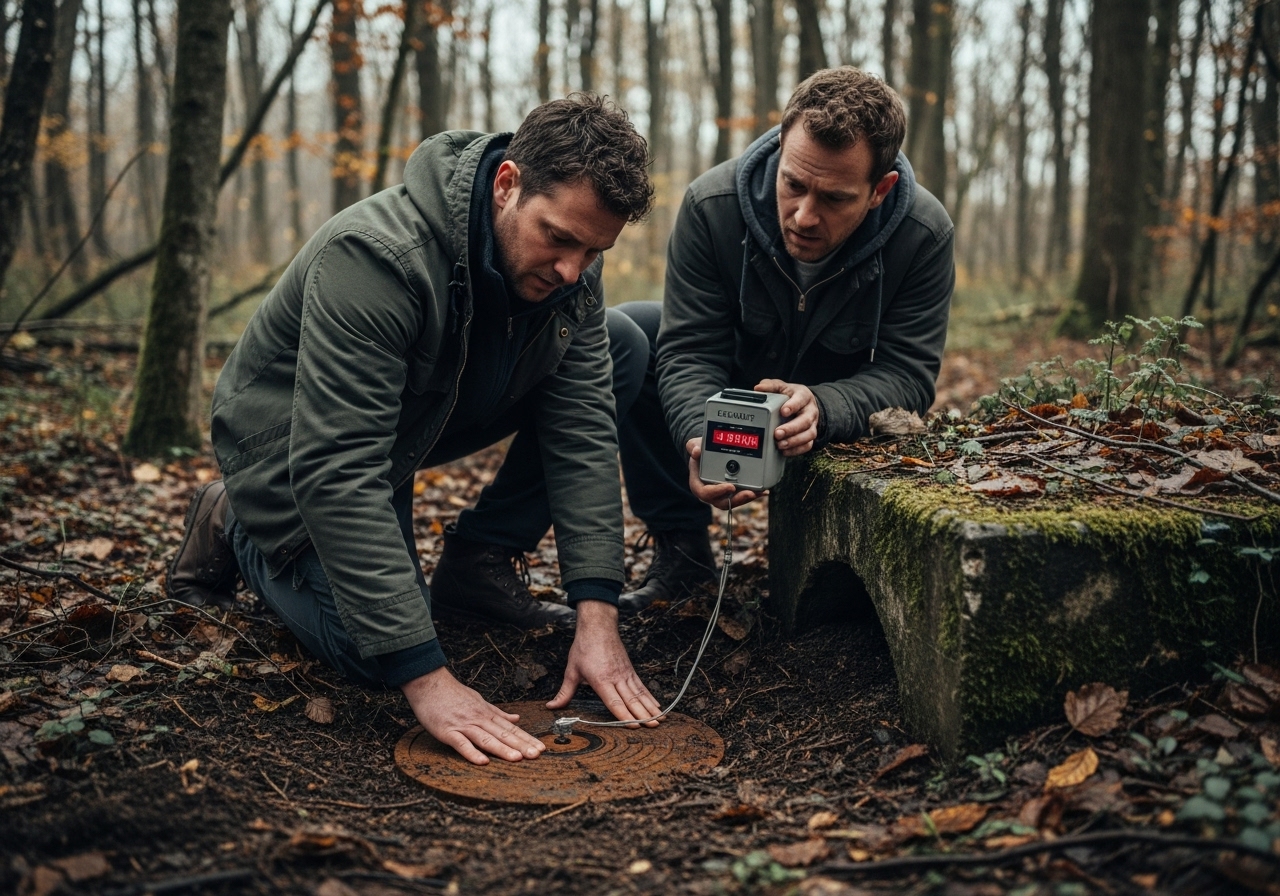
The Geiger counter shrieked, its urgent alarm echoing the sudden, chilling realisation that whatever lay beneath the forgotten hatch was far more significant—and dangerous—than any stray radiation from the old repository. What secrets had this neglected corner of the woods been hiding all along, and what fresh horror had they just unearthed?
Share This Story


