Dust on the Floorboards
The smell of wet leaves was a thick blanket over Clearwater Narrows, heavier than usual this autumn. It clung to the rough-hewn cabins, seeped into the cracks of the old dirt road, and whispered through the skeletal branches of the maples that lined the almost-empty lake shore. A low, persistent wind hummed, a mournful song against the silence that seemed to have deepened since the Event. There was a chill in the air, not just from the season, but from a quiet, almost imperceptible shift in the community's heart, a small, worried flutter that had nothing to do with firewood or dwindling rations.
The wind hummed, a low, persistent sound, rattling the last stubborn, russet leaves on the ancient oak outside my window. The light, when it arrived, was thin and watery, stretched across the sky like a weak promise. It was autumn, deep into it, the kind of autumn where your breath plumed out in small, ghost-like puffs even indoors if you weren't close enough to the communal wood stove. Everything smelled like damp earth and the distant, reassuring tang of burning pine. But today, under all that, I could smell something else. Something like… an absence.
I nudged a piece of kindling into the stove with the poker, watching the sparks climb like frantic, tiny spirits. My stomach rumbled, a polite but firm request for the oatmeal that was simmering in the big pot in the main room. But my mind was stuck on the absence. Lakeside Larry. He wasn't there. Not in the hall, not in his usual spot by the faded banner that read 'Clearwater Narrows: Resilience & Revival'. He was just… gone.
My feet, encased in my brother's old, slightly too-big boots, scraped on the uneven floorboards as I walked into the main room. George was already there, hunched over his bowl, meticulously picking out every single raisin. He hated raisins. I didn't mind them. He’d probably give me his.
“Morning,” I mumbled, reaching for my own bowl. The oatmeal was thick, a bit lumpy, but warm. It tasted of survival and, well, oats. Not bad.
George grunted, without looking up. His hair, the colour of dried grass, was sticking up in all directions, testament to a night spent dreaming or, more likely, just flopping about. He was a flopper. I knew because we sometimes shared a sleeping mat when it got extra cold and the adults wanted to save on fuel, piling us all together like a big, warm puppy pile.
“Larry’s still gone,” I said, not really a question. It was a statement of fact, solid as the rock I’d found by the creek yesterday, the one with the weird sparkly bits.
George finally looked up, his brow furrowed. He pushed a raisin to the edge of his bowl with his spoon. “The adults said… a prank.” He didn’t sound convinced. His voice was like a pebble skipping on ice, trying to hold its own.
A prank. That’s what they’d decided. Old Man Fitzwilliam, with his creaking knees and perpetually worried eyes, had declared it at morning assembly yesterday. "Just a bit of mischief!" he'd boomed, his voice echoing in the too-large hall, but his eyes had darted around, nervous, like he was looking for more mischief, or maybe for Larry himself, hidden in the shadows. "Someone's just… having a bit of fun! He'll turn up!" But Larry hadn't turned up.
“Who pranks Larry?” I asked, taking a mouthful of oatmeal. It was hot, almost burnt my tongue. Larry was the carved wooden loon. He was more than a bird; he was the symbol. Carved by the first settlers, the ones who had found this place before the Event, before the world tipped on its side and we had to rebuild with rusty tools and forgotten knowledge. Larry was old. Ancient, almost. His lacquered eyes had seen everything. Or, well, his original lacquered eyes had. These were replacements, carefully made by Mrs. Ford after the incident with the runaway piglet and the butter churn. Another story for another time.
George shrugged, pushing another raisin. “Maybe… maybe someone from the other side?” The 'other side' was what we called the small cluster of cabins across the lake, accessible only by the wobbly rope bridge or a canoe if you were brave enough to face the frigid water.
“They wouldn’t,” I countered, my voice firm. “They have their own things. Their giant squirrel. They wouldn’t take our loon.” The giant squirrel was a slightly less old, but equally cherished, wooden carving on their side. A bit lop-sided, but impressive for its size. No, the ‘other side’ had no reason to take Larry. There was a mutual, unspoken respect for each other’s carved mascots. It was a foundation of our post-Event diplomacy.
We finished our oatmeal in a quiet rhythm, the spoons clinking softly against the thick ceramic bowls. The silence stretched, not comfortable, not uncomfortable, just… present. It was the kind of silence that happened when a question hung in the air, too big for a simple answer, but too important to ignore. For the adults, it was just a prank. For us, it felt like a hole, a hollow space where something important used to be.
---
Later, after the morning lessons (which mostly involved learning how to mend tarps and identify edible fungi, not much reading or sums these days), George and I found ourselves drifting towards the community hall. It wasn’t a planned thing, not really. Our feet just seemed to know the way, drawn by the invisible string of the absence. The hall was a draughty, utilitarian building, built quickly after the Event using salvaged timber and corrugated iron. It stood on a slight rise, overlooking the lake, a bit like a sentry that had forgotten its watch. The paint, originally a cheerful blue, had long faded to a sickly grey, peeling in strips like sunburnt skin.
The heavy wooden door, always a struggle, creaked open with a groan that sounded older than Larry himself. A gust of cold air, smelling faintly of old wood and the stagnant dust of unused space, rushed out to greet us. Inside, it was even colder than outside, a damp chill that sank into your bones. The windows, high and narrow, let in only slivers of the weak autumn light, creating long, stretching shadows that danced with every little movement. The big, empty space swallowed sound. Our footsteps echoed, hollow and loud on the polished but scuffed floor.
“It’s… extra quiet,” George whispered, his voice small in the cavernous room. He scuffed his boot on a dark stain near the door. “Like something’s not just gone, but never was.”
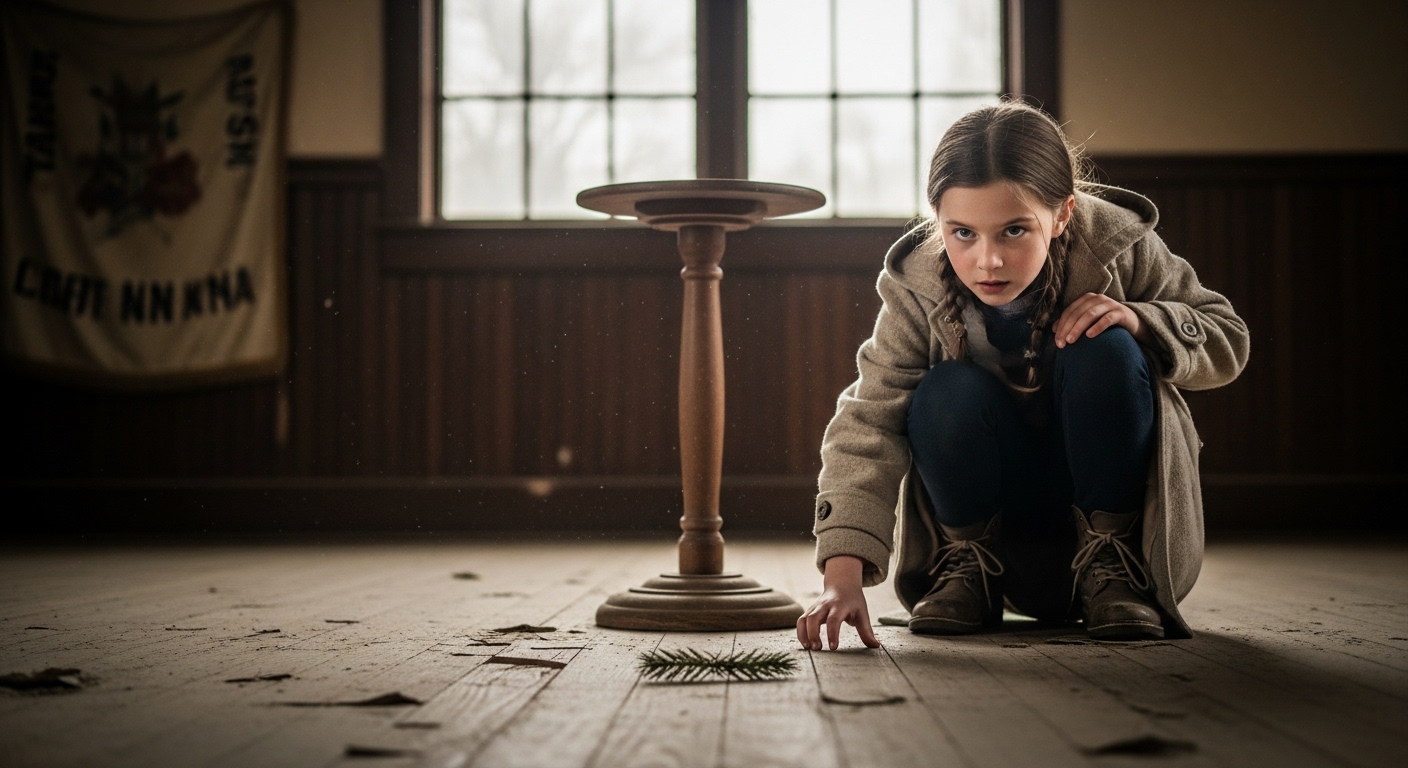
I nodded, already walking towards the pedestal. It stood in the centre of the hall, exactly where Larry had been. It was just a sturdy block of pine, sanded smooth by countless hands over the years, now bare. The wood was a richer colour where Larry had stood, protected from the dust and light that had discoloured the rest of the surface. A faint, almost ghostly outline remained. It was like a shadow, clinging to the wood.
I ran my fingers over the spot. It felt… smooth. Too smooth, maybe. No splinters, no obvious signs of a struggle. Just a clean lift. Whoever took Larry, they hadn’t messed about. They’d just… taken him. And that, in a world where everything felt like a struggle, felt wrong. Taking something important, something that belonged to everyone, so cleanly. That wasn’t a prank. Pranks left a mess. Pranks left a note, usually a silly one, maybe a potato in Larry's place. This was… too tidy.
I got down on my hands and knees, ignoring the damp chill seeping through my trousers. My boots, still a little large, made a soft thud against the wooden floorboards. I squinted, running my fingers along the edge of the pedestal, then outwards, following the ghost-outline. Dust was everywhere, a fine, grey powder. It coated everything, a testament to the fact that the hall was used mostly for assemblies and occasional, very solemn, communal meals. Not much daily cleaning went on in here anymore. Survival was a full-time job. Housekeeping was a luxury.
“What are you doing?” George asked, his voice still a whisper, but laced with a hint of exasperation. He was kicking at a loose floorboard near the wall, a small, rhythmic thud against the silence.
“Looking,” I said, my voice muffled. My nose was practically touching the floorboards. The smell of old pine resin was strong here, mixed with a faint, almost metallic tang, like old rainwater left in a tin bucket. It wasn’t exactly a bad smell, just… old. And quiet. I saw a thin streak in the dust, a faint drag mark leading away from the pedestal, towards the side door that led to the old storage room. It wasn’t much, barely visible, like someone had dragged something heavy, but carefully. Very, very carefully. Too careful for a prank.
And then I saw it. Tucked right into the faint drag mark, almost hidden by a small pile of dust that had accumulated against a raised grain in the wood. It was small, no bigger than my thumb nail. A pine needle. But not just any pine needle. This one was… different. Longer. Thicker. And the colour was a deeper, almost bluish-green, not the bright, sharp green of our local White Pine or the softer green of the Balsam Fir. This one felt… exotic. Like it didn't belong. Our pines were sturdy, robust, ready for the long winter. This one felt almost delicate, but with a surprising stiffness.
I carefully pinched it between my thumb and forefinger. It was sticky, with a subtle, sweet scent, not like the sharp, resinous smell of our local pines. Our local pines smelled like winter. This smelled… warmer. Like a summer evening, maybe, or something from a storybook. I held it up to the meagre light, turning it over and over. It was a beautiful, deep green, almost the colour of a shaded creek bed. It had a tiny, almost imperceptible curve to it, like a miniature crescent moon.
“Look,” I said, holding it out to George. He stopped kicking the floorboard and came closer, squinting at the needle. His hand was a bit shaky when he took it, careful not to break it. He turned it over, his usual cautious expression deepening into something more thoughtful. He picked at a tiny bit of dried sap on the end of it.
“That’s not… from around here,” he said, his voice softer now, almost reverent. “That’s not our kind of pine.” His brother, older and a bit of a wilderness enthusiast, had taught him all about local flora. George knew his pines. Knew his firs. Knew his spruces. This was a foreign visitor.
“Right?” I said, feeling a surge of satisfaction. This was it. This was the start of something. Not just a prank. A real mystery. Someone had brought a piece of somewhere else to our hall. Someone had taken Larry, and left a clue. A very small, very green clue.
We spent another long time in the quiet hall, searching for more needles. We found another two, both similar, tucked into corners, as if dropped by accident. They were all near the side door. The storage room door. It was locked, of course, with a heavy, rusty padlock that hadn't been opened in years. Old Man Fitzwilliam had the only key, kept on a massive ring with all the other keys to all the other things that no one really used anymore. It was more a symbol of authority than a practical key.
“Maybe they went in there,” George suggested, gesturing vaguely at the heavy, dark door. “And then… out the back?” The back of the storage room had a small, forgotten entrance, a low door that led into a tangle of overgrown berry bushes and, eventually, a path to the lake.
I considered it. The drag mark definitely led towards this door. But it was locked. Unless… whoever did it had their own key. Or they picked the lock. That felt a bit too spy-novel for Clearwater Narrows, but then again, a missing wooden loon was also a bit too peculiar for Clearwater Narrows.
---
On our way out of the hall, squinting against the brighter (though still weak) afternoon light, we saw Mrs. Ford. She was sitting on the old, weathered bench by the well, knitting something that looked suspiciously like another one of her famously lopsided scarves. Her spectacles were perched on her nose, glinting in the pale sunlight. She had a way of looking at you, even when she seemed to be looking at her knitting, that made you feel like she knew exactly what you were up to, and probably what you’d had for breakfast, too. Her face was a map of lines, each one telling a story, though she rarely shared them.
“Penny. George,” she said, her voice a soft rustle, like dry leaves. She didn’t look up from her needles, but I knew she saw us. She always saw everything. “Checking on Larry, were you?”
My heart did a little jump. She knew. She always knew. “Yes, Mrs. Ford,” I said, trying to sound casual, like I was just taking a leisurely stroll past the hall and happened to glance inside. My hand instinctively tightened around the pine needle I still clutched.
George, ever the direct one, blurted, “He’s still gone. And we found… a thing.” He held out the pine needle, an offering. Mrs. Ford stopped knitting. Her fingers, gnarled and surprisingly strong, took the needle from George. She turned it over, her eyes, magnified by her thick spectacles, scrutinising it. A flicker, quick as a dragonfly’s wing, crossed her face. Something like… surprise? Or maybe… recognition? It was hard to tell with Mrs. Ford.
“Hmm,” she hummed, a low, thoughtful sound. She pinched the needle, just as I had, and brought it to her nose. She inhaled slowly, her eyes closing for a moment. When they opened, they met mine. They were very blue, the colour of a deep lake on a cold day. “Not from our parts, this one.” She said it so quietly, so calmly, that it almost didn’t register as important. But it was. It was very important.
“Where’s it from then?” I asked, leaning forward, eager. My stomach was doing a little dance. This was it. She knew. She would tell us. She would unravel the entire mystery with a single, wise sentence.
She smiled, a slow, gentle curve of her lips. It was a real smile, not her usual knowing half-smile. “Oh, places,” she said, her gaze drifting over the lake, towards the distant, hazy line of the horizon. “Many, many places, child. All pines have their homes. And sometimes… their secrets.” She handed the needle back to George, her fingers brushing his, a faint, almost imperceptible warmth left behind. Then she went back to her knitting, her needles clicking again, a rhythmic, comforting sound that seemed to close off the conversation, like a door gently shutting.
George looked at the needle in his hand, then at me, then back at Mrs. Ford, who was now absorbed in her purls and plain stitches. His expression was a mixture of confusion and a sort of dawning understanding. He didn’t say anything. He didn’t need to. We both knew. Mrs. Ford knew more than she was letting on. And that meant the 'prank' was not a prank at all. It was something deeper. Something with roots that stretched further than the biggest pine, reaching to 'many, many places'.
Walking back to our cabin, the air felt colder, sharper. The leaves crunched under my boots, a symphony of tiny, brittle sounds. The quiet had returned, but it wasn't the same quiet as before. It was a heavier quiet, filled with unspoken questions and the faint, sweet scent of a foreign pine needle. The world hadn’t quite tipped back onto its axis, and maybe it never would. But a new axis was forming, a smaller one, centred on a missing wooden loon and the strange, silent wisdom of an old woman. The peculiar pine needle, an uninvited guest from a place far south, suddenly felt heavier in my palm, a small, sharp key to a lock I hadn't even known existed, hinting at something beyond a simple, mischievous prank.
The peculiar pine needle, an uninvited guest from a place far south, suddenly felt heavier in my palm, a small, sharp key to a lock I hadn't even known existed, hinting at something beyond a simple, mischievous prank.
Share This Story


