Winter's Iron Grip
The world had long forgotten the colour of green. Now, it was a study in desaturated greys and bruised whites, an unending expanse of ice and hard-packed snow stretching to a sky the colour of old lead. The air itself felt like a physical weight, cold enough to ache in the bones, carrying with it the scent of frozen earth and distant, unburnt ash. Here, in the forgotten northern reaches, survival was less a fight and more a slow, constant negotiation with the elements, punctuated by sudden, brutal disruptions.
The breath left Ford’s lungs in a violent plume, freezing instantly into a cloud that stung his nostrils. He hunched deeper into the collar of his parka, the worn, patched fabric doing little to keep the biting wind from finding its way through to his ribs. On the ridge, the cold was an unyielding presence, a dull throb behind his eyes. He’d been perched on this same rock, a jagged tooth of granite clawing at the grey sky, for nearly an hour. Just watching. Always watching.
Below, the valley was a choked throat of skeletal birches and pines, their branches caked in rime, groaning faintly under the burden of the ice. Nothing moved, save for the occasional drift of fine, granular snow, whispering across the frozen ground. This stretch of territory was usually dead, too exposed for the shufflers, too desolate for the sparse, desperate groups of scavengers. And yet, his gut clenched with a familiar, unwelcome tension. It felt… wrong.
His fingers, stiff despite the thick, leather-palmed gloves, adjusted the binoculars. The cheap glass, salvaged from a collapsed hardware store almost a year ago, was scratched, the lenses fogged with the lingering damp from his last breath. He wiped them with a sleeve, careful not to smudge the grimy surface further. The monotony of the white-and-grey landscape was a heavy blanket over his thoughts, a suffocating quiet that made every rustle of his own clothing sound like a gunshot. He imagined the quiet was a predator, always lurking, always waiting to make him slip.
Then, a flicker. Not a movement in the trees, not a shadow. Higher up, on the far ridge, where the old communications tower used to stand, something caught the sparse, flat light. A brief, almost imperceptible shimmer, like heat rising from tarmac in high summer, only it was a brutal, bone-piercing winter. He blinked, straining. It was gone.
“See anything, scout?” The voice, sharp as a shard of ice, cut through the quiet. Samantha. She was closer than he’d thought, her silhouette appearing from behind a snow-laden pine, a rifle slung over her back like an afterthought. Her face, framed by a hood trimmed with ragged fur, was wind-chapped and etched with the permanent worry lines of someone who’d seen too much too young. But her eyes, dark and quick, were always scanning.
Ford lowered the binoculars, the cold metal sticking to his cheek. “Thought I did. Up on Dead Man’s Peak. A shimmer, like… like a heat haze.”
Samantha snorted, a puff of steam. “Right. In minus twenty, we’re getting heat haze. You been eating those fermented berries again?” She moved to stand beside him, her boots crunching on the frozen earth. She was shorter than him, but radiated a no-nonsense pragmatism that made her seem taller. “Or just seeing things? The quiet gets to you, eh? Makes you wish for a good old-fashioned shuffler horde just for the company.”
“Funny,” Ford grumbled, rubbing his gloved hands together. “No, seriously. It was quick, but it was there. Like a distortion. Too high for a campfire, too regular for ice glare.” He glanced at her, a hint of genuine unease in his eyes. “Could be nothing. Or could be… something.”
Samantha looked out across the valley, her gaze fixed on the distant ridge. Her expression remained unreadable, a shield she wore well. “Something,” she echoed, the word a flat statement. “Something usually means trouble. What’s your gut saying? More hungry folk, or something… else?” Her finger tapped rhythmically on the stock of her rifle. Her gut was usually right.
Ford shivered, not just from the cold. “I don’t know. This area… it’s always felt wrong. Too empty. Like everything else knows to stay away.” He paused. “But that flicker… it means someone, or something, is active. We can’t just ignore it. What if it’s a signal? What if it’s… resources?” The last word was a bait, and it caught her attention.
“Resources,” Samantha mused, a flicker of something almost like hope in her eyes, quickly extinguished. “Could also be a trap. Could be a beacon for every groaner in a fifty-klick radius.” She sighed, a long, weary exhalation. “Fine. But we move slow. And if I hear even a whisper of something off, we’re out. Agreed?”
“Agreed,” Ford said, already heading back down the ridge, slipping on a patch of black ice. He nearly went down, flailing his arms for balance. Samantha snickered, a small, humourless sound. “Graceful, as always.”
---
The trek across the valley was brutal. The snow, crusted over with an icy skin, snapped and crumbled under their weight, making every step an effort. The wind picked up, a mournful howl that scoured the sparse landscape, carrying crystalline flakes that stung their exposed skin. Ford pulled his scarf tighter, the rough wool scratching at his chin. His knees ached with the cold, a deep, persistent pain that had become a constant companion.
They moved in silence for a long stretch, saving their breath. The only sounds were the crunch of their boots, the mournful wind, and the dull thudding of Ford’s own heart, a steady drum against the pervasive quiet. He noticed a patch of grey, brittle moss, clinging stubbornly to a frost-cracked boulder. It was the only deviation from the relentless white and grey. A small, irrelevant detail, but it grounded him. He focused on the patterns in the ice, the skeletal trees, anything to keep his mind from drifting to the deep, primordial fear this place stirred.
Then, a sound. A wet, dragging scrape from behind a clump of snow-laden cedars. Ford froze, hand already on the grip of his axe. Samantha, a shadow beside him, had her rifle up, finger brushing the trigger guard. They waited, breath held, the world shrinking to the sound of their blood pounding in their ears. Another scrape. Closer. And then a low, wet groan, the kind that made the hairs on Ford’s neck stand up.
A shuffler, its form obscured by a thick blanket of snow, lurched into view. Its face was a frozen mask of decay, one eye socket empty, the other glinting with a sickly yellow. Its jaw hung loose, a dark, ragged hole in its face. It moved with a disturbing lack of coordination, limbs jerking at odd angles, but it was heading in their direction, drawn by… what? The scent of their fear? The faint vibration of their footsteps?
“Slowly,” Samantha whispered, her voice barely audible over the wind. “Back up. Don’t run. It’ll hear us.”
Ford’s muscles screamed for him to bolt, but he forced himself to take slow, deliberate steps backward. The shuffler, maybe twenty feet away, tilted its head, a grotesque caricature of curiosity. Its breath plumed, not from warmth, but from the unholy moisture within its rotting lungs. It took another lurching step. Ford could smell it now—that sickly sweet decay, overlaid with the metallic tang of old blood and the sharp, clean scent of the biting cold.
“Oh, come on, you ugly sod,” Samantha muttered, her rifle still raised, but not quite aimed. “Can’t a couple of survivors have a nice, quiet walk without you showing up?” Her voice was steady, a deliberate attempt to cut through the rising terror. It almost worked.
Another foot of careful retreat. The shuffler, however, seemed to pick up on their movement. It let out a guttural shriek, a sound like tearing fabric and rusty metal, and broke into a staggering run. Not fast, but relentless. Ford didn’t think. He reacted. He shoved Samantha behind a thick spruce, yelling, “Go! I’ll draw it off!”
Before Samantha could object, Ford broke cover, sprinting sideways through a deeper drift, hoping to catch the shuffler’s attention. It worked. The creature turned, its single eye fixed on him, and changed its clumsy pursuit. Ford’s heart hammered against his ribs. He pumped his legs, each step a burning effort in the deep snow. He risked a glance back. It was closer than he liked, its ragged hands reaching. He could feel the phantom chill of its touch already.
Samantha’s rifle cracked, a sharp, clean sound in the biting air. The shuffler stumbled, a geyser of black fluid erupting from its shoulder. It fell, thrashing for a moment, then went still, partially buried in the snow. Ford skidded to a halt, gasping for breath, his lungs burning. He turned back, seeing Samantha emerge from behind the spruce, her rifle smoking faintly. She looked at him, then at the fallen creature. “You always were a loud mouth, Fordian. Lucky for you, that sometimes makes for good bait.”
“You could have just shot it from the start,” Ford wheezed, bending over, hands on his knees. “Didn’t need me to do a sprint for the undead.”
“Where’s the fun in that?” Samantha retorted, though her hands were trembling slightly as she lowered her rifle. “Besides, you need the exercise. You’re getting soft.”
---
They picked up their pace, the encounter leaving a residue of adrenaline and fear in their wake. Ford’s chest still ached, and his legs felt like lead. But the shimmer was still out there, a phantom lure. As they neared Dead Man’s Peak, the landscape shifted. The trees thinned, giving way to a more exposed, rocky terrain, haphazardly blanketed in snow. The wind here was a constant, vicious whip. And then they saw it.
Half-buried in a deep snowdrift, camouflaged by the brutal winter, was a structure. Not an old cabin, or a collapsed barn, but something angular, metallic, and decidedly out of place. It looked like a modular research unit, or maybe a comms station, scarred with rust and ice, clearly abandoned for years. A heavy-duty, reinforced door, half-ripped from its hinges, was all that remained of the entrance, leading into the gloom.
“Well, that’s not ominous at all,” Samantha murmured, her usual sarcasm laced with a genuine caution. She moved forward, rifle ready, her boots crunching on the frozen gravel that had been swept clear by the wind near the entrance. The air here was different, carrying a faint, acrid smell beneath the clean cold—like ozone and old dust.
Ford peered into the maw of the opening. It was dark, a blackness that seemed to swallow the dim light. “Think this is where your ‘heat haze’ came from?” he asked, pulling a scavenged tactical torch from his pack. Its beam, weak and flickering, struggled against the oppressive gloom.
They entered. The interior was a cavern of ice and shattered electronics. Cables, thick as a man’s arm, dangled like frozen vines from the ceiling, coated in rime. Panels had been ripped open, their guts exposed. The floor was a treacherous mix of ice, broken glass, and what looked like frozen, discarded data pads. The cold inside was bone-chilling, even colder than outside, a static, stagnant cold that had permeated everything. It smelled of metal, damp concrete, and something indefinably stale, like a sealed vault that had been opened after a century.
“This place… it’s been hit hard,” Ford observed, his voice hushed. Every sound echoed, bouncing off the hard surfaces, making them both jump at their own footsteps. He shone his light over a console, its screens smashed, keyboard frozen in place. A faded, peeling sticker read: ‘Project Chimera: Advancing Human Resilience’.
“Chimera?” Samantha scoffed, carefully stepping over a tangle of wires. “Someone had a sense of humour. Or a serious ego.” She pointed with the barrel of her rifle. “Look. What’s that?”
Nestled amongst a pile of debris, partially hidden by a collapsed shelf, was a sealed, waterproof document case. It was old, but intact. Ford knelt, his fingers stiff as he wrestled it open. Inside, tucked between what looked like old hard drives, were several laminated documents and a folded map. The documents were a series of research notes, full of scientific jargon he barely understood. Phrases like ‘neural augmentation,’ ‘viral vector stability,’ and ‘subject compliance’ jumped out, making his stomach clench.
He unfolded the map. It was a topographical survey of this region, but with several marked locations. One was this very outpost, labelled ‘Site Alpha’. Another, further north, deeper into the truly uninhabitable mountains, was circled in red, with the handwritten annotation: ‘Relay. Access key required.’
“Access key?” Ford mumbled, tracing the red circle with a gloved finger. “What kind of key?”
Suddenly, a rhythmic thumping began. Not loud, but deep. It resonated through the ice-cold floor, a low, consistent pulse that seemed to come from directly beneath them, or from deeper within the facility. Thump. Thump. Thump. It sounded like a heartbeat, or something heavy hitting metal, far, far away. The sound made the hairs on Ford’s arms stand straight up. He looked at Samantha, his eyes wide.
“What the hell was that?” Samantha breathed, her rifle snapping up, aimed at the unseen depths of the frozen complex. Her witty banter was gone, replaced by raw apprehension. The thumping grew marginally louder, more insistent. Thump-thump. Thump-thump.
Ford’s torch beam swung wildly, illuminating a heavy, insulated conduit running along the wall, sparking faintly where ice had frayed a section. It was still active, still carrying power from somewhere. This entire facility wasn’t dead. And whatever was making that sound, that deep, resonant beat, was connected to it.
“Ford,” Samantha whispered, her voice tight, “look at the map. That red circle… it’s not just a relay. It’s marked ‘Project Chimera — Primary Containment.’ We need to know what’s making that noise. We need to find that access key.” He knew she was right. They had stumbled into something far bigger than a simple abandoned station, and the pulse beneath them felt like the heart of a cold, new world.
---
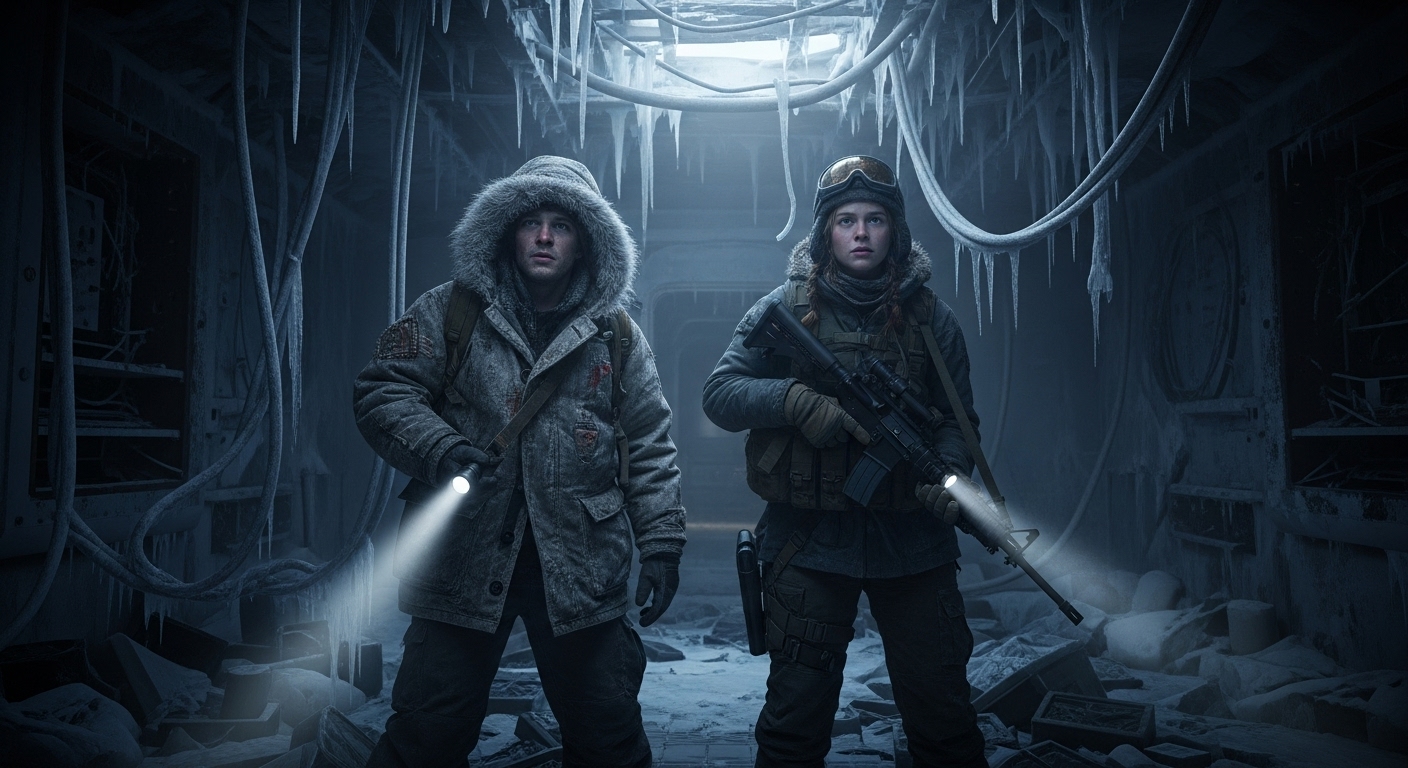
The rhythmic thumping vibrated through the frozen concrete, a promise of something ancient and terrible stirring beneath the ice. Ford glanced at the map, then at the sparking conduit. They were standing on the threshold of a dormant power, a secret that could either be their salvation or their final, frozen tomb.
Share This Story


