The Hum of Uncertain Hope
The old community hall always smelled of damp wood and something vaguely like stale coffee, a scent that deepened on evenings like this when the spring rain hammered the roof. Tonight, though, a different kind of scent was trying to break through: the faint, metallic tang of an idea beginning to form, mingled with the earthy dampness of new spring growth tracked in on muddy boots. Nathan sat hunched, knees knocking against the underside of the table, listening to the cacophony of voices. He could feel the weight of everyone's hopes and worries pressing down, a strange, warm blanket over the cold, scarred linoleum floor.
"Can you even reach that, Nathan?" Tracey's voice, bright and a bit too loud, cut through the scraping of chairs. She was perched on her own chair, arms stretched, trying to pin a drawing to the cork board with a thumbtack that looked too small for her determined grip. The drawing, a messy explosion of purple and orange, was supposed to be a 'Northern Lights' idea, but it looked more like a bruised banana split to Nathan.
Nathan grunted, stretching his nine-year-old arm further. His fingertips just brushed the edge of the poster, a printed photo of a group of kids painting, which felt incredibly far away, like a dream that was already fading. "Almost. Just… give me a sec." His sock was bunched inside his boot, an annoying friction point. He tried to wiggle his foot, but it only made it worse. He really hated having bunched-up socks.
"See? I told you. You’re too short." Tracey giggled, a high-pitched sound that always made Nathan’s ears feel like they were ringing. She finally got her thumbtack in, unevenly, then scrambled down, nearly tripping over a stack of old newspapers. She didn't fall, though. Tracey never really fell.
Willow, who was older and had hair the colour of a raven's wing, peered over at them from where she was arranging felt pens in neat rows. "Alright, you two. Less bickering, more getting ready. Carson will be here any minute. We want to look like we actually know what we're doing, yeah?" She smiled, but her eyes held a spark that said she meant business. Willow was always like that – calm on the outside, a tiny fire burning inside.
"I know what I’m doing," Nathan muttered, finally getting the poster straight. He hopped down, landing a bit awkwardly, his knee knocking against the table leg with a dull thud. "I just… it’s tall." He hated admitting it. He was a good climber, usually. But this was a boring wall.
"It’s an old hall, Nathan. Everything's a bit… grander than it needs to be." Willow tossed him a blue marker. "Go draw some ideas. Even the silly ones. Carson wants all the silly ones too, for 'brainstorming diversity'." She made air quotes, a tiny smirk playing on her lips.
Nathan caught the marker, the plastic cool against his palm. He liked the smell of new markers, that almost-sweet, chemical smell that promised possibility. He liked it more than the permanent smell of damp wood that clung to everything in the hall, like a ghost. He wandered over to a fresh sheet of butcher paper spread across the table, beside Tracey’s rainbow-vomit masterpiece.
The rain outside started to drum harder against the single large window, making the dim afternoon light feel even dimmer. It was a spring rain, not the heavy, cold kind from winter, but a determined, drumming noise that felt like it was trying to tell them something. Or maybe it was just a regular rain. Nathan wasn't sure. He squinted at the paper, then at the empty chairs, the air heavy with an unspoken anticipation.
---
Carson arrived a few minutes later, shaking out his old canvas jacket. Water beaded on his dark hair. He was taller than Willow, and his smile, though friendly, always seemed to hold a bit of tiredness around the edges, like he’d been up too long thinking about something important. "Hey, team," he said, his voice a low rumble. "Looks good in here. Thanks for getting things set up."
He carried a battered old briefcase, not the shiny kind, but one that looked like it had seen a lot of trips between this hall and bigger towns, holding who-knew-what important grown-up papers. Nathan always wondered if it held secrets. Probably just boring spreadsheets, though. He felt a tiny thrill anyway.
"Tracey stuck her rainbow explosion to the board," Mark piped up, already seated at the table, fiddling with a piece of string. Mark loved string. "Said it was a 'conceptual representation of joy'."
Tracey elbowed him lightly. "It is!" Then, to Carson: "It's for the new arts thingy, right? To make our town less… grey?"
Carson chuckled, pulling out a few folders from his briefcase. They weren't secrets. Just more papers. "Exactly, Tracey. Less grey. More vibrant. That's the idea. We're here tonight to really kick things off. To dream big about what a new, non-profit arts organization could look like for our community. For all of us."
He gestured broadly around the room, the gesture encompassing not just them, but the peeling paint on the walls, the dusty stage at the far end, and maybe even the whole quiet town outside. Nathan thought about the empty storefronts on Main Street, the way the old movie theatre had been dark for as long as he could remember. 'Less grey' sounded good.
"So, big ideas, little ideas, weird ideas, serious ideas," Carson continued, his gaze landing on Nathan for a second. Nathan ducked his head, pretending to be very interested in the blue marker he was still holding. "We want them all. What do you think our town, and especially our young people, really need? What kind of art do we want to make, or see?"
Mark immediately said, "A giant slingshot that flings paint onto a huge canvas! Like, splatter art, but with… propulsion!"
"That's not art, that's vandalism, Mark!" Tracey shrieked, but she was laughing. "I think… a place where we can make movies. Like, real movies. With special effects and everything!"
Nathan thought about it. Movies sounded cool. But he liked drawing, too. He liked the quiet scratch of a pencil on paper, the way a line could suddenly become a face or a tree. "What about… a place just for drawing?" he mumbled, barely audible.
"A drawing club!" Willow picked up on it. "That’s a great idea, Nathan! Or maybe a studio space. We could have workshops, bring in artists from other towns." She turned to Carson, her eyes bright.
Carson nodded, making a note on a legal pad. "Excellent. We're thinking broad, right? Anything that helps foster creativity, build skills, give people a reason to stay, or come back. We know our small communities face challenges. Limited resources, sometimes a feeling of isolation. Art can help with all of that."
---
Ms. Beverly, who had arrived quietly and was now sipping tea from a chipped mug, cleared her throat. She was older than Carson, with kind eyes that crinkled at the corners when she smiled, but a voice that held the firmness of someone who had seen a lot of things. "It's true," she said, her voice a little gravelly. "Sometimes it feels like the current just pulls everything away. Young people, especially. They go off to bigger cities for school, and then… they don't always come back. What is there for them here?"
A hush fell over the room. Even Mark stopped fiddling with his string. Nathan felt a familiar ache in his chest, a hollow feeling. He knew what she meant. His older cousin had moved to Thunder Bay last year and never visited anymore. It wasn't fair.
"This centre," Carson said, his voice a little softer, "could be a reason. A hub. A place to learn, to connect, to show off what we can do. Not just traditional art, but digital art, music production, maybe even a podcasting studio. Things that are relevant today, things that can connect us to the wider world even from here."
Nathan’s head swam with the possibilities. Podcasting? He listened to podcasts sometimes, usually about weird historical facts. He imagined making one about their town, about the funny things that happened, the strange old stories no one remembered anymore. That felt… important.
"We need internet for that," Mark pointed out, ever practical. "Good internet. Not the kind that cuts out when it rains too hard."
Carson sighed, a small puff of air. "You're not wrong, Mark. That's one of those 'community challenges' Ms. Beverly and I were just talking about. Infrastructure. But we're looking into grants, partnerships. We have to start somewhere. And the starting point is you. Your ideas. Your energy."
The conversation shifted then, moving into a territory that Nathan found harder to follow. Words like 'funding streams' and 'governance models' and 'community engagement strategies' floated through the air. He tried to focus, to pick out familiar sounds, but it was like listening to the rain outside – a constant, steady noise that blurred into itself.
He watched Carson, though. Carson kept running a hand through his hair, a nervous habit. And Willow, she was listening intently, but her gaze kept flitting to the dusty clock on the wall, and then to Carson. A tight line was forming between her eyebrows.
"So, the space," Willow said, cutting into a particularly dense explanation from Ms. Beverly about municipal bylaws. "Are we still looking at this hall? The old youth centre is definitely too small, and the church basement has that awful smell."
Carson hesitated, just for a moment. A tiny, almost imperceptible pause. But Nathan saw it. He always saw the small things. "This hall is… an option," Carson said, then cleared his throat. "It's big. It's centrally located. It needs work, obviously. A lot of work. But it has potential."
"A lot of work," Ms. Beverly echoed, her voice softer now, almost a whisper. "The roof. The heating system. The plumbing. And the… well, the permits."
"Permits can be acquired," Carson said quickly, maybe too quickly. He picked up his pen and started twirling it between his fingers. Nathan knew that twirl. It was Carson's 'I'm trying to sound confident but I'm actually a bit worried' move.
Nathan felt a prickle down his spine. The poetic hum of possibility had been replaced by a low, uneasy thrum. It wasn’t just the big adult words anymore. It was the way Carson looked down at his notes, the way Willow chewed on her lip, watching him. Like there was something else. Something they weren't saying.
---
Tracey, oblivious to the subtle shift in mood, was busy drawing a sprawling mural design for the hall. "And we could paint all the walls! Bright colours! Not this boring beige. And get new chairs! These ones squeak so much."
Mark, ever the contrarian, piped up, "I like the squeaky chairs. They make noise when you lean back, like a secret message."
Ms. Beverly gave a small, sad smile. "Well, Tracey, that's the spirit we need. But new chairs, new paint… these things cost money. A lot of money. And, as Carson knows, securing those initial funds can be the hardest part."
Carson nodded slowly. He finally stopped twirling his pen, placing it carefully on the table. He looked up, first at Willow, then at Ms. Beverly, and then his gaze swept across the kids. When it landed on Nathan, it held something that made Nathan's stomach do a cold flip. It wasn't just tiredness anymore. It was… fear.
"We're doing everything we can," Carson said, his voice now a little tight. "We've put in for the provincial arts grant, the federal infrastructure fund, even a few smaller community development grants. We're waiting to hear back. Most of them have deadlines approaching fast. Very fast."
"And if we don't get them?" Willow asked, her voice barely a whisper. She finally stopped chewing her lip, her eyes wide, locked on Carson.
Carson looked at the table. He didn't answer for a long moment, and the silence stretched, thick and heavy, like the deepest part of the lake on a moonless night. The rain kept drumming, a relentless, insistent rhythm. Nathan felt a chill, despite the warm air inside. He could almost taste the unspoken words hovering in the space between the adults.
"Then," Carson finally said, his voice flat, "we'd have to reconsider. Everything. The whole… project. Because without a substantial amount of initial capital, and a secure location, it just won't be feasible to launch a new, permanent non-profit like this. And frankly, this hall… this hall needs more than just a lick of paint. It needs serious, structural investment."
Nathan looked at the scuffed floor, the water stain on the ceiling near the back, the flickering fluorescent light. He hadn't noticed how bad it was until now. It wasn't just old. It was… crumbling. Like the ideas, like the hopes, could crumble too.
"But we sent in all the forms," Tracey said, her voice small, a fragile butterfly trying to beat against a window. "You said we just had to send in all the forms!"
Carson forced a smile, but it didn't reach his eyes. "It's more complicated than that, Tracey-bug. There are a lot of hoops. A lot of… competition."
Then, Ms. Beverly leaned forward, her voice very quiet. "And the biggest hoop, Carson, is the one we all know. The one about the… the sale."
Carson flinched. Nathan saw it. It was like he'd been poked with a sharp stick. Carson shot a quick, almost imperceptible glare at Ms. Beverly, a silent warning. But it was too late. The word hung in the air: sale. Sale of what? Nathan wondered, his gaze darting around the room, then back to Carson's tight, worried face. He hadn't heard anything about a sale. Why hadn't anyone mentioned a sale?
Tracey gasped, her eyes widening as she connected the dots. "The hall? They're gonna sell the hall?"
Carson opened his mouth, then closed it. He looked around the room, his eyes lingering on each of their hopeful, young faces, then on Willow's worried expression, and finally back to Ms. Beverly. He couldn't deny it. The truth, heavy and unspoken, settled over them like a shroud.
Nathan’s heart hammered, a frantic drum against his ribs. He felt a sudden, cold dread, as if the spring rain outside had somehow seeped right into the room, chilling him to the bone. Because what Carson hadn't mentioned, what he'd carefully avoided, felt bigger, colder, and much more real than just 'a few more forms.' Nathan looked from Carson’s pale face to Willow, who quickly averted her gaze, her shoulders suddenly stiff. He knew, with a certainty that pricked at the edges of his small, hopeful world, that they weren't talking about something simple. They were talking about losing it all.
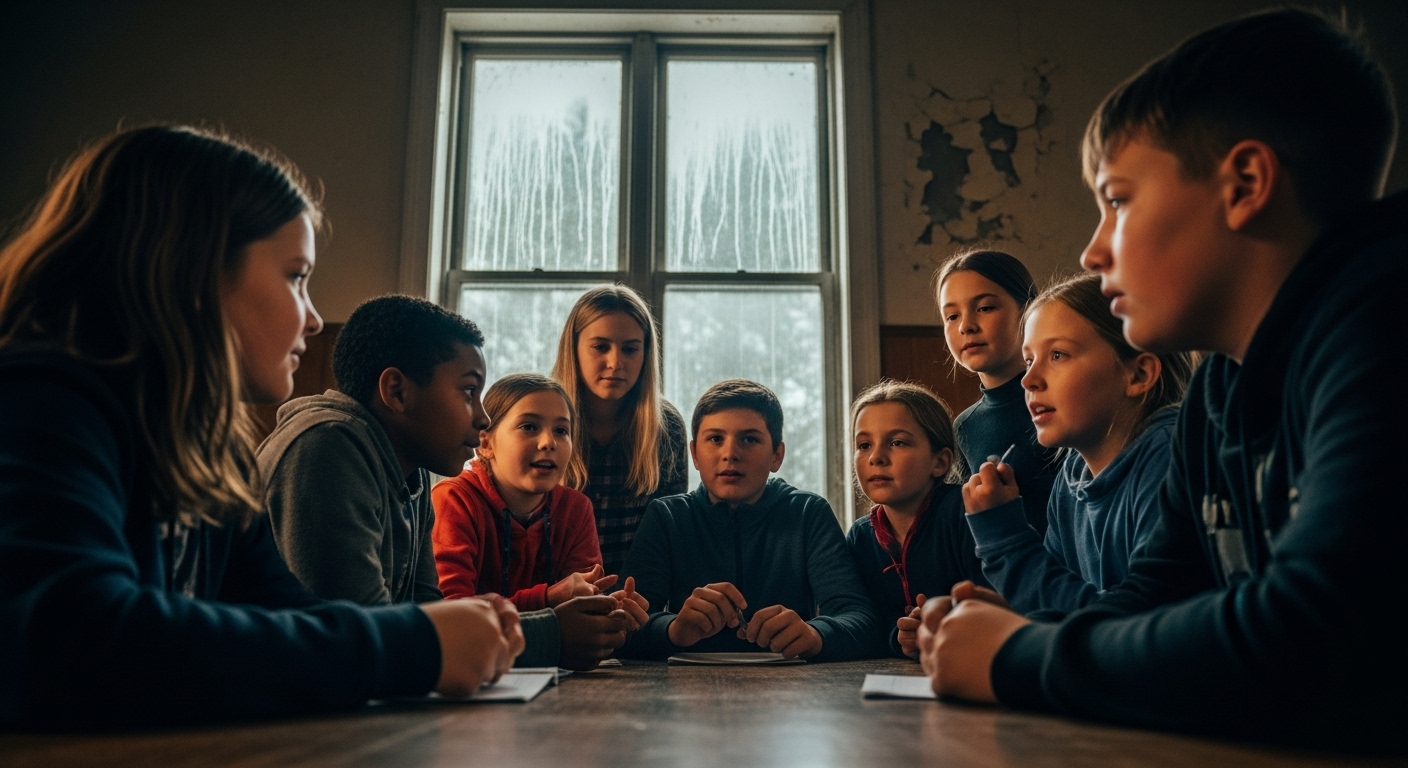
Nathan’s heart hammered, a frantic drum against his ribs. He felt a sudden, cold dread, as if the spring rain outside had somehow seeped right into the room, chilling him to the bone. Because what Carson hadn't mentioned, what he'd carefully avoided, felt bigger, colder, and much more real than just 'a few more forms.' Nathan looked from Carson’s pale face to Willow, who quickly averted her gaze, her shoulders suddenly stiff. He knew, with a certainty that pricked at the edges of his small, hopeful world, that they weren't talking about something simple. They were talking about losing it all.
Share This Story


