The Frost on the Panes
The community hall hummed with the dry, artificial warmth of forced air, a stark contrast to the biting winter outside. Dust motes danced in the anemic light filtering through the high, arched windows, each pane etched with a delicate lacework of frost. A faint, almost imperceptible scent of old coffee and fresh marker ink hung in the air, a familiar blend of earnest intention and lingering exhaustion.
My breath plumed in the cold air, though I was technically indoors. The old community hall in Churchill felt like it was doing its best to retain heat, but the wind rattling the single-paned windows gave the game away. Another blast of frigid air hit my face as Jamesie, bundled in a parka the colour of bruised plums, wrestled with the heavy door. Outside, the world was a study in white and grey, snow piled high against the building's faded clapboard. Winter, here, wasn't just a season; it was an entity, a constant, bone-deep presence.
Stephan cleared his throat at the front of the room, tapping a thick blue marker against the white board. He wore a sensible wool sweater, the kind that smelled faintly of cedar, and a determined expression. "Alright, team. Thanks for braving the minus thirty-five to be here." A few muffled chuckles, mostly from Leo, who was already hunched over his laptop, fingers flying across the keyboard.
I slid into a plastic chair, the kind that squeaked if you shifted your weight too much. Beside me, Sarah was sketching furiously in a small notebook, her dark curls falling over her face. She always drew during these sessions, something half-formed, a way to listen. Me? I just watched. Watched the steam curl from Stephan's coffee mug, watched the light catch the fine hairs on his arm, watched the way Jamesie kept rubbing her hands together, even inside her fingerless gloves.
"Today," Stephan continued, his voice echoing a little in the high-ceilinged room, "we're diving into the ECO-STAR framework." He wrote the acronym in neat block letters. "It's a process. A guide. For creative, climate, and community projects in Northern Canada." He paused, letting the words hang. I chewed on the inside of my cheek. Another framework. Another acronym to decipher.
He started with 'E'. "Environment. What does that mean to you, particularly in our Northern context?" He looked around, expectantly. Silence. Just the hum of the ancient fluorescent lights and the distant, mournful wail of a snowmobile engine. Sarah kept sketching. Leo typed. Jamesie adjusted her scarf, a flash of bright orange against the muted tones of the room.
"It's… cold?" I offered, deadpan. Leo snorted, and Sarah's pencil paused, a slight tremor in her shoulders. Stephan cracked a smile, a brief, fleeting thing. "Yes, Patti. It is indeed cold. Beyond the obvious, though. Think deeper. What does 'environment' encompass here?"
Jamesie finally spoke, her voice low, gravelly. "The land. The water. The ice. The connection people have to it. It's not just a backdrop, it's… part of us, part of the story."
Stephan nodded, scribbling 'Land, Water, Ice, Connection' on the board. "Exactly. It's the physical, yes, but also the cultural, the social, the historical layers. The ecosystem, the community ecosystem. What are the unique challenges? The specific opportunities?" He gestured vaguely towards the window, where the endless white stretched out beyond the town's edge.
My mind drifted, briefly. I imagined dragging a canvas out into that frozen expanse, trying to capture the subtle shifts of light on snowdrifts, the way the wind carved patterns into the ice. Stupid. My fingers would freeze off before I got a single stroke down. But Jamesie's point stuck. The land wasn't just 'out there.' It shaped everything. It shaped the people, the art, the problems, the solutions.
"Resource extraction," Leo mumbled, not looking up from his screen. "Permafrost melt. Shipping routes opening up." His fingers paused, then resumed their frantic dance. He had a way of distilling complex issues into stark, almost brutal facts.
"And the stories," Sarah added, her voice soft, barely audible. "The stories of how people live with it. Live through it." Stephan wrote that down too. Stories. I liked that. Less abstract than 'environmental impact statements.'
---
Mapping the Human Terrain
We moved to 'C' for Customer. This was where my journalistic instincts, usually dormant in these artsy circles, perked up. Stephan explained it wasn't just about 'who buys your art,' but 'who benefits.' Who are the stakeholders? The community members? The target audience? He stressed the 'community-centric' part, again, a word that felt like it had been said a thousand times since I moved North.
"So, if we're doing a digital storytelling project about climate change adaptation in a coastal community," Stephan prompted, pointing at the board, "who's our 'customer'?"
"The elders," Jamesie said immediately. "To share their knowledge. To preserve it."
"Youth," Leo countered, finally closing his laptop, giving us his full, intense gaze. "To engage them. To empower them to act."
Sarah looked up from her sketch. "The fishers. The hunters. The ones on the front lines, seeing the changes daily."
I shifted in my chair, the plastic groaning under me. "What about the tourists?" They all looked at me. "No, seriously. If we want to raise awareness, get funding, show the 'outside world' what's happening. They're a customer, right? A different kind of customer, but still."
Stephan nodded slowly. "An excellent point, Patti. It's about identifying all the beneficiaries and stakeholders, direct and indirect. Different 'customers' might require different approaches, different 'solutions.'" He made air quotes around 'solutions.' The whole thing felt like a particularly elaborate board game, with too many rules and not enough actual playing.
We spent the next hour splitting into pairs. Jamesie and Sarah huddled together, Sarah tracing quick lines on a fresh page. Leo, predictably, paired with a quiet graphic designer named Owen, their heads bent over a shared screen, a low murmur of technical jargon drifting from their corner. I was left with Stephan.
"Alright, Patti," he said, pulling a smaller whiteboard closer. "Let's take your idea. The tourist 'customer' for a climate change awareness project. What's the 'opportunity' here?" His earnestness was both admirable and exhausting. I just wanted to go home and thaw out.
"Opportunity?" I mused, rubbing my temples. "I don't know. To make them feel guilty? To get them to donate money to… whatever?" My sarcasm was thick enough to cut with a knife. Stephan didn't flinch.
"Or," he suggested gently, "to educate them in an engaging, culturally relevant way. To connect them to the land, to the people, so they become advocates, not just visitors." He looked at me, a glimmer of something I couldn't quite place in his eyes. Not pity, not frustration. Something else. Understanding, maybe.
I sighed, pushing a stray strand of hair behind my ear. "Okay, okay. Say we do. We show them the effects of melting ice, but through local art. Photos, sculptures made from found objects. Something impactful. The 'opportunity' is to leverage their curiosity, maybe, their desire for 'authentic' experiences." The word 'authentic' felt cheap on my tongue, but it was what they wanted, wasn't it?
Stephan grinned. "There you go. That's the spirit." He scribbled 'Engaging education via local art' on his whiteboard. "Now, what's a 'solution' for that? Keep it brief."
"An interactive art installation," I blurted, picturing something monumental, stark against the snow. "Or, like, an augmented reality app that lets them see historical ice levels overlayed on the current landscape." The ideas, once prompted, started to trickle, then flow. It was like breaking through a thin layer of ice on a river.
He jotted it down, his marker squeaking. "Excellent. See? It's not so complicated when you break it down." He meant it. He really did. And for a second, I almost believed him. The chill in the room suddenly felt less oppressive.
---
The Unseen Current
By the time we wrapped up, the sky outside had already begun its descent into the long, blue-grey twilight that swallowed the Northern afternoons whole. The heating system of the hall was fighting a losing battle, and I could feel the cold seeping into my boots. My brain, however, felt oddly warm, buzzing with concepts and half-formed ideas. The ECO-STAR framework, initially just another piece of jargon, had started to feel like a strange, clunky key. A key that might actually unlock something.
Jamesie was packing her bag, her breath fogging as she spoke. "I still think we need more time on 'Team.' That's always the tricky bit, isn't it? Getting everyone pulling in the same direction."
"And 'Results,'" Leo added, zipping up his jacket. "How do you even measure the impact of an art piece on permafrost awareness? It's not like we're selling widgets."
Stephan just smiled, that earnest, slightly tired smile. "All in good time. Next week, we'll delve deeper into 'Solution' and 'Team.'" He swept his hand across the whiteboard, erasing the carefully written letters and notes. The whiteboard, now blank, looked stark and unforgiving.
I watched the erased words fade, thinking about the invisible currents that ran through our small community, currents that were being shaped by ice and wind and the stories we told about them. The framework felt less like a map and more like a tool to find the hidden rivers. But as I stepped back out into the biting wind, the cold slicing through my layers, I couldn't shake the feeling that some of those currents ran deeper, colder, and far more dangerously than any of us had anticipated.
The streetlights, haloed by diamond dust, hummed faintly, casting long, distorted shadows that stretched and swayed like silent sentinels, guarding secrets only the deepest winter truly knew.
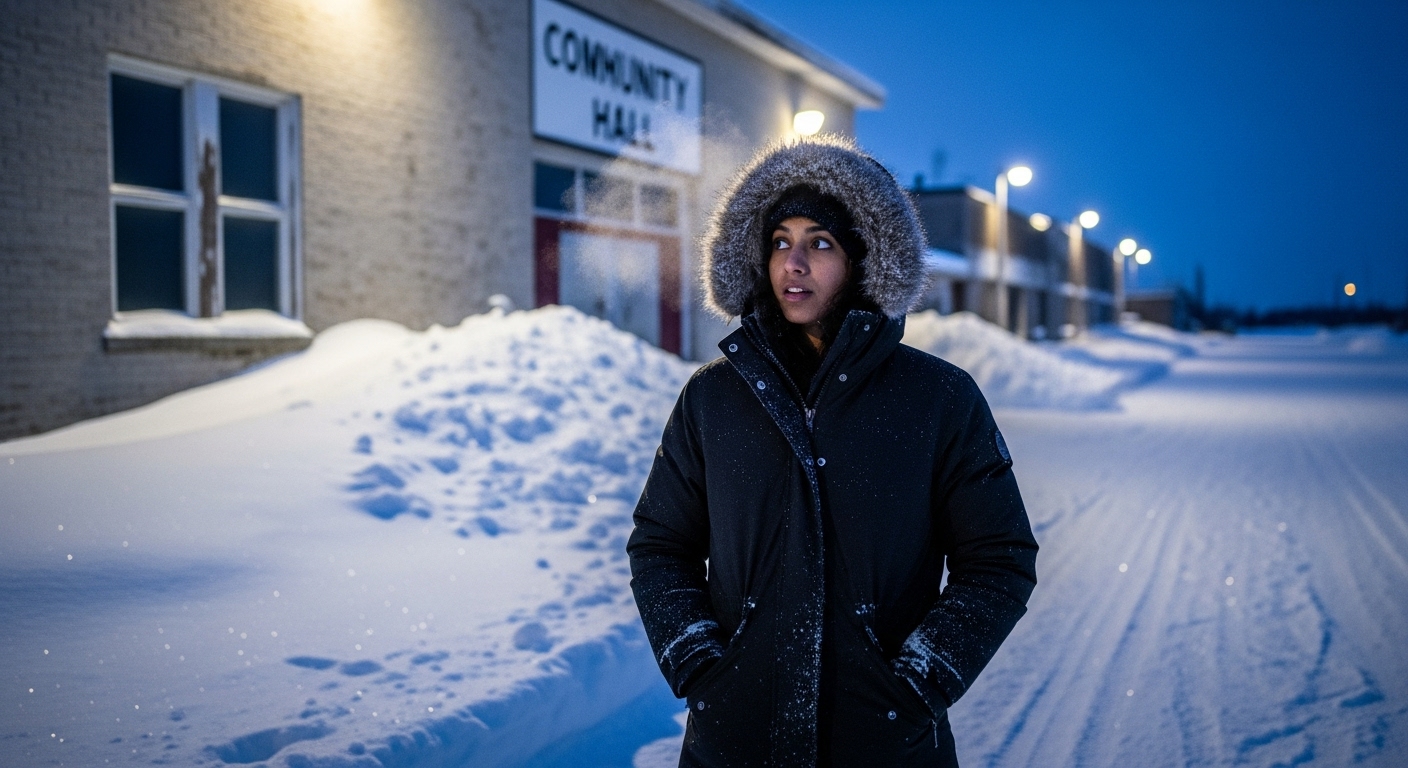
As I pulled my scarf tighter, the biting wind seemed to carry not just the sting of ice, but an almost imperceptible hum, a low, resonant frequency that felt less like the cold settling in, and more like something waking up beneath the frozen surface.
Share This Story


