The Stinging Descent
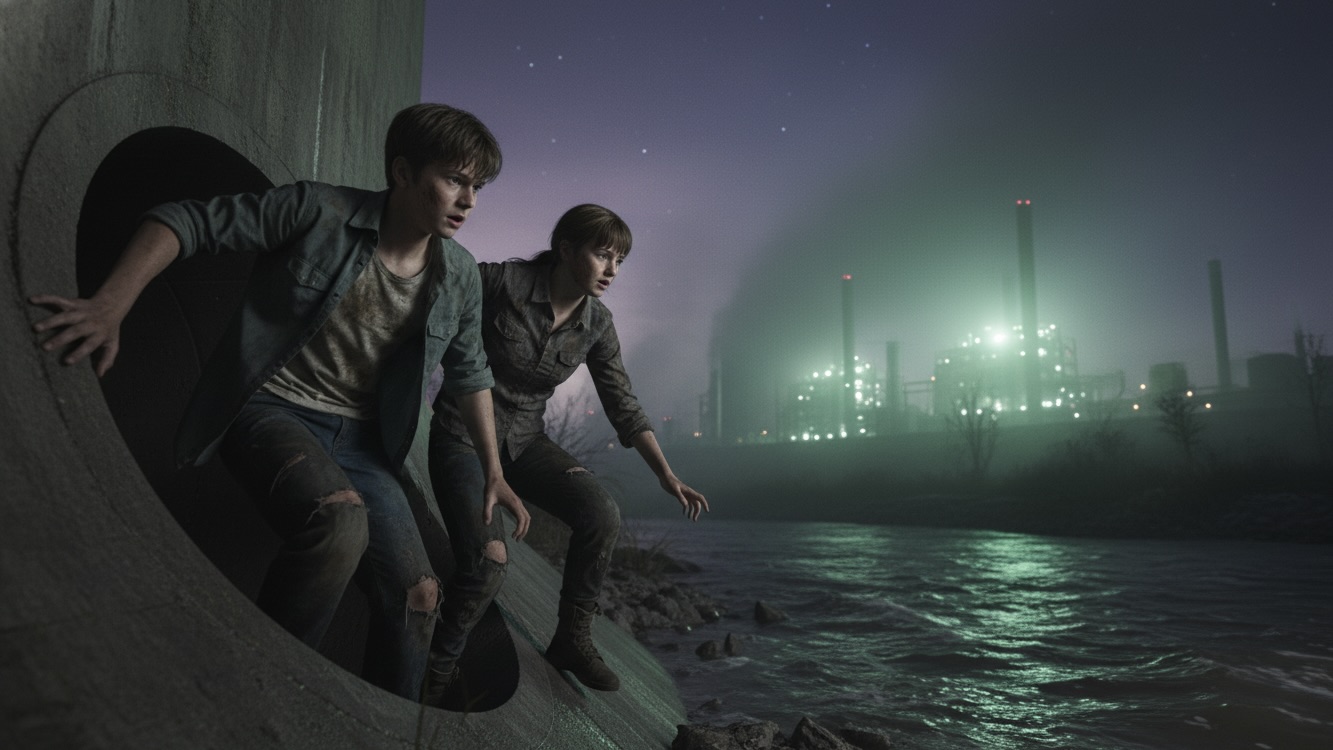
Two teenagers, covered in mud, are on a clandestine mission to expose an environmental crime at a sprawling industrial facility. They navigate treacherous terrain, infiltrate the heavily guarded complex, and narrowly escape after securing crucial evidence.
My lungs burned, sharp and acrid, like cheap chemical smoke. Each inhale scraped against my throat, a raw, desperate gasp for air that always seemed thin up here. The ground under my palms was slick, a mix of wet clay and pine needles, the kind that stuck to everything. Above, the sky was a bruised purple, smudged with industrial haze from the complex stretching out below, a skeletal beast of steel and pipework. My knee buckled, sending a sharp pain up my thigh, but I ignored it. Had to. There wasn’t time for anything else, not right now. Not for pain, not for breath, certainly not for the ridiculous memory that kept scratching at the edge of my awareness.
Christmas. Why Christmas? It was April. Early spring, though the cold still bit with winter’s teeth. But there it was again, the faint scent of pine—not real pine, but the air freshener Mom used, trying to cover up the damp-dog smell of the living room carpet. Trying to cover up everything. My hands, caked in mud, felt like they were clutching the rough, fake branches of a tree we’d bought one year, shedding its plastic needles even as we hauled it in.
“You good?” Sam’s whisper was a raspy breath beside me, barely audible over the thrumming hum of the distant generators. His face, streaked with dirt, was a pale blur in the fading light. His eyes, though, were sharp, darting, constantly assessing. Always. He didn't wait for an answer, already shifting, a dark shadow against the darker slope.
“Yeah.” My voice was just a puff of air, useless. He didn’t need to know my lungs felt like deflated balloons, that my calf muscle was screaming. He needed me to keep moving. We needed to keep moving. The data. The proof. It all hinged on this. Everything we'd been working toward, everything that had driven us into this desolate landscape, covered in mud and fear, came down to what lay beyond that fence.
The air, even up here, carried a metallic tang. Not the crisp, clean scent of rain on spring leaves, but something heavy, industrial, clinging to the back of my tongue. It tasted like what they were doing to the river, what they were doing to the soil. My stomach twisted. It always did. That familiar coil of anger and helplessness, the one that had festered since last summer, when the signs first started showing up. When the water turned cloudy, then slick. When Dad started coughing, a dry, persistent hack that rattled his whole chest.
Christmas. That last good one, before the cough, before the lawsuits, before the endless meetings that went nowhere. Before the hollow promises from the local council, the state representatives. Before the smiles that felt like sneers. We’d had a small tree, real that year, smelling of resin and cold wood. Mom had made hot chocolate, thick with marshmallows. Even Dad had managed a laugh, a real, full sound, when my younger sister, Lily, accidentally spilled hers on the dog. I remembered watching him, really watching him, thinking: This is it. This is normal. This is how it should be.
Now, the only laughter I heard was the wind, whistling through the dying branches of a black locust tree above, stripped bare before its time. We crawled. Every inch was a struggle. My jeans, already torn, snagged on something sharp. A small, fresh gash opened on my knee. I hissed, a quiet, involuntary sound. Sam didn’t react, just kept his eyes forward, inching closer to the low ridge that would give us our first real look. His silence was its own kind of urgency. More effective than any shouted command.
We reached the crest. Below, the facility sprawled, a maze of corrugated steel walls, floodlights that cut harsh, blinding swathes through the gloom, and the omnipresent, bone-deep hum. Fences. Lots of fences. And guards. Two sentries, clearly visible in the arc of a distant light, walked a slow, practiced patrol. Their uniforms were dark, paramilitary. Not the usual rent-a-cops. These were serious. These were theirs.
“They upped security,” Sam murmured, his breath ghosting my ear. He lay flat, face pressed into the damp earth, a small pair of binoculars already at his eyes. “Since Tuesday. Just like we thought.”
Tuesday. The public hearing. The one where they’d presented their 'environmental impact report'—a stack of glossy paper filled with pretty graphs and outright lies. We’d sat in the back, me and Sam and a few others, listening to the smooth, rehearsed voices. Saw the fake smiles. Heard the dismissive laughter when someone from our town tried to ask a real question, tried to show the photos of the yellowed trees, the dead fish in the creek. I remembered my mom’s face, tight with suppressed rage, knuckles white where she gripped her worn handbag. Her eyes had met mine across the crowded room, a silent pact: We can’t let this stand.
“See anything new?” I asked, keeping my voice low, barely a vibration. My heart hammered against my ribs, a frantic drum against the muddy ground. My breath hitched. This was the moment. The jump from theoretical anger to actual risk. To actual danger.
He grunted, adjusting the binoculars. “New camera on the southeast gate. Thermal sensor, too. And… the main pumping station has a reinforced perimeter now. Looks like… three more guys. Heavy gear.” His voice was flat, devoid of emotion, but I felt the weight of it. It meant everything was harder. More dangerous. “They’re not just guarding a construction site anymore. They’re guarding something big.”
Of course they were. They always were. The environmental studies they’d buried, the ones that showed the toxic runoff, the contaminated water table, the irreversible damage to the local ecosystem—they weren’t just inconvenient facts. They were evidence of a crime. A crime committed on a massive, unforgivable scale. And we were trying to steal the smoking gun.
Another Christmas memory flickered, unbidden. The year before all the trouble started. Lily had wanted a specific toy, a plastic unicorn with rainbow hair. Dad had promised it. But then he lost his job, just before the holidays. The unicorn never materialized. Mom had tried to explain, her voice gentle, but Lily’s face had crumpled, and that little piece of magic, that innocent, unshakeable belief, had just… evaporated. It wasn't the toy itself, I knew even then. It was the feeling. The fragile trust, broken. This felt like that. Except now, it wasn't just a toy. It was our water, our air, our future.
“The old storm drain?” I asked, pushing the memory away. Focus. Now. Always now. The storm drain was our last resort, a decaying concrete pipe that ran under the facility, meant to channel rainwater into the main river system. It was narrow, prone to flooding, and probably filled with rats. But it was also largely unguarded, an oversight in the original blueprints they’d released to the public, blueprints we’d painstakingly cross-referenced with satellite imagery and old municipal records.
Sam nodded, pulling the binoculars down. His lips were a thin line. “Still looks clear. But the water level in the river’s higher than last week. Could be tight.” He looked at me, really looked at me, and in his eyes, I saw it: the same fear, the same grim determination. “It’s a long crawl, and it stinks in there. Bad.”
I just nodded. Stinks. Bad. That was fine. We were used to bad smells. The air around our town had smelled of chemicals and something vaguely sulfuric for months now. You got used to it, in a way. Or you just stopped noticing it. Which was worse. The crawl. That was the thing. Claustrophobia. Not my favorite. But better than facing down armed guards, or letting them get away with this. Better than watching my sister cough, watching my parents argue, watching our town slowly, quietly, sicken.
He started moving, sliding backward, down the gentle slope. I followed, careful to keep my movements fluid, quiet. The mud sucked at my boots. A sharp twig scraped against my cheek, leaving a thin, stinging line. I tasted dirt, mixed with the ever-present metallic tang in the air. The smell of wet dust and cold sweat, and something else, something vaguely like burning copper, drifted up from the valley. I closed my eyes for a second, just one second, imagining a different smell. Gingerbread. Cinnamon. The cheap plastic scent of new toys.
We reached the edge of the tree line, a thick cluster of hawthorns and oaks, their budding leaves still small and fragile. They offered little cover, but it was better than the open slope. Sam pointed with his chin, a slight jerk. “This way. The old access road.”
The access road was barely more than two faint ruts in the earth, overgrown with weeds and moss. It led down into a small ravine, hidden from the main facility. From there, we could get to the riverbank, and the drain. The descent was steep, treacherous. Loose stones skittered underfoot, threatening to send us tumbling. I slid more than walked, bracing myself with my hands, feeling the sharp bite of pebbles digging into my palms. My heart rate stayed stubbornly high, a frantic hummingbird trapped in my chest.
The ravine bottom was darker, cooler. The air here was heavy, still. A stagnant puddle, reflecting the grey sky, stretched across our path. It shimmered with an oily sheen. I stepped around it, careful not to disturb the surface, not wanting to know what exactly was in that water. Sam was already a few paces ahead, a low-slung shadow. He moved with a practiced ease, a quiet efficiency born of countless nights spent out here, watching, gathering intelligence, looking for a way in.
“The drain’s just ahead,” he mouthed, pointing to a dark, gaping hole in the concrete wall of the riverbank. The river itself, usually a gentle murmur, was a swollen, turbid rush after the spring rains. Its current tugged at the debris collected along its banks: plastic bottles, snapped branches, something unidentifiable that looked like a deflated industrial bag. The whole scene felt choked, suffocated.
I took a deep breath, the foul air doing little to steady me. The entrance to the drain was partially submerged, the river water swirling around its mouth. It was even narrower than I remembered from the blueprints. And darker. A deep, impenetrable black. I felt a tremor of pure claustrophobia, a tightening in my chest that had nothing to do with the air quality. It was the thought of being enclosed, of that dark, wet tunnel stretching on and on. But then I saw Lily’s face again, her small, pale face, and the tremor solidified into resolve. This wasn't for me. This wasn't about my fear. This was for her. For all of us.
“Ready?” Sam asked, already crouching at the entrance, shining a small, weak beam from his waterproof flashlight into the darkness. The light barely scratched the surface, swallowed by the gloom.
“Yeah.” I tried to sound braver than I felt. My hand brushed against the cold, slimy concrete. It smelled of decay and raw sewage. Not pine, not cinnamon, not hot chocolate. Just the grim reality of what lay beneath everything, what they tried to hide. I squeezed my eyes shut for a second, pushing away the memory of Christmas lights blinking on a tree. Pushing away the quiet ache of a promise that had been broken, not by malice, but by circumstance, by things far larger than us. Things that now, we were trying to fight.
He went in first, a dark shape disappearing into the black maw. I followed, crawling on my hands and knees, the river water immediately seeping into my already soaked jeans. It was bone-chilling, frigid. The air in the drain was thick, heavy, tasting of damp concrete and something metallic. I pushed forward, one slow, measured crawl after another, trying to ignore the pressing darkness, the cold, the tightness in my chest. Trying to focus only on the rhythmic scrape of my knees, the splash of the water, and the faint, bouncing beam of Sam’s flashlight ahead.
The tunnel seemed endless. Every now and then, something brushed against my face – a spiderweb, a hanging root, something I didn't want to think about. I kept my head down, eyes fixed on Sam’s bobbing light. My arms and legs ached, unused to this kind of sustained, awkward movement. The constant chill seeped into my bones. I wondered how long we had. How long until the next patrol. How long until someone noticed something was amiss. The urgency was a constant, low thrum beneath my growing exhaustion.
Sam stopped abruptly. I bumped into his foot. “Hear that?” he whispered. It was a faint, mechanical whine, growing louder. Pumping. Deep underground. Exactly what we were looking for. The sound filled the narrow tunnel, a low, metallic groan that resonated through the concrete, through my bones. It felt like the facility was breathing, a monstrous, metal organism drawing its poisoned breath. I could almost taste the fear, sharp and metallic, on my tongue.
We crawled closer, following the sound. The tunnel opened into a slightly larger chamber, still dark, but with a faint, greenish glow emanating from an opening in the far wall. A large pipe, thick with algae and grime, ran along the ceiling, dripping steadily. The air here was even heavier, saturated with a strange, sweet chemical smell that made my eyes water. This was it. The heart of it. The pumping station Sam had mentioned. The place where they were processing… something. Something they didn’t want anyone to see.
“Look,” Sam breathed, pointing to the green glow. The opening led into a vast, cavernous space. Through it, I could see massive tanks, glowing with an eerie, sickly light. Pipes, thick as tree trunks, snaked across the floor and up the walls. A web of conveyor belts moved slowly, carrying dark, sludgy material. And the smell. It was stronger here, a mix of chlorine and something rotten. A burning sensation started in my nose, spreading to my lungs. This wasn’t just a construction site. This was a factory of poison.
My hands clenched into fists. This was worse than the reports, worse than the rumors. This was active. This was happening. The sheer scale of it was overwhelming, a punch to the gut. All those lies, all those smooth words, all that talk about 'economic development' and 'job creation'—it was all to hide this. This toxic, glowing monstrosity that was slowly, systematically, killing our town. Killing my dad.
A wave of pure, cold rage washed over me, momentarily eclipsing the fear, the exhaustion, even the absurd Christmas memory. They deserved to be exposed. Every single one of them. We had to get the data. We had to get proof. My gaze swept across the cavernous space, looking for a way in, looking for an access point. My eyes caught on a small, elevated control room, tucked away in the corner, its windows dark. That had to be it. That was where the records would be. The real ones.
“Control room,” I mouthed to Sam, pointing. He nodded, his face grim. “Up there. No visible cameras on that wall.” His voice was tight, thin. He saw it too. The scope of it. The audacity. He checked his watch, a quick flick of his wrist. “Fifteen minutes. That’s all we’ve got before the next patrol shift.”
Fifteen minutes. Not enough. Never enough. But it had to be. We found a maintenance ladder, old and rusted, leading up to a catwalk that ran alongside the tanks. The climb was slow, painstaking. Each rung was cold and slippery. My muscles burned. Below, the glowing tanks pulsed, casting a shifting, spectral light on the cavern floor. The hum of the machinery vibrated through the metal, through my teeth. I could feel the vibrations deep in my chest. It felt like the whole world was shaking apart.
We reached the catwalk. The air up here was even more potent, making my head feel light. I clutched the railing, my knuckles white. Across the catwalk, a narrow walkway led directly to the control room door. It looked flimsy, not much of a barrier. A small keypad was mounted beside it. Sam pulled out a slim device, his fingers moving with practiced speed over the buttons. A quiet click. The door opened, revealing a dark interior.
We slipped inside. The control room was small, cramped. A bank of monitors lined one wall, dark now, waiting. A single desktop computer sat on a heavy metal desk, its screen a black mirror reflecting our anxious faces. This was it. The evidence. My heart thumped, a frantic drum against my ribs. Sam moved to the computer, plugging in a small USB drive. The screen flickered to life. Lines of code, then folders, files. The real data. The hidden reports. The suppressed environmental assessments.
As Sam worked, furiously downloading, I glanced around the room. A coffee mug sat on the desk, half-empty. A crumpled sandwich wrapper. A family photo, tucked into the corner of a monitor: a man, a woman, two small kids, all smiling, standing in front of a brightly lit Christmas tree. Tinsel, ornaments, fake snow. The same kind of tree Mom had used that one year. The kind that shed its plastic needles. The kind that tried to make everything seem normal, even when it wasn't. A cold, hard knot formed in my stomach. The people who worked here, they had families too. They had their own Christmas trees. Did they know? Did they care? Or did they just… not think about it?
A sudden, sharp beep. Sam pulled the USB, his face pale. “Got it. All of it.” But then, the monitors on the wall flashed to life, one by one. Red warnings. Alarms blared, a piercing, insistent shriek that echoed through the entire facility. We’d tripped something. A proximity sensor, a silent alarm somewhere else. “They know we’re here,” Sam yelled over the noise, already yanking me toward the door.
We burst out onto the catwalk. Below, the cavern floor was now swarming with guards, their flashlights cutting through the sickly green glow. Shouts, distant commands. They were everywhere. “Run!” Sam screamed, shoving me ahead of him. My legs were like lead, heavy, unresponsive. But the fear, sharp and cold, cut through the exhaustion. We scrambled back down the ladder, fumbling, almost falling. The rungs scraped my already raw palms. Below, the guards were already converging on our position, their shouts growing louder, more urgent. We could hear the heavy thud of their boots.
We hit the concrete floor of the chamber, scrambling back into the narrow drain. The water, now churned by the commotion, splashed higher, drenching us further. The chemical smell was overpowering. I could taste it, a bitter burn on my tongue. The alarm, though muffled by the concrete, still vibrated through the ground, a frantic, pounding heartbeat. I crawled, desperate, fast, my body aching, protesting. Sam was right behind me, pushing, urging me on. “Keep going! Don’t stop!”
The drain felt even longer now, a suffocating, endless tunnel. My mind was a jumble of fear, adrenaline, and that persistent, illogical image of a Christmas tree. I could hear them behind us, their shouts echoing faintly in the tunnel, growing closer. Footsteps, heavy and fast, splashing in the water. They were coming. They were right there. The cold, wet concrete scraped against my skin. My breath hitched, a dry, choked sound. We had the data. We had the proof. But would we get out? Would it matter? Would it change anything?
We burst out of the drain, gasping, into the cold, dark spring night. The river was a roaring torrent beside us. The alarm was a distant, fading shriek now. Behind us, the facility still pulsed with that sickly green glow, but we were out. We were running, blindly, through the dense undergrowth, away from the complex, away from the lights, away from the guards. My lungs burned, my legs ached, my clothes were soaked and ripped. Sam stumbled, then recovered, pulling me along. We didn’t stop until we collapsed, hidden deep in a thicket of thorny bushes, far enough away that the shouts were just whispers carried on the wind.
We lay there, panting, shivering, the cold night air biting at our skin. The taste of metallic water and chemical residue lingered in my mouth. My entire body throbbed. Sam lay beside me, eyes closed, his chest heaving. We had it. The USB drive, clutched tight in his hand. The proof. The evidence. But the cost… the scale of it. It weighed on me, a heavy, cold stone in my chest. The world was not fixed. Not by a long shot. The fight was far from over.
I looked up at the sky. A few stars had pierced the haze, small, distant pinpricks of light. They didn't twinkle like they did in the movies, didn't offer any grand pronouncements. Just existed. And in that quiet, aching stillness, away from the frantic urgency, the adrenaline slowly draining, the Christmas memory returned, softer this time. Not the broken promises, not the fake pine. But the shared silence in the living room, after Lily had finally fallen asleep, curled up next to the dog, a faint smile on her face. Mom and Dad, on the worn couch, not arguing, just sitting, watching the cheap, blinking lights. A moment. A fragile, imperfect moment of peace, purchased dearly. Maybe that was it. Not perfection, not grand gestures. Just the quiet, persistent fight for those small, impossible moments. And the hope that maybe, just maybe, one day, they wouldn't have to be purchased at such a high price.
And the hope that maybe, just maybe, one day, they wouldn't have to be purchased at such a high price.
Share This Story


