Beneath the Sky's Wide Turn
The river, swollen with spring melt, surged with a relentless, cold power. Its sound, a low, continuous growl, swallowed all lesser noises, forcing Owen's world into a contained pocket of damp air and the rhythmic crunch of shale under his boots. The sky above was a bruised lavender, pregnant with the promise of more rain, and the skeletal branches of the cottonwoods lining the bank seemed to reach, almost pleadingly, towards the coming deluge.
The ground gave way with a wet sigh beneath Owen’s worn leather boots. It wasn’t solid earth so much as a conspiracy of spring mud, loose gravel, and the flattened, skeletal remains of last year’s reeds. Each step was a conscious negotiation, a physical argument with the terrain that threatened to suck a boot clean off his foot. He had to think about his balance, about the placement of his heel, the roll of his sole. It was a deliberate act of engagement with a world that felt increasingly distant, a rebellion against the frictionless, disembodied existence that had become the default setting for everyone he knew. The air, damp and sharp, scraped the back of his throat. It smelled of thawing soil, of decay giving way to life, and carried the distant, metallic tang of an approaching storm. It filled his lungs with something raw and substantial, a stark contrast to the stale, recycled oxygen of his apartment, a space that felt more like a server farm for one than a home.
He’d been walking for an hour, maybe longer. Time had lost its sharp edges out here, measured not in notifications or refresh cycles but in the shifting angle of the flat, grey light and the growing ache in his calves. The river was his only steady companion, a churning, grey-brown current that moved with a relentless, muscular purpose. It was late spring, a violent season of transition. The new leaves on the willow branches were a tender, almost acidic green, shockingly bright against the still-bare skeletons of the deeper forest. In the shaded crevices of the bank, patches of lingering snow clung on, dirty and granular, stark white against the nascent grass. They were stubborn pockets of winter, refusing to yield entirely to the season’s gentle, insistent persuasion. The river itself was a leviathan, gorged and angry on mountain melt. Its roar wasn’t just a sound; it was a constant, low-frequency vibration that hummed in his sternum, a physical presence that made thought difficult and feeling unavoidable.
Owen stopped and ran a hand over the rough, peeling bark of a fallen cottonwood. Its surface was slick with rain-dampened moss, cool and alive under his palm. As he touched it, a tiny beetle, its carapace an iridescent flash of petrol-blue, scuttled from under his fingers and vanished into a crack. He watched it go, a knot tightening in his chest. These small, intricate moments—the fleeting brush of a wing, the living texture of wood, the specific weight of a stone in his hand—felt increasingly rare, like artifacts from a forgotten civilization. They were being systematically replaced by the flat, glowing rectangles that consumed every waking second for most everyone. He’d seen the shift happen, had felt it in his own bones, this slow, insidious drift from the tangible to the simulated. It wasn’t a hostile takeover; it was a quiet, seductive erosion. In 2025, the world wasn’t just online; it had been fundamentally redefined by the network. Every social interaction, every purchase, every opinion was curated, quantified, endlessly echoed and amplified until the original signal was lost in the noise.
He thought of the message from his sister that morning, the one that had finally driven him out of the city. Not a call, never a call. Just a string of text, punctuated by a perfectly chosen GIF of a cartoon animal looking concerned. ‘Heard about the layoffs. U ok? Thinking of u.’ The sentiment was there, he supposed, but it was buffered by pixels, sterilized by the medium. He’d stared at it, at the blinking cursor, and felt nothing but a vast, echoing emptiness. The digital bridge, built to connect, had become a chasm of polite, frictionless disconnection.
He paused at a bend where the current tore savagely at the bank, exposing a tangled web of dark, twisted roots. They clawed at the soil, tenacious and desperate, holding on against the river’s insistent pull. He often wondered if people possessed such roots anymore. Or had the relentless scroll, the endless feed of curated perfection, pruned them back to brittle, shallow stubs? He pictured the faces in his feed from the night before: smiling, perfectly lit, cocktails raised in a toast to something utterly meaningless. Friends, acquaintances, strangers—all performing for an invisible audience, their lives meticulously constructed and maintained like bonsai trees. Real community, the messy, inconvenient, awkward business of actually being with other people, felt like a relic. People weren’t just disconnected from nature; they were disconnected from the clumsy, unedited, inconvenient truth of each other.
A twig snapped nearby. A sharp, percussive crack that cut cleanly through the river’s roar.
Owen’s head snapped up. His heart, which had been beating in a slow, walking rhythm, gave a painful, violent lurch against his ribs. It was an animal response, pure and unfiltered. He froze, his hand still resting on the damp log, every muscle tensed. He squinted through the shifting, watery light, past the skeletal birches and their peeling white bark, towards a small, rocky cove where the river momentarily slowed its frenzied pace, swirling into a dark eddy. A figure stood there. Unmoving, back mostly to him, gazing out across the water. A rucksack was slung over one shoulder, its canvas faded and stained. One hand rested on the head of a gnarled walking stick planted firmly in the mud.
It was just a person. A hiker, maybe. Owen’s adrenaline began to recede, leaving a faint tremor in his hands. He should just keep walking, leave them to their solitude. But something held him rooted to the spot. The set of the shoulders, broad and certain. The particular way the weight was distributed, balanced easily on the balls of the feet. The old, familiar posture… a kind of stillness that was less about a lack of motion and more about a deep, settled presence.
A gasp caught in Owen’s throat, a sharp intake of air that made no sound. His mind, slow and stunned, assembled the pieces. It couldn't be. It was impossible. A ghost conjured by the landscape, by his own melancholic rambling.
Terrence.
The name didn’t just surface in his mind; it felt like it was unearthed, pulled from a deep, cold place where it had been buried for years. He hadn’t seen Terrence, not in person, not since that long, quiet summer before university split their lives into different trajectories. That summer before the world had accelerated into its current, frantic pace, when the future still felt vast and full of raw, unmapped potential. Terrence, who had always been a creature of the earth, of the wild and quiet places, seemed not to be standing in the landscape but to be an extension of it. Carved from it.
As if sensing the disruption in the air, the sudden focus of another’s gaze, Terrence turned. Not quickly, but with a slow, deliberate pivot, his boots squelching softly in the mud. His eyes, dark as wet river stones, found Owen’s across the hundred feet of churning water and bare willows. They didn’t just glance; they locked on, holding him with an unnerving, unblinking intensity. There was no flicker of surprise, no immediate smile of recognition. Just a deep, quiet seeing that felt like it stripped away every layer of pretense Owen had spent years constructing.
Owen felt a peculiar, contradictory storm inside him. A cold wave of apprehension washed over him, the instinct to turn, to retreat back into the woods and pretend this never happened. But beneath it was something else, a sharp, painful pang of something that felt like hunger. A forgotten craving for something real. He couldn’t move. He was pinned by that gaze.
He took a breath, the cold air scraping his lungs, and started walking. Each step felt heavy, momentous, laden with the weight of years of silence, unsaid words, and a shared history that felt both impossibly distant and terrifyingly present. The squelch of his boots was the only sound in his own world, the river’s roar fading to a dull hum in the background. As he drew closer, the details sharpened, emerging from the soft-focus of memory. The fine lines etched around Terrence’s eyes, deeper than he remembered. A faint, silvery scar that cut through his left eyebrow, a relic from a foolish teenage dare involving a rope swing and a misjudged release. Time, it seemed, had carved its own story into Terrence, a narrative of wind and sun and enduring the elements.
His dark hair was longer now, brushing the collar of a worn canvas jacket that had been patched at the elbow. He looked… solid. Grounded. As if he could stand there for a thousand years and the river would simply have to learn to flow around him. Owen, by contrast, felt ephemeral, a collection of anxieties held together by a thin membrane of flesh.
He stopped about ten feet away, the space between them charged with a strange, static energy.
“Owen,” Terrence said. His voice was a low rumble, deeper than Owen remembered, surprisingly formal against the roar of the water. It wasn’t a question or an exclamation, just a statement of fact. “A rather unexpected pleasure, to find you amidst this nascent vigour.” His gaze swept from Owen’s face to the turbulent river and back again, a subtle gesture that seemed to group Owen with the wildness, as if his presence here was a natural, if surprising, phenomenon.
There was no warmth, precisely, but there was a careful, measured acknowledgment that was so quintessentially Terrence. Owen fumbled for his own voice, striving for a similar composure, for the familiar cadence of their old, slightly theatrical conversations.
“Terrence,” he managed, the name feeling foreign and familiar on his tongue. “The same, I assure you. This season… it compels one to witness such elemental power.” The words felt stiff, inadequate. A formal dance of veiled meanings and chosen phrases that belied the torrent of emotions churning just beneath the surface. He wanted to say, Where the hell have you been? He wanted to say, I thought you’d disappeared forever. He wanted to ask if Terrence ever thought of that summer, of the nights spent talking by a fire until the stars faded.
Terrence gave a slow, deliberate nod, his eyes returning to the river’s frenetic dance. “Indeed. A spectacle of change, yet the river persists in its ancient course. Unlike man, perhaps.” His brow furrowed slightly, a hint of the old, melancholic wisdom Owen remembered so clearly. “The world, it seems, has become a thing of fleeting images. Do you not find it so?” He didn't look at Owen as he spoke, his words addressed more to the panorama of rushing water and budding trees than to the man standing before him.
The question hung in the air, heavy and direct. “The currents of existence do indeed appear to accelerate,” Owen agreed, his throat tightening. He could feel the chasm between them, not just of time, but of experience. Terrence had clearly spent his years in places like this, while Owen had spent them navigating the glittering, hollow corridors of the digital world. “And the images, as you describe them, often lack true substance. A paradox, is it not? We are more connected than ever, yet perhaps more profoundly solitary.” He gestured vaguely with one hand, a weak, encompassing motion meant to indicate the invisible sphere of digital presence that now encased everyone.
Terrence finally turned to face him fully, his gaze piercing, direct, and unnervingly perceptive. “Solitude, Owen, is not isolation. It is merely the absence of the superfluous.” He took a slow, deliberate step closer. The tip of his walking stick sank an inch into the soft earth with a faint sucking sound. The proximity, the sheer, undeniable physical presence of him after so long, sent a tremor through Owen’s legs that he fought to control. “This river,” Terrence continued, his voice still low but gaining a harder edge, “it is solitary, yet it is not alone. It carves the earth. It feeds the forest. It answers to the moon. What, pray tell, does the constant stream of human utterance truly nourish?”
The question wasn't philosophical; it felt like an indictment. Owen felt a flush of defensiveness, a need to justify the world he lived in, to justify himself. He gripped his hands behind his back, feeling the chill air on his knuckles.
“A question of considerable weight, Terrence,” Owen managed, his own voice a little strained. He met Terrence’s gaze, searching for something, anything, of the boy he used to know, of the easy intimacy they had once shared. He found only a guarded, knowing stillness. “Perhaps the hope is that, amidst all the superficiality, some genuine connections might still be forged. Or perhaps… we merely cling to a fading ideal because the alternative is too bleak to consider.” He held the eye contact, a silent plea. Do you see me? Do you remember?
There was a flicker in those dark eyes. Something unreadable, a brief turbulence in their depths, before his expression became carefully neutral again, the shutters closing once more.
“Hope is a fragile bloom in this climate, Owen.” He looked away, back towards the rushing water. “But the river… the river continues. It remembers its source, its purpose. Unlike so many.” He shifted his weight, a subtle, almost imperceptible movement that signaled an ending. He pulled his walking stick from the mud. “It was… a moment of reflection, then. My path calls me further upstream.”
And that was it. No farewell, no promise of a future encounter, no ‘good to see you.’ Just the stark, simple statement of his departure. It was a dismissal as clean and sharp as a shard of ice.
Owen watched him go. He wanted to call out, to say something, anything, to stop him. But his throat was closed, his feet cemented to the mud. Terrence moved with an easy, ground-covering stride, a silent, powerful presence receding into the blossoming undergrowth. He didn’t look back. Within moments, he was one with the rugged terrain, vanishing as completely as if he had been a hallucination all along.
The air, already heavy and damp with the coming rain, felt suddenly colder, sharper, as if something essential had been stripped from it. Owen stood alone, the roar of the river suddenly deafening. The burgeoning green all around him, which moments before had felt like a promise of life, now seemed like a stark, indifferent beauty that had no place for him. Terrence’s words, formal and resonant, echoed in his mind: What, pray tell, does the constant stream of human utterance truly nourish?
Nothing, he thought. It nourishes nothing. It’s just noise to drown out the silence.
He was left standing with the hollowness in his chest, the weight of a world digitally fractured, and the profound, lingering ache of a connection that had never truly found its footing, now perhaps lost to the wilderness entirely. He looked down at his own hands. They were pale, clean, the hands of someone who typed more than they touched. He felt a wave of self-loathing so intense it made him dizzy.
Slowly, mechanically, he walked to the spot where Terrence had stood. He could see the impressions of his boots in the soft earth, deeper and more defined than his own. He saw the small, round hole where the walking stick had been planted. He reached down, his fingers hovering over the disturbed mud, as if he could somehow draw some warmth or meaning from the imprint. A single, cold drop of rain hit the back of his hand. Then another. He looked up at the sky, a bruised, swirling ceiling of grey. The storm was no longer approaching; it was here.
He watched the spot where Terrence had vanished, a growing apprehension tightening his chest into a painful knot. The current, relentless and unyielding, seemed to tug not just at the banks but at something deep within him, pulling him towards an inevitable, perhaps unwelcoming, future. The storm was coming, he could feel it, not just in the air, but in the unsettling churn of his own heart. And he knew, with a certainty that chilled him to the bone, that the river always, always claimed its due.
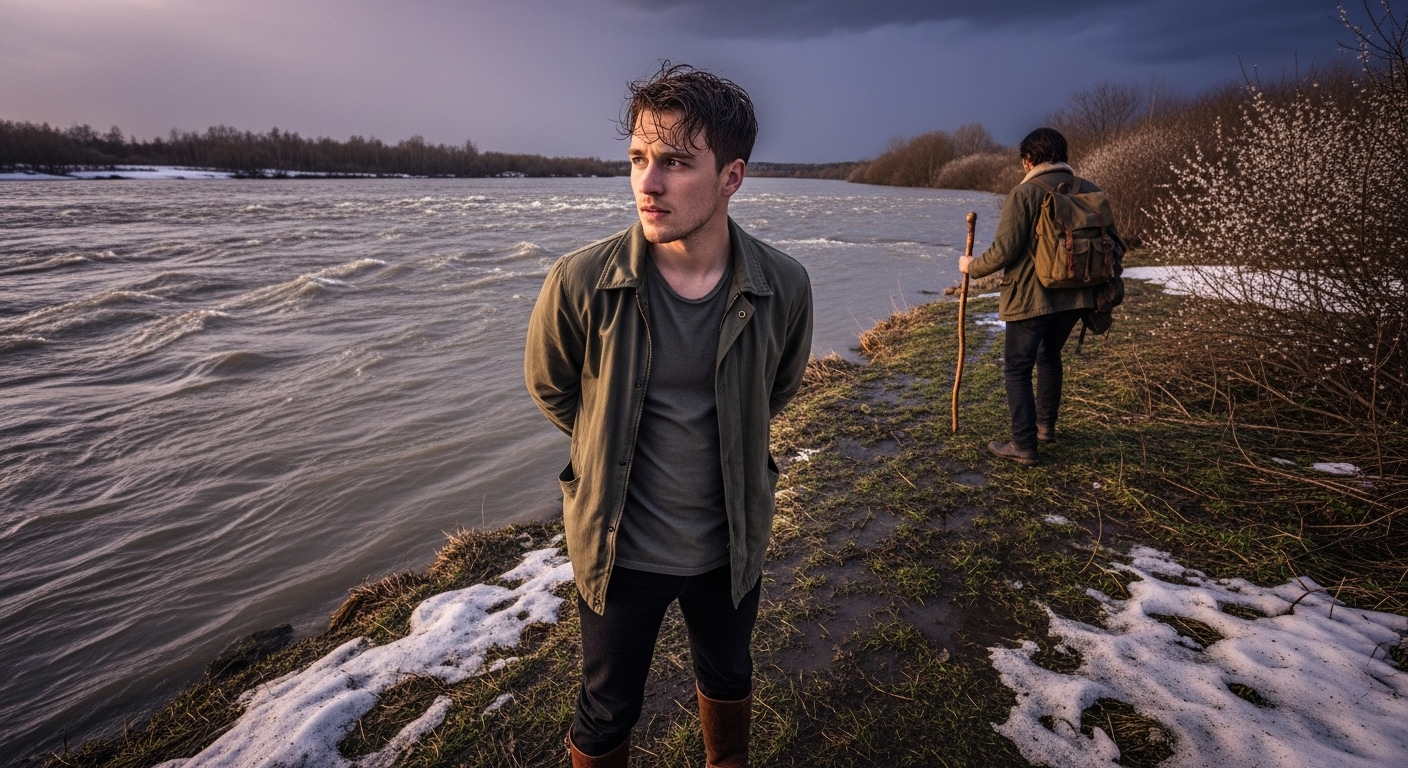
The storm was coming, he could feel it, not just in the air, but in the unsettling churn of events. And he knew, with a certainty that chilled him to the bone, that the river always claimed its due.
Share This Story


