Where the Histories Bleed
The hum of the dehumidifiers in the provincial archives was a constant, low drone, a sound designed to preserve paper but which always made Pete's teeth ache. He sat at a heavy oak table, the only person in the reading room. On the grey foam cradle in front of him lay the diary of one Alistair MacLeod, a surveyor who had the profound misfortune of being in Winnipeg during the great flood of 1826. The book itself was a wreck; the leather cover was warped and stained, and the pages inside were a mottled brown, the ink bleeding into spidery, illegible fractals.
The hum of the dehumidifiers in the provincial archives was a constant, low drone, a sound designed to preserve paper but which always made Pete's teeth ache. He sat at a heavy oak table, the only person in the reading room. On the grey foam cradle in front of him lay the diary of one Alistair MacLeod, a surveyor who had the profound misfortune of being in Winnipeg during the great flood of 1826. The book itself was a wreck; the leather cover was warped and stained, and the pages inside were a mottled brown, the ink bleeding into spidery, illegible fractals.
For three days, Pete had been trying to make sense of it for his thesis on hydrographical anomalies in early settlement records. Most of it was standard surveyor's fare: notes on elevations, soil composition, and complaints about the mosquitoes. But the entries from the flood period were different. The language became... unhinged.
He leaned closer, a magnifying glass in hand, tracing the faint, ghostly script. The entry for May 19th, 1826, was particularly difficult. MacLeod's handwriting, usually so precise, had devolved into a frantic scrawl.
'The water is not mere water,' Pete deciphered, whispering the words aloud to the empty room. 'It has... a character. A memory. It remembers the banks it has broken and desires more. At night, I hear it... singing. It is a song of… of taking. It does not simply rise. It consumes. It has taken the church. It has taken the fort. It has taken Finch's boy right off his own rooftop. It has a throat, this river. And it is always thirsty.'
Pete sat back, a shiver tracing its way down his spine despite the stuffy warmth of the archive. A throat. Always thirsty. It was powerful imagery, the product of a mind clearly buckling under extreme stress. He made a note: 'Flood trauma manifests in anthropomorphism of the natural disaster.' It was a tidy, academic explanation. It was also, he felt, profoundly inadequate.
The Sound Below the Bridge
He needed air. The scent of old paper and decay was starting to get to him. He signed out, blinking in the unexpectedly sharp afternoon light. The archives were only a short walk from The Forks proper, and he found himself drifting towards the river, the surveyor's words still echoing in his head.
He walked out onto the Esplanade Riel, the pedestrian bridge that spanned the Red River. The water below was high and muddy from the summer rains, a churning brown expanse. He leaned on the railing, watching the current swirl around the bridge's piers. A song of taking.
That's when he heard it. Underneath the traffic noise from the nearby road, underneath the chatter of people walking past, there was another sound. A low, resonant hum. It wasn't mechanical, like a boat engine. It was deeper, more organic. It sounded, bizarrely, like a thousand voices humming a single, dissonant chord. It seemed to be coming from the water itself.
Pete shook his head, pressing the heels of his palms into his eyes. Too much caffeine, not enough sleep. He was letting the melodrama of a 19th-century diary infect his senses. He was a historian, a man of facts and primary sources, not ghost stories.
He walked down from the bridge, heading towards the Oodena Celebration Circle, a shallow amphitheatre with celestial markings etched into the stone. He wanted solid ground under his feet. He passed under the main road bridge, the concrete underpass dark and cool.
The humming was louder here, echoing off the concrete walls. And it wasn't just humming anymore. He could almost make out words, whispers in a language he didn't understand, slithering at the edge of his hearing. The air grew cold, smelling of wet silt and something else. Something like rot, but older.
He saw a flicker of movement out of the corner of his eye. He turned. Nothing. Just graffiti and damp patches on the concrete.
He started walking faster, his footsteps unnervingly loud in the enclosed space. He felt a sudden, inexplicable terror, a primal urge to get away from the river. The feeling of being watched was immense, a physical pressure on his back.
---
He burst out from under the bridge into the sunlight, his heart racing. He didn't stop until he was standing in the very centre of the Oodena Circle. He took deep, ragged breaths, trying to calm himself. It was just his imagination. He had immersed himself too deeply in his work.
He looked back towards the river, a hundred metres away. The water flowed on, indifferent. But as he watched, the surface seemed to darken. For a single, horrifying moment, he saw a face in the roiling current. Not a human face, but something made of mud and weeds and swirling water, with two dark, empty hollows for eyes. It stared at him, and he felt a cold intelligence in its gaze, a deep and ancient hunger.
It was gone as quickly as it appeared, the river returning to its mundane, muddy state. But Pete couldn't unsee it. He couldn't unhear the whispers.
MacLeod wasn't traumatised. He wasn't being metaphorical. He was a surveyor, a man who dealt in precise measurements and observable facts. And he had observed this. A throat, this river. And it is always thirsty.
The lesson was cold and vast as the prairie sky. History wasn't just a collection of stories on paper, safely contained in archives. Some parts of it were still alive, still present. And he had just looked into the eyes of something that had been waiting patiently since 1826.
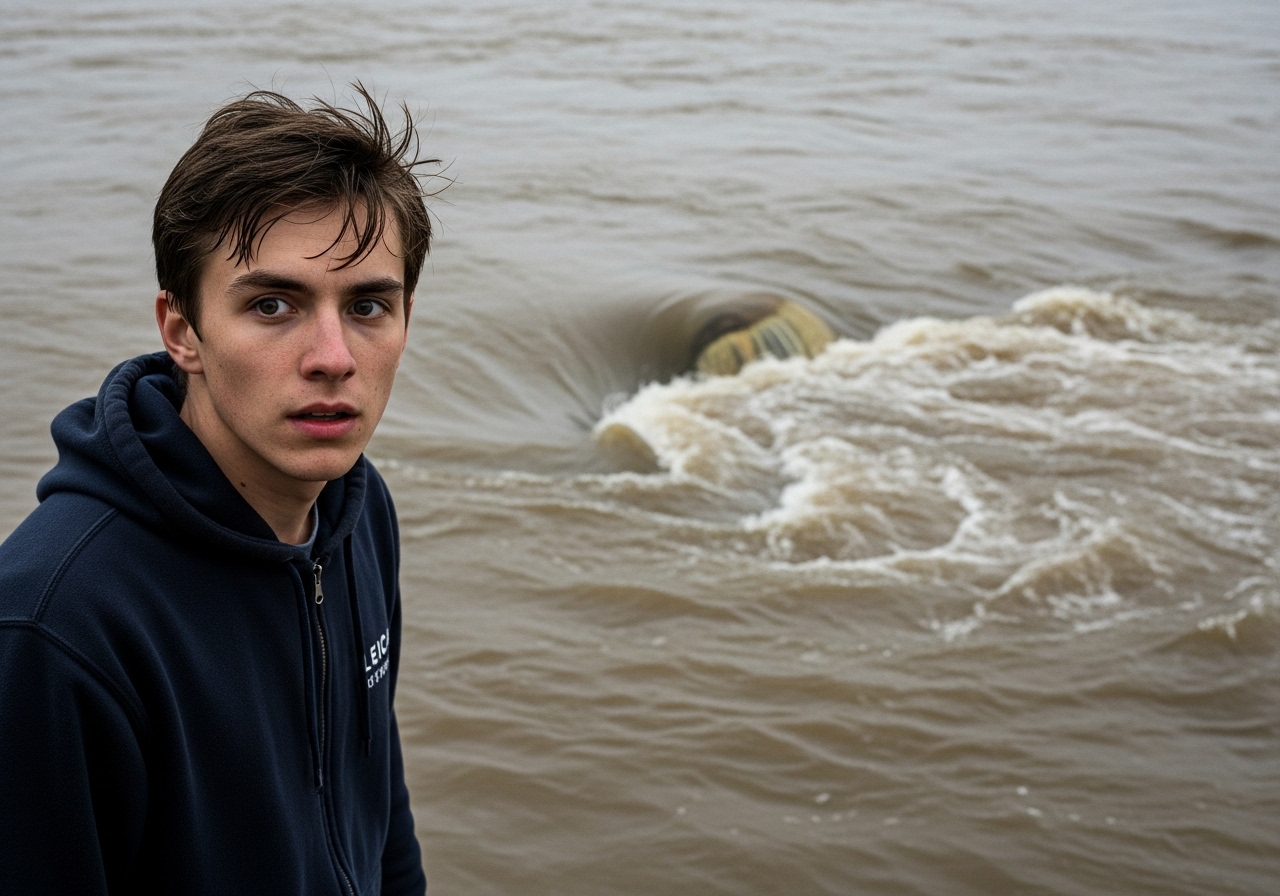
He stumbled back to his apartment, locking the door behind him. He went to the sink to splash water on his face, but when he turned on the tap, the water that came out was thick, brown, and smelled of the riverbed.
Share This Story


