Celluloid and Silver
It’s a lie that dust is silent. It has a voice, a dry, papery whisper that speaks of shed skin and crumbled memories, and tonight, in the suffocating stillness of the archive, it is the only sound I can reliably name. The dehumidifier offers its monotonous, asthmatic hum from the corner, a mechanical prayer against the damp that forever threatens to turn this collection of a town’s life into a pulpy, unreadable mass of mould. But the dust is the true historian here, settling with democratic indifference on the pension records of lumber barons and the chipped teacups of farmers’ wives.
I should have gone home hours ago. The last of the autumn light was bled from the high, grimy windows by six, and the sodium lamps in the car park now cast a sickly orange pallor across the floor, a colour that makes the oak cabinets look like jaundiced old men. But the Bailey estate donation sits before me, a cardboard sarcophagus exhaling the particular scent of mothballs and seventy years of solitude. A duty. That’s what I call it. But it’s more an addiction, this need to be the first to touch the things left behind, to reconstruct a life from the sediment it leaves in its wake.
Elizabeth would have understood. She would have been right here, her glasses perched on her nose, her fingers, impossibly delicate, tracing the faded ink on a postcard. She always said that objects have a memory, a resonance. Not in some fanciful, spectral sense, but in a real, physical way. The oils from a hand, the microscopic scratches of use, the slow patina of breath and time. For her, history was a tactile science. For me, now, it is the only way I have of touching her.
A cold spot blooms by my left shoulder, the air suddenly dense and smelling faintly of lilac soap, the kind she used to keep in a porcelain dish by the sink. I don't flinch anymore. I just pause, my hand hovering over a bundle of letters tied with brittle twine. “Hello, my love,” I murmur to the empty, humming air. There’s no reply, of course. There never is. Just a brief, intense drop in temperature, a fleeting scent, a feeling of being observed with a profound, silent affection. It is enough. It has to be.
---
The contents of the box are a constellation of a quiet life. Receipts from the old grocer on Queen Street, a service medal from the war, its ribbon frayed to threads, a child’s drawing of a lopsided horse. I handle each with the same reverence, documenting, assigning an accession number, my pen scratching across the archival-quality tag. The process is a litany, a ritual against chaos. My kingdom is one of acid-free tissue paper and climate control, my battles fought against silverfish and the slow, inexorable decay of all things.
My fingers brush against something hard and cool at the bottom. I pull it out. A silver locket, tarnished almost black in the crevices of its ornate floral engraving. It’s heavier than it looks, solid, with a satisfying density. The clasp is fused shut with age. I turn it over in my palm, the metal warming to my skin. The cold spot returns, this time directly over my hand, a palpable weight. The lilac scent is so strong it’s like burying my face in a phantom bouquet.
This is her. I know it with a certainty that defies logic. She is here, in this object. In all these objects. The museum isn’t just a building full of old things; it’s a library of these moments, these echoes. And the new guard, the ones with their tablets and their talk of ‘user engagement’ and ‘digital outreach,’ they want to silence it. They want to turn this breathing, living place into a database, a collection of flat, soulless images on a screen, accessible from anywhere, which is to say, truly present nowhere at all.
The thought sends a spike of pure, hot anger through me. They talk of ‘preparing for the next generation,’ but what they mean is erasing the last one. They cannot feel what I feel. They can’t smell the lilacs.
The Peril of Progress
The heavy front door groans, the sound cannoning through the building’s hollow spaces. Footsteps, quick and precise, click on the polished concrete of the main hall. Not the shuffling gait of our night watchman, Hector. These are sharper. Younger.
Leona appears in the doorway of the archive, a silhouette against the lurid orange from the hall. She’s holding a manila folder. “John. I thought I might find you still here.”
I place the locket carefully on a square of velvet. “Leona. A bit late for you, isn’t it?”
“Could say the same for you.” She steps into the room, her presence, all sharp angles and modern perfume, a stark contrast to the rounded, worn-out shapes of the archive. She eyes the box. “The Bailey stuff?”
“Just making a start,” I say, my voice carefully neutral. The cold spot has vanished. The air is just air again, thick with the smell of old paper.
“Good.” She places the folder on the corner of my desk, well away from the artifacts. “Just wanted to drop off the final proposal for the digital initiative. The board votes on Tuesday. I wanted to make sure you had a chance to look it over again.”
I look at the folder as if it were a venomous snake. “I’m sure it’s very thorough.”
“It is.” Her tone is crisp, business-like, but I can hear the undertone. A plea? A warning? “John, this is a good thing. It’s about accessibility. It’s about preservation. If there was a fire… this,” she gestures to the shelves, to the boxes, to my entire life’s work, “would all be gone. The scans would be a permanent record.”
“A permanent, two-dimensional record,” I counter, my voice quieter than I intended. “A photograph of a meal is not the same as the meal itself, Leona. You can’t taste a photograph.”
She sighs, a small, frustrated sound. “We’re not talking about taste. We’re talking about data. Information. We can catalogue everything, cross-reference it. A researcher in Vancouver could access our entire collection. Think of the reach we’d have.”
My hand instinctively closes around the locket, my thumb rubbing its smooth, worn surface. “They can come here. The reach is through that door. The experience is in this room. It’s the smell. The temperature. The… the weight of things.”
She looks at me, and for a moment, the corporate efficiency in her eyes softens. There’s a flicker of something—pity, maybe. She thinks I’m just a relic myself, a dusty old man clinging to a dusty old world. “The funding is contingent on modernization, John. This is happening. I just hoped you’d want to be a part of shaping it, not… obstructing it.”
Subtext. She’s telling me to get on board or get out of the way. She’s telling me my time is over. “Thank you for dropping this off,” I say, my gaze fixed on the locket. “I’ll be sure to give it the consideration it deserves.”
The silence stretches. She knows it’s a dismissal. She knows I am a lost cause. “Right. Well. Don’t stay too late. Hector gets anxious.” She turns and her footsteps click away, the sound fading until the great door groans shut once more, sealing me back inside the quiet.
---
The quiet is different now. It feels heavier, more final. The folder on my desk seems to radiate a sterile energy, a threat more potent than damp or silverfish. This is the true decay. A decay of meaning.
I pick up the locket again, holding it to the weak light of my desk lamp. Obstruction. Is that what I am? A knot of old wood in the path of a clean, efficient saw. Perhaps she’s right. Perhaps I am just afraid of being made redundant, not just me but my entire way of knowing the world. A world where history has a scent and a temperature and a ghost who smells of lilacs.
I’m tired. The anger has drained away, leaving a hollow ache deep in my bones. It’s the same ache I’ve carried since Elizabeth’s funeral, a phantom limb where my future used to be. For a moment, I let myself imagine the museum as Leona sees it. Clean, bright, searchable. A website. An app. No dust. No cold spots. No Elizabeth.
My thumb presses, unconsciously, on the seam of the locket. For all my effort, my fingers are clumsy, stiff with arthritis. I can't find the purchase to pry it open. It remains sealed, a tiny silver fist clenched around its secret.
I set it down, defeated, and stare at the proposal. It’s not a proposal. It’s an obituary. An obituary for the tangible, for the real, for the quiet language of things.
And then I hear it. A tiny, distinct click.
My head snaps up. The sound was impossibly small, yet it cut through the hum of the archive like a gunshot. My eyes dart around the room, expecting… I don’t know what. Hector at the door? A settling of the old building’s bones?
But the room is empty. The silence rushes back in, deeper than before. My gaze falls back to the desk, to the square of velvet where the locket sits. It’s open. The two halves of the silver shell lie apart, gleaming in the lamplight as if a hidden spring has just been released. It lies there, patiently, waiting for me.
My breath catches in my throat. It didn't just fall open. I heard it. A mechanism, precise and deliberate. I stare at it, my heart a frantic, hammering drum against my ribs. It sits there, an invitation. A reply.
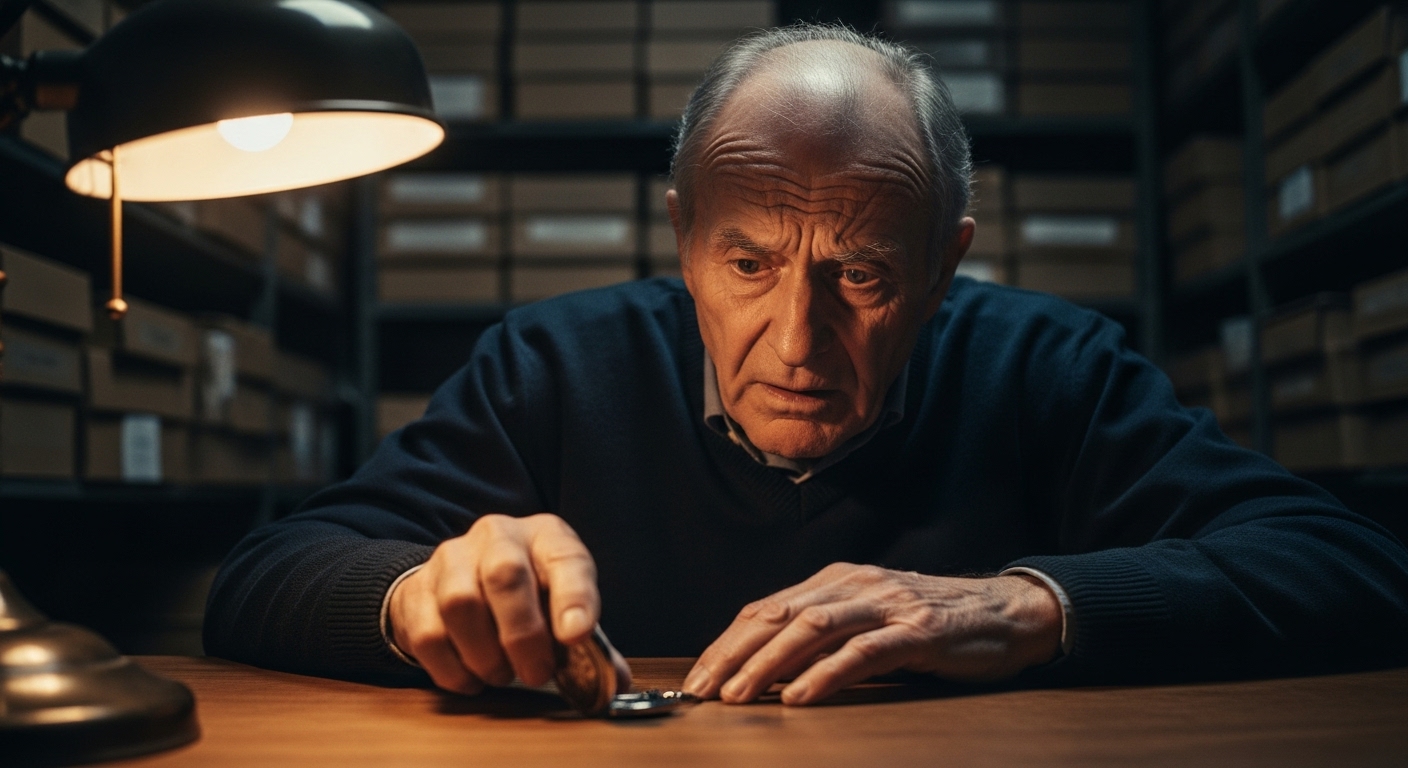
With a hand that trembles uncontrollably, I reach for the open locket, my mind screaming that it's impossible. Inside, where a faded portrait should be, is something else entirely—something that cannot, should not, exist.
Share This Story


