The Weight of Gold and Rust
The air held that particular, metallic tang of late autumn, a scent of damp earth and decaying leaves that clung to David's coat. A low, grey sky pressed down, threatening rain, but for now, only a persistent wind rustled through the skeletal trees, plucking the last stubborn ochre and crimson leaves from their branches. The quiet crunch underfoot was a lonely rhythm against the vast silence of the suburban street.
The rake dragged through the soggy, matted leaves, a sound like tearing fabric. David leaned into it, his shoulders aching, the metallic tines catching on a forgotten plastic bag. He pulled it free, a ripple of cool, damp air washing over his face, smelling of compost and something faintly acrid, like burnt toast from a distant kitchen.
His breath plumed, ghost-like, in the crisp air. November. Already. It felt like only yesterday he’d been swatting at mosquitoes, complaining about the heat, wishing for this cool relief. But the relief was thin, an illusion. The cold got into bones in a way summer never could, and it stayed there.
He straightened, flexing his spine, the cheap plastic handle slick in his gloved hands. Across the lawn, the swing set stood stark and forlorn, a rusted monument. Two swings, still tangled, one chain half-snapped, the plastic seat cracked and faded. Belinda used to fly so high on that thing, her small legs pumping, hair a wild mess against the hazy summer sky. She’d always scream, a delighted shriek that carried across the street, annoying Peter next door.
Peter. David glanced at the house, a beige brick box with meticulous, if colourless, flowerbeds. No sign of him. Good. Peter tended to stare, his gaze heavy, as if David was a museum exhibit, something to be analysed and catalogued.
A particularly stubborn clump of maple leaves had gathered by the oak, clinging to the damp soil like tiny, dead hands. He stabbed at them, frustration a dull throb behind his eyes. It was stupid. All of it. The raking. The pretending that life was normal. The quiet ache that never really left, just shifted its weight from one side of his chest to the other.
He should be angry. He was angry. But it was also… tiring. God, so tiring. Belinda wouldn’t have wanted this. She would have wanted him to… what? Live? Be happy? He didn't even know what that felt like anymore, not truly. It was a word, a concept, like 'equilibrium' or 'serendipity'. Just sounds.
A car pulled up at the kerb, its engine a low grumble. David didn't look up, assuming it was a delivery driver, or perhaps Peter’s estranged son, the one who only visited twice a year. But then a door clicked shut, and light, quick footsteps crunched on the fallen leaves. He knew those footsteps.
“David?”
Tara. She stood by the path, a canvas bag slung over her shoulder, a knitted scarf wrapped twice around her neck. Her cheeks were already pink from the cold, and her breath misted around her words. Her hair, the colour of strong tea, was pulled back in a loose, messy bun, a few strands escaping around her face.
“Hey,” he grunted, not quite able to summon a smile. He let the rake clatter against the fence post, the sound sharp and intrusive.
“Thought I’d find you out here,” she said, her voice soft, careful, like treading on thin ice. “The wind’s picking up. You’ll freeze.”
He shrugged, shoving his hands into his pockets. “Someone’s gotta do it. The city by-laws, you know.”
She gave a small, almost imperceptible shake of her head. “Right. The city by-laws. Anyway, I brought something.” She held up the canvas bag. “Found them when I was clearing out my old storage locker. Thought you might want them. Or not. No pressure.”
He hesitated, then walked towards her, the uneven ground making him stumble slightly. A small stone dug into the sole of his boot, but he ignored it. Tara’s eyes, the deep brown of rich soil, met his. They held a sympathy that always felt like a physical weight, pressing down on him. Shared grief. It was a peculiar thing, a bond forged in mutual agony.
She reached into the bag and pulled out a small, worn leather-bound book. It looked like a journal, but it wasn't. It was Belinda's poetry anthology, the one she'd carried everywhere. David remembered the way she used to underline passages, scribble notes in the margins, her handwriting a chaotic dance of loops and sharp angles.
“Her Rilke,” Tara said, a faint smile touching her lips, but her eyes remained shadowed. “She practically memorised it. Said it made sense of the chaos, or something.”
He took the book, his fingers tracing the embossed title. The leather was cool, dry, the scent of old paper and something else – faint, sweet, like dried lavender. Belinda’s scent. He inhaled, a sharp, involuntary gasp.
“And this,” Tara continued, pulling out a small, tarnished silver locket. “From her eighth birthday. Your mum gave it to her.”
The locket felt impossibly light in his palm, cold as an autumn night. He remembered Belinda wearing it constantly, even to bed. It had a tiny, faded photo inside, a miniature of their parents, beaming, younger, before everything.
“Thanks,” he managed, his voice thick. He cleared his throat, feeling a stupid, prickling heat behind his eyes. “You didn’t have to.”
“I know,” she said, her gaze fixed on a distant oak, its branches bare against the grey. “But they’re hers, David. They should be with… someone who remembers.”
The silence that fell between them was a heavy shroud, draped over unspoken words, over the chasm Belinda had left. David flipped open the Rilke, his thumb brushing over the brittle pages. He found a heavily underlined poem, 'Autumn Day'. Belinda's pencilled notes in the margin were almost illegible, but one word stood out, circled fiercely: 'Wait'.
“She was really into Rilke,” Tara murmured, as if sensing his focus. “Said he understood the stillness. The parts you can’t quite articulate.”
“Wait for what?” David said, the question hanging in the air, aimed not at Tara, but at the ghost of his sister. He glanced up, catching Tara’s eye. Her expression was unreadable, a complicated mixture of sadness and something he couldn't quite decipher. A distant ambulance siren wailed, fading quickly.
“I don’t know, David,” she said, her shoulders slumping slightly. “I wish I did.” She pulled the scarf tighter around her. “Did you ever… I mean, did she ever say anything to you? Anything odd? Before… before she left?”
He shook his head, looking down at the book. “No. Just… normal stuff. Complaining about Peter’s garden gnomes. Planning that hiking trip she never took.” He paused, a memory surfacing, unwelcome. “She did mention wanting to find an old lighthouse. Said it was for a project. Never told me what kind of project.”
Tara frowned. “A lighthouse? That’s… specific. She never mentioned that to me.” She shifted her weight, kicking at a pile of leaves. “This feels… heavier this year, doesn’t it? The autumn.”
David nodded, tucking the Rilke and the locket into his own jacket pocket. The weight of them was comforting, yet oppressive. “Every year,” he said. “It just piles up.”
A rustling at the edge of the property made them both look up. Peter stood by his perfectly manicured fence line, a small, faded gardening trowel in his hand, his eyes fixed on them. He didn’t smile. He didn’t frown. Just watched.
---
David felt a sudden, irrational spike of annoyance. Peter was always there. Always watching. He remembered Belinda joking about it, calling him 'The Warden of the Chrysanthemums'. But it wasn't funny now. Nothing was.
“Anyway,” Tara said, breaking the spell, her voice a little too loud. “I should go. My shift starts soon.” She nodded towards the canvas bag, now empty. “Let me know if you want me to take any of it back. Or… if you need anything.”
“Thanks, Cath,” David said, genuinely. She was always there, too. A different kind of presence. Solid. Real. He watched her walk back to her car, the grey light reflecting off the chrome. As she drove away, the faint smell of wet dust from her tyres lingered.
He turned back to the Rilke, pulling it out again. He had to know about the lighthouse. It felt important, a stray thread leading somewhere. He opened to the 'Wait' page, then flipped to the very back, where Belinda often scribbled phone numbers or shopping lists. Nothing. Just an old library stamp.
He started thumbing through the front pages, past the introduction, past the dedication. And then, between the first blank endpaper and the title page, something small, barely visible. A crease. He ran his finger over it, then carefully pulled at the corner. A tiny, folded piece of paper, tucked into the spine.
His heart gave a lurch, a sudden, unexpected jolt. He unfolded it, his fingers fumbling. It was a faded map, crudely drawn, with a jagged coastline and a large 'X' marked precisely where a lighthouse should be. Below the 'X', in Belinda’s distinctive scrawl, were three words. Words that hit him like a physical blow, knocking the breath from his lungs and sending a chill colder than any November wind through his bones.
"The Grey Door."
He stared at the map, then at the words, the world around him fading into a soft, indistinct blur. The grey light of the day seemed to intensify, pressing down, threatening to swallow him whole. Peter was still watching from his garden, a silent, unmoving figure. And then, David heard it, a faint, metallic groan from the old swing set, rocking slightly in the relentless autumn wind, as if a small, unseen hand had just pushed it.
A tiny, almost imperceptible tremor ran through the ground beneath his feet, a vibration that felt both familiar and utterly alien. He tightened his grip on the faded map, his knuckles white, a growing dread blossoming in his chest, cold and insistent.
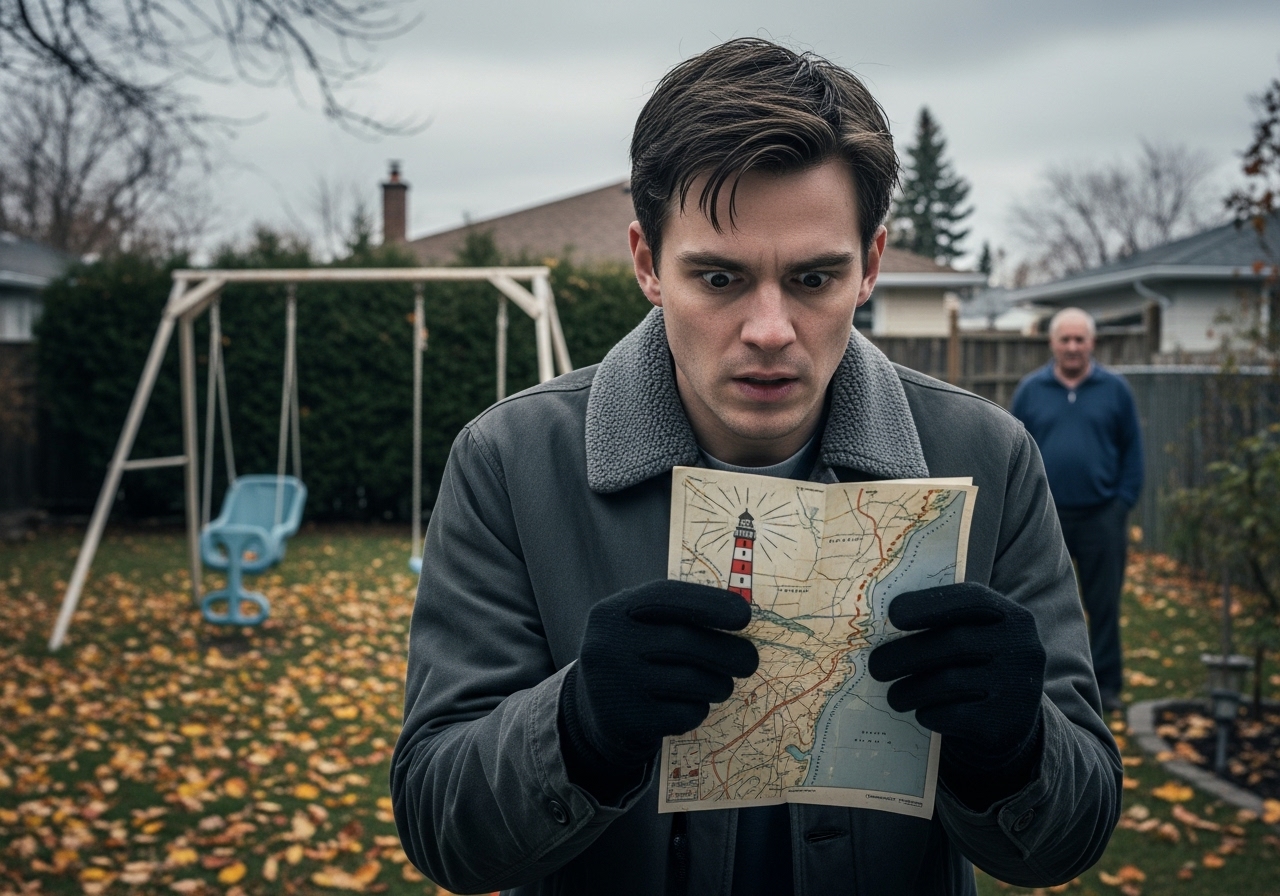
David gripped the faded map, the cryptic words 'The Grey Door' echoing in his mind, while a faint, unnatural tremor shook the earth beneath him, hinting at a secret far deeper than a forgotten lighthouse.
Share This Story


