The Grey of Spring and Growing Ideas
Parker pressed his forehead against the cold windowpane of the community hall, leaving a damp smear. Outside, the world was still waking up from winter, hesitant and muddy. Grey puddles shimmered like spilled mercury on the gravel, reflecting the equally grey sky. A lone robin, plump and confused, pecked at a patch of brown grass that stubbornly refused to turn green. It was supposed to be spring, Aunt Donna had declared, but the air still carried a bite, a damp, earthy smell that seeped right into his bones, reminding him of old boots left out in the rain.
Parker pressed his forehead against the cold windowpane of the community hall, leaving a damp smear. Outside, the world was still waking up from winter, hesitant and muddy. Grey puddles shimmered like spilled mercury on the gravel, reflecting the equally grey sky. A lone robin, plump and confused, pecked at a patch of brown grass that stubbornly refused to turn green. It was supposed to be spring, Aunt Donna had declared, but the air still carried a bite, a damp, earthy smell that seeped right into his bones, reminding him of old boots left out in the rain.
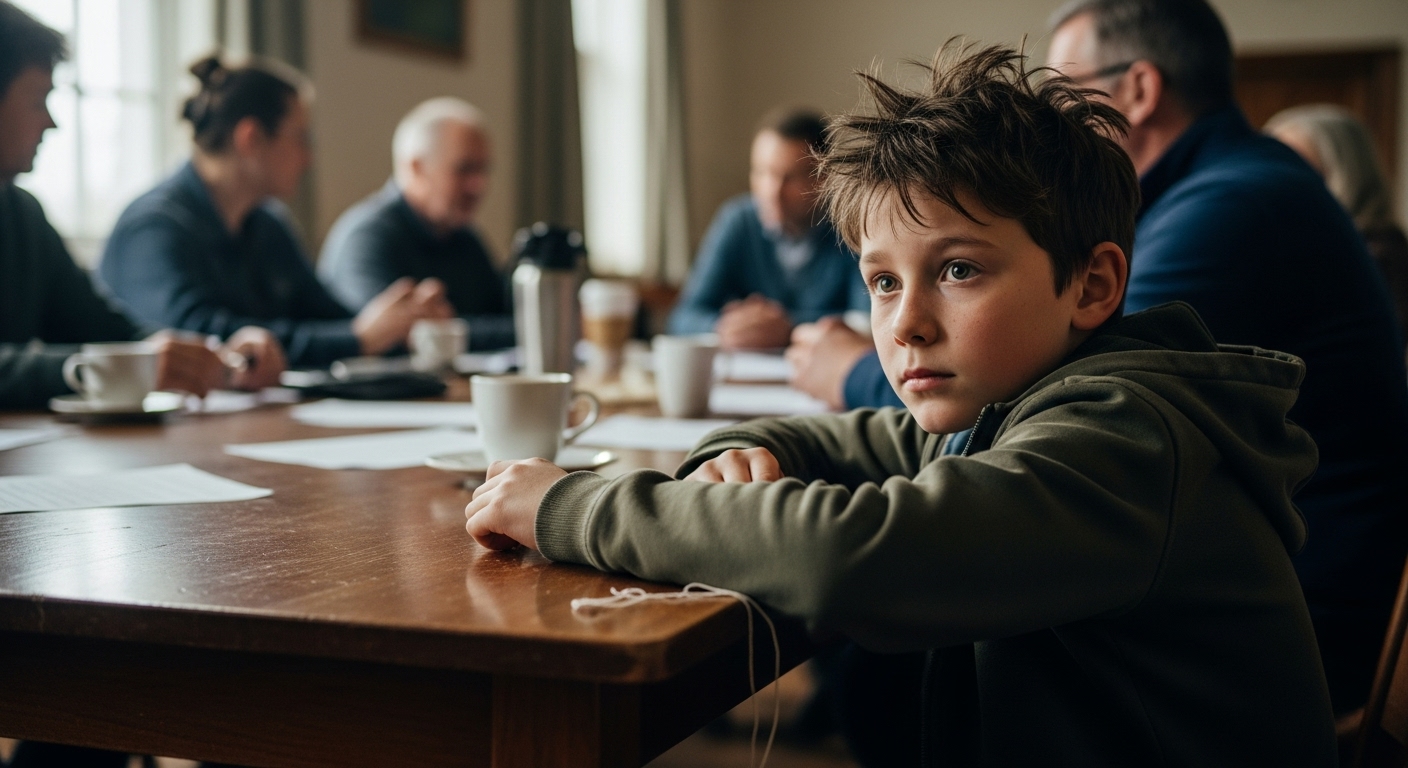
Inside, the hall smelled of lukewarm coffee, chalk dust from the blackboard that hadn't seen a proper cleaning since last Christmas, and something else – a faint, sweet scent, like overripe apples, coming from the wilting bouquet on the table. He didn't like the smell of overripe apples. It made his nose wrinkle. Aunt Donna, bless her booming voice and even boomier ideas, was at the head of a long, chipped folding table, waving her hands about. Her bright, floral scarf, probably a recent acquisition, seemed to vibrate with her enthusiasm, a stark contrast to the drab grey sweater she wore. She was, he often thought, like a perpetual spring bloom trying to force its way through a very stubborn patch of late frost.
"Now, now, dear friends," Aunt Donna proclaimed, her voice echoing a bit too much in the half-empty hall. "Let us revisit the core concept. The 'Northern Spark Arts Collective,' yes? It simply… sings, does it not? A beacon for our artistic endeavours, a hearth for creative souls in this grand, sweeping expanse of Northwestern Ontario!"
Mr. Peterson, who was perched on a plastic chair that looked far too flimsy for his considerable frame, cleared his throat. He had paint stains on his old denim jacket, like colourful battle scars, and his spectacles were perpetually sliding down his nose. "Donna," he rumbled, his voice like rocks tumbling down a small hill. "It's a fine name, truly. But what are we doing? We have a name. We have… zeal. But the doing part. How do we ensure this 'spark' doesn't flicker out before it's even truly lit, eh?" He nudged his spectacles up with a paint-splattered finger.
Parker watched Mrs. Henderson, a woman whose every movement was precise, even her sips of coffee. She wore a neatly buttoned cardigan despite the hall being a touch chilly. She adjusted the brim of her hat, a modest felt affair, and spoke with a cadence that reminded Parker of a clock ticking, steady and unwavering. "Indeed, Mr. Peterson. The practicalities. We must consider the resources. Our community, while rich in… spirit," she paused, her eyes scanning the small gathering as if taking inventory, "is perhaps not overflowing with tangible assets. We require a structure. A… foundation, upon which this spark may safely burn." She took another slow, deliberate sip.
Parker fidgeted with a loose thread on the sleeve of his own jacket. The meeting had been going on for what felt like forever, even though Aunt Donna said it had only just begun. His knee knocked against the underside of the table, producing a dull thud. He imagined the meeting as a really big, long train, and he was a little pebble on the tracks. It was going to keep going whether he was there or not. He pressed his face against the window again. The robin was still there, now hopping closer to a patch of weeds, its little head cocked. It seemed to be listening, too.
"Our youth," Ms. Delgado interjected, her voice clear and crisp, like fresh spring water. She was the youngest adult in the room, with short, practical hair and quick, observant eyes. "We must engage the youth. Provide them a space. Not merely a dusty hall, but a vibrant centre. A place where their voices are not simply heard, but amplified." She gestured emphatically towards Parker, who quickly pulled his face from the window, feeling a hot flush creep up his neck. He wished she hadn't pointed. He wasn't doing anything.
Aunt Donna clapped her hands together, a sound like two wet towels snapping. "Precisely, Delia! The youth! Parker, dear, what are your thoughts? You are a youth, are you not? A connoisseur of youthful perspectives!" She beamed at him, a wide, challenging grin.
Parker swallowed. His throat felt dry. He looked at the half-eaten doughnut on the paper plate beside his uncle Robert’s elbow. The powdered sugar looked like a tiny, abandoned snowdrift. He cleared his throat. "Well," he began, his voice barely a squeak. "It is… very important, I suppose. For art." He trailed off, suddenly fascinated by the way a streak of dust caught the pale, watery light from the window, swirling slowly, like tiny, bored ghosts.
Uncle Robert, who had been mostly silent, twirling a pen between his fingers, offered a small smile. He had kind eyes, Uncle Robert did, and always seemed to understand when Parker was uncomfortable. "Parker is quite correct," he said, his voice soft, a welcome contrast to Aunt Donna's vivacity. "Art is important. But perhaps, Parker, you could elaborate? What sort of art, in your estimable opinion, might 'amplify' the voices of… well, of your peers?" He winked, a slow, deliberate wink that only Parker seemed to notice.
Parker felt a bit bolder. "Drawing," he said. "And… building things. Like, with wood. My friend, Pat, he likes to carve. And… stories. Some kids tell really good stories. Not just reading, but, like, making them up, out loud." He stopped, wondering if he had said too much. His gaze drifted to Mr. Peterson’s paint-splattered jacket again. Mr. Peterson nodded slowly, a thoughtful expression on his face.
"Excellent!" Aunt Donna boomed, quite pleased. "You see? The practicalities! Drawing, carving, storytelling! These are the very sinews of community, the threads of our cultural fabric!"
Mrs. Henderson sighed softly, a sound like a deflating balloon. "Threads are well and good, Donna. But one requires a loom. A physical location. The old abandoned general store on Fifth Street. Is that still the proposal?"
"Indeed it is, Margaret!" Aunt Donna exclaimed, her eyes gleaming. "The perfect canvas, if you will! Imagine! The high ceilings, the natural light pouring in from those magnificent arched windows! It simply beckons creativity!"
Parker shifted in his chair. The old general store. He had snuck in there once with his friend, Pat. It was dark and cold, and smelled like damp earth and old newspapers. Not like overripe apples, thank goodness. He remembered the feeling of cobwebs on his face, soft and sticky, and the way the floorboards groaned under their weight. It had felt like the belly of a sleeping monster. He had tripped over a loose floorboard and scraped his knee, a jagged line that had taken ages to heal.
---
The Bones of the Store
"The general store has… character," Mr. Peterson allowed, a faint smile playing on his lips. "And ghosts, I imagine. But it is structurally sound, mostly. A new roof, certainly. And a good deal of cleaning. The dust in there, Donna, is not merely dust. It is a historical archive of neglect."
Ms. Delgado tapped her pen against a notebook. "The renovation costs will be substantial. We have some grant applications pending, of course. But local investment is crucial. And volunteers. Many, many volunteers. We must present a compelling vision to the council."
Parker watched his uncle Robert, who was now sketching something in his notebook. Not words, but shapes. Squares and circles, then lines connecting them, like a map of constellations. He wondered if Uncle Robert was secretly an artist. He never really talked about himself much, not like Aunt Donna. Uncle Robert was like a quiet, sturdy tree, while Aunt Donna was a whole wild forest.
"The council," Mrs. Henderson articulated, "is concerned with fiscal prudence. They will require a robust business plan. How will this 'collective' sustain itself? Fees for classes? Sales of artwork? Community events?" She ticked off points on her fingers, each movement precise and unhurried.
Aunt Donna leaned forward, her scarf almost dipping into her coffee cup. "All of the above, Margaret! And more! Imagine! A gallery space, a workshop for artisans, a stage for local musicians, even a small theatre for our budding playwrights! A café, perhaps, serving local produce, fostering community engagement! Think of the tourists! The influx of cultural capital!" Her eyes were wide, sparkling with her vision.
Parker thought about the old general store. He imagined it as a cafe. Would they serve hot chocolate? With marshmallows? Maybe even whipped cream. He liked whipped cream. He tried to picture the dusty shelves lined with jars of local jam instead of forgotten tins of beans, and the peeling wallpaper replaced with colourful paintings. It was hard. The general store in his mind was stubbornly dark and smelling of damp.
"Tourists are… capricious," Mrs. Henderson observed, adjusting her hat again. "And the season for tourism in our region is regrettably brief. We must focus on the local community, its needs, its engagement. What keeps our young people here? What makes them return after they venture to the bigger cities?" Her gaze swept over them all, settling momentarily on Parker, who quickly looked down at his shoes. His laces were slightly untied. He made a mental note to fix them later, a fleeting thought.
"That, Margaret, is the crux of it," Mr. Peterson said, his voice losing some of its gruffness, becoming softer, more earnest. "We lose our talent. They go off to Toronto, Montreal, Vancouver. They learn, they grow, and they rarely come back. This collective, this 'Northern Spark,' it has to be more than just a place to hang paintings. It has to be a reason. A reason to stay. A reason to invest their lives here." He tapped the table gently with his knuckles, a sound that seemed to carry the weight of many years of observation.
Ms. Delgado nodded. "Exactly. We've seen it time and again. The brain drain. We offer sports, some clubs, but for the creative minds, the opportunities dwindle. A dedicated arts space, run by and for the community, could be transformative. It offers a future. A place to belong and create." She glanced at Parker, a flicker of something he couldn't quite name in her eyes – understanding, maybe.
Parker felt a strange warmth bloom in his chest. He liked the idea of a reason to stay. His big sister, Willow, was always talking about leaving, about the big city lights and all the things she couldn't do here. He didn't want her to leave. He liked having her around, even when she stole his comic books. He traced the pattern of a faint scratch on the wooden table. It looked like a tiny river, winding its way through a forest of splinters.
---
A Faint Memory of Something Else
The discussion drifted to potential workshops. Aunt Donna suggested pottery. Mr. Peterson spoke of printmaking. Ms. Delgado advocated for digital storytelling and media labs, eyes shining. Mrs. Henderson, predictably, asked about the cost of clay and kilns, and the lifespan of digital equipment.
Parker found himself staring at the old brass doorknob on the hall's main entrance. It was tarnished, green in places, and reflected his distorted face like a funhouse mirror. He saw a tiny, stretched version of himself, a bit like a ghost trying to peek through a thin sheet. He remembered the general store's doorknob. It was big and black, heavy cast iron, and felt cold even in summer. His fingers had left rusty smears on it when he'd opened the creaky door with Pat.
A sudden, sharp question from Mrs. Henderson cut through his reverie. "Donna, dear. The historical significance of the building. Have we truly… accounted for it? There are murmurs, you know. Old stories. About what might be found within its walls, should we disturb them too greatly." She spoke softly, but her words seemed to carry a strange weight, like stones dropped into a quiet pool. Her eyes flickered towards Uncle Robert, who, for the first time, looked up from his sketching, his brows furrowed slightly.
Aunt Donna waved a dismissive hand. "Nonsense, Margaret! Old wives' tales! Every old building in this town has its legends. 'The spirits of the old trappers,' 'the lost miner's gold,' 'the phantom fiddler'! Charming folklore, nothing more. We are establishing an arts collective, not conducting an archaeological dig!" She laughed, a hearty, booming sound, but Parker noticed it sounded a little… forced. Like a bell rung with too much force, creating an echo that felt wrong.
Mr. Peterson cleared his throat again. "Still, Donna. There are stories. The general store was here a long time. It saw things. People always said old Jebediah, the last owner, kept more than just flour and nails in the back room. Not illegal, perhaps, but… curious. Peculiar. He was a collector of sorts. And a hoarder."
"Indeed," Mrs. Henderson affirmed, her voice a low murmur. "And some of those 'collections,' Mr. Peterson, were rumoured to be rather… sensitive. Matters best left undisturbed. For the sake of certain families, perhaps." She took another slow sip of her coffee, her gaze now fixed on Uncle Robert, who had gone back to his sketching, but his pen was moving slower, more hesitantly.
Parker felt a prickle on the back of his neck. This was new. The adults usually just talked about budgets and permits. He didn't understand "sensitive matters" or "certain families." But the way Mrs. Henderson said it, and the way Uncle Robert had reacted, made a small knot form in his stomach. It felt like a chill, despite Aunt Donna's warm floral scarf. Was this the "noir" bit? The grown-ups having secrets that they thought kids wouldn't notice?
He looked at his Uncle Robert again. Uncle Robert was drawing a very intricate spiderweb now, with a tiny fly caught in the middle. His face was unreadable. Parker wondered if his uncle knew something specific about old Jebediah's peculiar collections. Uncle Robert wasn't from here, not originally. He had moved to town to be with Aunt Donna. But he’d been here long enough.
"Well, whatever Jebediah kept, it is surely long gone," Aunt Donna declared, her voice regaining some of its usual vigour, though Parker thought he detected a faint tremor around the edges. "We shall simply ensure a thorough, professional clean-out. Any… curiosities… will be respectfully catalogued and, if appropriate, donated to the local museum. Now, back to our vision! The potential impact on our community's identity!"
The conversation shifted, but the brief exchange about the general store’s secrets lingered in Parker’s mind. It was like a little dark smudge on a bright, happy drawing. He remembered the feeling of the general store being a sleeping monster. What if it wasn't sleeping? What if it was just… waiting?
---
The Promise of Spring, and Other Things
The meeting eventually wound down. The half-empty coffee pot looked sad, like a discarded thought. Doughnut crumbs dusted the table like pale snow. Aunt Donna, despite the minor interruption, still glowed with her grand vision. Mr. Peterson gathered his papers, humming a tuneless little song. Ms. Delgado organized her notes with efficient clicks of her pen. Mrs. Henderson carefully replaced her coffee cup on its saucer, not a drop spilled.
"Thank you, dear friends, for your invaluable contributions!" Aunt Donna announced, rising to her feet, her scarf billowing around her like a colourful flag. "We shall reconvene next Tuesday, same time, same place, to delve deeper into the architectural schematics and the volunteer recruitment strategy! Spread the word! Let the Northern Spark ignite!"
Parker watched as the adults slowly packed up. He walked over to the window again. The robin was gone. The puddles were still grey, but a thin, pale ray of sunlight had managed to break through the clouds, touching the wet gravel with a fleeting, hopeful gleam. The wind still smelled of damp earth and something cold.
Uncle Robert walked over to Parker, ruffling his hair. "A long meeting for a young man, eh, Parker?" he said, his voice gentle.
"It was… interesting, Uncle Robert," Parker replied, trying to sound grown-up. He thought about the spiderweb his uncle had drawn, and the fly caught in it. "Do you think… will the old general store be safe?"
Uncle Robert paused, looking out at the faint sunlight. His expression was thoughtful, a little distant. "Safe?" he repeated, almost to himself. "Buildings are rarely just safe, Parker. They hold stories. And sometimes, those stories can be… complicated. Like old roots. You can't just dig them up without disturbing the ground around them." He didn't look at Parker when he said it, but kept his gaze fixed on the grey horizon, where a thin line of budding trees made a dark, delicate fringe against the sky.
Parker didn't quite understand. Roots and disturbing the ground. It sounded a bit scary, but also… important. He remembered the loose floorboard in the general store, the one that had tripped him. What if those roots were under the floorboards? What if the secrets were too? He looked at his uncle, who seemed lost in his own thoughts.
Aunt Donna bustled over, cheerfully oblivious. "Come along, boys! Supper awaits! And Parker, you were splendid! A true asset to the 'youth engagement' committee!" She clapped his shoulder, her hand surprisingly heavy.
As they walked out of the hall, the damp spring air hit Parker’s face.
He kicked a loose pebble, sending it skittering across the wet asphalt. The tiny sound was swallowed by the vast, open quiet of Northwestern Ontario in early spring. The silence felt heavy, full of unspoken things.
Share This Story


