The Midnight Arc of the Slushie Machine
The air in the convenience store was a stale blend of old coffee, synthetic fruit scents from the slushie machine, and the metallic tang of melting snow tracked in from outside. Fluorescent tubes hummed overhead, a sound so constant it had become a new form of silence, casting a sickly, unchanging light on rows of chips and forgotten magazines. Outside, the early spring night pressed against the smudged plate-glass, a murky canvas where streetlights bled into the lingering slush on the pavements.
Larry watched the single, errant fly trace lazy circles near the ceiling. It was too early for flies, really, still March, but the store’s heat was always a little too high, a little too much like an incubator for whatever oddities preferred this specific brand of fluorescent glow. He’d worked here for eight months, since dropping out of community college, and the world had shrunk to the four walls of this convenience store on Portage Avenue. Outside, spring was a cruel joke, still spitting bits of snow and ice, but promising something greener, something less… stuck.
He leaned against the worn counter, feeling the grit of spilled sugar under his elbow. His future, he figured, felt about as distinct as the pattern on the floor after a fresh thaw — blurred, smeared, mostly grey with streaks of brown. This was his life now: ringing up lottery tickets and cheap beer, wiping down the slushie machine that perpetually smelled of overripe grapes, listening to the half-stories people left behind like forgotten change.
A bell above the door jingled, thin and tinny, announcing Paul. Paul wasn’t a regular, not exactly, but he appeared often enough that Larry knew his rhythm. Always late at night. Always quiet. Paul moved with the careful, deliberate gait of someone trying not to wake the whole building. He wore a heavy, shapeless coat, even though it wasn't that cold, and had eyes that seemed to absorb light rather than reflect it. They passed over the candy bars, the chips, the rows of brightly coloured pop, without seeming to truly see them.
Paul stopped at the back aisle, near the cleaning supplies. Larry picked at a loose thread on his hoodie string. His own breathing sounded too loud in the quiet. Paul picked up a small, forgotten bottle of wood polish, the kind Larry’s grandmother used, with a picture of an ornate antique cabinet on the label. He brought it to the counter, setting it down with a soft clink.
“Just this?” Larry asked, the words feeling clumsy, too bright in the dim store. He hated the forced cheeriness. Didn’t fit Paul. Didn’t fit the store. Didn’t fit him.
Paul nodded, his gaze somewhere over Larry’s shoulder, perhaps at the dusty security camera. “For the sheen,” he murmured, his voice thin, like air escaping a pinprick. He offered a handful of crumpled bills, exactly the right amount, then picked up the polish bottle. His fingers, thin and long, closed around it with an almost reverent grip. He left without another word, the bell jingling its farewell, leaving behind only the faintest scent of old wood and something else, something like dry leaves and dust.
Larry watched him go, then slowly wiped down the counter where Paul’s money had rested. The strange sense of a story unfinished, a page torn out, always clung to Paul. He wondered, sometimes, what kind of wood Paul was polishing, what kind of secrets that sheen might hide. Maybe he didn't want to know. Maybe it was better to just let the half-stories stay that way. Unfinished.
---
The next customer was Betty, a girl Larry recognised from his aborted college stint. She was a year older, maybe two, her hair now a shocking shade of electric blue. She paced near the magazine rack, a phone pressed to her ear, her other hand twisting a loose strand of hair so violently Larry thought it might snap. Her movements were jerky, agitated.
“...I told him,” she hissed into the phone, her voice tight, a frayed wire. “I told him not to go near that place. It’s… it’s not right.” She stopped, chewing on her lip, listening. Her eyes, wide and a bit bloodshot, darted around the store, not meeting Larry’s, but glancing at the corners, at the dark patches between the shelves.
Larry pretended to be restacking chocolate bars, making a clatter. His stomach felt a bit hollow. The air, usually thick with the low hum of the coolers, seemed to grow heavier. She was talking about a place. What kind of place wasn’t “right”? Was it another convenience store? A house? A vacant lot?
“No, I… I saw it,” Betty continued, her voice dropping to a near whisper. “The way the light just… didn’t hit it. Like a black hole. And the smell, you wouldn’t believe the smell.” She shuddered, pulling her thin jacket tighter around herself. She wasn't buying anything. Just pacing, agitated, a storm cloud trapped indoors. She glanced one more time towards the back of the store, a quick, fearful flicker, then mumbled something else into the phone and bolted out, the bell shrieking a sudden, angry sound.
He stood there, a chocolate bar still in his hand, feeling the chill from the door she’d left open. The ‘black hole’ and the ‘smell’… it was the kind of vague, unsettling horror that made the hairs on his arms stand up. The kind that made you look a little closer at the shadowed corners of your own mundane world. This was Winnipeg. Not exactly a hotbed for existential dread, or at least, not the kind that smelled bad and didn’t reflect light. Usually, the dread here was more about property taxes and the Jets losing again.
Echoes of Cold Coffee
Mrs. Yershova arrived for her shift change a little after midnight, her usual clatter of keys and plastic lunch bag cutting through the quiet. She was a woman built like a brick, with hair pulled into a severe bun and eyes that missed nothing. She slid behind the counter, nudging Larry aside without a word. Her gaze, however, lingered on the door Betty had left through. Mrs. Yershova had an uncanny knack for knowing when things were off.
“Another one,” she grumbled, her voice like gravel. She was speaking more to the air than to Larry. “Always the same. Come in, don’t buy, leave their troubles all over the floor.” She picked up a stray flyer Betty had dropped, crumpled it, and tossed it into the bin. “People think this place is a confessional. Or a cheap shrink.”
Larry shrugged. “She seemed… upset. Talking about a ‘place’.”
Mrs. Yershova scoffed, already wiping down the coffee machine with a practiced, efficient motion. “Always a ‘place’. Or a ‘thing’. Or a ‘person who disappeared’. Like the air here isn’t thick enough already.” She looked at him then, a direct, knowing look that always made him feel about eight years old. “You listen too much, Larry. It’ll get into your head, all this junk. Like that old Bellman.”
The Bellman. He was another regular, though less frequent than Paul. A short, wiry man with a shock of pure white hair and a perpetually surprised expression. He always wore the same slightly too-large, dusty grey suit, and carried a small, tarnished brass bell, which he’d occasionally ring softly, just once, when no one was looking. He’d told Larry once, in a rambling monologue, that he was a “collector of lost things.”
“What about him?” Larry asked, pulling a new box of gum from the back. The thought of the Bellman made his skin prickle, not with fear, but with a strange, melancholic curiosity.
“He’s got stories,” Mrs. Yershova said, her voice dropping, almost conspiratorial. “About this very place. Before it was a convenience store. Back when it was… something else. He says it was a post office once, but not a normal one. A place for letters that couldn’t be delivered. For messages from the… un-found.” She shuddered, a quick, involuntary movement that surprised Larry. Even Mrs. Yershova, for all her practicality, wasn't immune.
“What kind of messages?” Larry asked, leaning closer, his own weariness momentarily forgotten. The thought of this mundane place, this fluorescent box, having a history beyond stale doughnuts and forgotten magazines, was suddenly captivating.
Mrs. Yershova shook her head, busying herself with refilling the sugar packets. “He says the building… it keeps things. Like a magnet for the unfinished. For the things that slip through the cracks.” She paused, looking at Larry again. “And he says the bell… it helps. Rings out the lost. Or calls them in. Hard to tell with the Bellman.”
---
The Bellman came in an hour later. The rain outside had started again, a soft, persistent drumming against the roof, washing the streetlights into blurry halos. He didn’t ring his small bell this time. He just walked in, looking damp, and shuffled towards the coffee station, pouring himself a lukewarm cup. His eyes, usually wide with a peculiar alertness, seemed heavy, weighed down. He didn’t greet Mrs. Yershova, who simply nodded her curt acknowledgement. He seemed to sense that Larry, now on his break, was listening.
He brought his coffee to the counter, setting down a few coins. “The collector,” he said, his voice raspy, a whisper against the rain. “He’s active tonight.”
Mrs. Yershova sniffed, wiping the counter. “Always is, isn’t he? Some things never take a holiday.”
The Bellman ignored her, focusing his gaze on Larry. “He comes for the loose ends. The stray threads. Things people wish would just vanish. Or things they wish would return.” He took a slow sip of his coffee, his eyes still fixed on Larry’s. “This place, you see, it’s a crossroads. A place where the world sheds its unwanted. And he… he picks them up.”
“What does he do with them?” Larry asked, his voice barely audible. He felt a sudden chill, despite the warm coffee smell.
The Bellman smiled then, a slow, thin widening of his lips. It wasn't a comforting smile. It was the kind of smile that knew a secret it shouldn’t. “He rearranges them. Gives them new purpose. Sometimes… he gives them back. But never as they were. Never quite whole.” He paused, looking around the store, his gaze lingering on the cleaning aisle, then on the slushie machine. “He likes to leave a little something, too. A reminder of what’s been picked up.”
He finished his coffee, put the empty cup on the counter, and gave Larry a final, unnerving look. “Be careful what you look for, young man. Some things, once found, can’t be put back.” Then he turned and walked out, into the damp, insistent spring night. No jingle of a bell this time either.
Mrs. Yershova sighed, a heavy, world-weary sound. “Right. Off to the land of lost socks, I suppose.” She started wiping down the counter again, then stopped, her rag hovering. “He forgets things sometimes. Leaves little trinkets. Annoying.” She gestured with her chin towards the floor behind the counter, near Larry’s feet.
Larry looked down. Tucked away in the grime and dust against the kick plate, almost completely obscured, was a small, tarnished brass bell. Not the Bellman’s, surely, his was always with him. This one was older, smaller, darker, its surface dulled by age and neglect. He knelt, his fingers brushing against the cold metal. It felt heavy, much heavier than its size suggested. As he picked it up, a faint, almost imperceptible tremor ran through the metal, and for a split second, he could almost swear he heard a sound, faint and distant, like a breath drawn in the deepest, darkest part of the store.
The bell was cold in his hand. It wasn't making any sound now. But the sheer wrongness of it, sitting there, waiting, seemed to hum in the silent space between the aisles. He gripped it tighter, his knuckles white. The old Bellman’s words came back to him, chillingly clear. “He likes to leave a little something, too. A reminder of what’s been picked up.”
Larry looked at the small, dark bell in his palm. He felt a shift in the air, a subtle rearrangement of the shadows under the shelves, like something had finally settled into place. He suddenly knew, with a certainty that thrummed in his bones, that the bizarre tales weren't just passing whispers. They were accumulating, gathering in this very spot, and he, with this forgotten bell in his hand, might be the next thing to be picked up.
He felt a growing pressure, a faint, persistent coldness spreading from the bell through his fingers, up his arm. It was a cold that wasn't from the Winnipeg spring, but from something far older, far deeper. He looked up at the quiet, brightly lit convenience store, at the perfectly aligned rows of products, and realised how fragile that order truly was. Something had arrived. Something had found its way in. And he was holding the key.
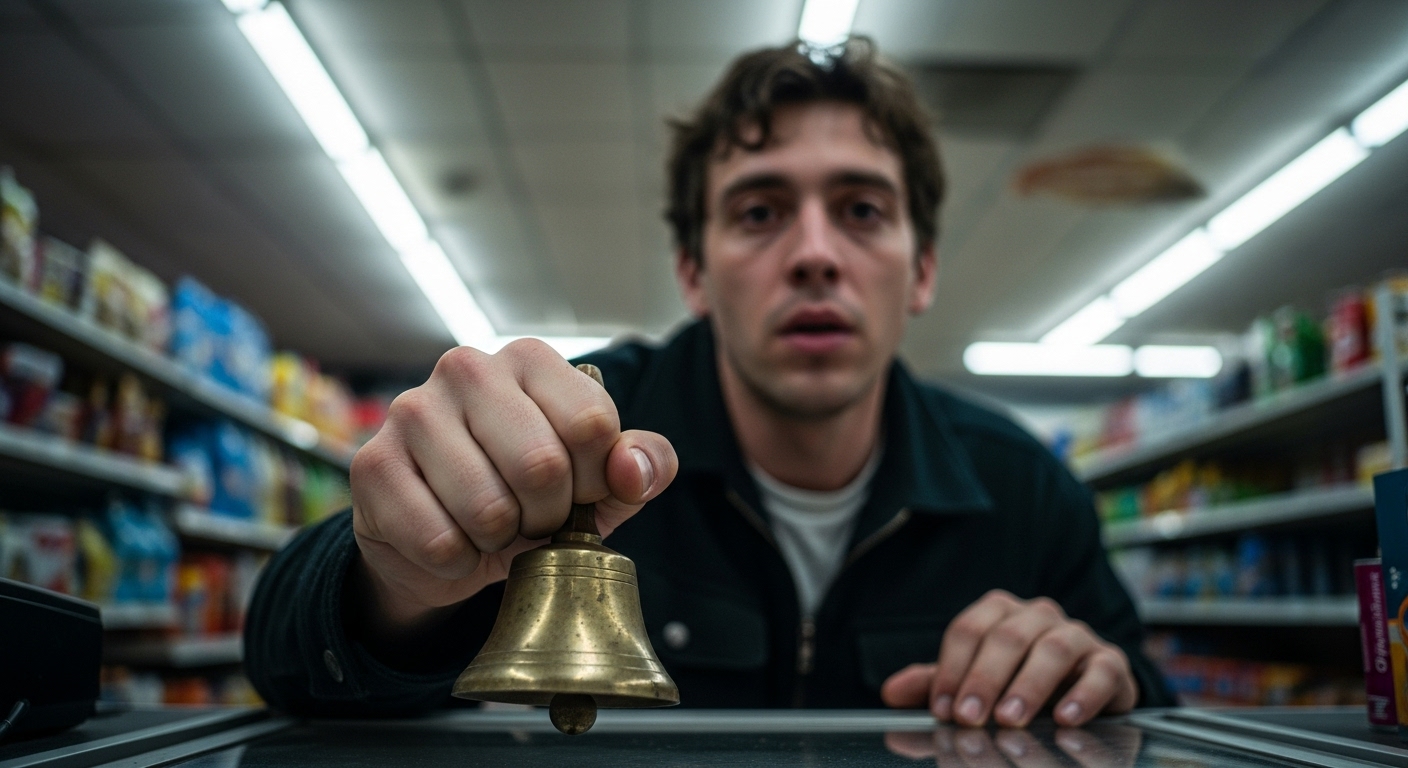
Larry looked at the small, dark bell in his palm, feeling a coldness spread through his fingers. He suddenly knew, with a certainty that thrummed in his bones, that the bizarre tales weren't just passing whispers; they were accumulating, gathering in this very spot, and he, with this forgotten bell in his hand, might be the next thing to be picked up.
Share This Story


