A Shimmer on Selkirk Avenue
The asphalt shimmered under the kind of August sun that baked the very oxygen out of the air, leaving it thin and tasting faintly of exhaust and dry earth. Even the pigeons, usually brash, huddled in the meagre shade of a leaning power pole, their beady eyes half-closed. Selkirk Avenue, usually a cacophony of truck brakes and shouted greetings, felt muted, stifled by the oppressive heat. My shirt, a faded cotton number from a long-forgotten fishing trip, already stuck to my back, a clammy testament to the relentless summer.
"Honestly, Moira," I wheezed, adjusting my glasses and wiping the sweat from my brow with the back of my hand, "this heat's a conspiracy. My knees ache just contemplating the air." A bead of perspiration, thick and annoying, crawled down my temple and settled perilously close to the rim of my spectacles.
Moira, perched on the chipped wooden bench across from me in the sliver of shade offered by a struggling elm, merely snorted. She looked remarkably unbothered, her silver hair pulled back in a severe bun, defying the humidity. "Perhaps, old man, it's less conspiracy and more the inevitable consequence of a failing system. Like your memory. Did you bring the rye bread?"
I patted my tattered canvas bag. "Rye bread, dill pickles, and a fresh grievance against the elements. A full kit." My knee popped audibly as I shifted, a small, painful reminder of the decades ticking by. My hip felt like it was trying to escape my body, a dull throb that had been a constant companion since June.
"The elements, Elias, are merely reacting to neglect," she said, her gaze sweeping over the parkette. Her eyes, sharp as a hawk's, missed nothing. She paused on a patch of grass where dandelions, in a violent burst of yellow, seemed to push through the concrete with a shocking ferocity. They weren't just growing; they were proliferating, like a golden, botanical uprising. "Have you noticed the dandelions? They're practically organised. And the humidity, it's… thick. Not just humid. It feels like the air itself has forgotten how to breathe out."
I had noticed. My small patch of lawn, usually a tame affair of scruffy grass and a few persistent crabapples, had been taken over. It was a fuzzy, yellow carpet, each flower seemingly larger, brasher than the last. And the heat, God, the heat. It wasn't merely hot; it felt like the sun itself had settled directly over the North End, refusing to move. Every breath felt like inhaling a warm, damp sponge.
"The Great Procrastinator," I muttered, reaching for a pickle from the container between us. The brine stung a small cut on my finger. "The lazy sod has finally decided to check out. Left his duties to fester."
Moira nodded slowly, a rare moment of agreement. "Indeed. Our venerable, if perpetually lethargic, river sprite. He's usually just… slow. But this? This is outright abandonment. His slumber is usually the city's gentle hum; now it's a silent scream. The lack of active procrastination means the 'Verdant Scourge' and the 'Suffocating Haze' have free rein."
The 'Great Procrastinator' wasn't exactly a deity. More a local administrative spirit, one of the many forgotten, quirky entities that supposedly kept inner-city Winnipeg's peculiar balance. He was responsible for the pleasant lethargy of summer afternoons, the kind of heat that made you want to nap rather than toil. He ensured that even the most determined weeds took their sweet time, and that the Red River's flow maintained its specific, slightly muddy languor. His 'magic' was, in essence, managed inaction. Now, it was just… inaction. Complete, unmitigated.
"So, the usual rigmarole?" I asked, taking a bite of the pickle. It was crisp, sour, a welcome shock to the tongue. "We find the missing trinket, make a fuss, maybe leave a plate of bannock by the riverbank?"
"The usual rigmarole, Elias, but with a heightened sense of urgency and your customary grumbling," Moira retorted, a thin smile playing on her lips. "Bartholomew's Tarnished Spoon. That's the key."
Bartholomew. My stomach dropped a little, a familiar, unwelcome pang of loss. Bartholomew was another of our lot, a 'Weaver' of the urban energies, much like Moira and I. He'd passed last spring, quietly, in his sleep. A good way to go, I supposed, but it left a hole in our small, dwindling council of city guardians. He'd always been the one to keep the Procrastinator in line, mostly by telling him bad jokes and leaving him specific, shiny lures by the water's edge.
"His fishing lure?" I almost choked on my pickle. "The one he swore caught only carp with existential dread?"
"The very same. It's not just any lure, Elias. It's a focus. A particularly dull, scratched focus, but potent. Bartholomew spent decades imbuing that bit of tarnished metal with enough passive-aggressive energy to keep the Procrastinator content. Without it, the spirit's just… unchecked idleness."
"Right," I sighed, pushing myself up from the bench, my bones protesting like an old boat creaking against a dock. "So, we're off to Bartholomew's place. I suppose his nephew, the one who tried to sell me a 'vintage' eight-track player last month, will be thrilled to see us. Or more likely, will accuse us of trying to swipe his inheritance of mouldy golf clubs."
Moira stood, brushing invisible crumbs from her skirt. "Details, Elias. The city, as ever, depends on our eccentricities." She looked at me, a flicker of something genuinely warm in her eyes. "It's good to see you moving, though. Thought this heat had finally cemented you to your armchair."
"Don't tempt fate," I grumbled, already feeling the full assault of the sun again as we stepped out of the elm's shade. The air immediately thickened around me, clinging to my skin, making my cotton shirt feel like a wet compress. A bus rumbled past, exhaling a cloud of black diesel fumes that momentarily choked the humid air. I coughed, a dry, rasping sound.
We walked, Moira with her brisk, determined stride, me shuffling a little, my gaze fixed on the uneven pavement. The cracks in the sidewalk seemed wider, deeper, as if the concrete itself was giving up the ghost. I squinted against the glare, the sheer brightness of the summer afternoon a physical weight. The houses we passed were mostly old, their paint peeling like sunburnt skin, their small, defiant gardens choked with the rampant yellow of dandelions. Some had little plastic flamingos, bleached pale by too many summers.
My mind wandered, as it often did these days, to other summers. Summers when the city's hidden pulse felt stronger, less fragile. When Bartholomew would cackle about catching a 'philosophical perch' or when we'd actually gather, all of us, on the riverbanks, not just to perform our strange, antiquated duties, but to share stories, to drink lukewarm beers, to simply be. Now, it was just Moira and me, two old relics trying to patch up a city that barely remembered their existence, let alone their purpose.
"Mind that pothole, Elias," Moira's voice cut through my reverie, crisp and practical. "Don't want you tumbling into another dimension before we've even reached the North End."
"Hardly a dimension, Moira, just a broken ankle," I retorted, carefully sidestepping the deep cavity. A car sped past, splashing muddy water from a recent downpour that hadn't quite evaporated from a previous dip. The driver, a young fellow with a baseball cap on backwards, blared his horn for no discernible reason. Kids on bikes zipped by, oblivious to the heat, their laughter sharp and clear.
The Unlocking of Dusty Air
Bartholomew's house was a testament to his particular brand of organised chaos: a leaning, two-story structure on a quiet, tree-lined street off McGregor. The porch steps sagged under their own weight, and the screen door had a tear in the mesh, repaired crudely with duct tape. A sign, hand-painted years ago, still hung crookedly by the front door: 'Gardening Advice - Free (But bring snacks)'.
"Ah, the temple of clutter," Moira murmured, stepping over a rogue garden gnome missing an eye. The air here was thicker, heavy with the scent of old wood, dust, and something vaguely floral, perhaps dried potpourri that had long since given up its ghost. A fly buzzed lazily against the glass of the storm door.
We tried the front door. Locked, naturally. Bartholomew had always been paranoid about squirrels. "Right," I said, testing the doorknob again, just in case. "The shed, then. He always kept his 'special' fishing gear in the shed, away from prying eyes and Agnes."
Agnes. Just saying her name out loud felt like an incantation for bad luck. Agnes next door, a woman whose life's mission seemed to be the cataloguing of other people's perceived failures. Sure enough, as we rounded the side of Bartholomew's house, a curtain twitched in Agnes's kitchen window.
"Afternoon, Agnes! Lovely weather for a stakeout, wouldn't you say?" Moira called out, her voice bright, saccharine. I saw Agnes's face, a pale blur behind the netting, recoil slightly. Moira had always delighted in tormenting Agnes. It was a small, petty joy, but a joy nonetheless.
The shed was at the back of the overgrown yard, a ramshackle affair of mismatched planks and rusting corrugated iron. A faint, metallic clang echoed as I pulled the stubborn latch. The air inside was stifling, oven-like, smelling of stale earth, oil, and the fainter, sweeter scent of old tobacco. Dust motes, thick and golden in the narrow shafts of light that pierced the gaps in the walls, danced a lazy jig.
"God, Bartholomew, you could have at least tidied up before you shuffled off," I muttered, wincing as I bumped my shin on a forgotten watering can. It scraped against the concrete floor, a loud, metallic grating sound that made my teeth ache. My hands, calloused and spotted with age, fumbled for the light switch that I knew, from years of experience, would be just inside the doorframe. Click. Nothing. Of course. The bulb was likely fused, or gnawed by mice.
Moira, ever practical, pulled a small, surprisingly bright LED torch from her pocket. The beam cut through the gloom, illuminating shelves laden with ancient seed packets, rusty tools, and an impressive collection of empty jam jars. Spiderwebs, thick as cotton wool, draped from the ceiling, shimmering in the torchlight.
"The fishing corner, Elias. You remember," Moira directed, her beam settling on a far wall, covered in hooks, tangled lines, and a few dusty, mounted fish that looked like they'd died of sheer boredom. A faint, almost imperceptible hum seemed to eman emanate from this corner, a ghost of Bartholomew's long-lost presence.
My eyes scanned the hooks, the boxes of ancient flies, the reels covered in a fine layer of grime. I ran a finger along a dusty, wooden rod, the varnish cracked and splintered. It felt brittle, a fragile memory. I recalled Bartholomew, hunched over this very bench, humming off-key tunes as he tied new knots, his pipe clenched between his teeth, a small, contented smile on his face.
"It should be here," I said, my voice a little rougher than I intended. "He always kept the Tarnished Spoon on that brass hook, right next to his lucky lure, the one shaped like a tiny, disgruntled beaver."
Moira's torch beam moved to the brass hook. It was empty. A small, almost invisible scorch mark marred the wood around it. The space where Bartholomew's most potent focus should have been was bare.
My heart gave a sudden, uncomfortable lurch. A cold, alien knot began to form in my gut, battling with the heat. This wasn't right. Bartholomew was meticulous about that lure. He'd never leave it unguarded, let alone simply... gone. It was like a cardinal leaving his mitre in a public washroom. Unthinkable. A thin, almost imperceptible layer of grit covered the floor where it should have been, as if something had been dragged away recently.
"Empty," Moira said, her voice devoid of its usual mirth, a rare note of genuine concern. Her brow furrowed, a network of fine lines deepening. The air in the shed, already thick, suddenly felt heavier, the silence amplifying. Even the buzzing fly seemed to have quieted.
---
I ran my hand over the empty hook again, the brass cold under my touch. It wasn't just gone. The scorch mark, faint but undeniable, told a different story. And then I noticed the faint, almost invisible trail in the dust on the floor, leading not out the shed door, but towards a narrow, dark crack in the far wall, where the old planks met the crumbling foundation. A crack that had certainly not been there when Bartholomew was alive, nor when I'd helped him patch the roof last autumn. It looked as if something had forced its way through, leaving behind a subtle, unsettling residue, smelling faintly of ozone and something cloyingly sweet, like decaying lilacs. It was a smell I recognised, a smell that made the hairs on my arms stand on end. The Great Procrastinator wasn't just dormant. Something had come for his focus. And if that wasn't unsettling enough, a low, rhythmic thrumming began to vibrate through the very floorboards beneath my feet, growing louder, deeper, emanating from the cracked foundation and into the suffocating, summer air outside.
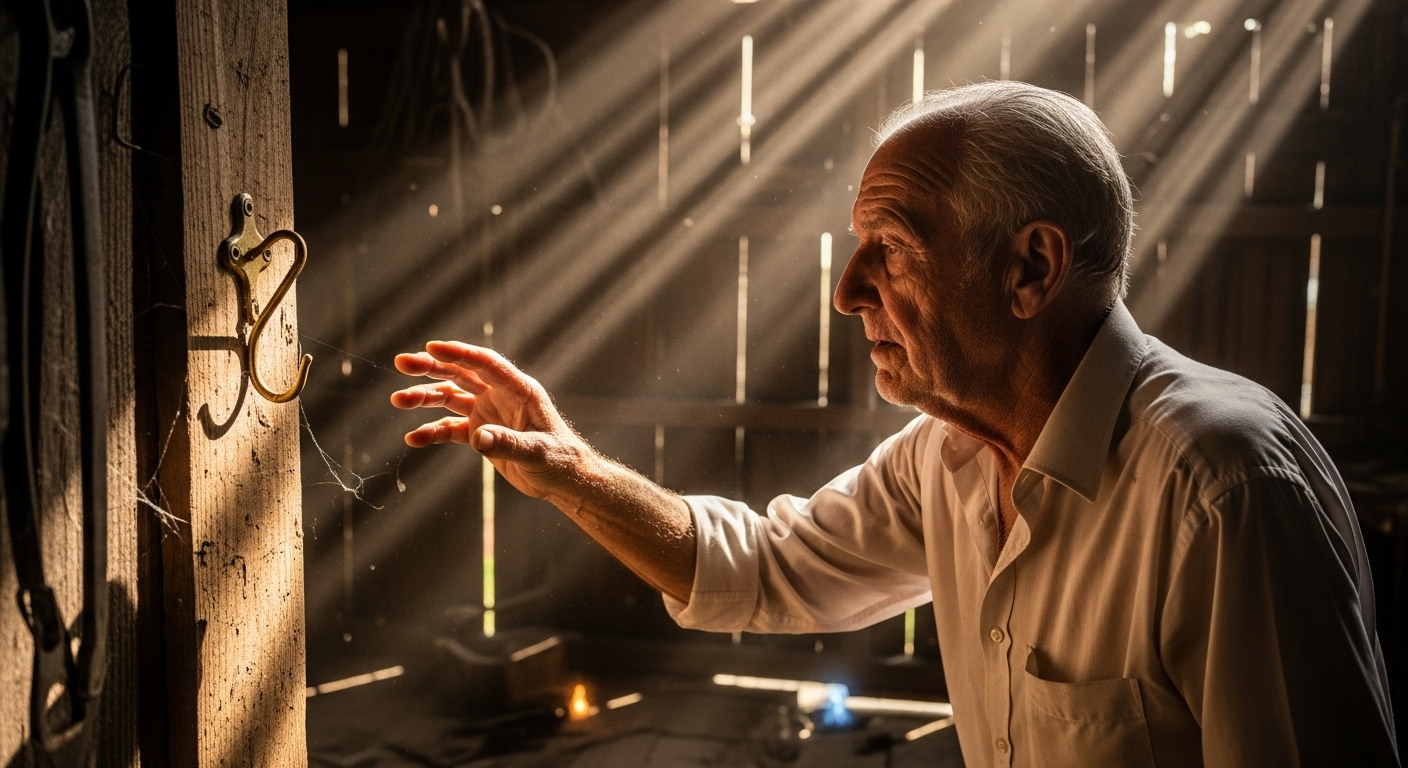
The Great Procrastinator wasn't just dormant; his focus was gone, taken by something that smelled of ozone and decaying lilacs. And now, a low, rhythmic thrumming vibrated through the ground, announcing a presence far more unsettling than mere urban sloth.
Share This Story


