The Intrusion
Deven wakes to find a massive tree root has breached the foundation of his minimalist family home, disrupting his carefully curated isolation.
The Intrusion
The root should not have been there. It was a biological impossibility, a thick, gnarled artery of wood pulsing silently in the centre of the living room. Deven stared at it from the sofa. He had been staring at it for three hours, or perhaps three minutes; the elastic nature of the morning made it difficult to be sure. The room was a study in aggressive minimalism—polished concrete floors, glass walls, furniture that looked uncomfortable and cost more than a car—and the root was an insult to it all. It had erupted through the grey slab without creating dust or rubble, as if the concrete had simply turned to water to let it pass and then solidified again around the bark.
Deven blinked. His eyelids felt like sandpaper. He wanted to get up and touch it, to verify that he hadn't finally snapped, but his legs were filled with lead. Not metaphorically. He could feel the heavy, dense metal replacing the marrow in his femurs. This was the paralysis. The familiar, warm bath of static that kept him pinned to the beige linen cushions while the world outside the glass walls exploded into a violent, churning spring.
Outside, the garden was screaming with life. Rhododendrons were bursting open like pink wounds, and the grass was growing so fast he imagined he could hear the friction of the blades rubbing together. But inside, everything was cool, grey, and dead. Except for the root.
It was dark, almost black, covered in wet soil that smelled of iron and rot. It looked like the arm of a buried giant reaching up for air. Deven shifted his weight, and the sofa creaked, a lonely sound in the cavernous room. He needed to pack. The boxes were stacked in the corner, flat and brown, accusatory. He needed to call the estate agent. He needed to shower. He needed to eat something other than dry toast.
Instead, he watched the root.
It twitched. A tiny movement, like a flinch. Deven felt a corresponding thud in his chest. He closed his eyes, hoping that when he opened them, the floor would be smooth again, the seamless expanse of the 'modern masterpiece' his grandfather had built to erase the family’s messy history. A house designed to have no corners for ghosts to hide in.
He opened his eyes. The root was thicker now. A pale green shoot was curling off the side.
---
The Sister
The sound of the front door unlocking was sharp, a physical blow to the quiet. Deven didn't move. He couldn't. The lead in his legs had spread to his stomach. He heard the jingle of keys, the scuff of boots on the mat, and then the rapid, staccato rhythm of Bea’s walk. She didn't walk; she marched. She was a force of kinetic energy that made Deven feel even more like a statue.
"Deven? You in here? God, it’s freezing. Why is the heating off?" Bea came around the corner, carrying two coffees and a bag of pastries that was already greasing through the bottom. She stopped. She looked at the boxes in the corner. Then she looked at him.
She didn't look at the root.
"You haven't... Si, you haven't done anything," she said, her voice dropping. It wasn't a question. She set the coffees down on the low table, right next to where the root had cracked the floor. She stepped over the root to get to him.
"I... I was going to," Deven managed. His voice was rusty, a hinge that hadn't been oiled in years. "Just... woke up late."
"It's noon," Bea said, unwinding her scarf. She smelled of cold rain and exhaust fumes. Real smells. "The movers are coming tomorrow. You know that, right? We talked about this. Tuesday. Movers. Tuesday."
"I know. I just..." Deven looked at the root. It was pulsing again, a slow, rhythmic expansion and contraction. "Do you see that?"
Bea followed his gaze. She frowned, squinting slightly. "See what? The floor? Yeah, it’s filthy. We need to mop before the inspection. God, did you spill something? It looks like mud."
"It's a root, Bea. It's a tree root coming out of the floor."
She laughed, a sharp, brittle sound. "Very funny. Metaphorical roots. We're uprooting you, I get it. Very poetic. Here, drink this." She shoved a paper cup into his hand. It was hot, scaldingly so. The pain was grounding. "I'm not doing this for you, Deven. I can't. I have the shift at the hospital at four, and mum is blowing up my phone about the auction items, and I just... I can't pack your socks for you."
"I'm not asking you to," he whispered. The steam from the coffee hit his face. "I'm stuck, Bea. I can't... I don't know how to start."
Bea sighed, the sound of a tire deflating. She sat down next to him, the sofa dipping under her weight. She picked at a loose thread on her jeans. "It's just boxes, Si. You put the thing in the box. You tape the box. You move the box. It’s not physics. It’s just... motion."
"It feels like physics," he said. "It feels like gravity is different in here."
"It's the house," she said, looking around the empty, glass-walled room. "This place. Grandad loved it, but it’s... it’s a vacuum. It sucks the air out of you. That’s why we’re selling. So you can go somewhere with, I don't know, wallpaper. Curtains. Oxygen."
Deven looked back at the root. A small, white flower was pushing its way out of the green shoot. It unfolded with a wet pop that only he seemed to hear. "I think the house is trying to keep me," he said.
Bea stood up, brushing crumbs off her lap. "The house is a pile of glass and overpriced concrete. Come on. Kitchen. We start with the cutlery. Small things. You can do small things."
She walked away, her footsteps echoing. She stepped right through the thickest part of the root. Her boot passed through the wood like it was smoke, but Deven saw the bark shiver where she touched it. It was real for him. Only for him.
---
The Weight of Smoke
He didn't follow her. He couldn't. The distance to the kitchen felt like miles. A tundra of grey floor. He leaned forward, the coffee cup trembling in his hand. A drop of brown liquid spilled over the rim and fell. It hit the floor and didn't splash. It was absorbed instantly by the concrete.
The flower on the root had fully opened. It wasn't a normal flower. The petals were jagged, grey and papery, like ash. And then the smell hit him.
It wasn't the smell of a flower. It was the smell of pipe tobacco. Rich, sweet cherry tobacco. The specific brand his grandfather used to smoke in the garden shed, away from the pristine, smoke-free interior of the main house.
Deven’s chest tightened. The paralysis shifted, changing from a heavy weight to a tight, constricting band. This wasn't just depression; it was haunting. The family saga wasn't written in books; it was written in the architecture, and now the architecture was bleeding.
"Deven!" Bea called from the kitchen. The clatter of silverware. "I'm starting! If you don't come help, I'm throwing all the forks in the bin!"
He tried to stand. He pushed his hands against his knees. His knuckles turned white. Move, he told himself. Just move one leg.
His brain sent the signal. The nerve fired. But the muscle didn't respond. It was as if his legs belonged to someone else, someone dead. He stared at the root. The ash-flower was vibrating. A wisp of actual smoke curled up from its centre.
"I can't," he said to the empty room. It came out as a whimper. "I can't do it."
The room seemed to darken, the spring light outside dimming as if a cloud had passed over the sun. But the sky was blue. The darkness was internal, leaking out. The root grew another inch, sliding across the floor with the sound of grinding stone.
It was heading for him.
This was it. The choice. He could stay on this sofa, let the moss grow over him, let the root wrap around his ankles and pull him down into the foundation, become just another secret buried under the minimalist floorboards. It would be easy. Peaceful, even. No more boxes. No more expectations. Just silence and the smell of cherry tobacco.
Or he could move.
He looked at the coffee cup. He looked at the root. The root was ugly. It was messy. It was life, raw and unfiltered, breaking the clean lines of his denial. His grandfather had built this house to hide from the mess of life, and Deven was using it to hide from the mess of himself.
"Bea!" he yelled. It was loud. Too loud. His voice cracked.
The clattering stopped. "Yeah?"
"Don't... don't throw the forks away."
"Then get your arse in here!"
Deven looked at the root. It was inches from his foot now. He could feel the heat radiating from it. It wasn't cold like the floor; it was fever-hot. He took a breath. The air tasted of wet dirt and old smoke.
He didn't try to stand. That was too much. Instead, he slid off the sofa.
He hit the floor with a thud. His hip bone cracked against the concrete. Pain. Good. Pain was a signal. Pain meant nerves were working.
He lay there for a second, cheek pressed against the cold floor, eye-to-eye with the root. Up close, the bark wasn't black; it was a deep, bruised purple. He could see veins pulsing under the wood.
"You're not real," he whispered to it. "You're just... fear."
The root didn't answer, but the smoke from the flower blew into his face. He coughed.
He reached out. His hand shook, tremors running up his arm like electricity. He stretched his fingers toward the flower. If he touched it, maybe it would disappear. Maybe it would burn him.
His fingertip brushed the ash-petal.
It crumbled instantly. But beneath the ash, there was something sharp. A thorn. It pricked his finger. A tiny bead of blood welled up, bright red against the grey dust.
The shock of it—the sharp, stinging reality—cleared the static in his head for one second. Just one second. But that was enough.
He pushed himself up. His arms shook, his triceps screaming at the effort, but he pushed. He got his knees under him. He was on all fours, panting like a dog.
"Deven?" Bea was in the doorway. She was holding a bundle of spoons.
He looked up at her. He was on the floor, bleeding from his finger, next to a hallucinated root that was cracking the foundation of their inheritance.
"I'm up," he croaked. "I'm... up."
Bea didn't ask why he was on the floor. She just looked at him, her expression softening. A tiny, sad smile quirked her lips. "Okay. You're up. That's... that's good, Si. That's a start."
She turned back to the kitchen. "I found the silver polish. It's dried out, but we can spit on it."
Deven stayed on his hands and knees for a moment longer. He looked at the root. It hadn't disappeared. The thorn was still there, coated in his blood. The root had stopped growing, but it hadn't retreated. It was part of the room now. A scar on the perfection.
He forced one leg forward. Then the other. He stood up. The blood rushed from his head, making him dizzy, but he stayed vertical. He swayed, catching his balance.
He looked down at the crack in the floor. The root was still pulsing, slow and steady, like a sleeping animal. He stepped over it.
He walked toward the kitchen. It was a clumsy walk, his legs feeling like they were made of wood, but he was moving. He was moving forward, leaving the perfect, empty room behind for the noise of the kitchen.
Behind him, the root settled. It seemed to exhale. A second flower began to bud, silent and unseen.
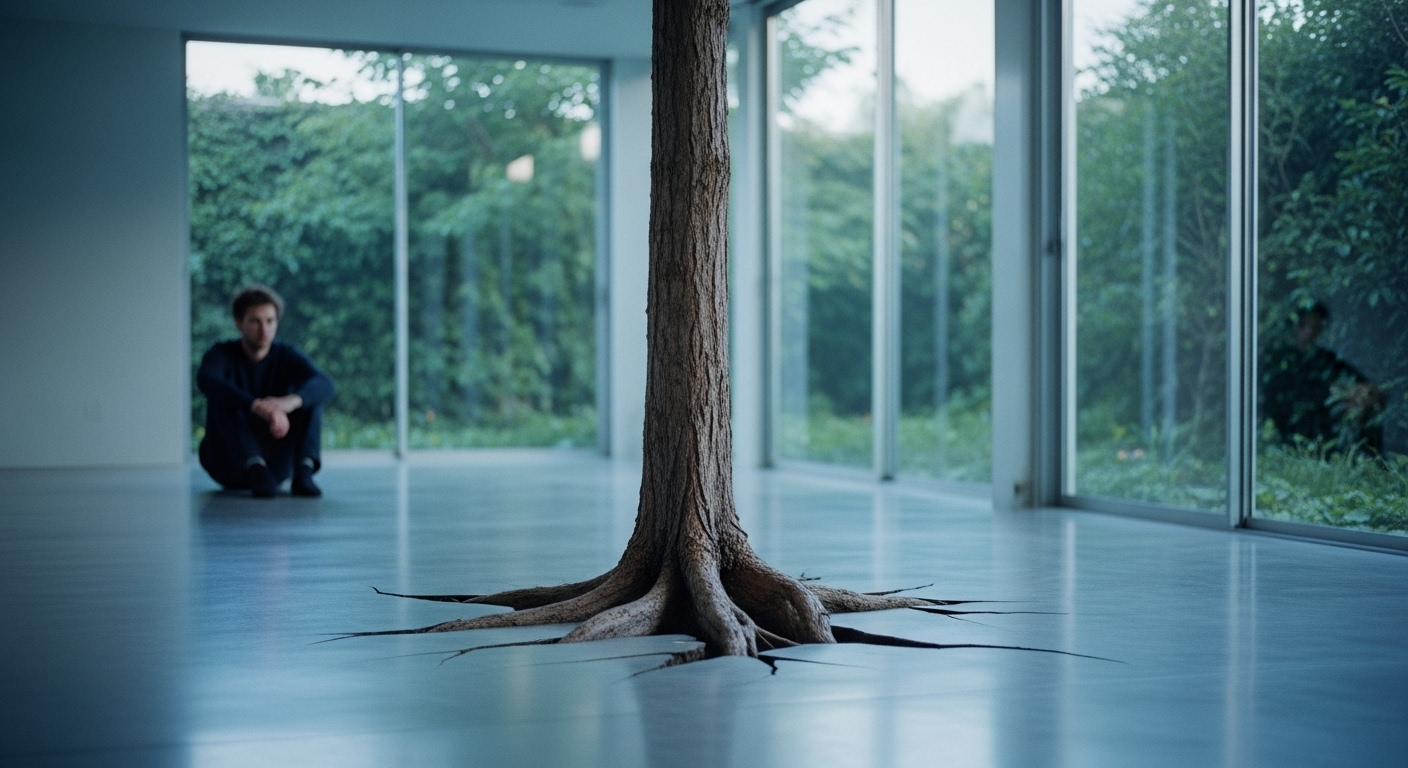
He didn't see the hairline fracture running from the base of the root to the load-bearing wall, nor the way the glass pane vibrated, just once, like a tuning fork struck in the dark.
Share This Story


