The Unveiling of Coated Grain
A biting spring morning unfurls over 'The Verdant Citadel,' an intentional community cobbled together from salvaged timber and earnest, if misguided, ambition. The air, crisp with the scent of thawing earth and nascent growth, carries a faint undercurrent of woodsmoke and damp soil. A small gathering has convened in the central clearing, a patch of churned mud still battling the last vestiges of winter's chill, all eyes fixed on a canvas-draped crate that promises, or so the rhetoric insists, a new dawn.
The crate arrived precisely at dawn, borne aloft by four individuals whose faces were scrubbed clean of sleep and smeared with a reverent sort of grime. It wasn't particularly large, barely a metre square, yet it was treated with the solemnity usually reserved for enshrined relics. 'The Arbiter of Verdant Futures,' a man whose natural pomposity was amplified by a hand-woven tunic and a truly magnificent beard, began the ritualistic unwrapping. The canvas, a rough hessian, was slowly, excruciatingly peeled back, corner by corner, to reveal not a golden idol or a tome of ancient wisdom, but a standard, industrial-grade cardboard box, slightly scuffed at the edges. Sylvain, leaning against a particularly wonky compost bin, watched the entire spectacle with an expression that aimed for detached amusement but probably only achieved profound teenage boredom.
He'd been here for three months, having absconded from a life of manicured lawns and relentless parental expectations, hoping to find something 'real.' What he'd found instead was a different flavour of performance, a commune that had traded corporate jargon for ecological cant, and designer labels for aggressively hand-stitched garments. The constant, almost evangelical insistence on 'authenticity' here was, ironically, the most artificial thing about the place. Every action, every utterance, felt carefully curated for an invisible audience of ethical purists. His initial, romanticised notions of pastoral simplicity had evaporated faster than morning mist under the Arbiter's relentless pronouncements.
The box, now fully exposed, bore the label 'Agri-Corp Global: New World Seeds – Drought Resistant Varietals.' A collective gasp rippled through the small assembly. Agri-Corp Global, the very antithesis of everything 'The Verdant Citadel' supposedly stood for, was the source. The Arbiter, momentarily nonplussed, quickly regained his oratorical footing. 'Behold!' he boomed, gesturing dramatically. 'Even from the belly of the beast, we extract sustenance! This, my friends, is not capitulation, but reclamation! We shall purify these seeds with our intent, imbue them with our spirit of defiance, and grow not just crops, but a revolution!' A smattering of earnest applause followed, punctuated by a few heartfelt 'Huzzahs!' Sylvain merely shifted his weight, a faint, metallic tang of irony on his tongue.
The Weight of a Sprout
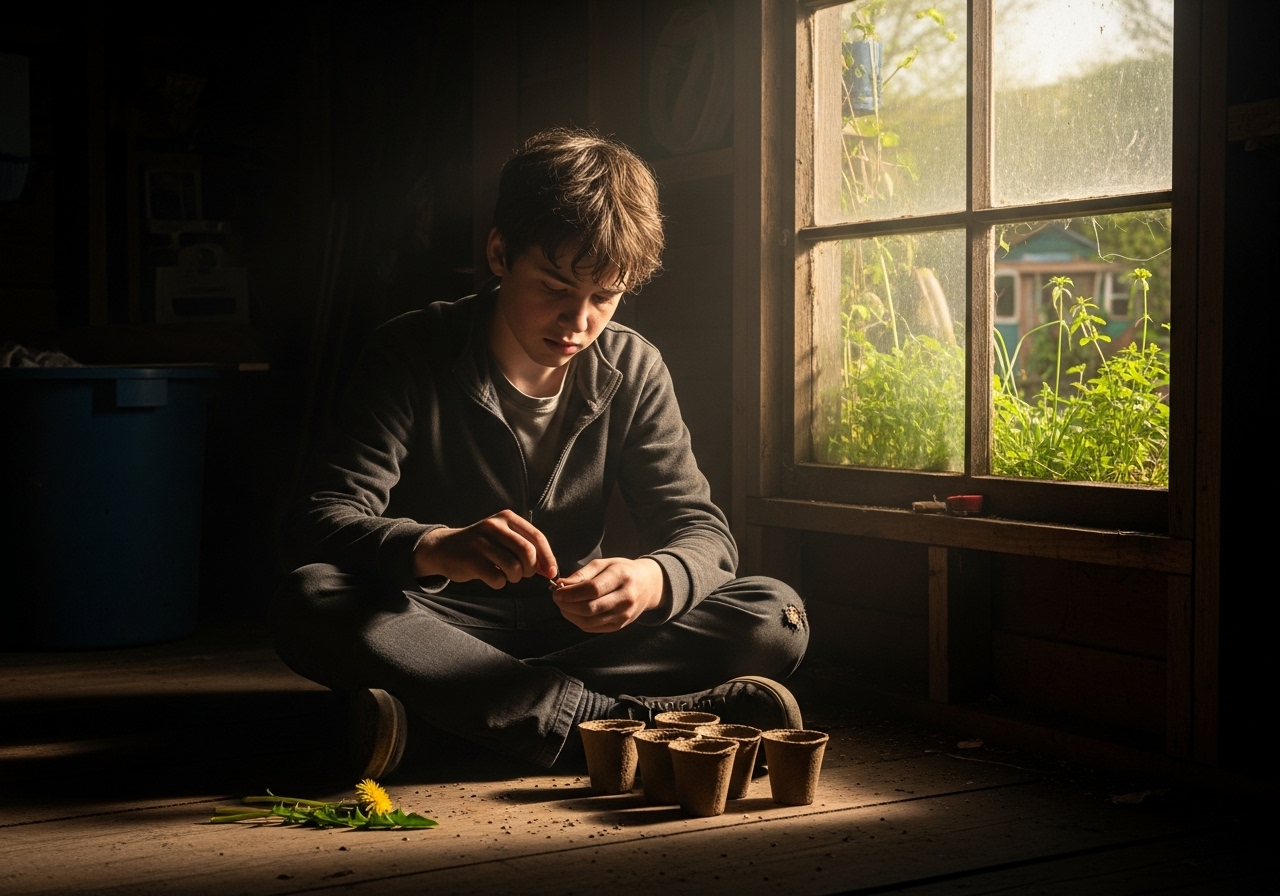
His task, when the morning's sermon finally concluded, was to sort the 'New World Seeds' into individual, hand-pressed peat pots. Thousands of them. The sheer, soul-crushing monotony of it threatened to eclipse even the Arbiter’s most convoluted metaphors. He sat cross-legged in a dusty, sun-dappled shed, the air thick with the smell of damp soil and something vaguely herbal – probably patchouli. Each seed, no larger than a peppercorn, felt like a minuscule weight of contradiction in his palm. He was told to 'handle each with conscious intention,' a phrase that, after the first hundred, became a hollow echo in his skull. The instructions, handwritten on a scrap of recycled paper, specified a precise depth, a particular compaction of soil, and a specific incantation to be silently recited. Sylvain settled for a string of colourful expletives, muttered under his breath.
The shed door creaked open, admitting a sliver of brighter spring light and the angular silhouette of Aspen. She was a year older than him, with hair the colour of dry wheat and eyes that seemed permanently fixed on some distant, hopeful horizon. She carried a basket of freshly picked dandelion greens, their vibrant yellow a stark contrast to her own muted, hand-dyed garments.
---
'Still at it?' Aspen's voice was soft, almost a murmur, yet it cut through the drone of Sylvain’s internal monologue. She moved with an easy, fluid grace that made him feel even more gangly and awkward.
Sylvain grunted, picking up another seed. 'Looks like it.'
She set the basket down. 'The Arbiter says these will be our strongest yield yet. A testament to our resilience.' Her eyes, usually so bright, held a fleeting shadow of something Sylvain couldn’t quite place – doubt, perhaps, or just profound weariness.
'Right,' Sylvain muttered, pressing a seed into the peat. 'From the company that paved over the last five ancient forests.'
Aspen knelt beside him, her fingers tracing the edge of a pot. 'It's about transformation, Sylvain. Taking what’s… polluted, and making it pure.' Her voice was earnest, almost pleading, as if trying to convince herself as much as him.
'Sure,' he said, not looking up. 'Like turning a pig into a philosopher, just by changing its diet.'
A small, almost imperceptible sigh escaped her. 'You don’t believe in any of it, do you?'
He paused, a seed suspended between his thumb and forefinger. 'I believe in compost. And maybe… maybe not believing in anything too hard. That’s usually where the trouble starts.' He didn't elaborate, the words feeling too heavy, too revealing, for the minimalist script they adhered to. She said nothing more, just watched him for a long moment before rising, her silence a dense weight between them. She left the dandelion greens, a small, vibrant mound on the dusty floor, and disappeared back into the relentless spring sunlight.
The Sermon on the Soil
Later that afternoon, the Arbiter gathered everyone again, this time by the fledgling orchard, where struggling saplings bowed in the gentle breeze. He spoke of 'symbiotic relationships' and 'conscious consumption,' his voice resonating with a practiced gravitas. The air was thick with the scent of damp earth and the sweet, almost cloying perfume of early blossom. He gestured expansively, his gaze sweeping over the assembled 'citizens' – a term he’d recently adopted, much to Sylvain's internal chagrin. 'Each seed,' he declared, 'is a promise. A covenant with the future. A rejection of the mechanistic, the synthetic, the soulless! We are weaving a new tapestry of existence, fibre by organic fibre!' He paused for dramatic effect, allowing the gentle rustle of leaves to underscore his pronouncements. Sylvain caught sight of a large, unopened packet of store-bought organic fertiliser tucked behind a pile of carefully arranged stones near the Arbiter’s feet, a brand Sylvain recognised from his old life. The irony was so stark, so utterly predictable, it almost made him laugh. Almost.
He continued sorting the seeds, his fingers growing stiff, the earthy smell now clinging to his clothes and skin. The commune was supposed to be an escape from the hypocrisy, from the relentless performativity of modern life, but it felt like he’d simply swapped one set of absurd rules for another. Here, the currency wasn't money but virtue signalling, the competition not for promotions but for who could appear the most 'aligned' with their utopian ideals. He remembered his father, a man obsessed with appearances, meticulously tending his rose garden while secretly fuming over property taxes. The Arbiter, with his grand pronouncements and hidden fertiliser, was just a different kind of gardener, cultivating a different kind of image.
The sun began its slow descent, painting the western sky in hues of soft orange and bruised purple. A chill seeped into the shed, reminding Sylvain that even in spring, the nights retained a bite. He finished the last pot, placing it carefully in a tray with its thousands of identical brethren. The quiet hum of the commune settling for the evening, punctuated by the distant bleating of the goats and the occasional hoot of an owl, filled the air. He’d walked away from everything, from the drone of city traffic, the incessant digital notifications, the curated perfection of social media feeds. He’d craved something raw, untamed, unpretentious. And yet, here he was, meticulously enacting a ritual of contrived authenticity, sorting genetically modified seeds from a global corporation, all under the auspices of a man who preached purity while hiding synthetic nourishment.
The spring wind, cool and insistent, found its way through a crack in the shed wall, rustling the loose pages of the seed-sorting instructions. He picked up one of the dandelion greens Aspen had left, its stem still firm, its colour stubbornly vibrant. He considered his choices, the grand gesture of leaving, the hopeful ideals he’d carried like fragile eggs. He looked at the row of peat pots, each a tiny, dark mound containing a promise he wasn't sure he believed in anymore. He didn't know if this was supposed to feel like freedom, or merely a different, more complicated cage. The fading light cast long, distorted shadows across the shed floor, making the mundane objects take on strange, unknowable forms.
He was tired. The spring, bursting with its loud, insistent promise of renewal, felt heavy. He looked at the dandelion, then crumpled it, letting the faint bitter scent cling to his fingers. The silence in the shed stretched, vast and unyielding, reflecting a quiet, unwelcome truth. He had fled one world, only to find another where the echoes of absurdity simply wore a different costume.
---
As the last sliver of light vanished, Sylvain realised he hadn't truly escaped; he had merely traded one elaborate charade for another, leaving him to wonder if genuine freedom was an illusion or simply something he hadn't yet been cynical enough to find.
Share This Story


