Metric Tonnes of Silence
The family gathers in a hyper-modern, sterile living room to decorate a sparse Christmas tree, battling over the conflicting desires for aesthetic perfection and sentimental chaos.
The tree was dead. Not in the biological sense—it was a frantic, terrifyingly expensive noble fir flown in from a sustainable, high-altitude nursery in Norway—but it was dead in spirit. It stood in the centre of the living room, a room that felt less like a home and more like a waiting area for a high-end dental surgery. The walls were polished concrete. The floor was poured resin, the colour of a heavy overcast sky. The furniture was low, angular, and uncomfortable, upholstered in a fabric that felt like recycled oat sacks.
Julianne stood before the tree, her arms crossed, evaluating the needle density. She wore a cashmere loungewear set in a shade the catalogue called 'Oyster,' which was indistinguishable from the walls, the floor, and, frankly, her own pallor. She looked like she was camouflaged for a war in a fog bank.
"It’s aggressive," she said. Her voice didn't echo; the room was acoustically treated to absorb life.
David, sitting on the edge of the sectional sofa, swirled his gin. It was 2:00 PM on a Saturday. "It’s a tree, Jules. It’s nature. Nature is aggressive. That’s why we live indoors."
"The symmetry is off," she murmured, stepping closer, her socks making no sound on the resin. "The negative space on the lower quadrant is… cluttered. We need to prune."
"Please don't prune the sixty-dollar-a-foot tree," David said, tiredly. He took a sip. The gin was cold, sharp, and tasted of juniper, the only plant life he actually enjoyed interacting with lately.
Julianne ignored him. She was already mentally calculating the lumens. The lighting scheme this year was 'Arctic Dusk.' Last year it had been 'Industrial Dawn,' which had mostly involved Edison bulbs that got so hot they scorched the pine needles. This year, they were going for LEDs so cool they registered as blue on the Kelvin scale. It was going to look like the tree was being interrogated by the FBI.
"Where are the children?" Julianne asked, not turning around. She reached out and flicked a single, imperfect needle from a branch.
"Ethan is charging," David said. "Or buffering. One of the two. Sophie is in the basement getting the box."
Julianne froze. Her hand hovered over a branch. "Which box?"
"The box," David said. He felt a small, malicious thrill. "The Legacy Box."
Julianne turned slowly. Her expression was one of pained tolerance, the look of a woman who has just found a hair in her macrobiotic salad. "David. We discussed this. The theme is 'Texture and Void.' We agreed on the matte ceramic spheres and the driftwood geometric shapes. We did not agree on… plastic."
"It’s Christmas," David said, shrugging. "The kid wants to hang the things she made. You know, the memories?"
"Memories can be digitized," Julianne countered. "We don't need to physically display them. It disrupts the visual flow. I’m trying to create a sanctuary, David. A space of visual silence. How can we have silence when there is a glitter-encrusted reindeer screaming at us from the spruce?"
The Arrival of the Artifacts
Before David could argue that silence wasn't a visual medium, Sophie entered. At eight years old, she was the only splash of colour in the house, currently wearing a bright purple hoodie that Julianne had tried to donate to charity three times. She dragged a battered cardboard box behind her. It was taped shut with duct tape and marked 'XMAS JUNK' in David’s handwriting.
The box scraped loudly across the floor. It was a beautiful, jagged noise.
"I found it!" Sophie announced, breathless. "I found the baby Jesus with the missing head!"
Julianne closed her eyes for a brief second, centering herself. She inhaled through her nose, likely smelling the faint scent of eucalyptus that was pumped through the HVAC system, and exhaled. "That’s lovely, Sophie. Put the box over there. In the corner. Behind the ficus."
"No, we have to put them on the tree!" Sophie ripped the tape off. The sound was like a gunshot in the quiet room.
Ethan shuffled in a moment later. He was fifteen, lanky, and wore noise-cancelling headphones around his neck like a life support collar. He looked at the tree, then at his mother, then at the box. "Are we doing this?" he asked. "I have a raid in twenty minutes."
"We are creating a memory," Julianne said, her voice tight. "Put your phone away."
"It’s in my pocket," Ethan said, patting his grey sweatpants.
"Participate," she commanded.
Julianne walked to the side table and picked up three flat, white boxes. They were heavy, embossed with the logo of a Danish design firm that probably charged extra for the vowels in their name. She opened the first one. Inside, nestled in black foam, were six grey spheres. They looked like fossilized planets.
"Okay," she said. "Here is the plan. We start with the anchor pieces. These are hand-turned concrete, so they need to go on the sturdy branches near the trunk. David, you handle the elevation. Ethan, you hand them to him. Sophie… you can supervise."
"I want to hang the pickle," Sophie said, digging into the cardboard box.
"There is no pickle," Julianne said quickly. "The pickle is lost."
"I'm holding the pickle," Sophie said, holding up a glass ornament that looked like a diseased cucumber. It was shiny, green, and hideous. It was the most beautiful thing David had seen all day.
"That is not consistent with the palette," Julianne said, her voice rising an octave. "Green is not a neutral, Sophie. The tree is green. We do not put green on green. It lacks contrast. It lacks intentionality."
"It’s a pickle," David said, standing up. "Give it to me, Soph."
He took the ornament. It was cool and smooth. He remembered buying it at a petrol station in 2012, back when they lived in the semi-detached with the drafty windows and the carpet that smelled of wet dog. They had laughed so hard that night. He looked at the pickle, then at the tree.
"David," Julianne warned. "Don't."
"I’m just holding it," he lied.
Texture and Void
The decorating process was less of a celebration and more of a surgical procedure. Julianne directed the placement of each concrete sphere with the precision of an air traffic controller. She stood back, squinting, making hand gestures that implied 'move it three millimetres to the left'.
"The visual weight is leaning too far right," she critiqued. "Ethan, move the sphere. No, not that one. The felted wool teardrop. Yes. Up. No, down. There."
Ethan sighed, the sound loud in the silence. "It’s a ball, Mum. It’s just a ball of fuzz."
"It is sustainable alpaca wool," she corrected. "And it provides textural warmth without chromatic distraction."
David watched from the sofa, the pickle hidden in his pocket. He had been relegated to 'Observer' status after he attempted to hang a snowflake that had a hint of glitter on it. Julianne had intercepted him with a look that could have curdled milk.
Sophie was sitting on the floor, surrounded by the rejects. The plastic Santa. The red wooden soldier. The string of popcorn that was probably five years old. She was arranging them in a circle on the resin floor, a pagan ritual of kitsch.
"Can I put the star on?" Sophie asked, looking up.
Julianne froze. The topper. The issue of the topper had been a point of contention for weeks.
"We don't have a star this year, sweetie," Julianne said gently. "Stars are… traditional. We have something better."
She reached into a separate box and pulled out the object. It was a geometric structure made of welded brass rods. It looked like a model of a virus, or perhaps a caltrop designed to puncture tires. It was sharp, angular, and abstract.
"What is it?" Sophie asked, wrinkling her nose.
"It’s a spire," Julianne said. "It represents aspiration. Ascension. It catches the light."
"It looks like a cage," Ethan said.
"It’s sculptural," Julianne snapped. "David, the ladder."
David retrieved the stepladder. It was aluminium, sleek, and probably German. He set it up next to the tree. He climbed, his knees cracking audibly. He took the brass virus from Julianne.
"Be careful," she whispered. "It’s heavy."
He reached up. The top of the tree brushed the ceiling—not quite, but close. The room was twelve feet high, but the tree was eleven. The proportions were deliberate. He placed the brass shape on the delicate leader branch. The branch sagged immediately under the weight.
"It’s drooping," David said.
"Adjust it," Julianne commanded. "Bend the branch back. Use a cable tie. A clear one."
David fumbled in his pocket, not for a cable tie, but just to touch the glass pickle again for reassurance. He managed to secure the brass spire so it only looked slightly like it was crushing the tree's spirit. He climbed down.
Julianne stepped back. She put her hands on her hips. She tilted her head.
The tree stood before them. It was a masterpiece of restraint. The grey spheres hung motionless. The white wooden diamonds didn't spin. The alpaca teardrops absorbed the light. It was elegant. It was tasteful. It was utterly, profoundly depressing.
"It needs… something," David ventured.
"It needs nothing," Julianne said. "It is complete. It breathes."
"It looks like it's holding its breath," Ethan muttered.
The Macaroni Protocol
"Now," Julianne said, clapping her hands once. "Photo. Everyone, linen shirts. Now."
This was the ritual. The documentation. They changed into the matching oatmeal-coloured linen shirts that Julianne had laid out. They stood in front of the tree. Julianne set up the tripod and her phone. She adjusted the ring light.
"Ethan, headphones off. Sophie, stop fidgeting. David, suck in."
"I am sucking in," David said.
"Smile," she commanded. "But not… toothy. Just a relaxed, Sunday-kind-of-contentment. Think 'hygge'."
"I'm thinking about roast beef," Ethan said.
"Click." The phone flashed.
"One more. Sophie, put your hand on your brother's shoulder. Natural. Casual."
They posed. They were a tableau of modern success. A wealthy family in a beautiful house with a beautiful tree. If you looked closely at the photo, you might see the dead look in David’s eyes, or the way Sophie was digging her fingernails into the fabric of her trousers, but the filter would wash that out. The filter would make them look ethereal. Timeless.
"Got it," Julianne said, checking the screen. "Perfect. The lighting is exquisite."
She began to dismantle the tripod. "Okay, clean up the boxes. Sophie, put the junk back in the basement. We have guests coming tomorrow and I don't want them tripping over a headless Jesus."
Sophie looked at her pile of treasures. Her lower lip trembled. It wasn't a tantrum; it was a quiet, crushing defeat.
David saw it. He looked at the perfect, cold tree. He looked at his wife, who was already typing a caption—something about simplicity and gratitude, no doubt.
"Jules," David said. "Let her put one on."
Julianne looked up, tapping her screen. "What?"
"One ornament. From the box. Just one."
"David, we've finished. The composition is balanced."
"The back," David said. "Put it on the back. Facing the wall. Nobody will see it. The Instagram people won't see it. The guests won't see it. Just… for us."
Julianne looked at the tree, then at Sophie. She sighed, a long, suffering exhalation that seemed to deflate her perfect posture. "Fine. The back. Low down. Hidden."
Sophie didn't wait. She grabbed the macaroni star. It was a monstrosity of pasta shapes glued to a cardboard cutout, painted a violent, acrylic yellow and dusted with glitter that had long since lost its shine. It had been made in Year One. It was shedding dry pasta flakes.
She ran to the tree. She didn't go to the back. She went to the side, visible from the hallway, but obscured from the main seating area. She hung it on a low branch.
The branch dipped. The yellow clashed horribly with the grey felt. The glitter fell onto the resin floor like dandruff.
"There," Sophie said. She smiled. It was the first real smile in the room for three hours.
"Hideous," Julianne whispered, but she didn't move to take it down. She turned off the main overhead lights.
---
Later that night, the house was silent. The heating system hummed its low, expensive frequency. The only light came from the streetlamps filtering through the sheer blinds.
David came downstairs for a glass of water. He stood in the doorway of the living room.
The tree was a shadow in the darkness. The brass spire caught a glint of stray light, looking sharp and cold.
He walked over to it. He reached into the pocket of his pyjama bottoms. He pulled out the pickle.
He looked around. The house was asleep. The aesthetic police were off duty.
He found a spot, right in the centre, nestled deep near the trunk where the needles were thickest. He hung the green glass pickle. It was invisible from the outside, buried in the dark heart of the tree.
He stepped back. He couldn't see it, but he knew it was there. A secret heart. A tiny, green, store-bought soul in the middle of the void.
He took a sip of water. It tasted like metal and fluoride.
"Merry Christmas," he whispered to the empty room.
He turned to leave, but stopped. A faint reflection in the window caught his eye. It was the macaroni star, catching a beam of light from a passing car. For a second, just a microsecond, the yellow paint glowed like real gold, warm and messy and alive.
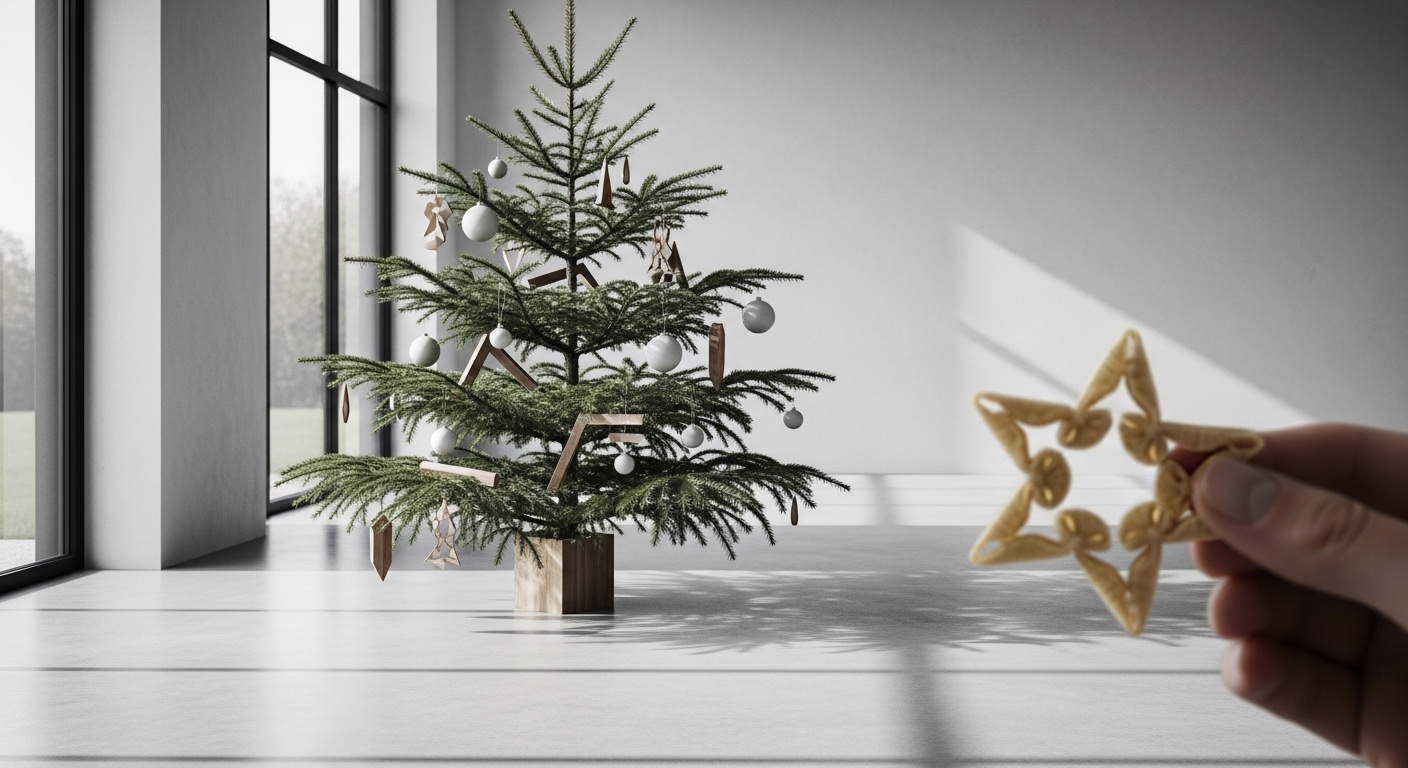
In the reflection of the darkened glass, the single red bulb seemed to burn with a quiet, chaotic heat, threatening to set the whole beige world on fire.
Share This Story


