The Frozen Sidewalk's Secret
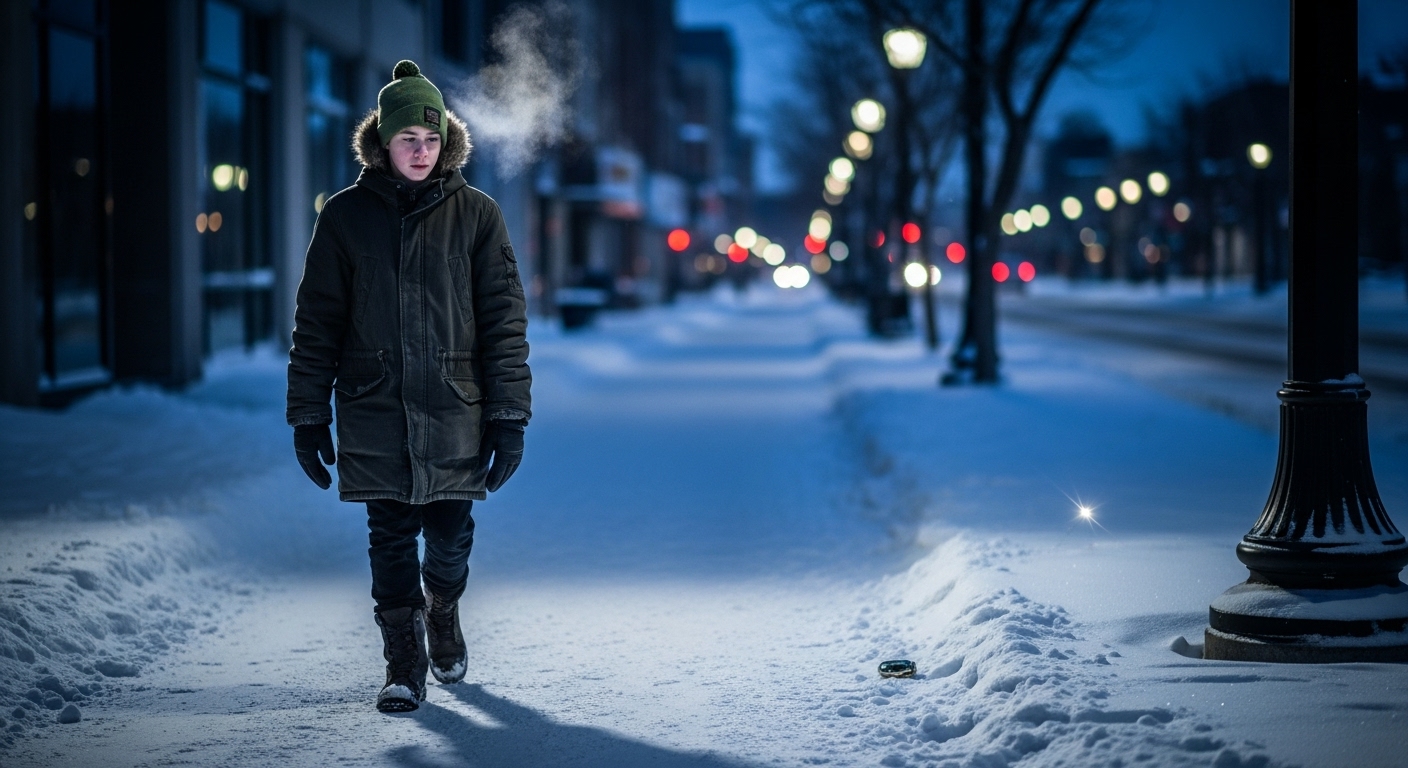
The wind howled a familiar, mournful song through the concrete canyons of downtown Winnipeg, a symphony of complaint against anyone foolish enough to be out in it. Snow, fresh and impossibly white, crunched under my boots, each step a dull, satisfying percussion against the city's muted hum. It was that peculiar hour when the last vestiges of a weak winter sun bled into the first, tentative lights of the city, painting the sky in bruise-purple and fading tangerine. My breath plumed out in thick, ephemeral clouds, and my nose, despite the scarf wrapped twice around it, felt like it might snap off. The cold here wasn't just a temperature; it was a presence, an argument against motion, against thought, against everything but the simple, desperate need for warmth. I pulled my toque lower, the rough wool scratching my forehead, trying to shut out the encroaching chill that seemed to seep into my bones, into the very corners of my mind.
I was halfway down Broadway, past the shuttered storefronts and the perpetually half-empty parking lots, when it happened. My gaze, usually fixed on the treacherous patches of ice or the hopeful glow of a Tim Hortons sign in the distance, snagged on something unusual. Not a crumpled lottery ticket, or a discarded cigarette butt, or even a lone mitten, all standard winter street detritus. This was different. A glint. A sharp, almost painful sparkle against the dull, matte white of the fresh snowfall, just under the wan light of a flickering streetlamp.
My feet, accustomed to the rhythmic plod of city walking, hesitated. My curiosity, a fickle and often inconvenient companion, tugged at me. It was probably just a bottle cap, some scrap of metal, shiny and meaningless. But the light… it caught the light in a way that felt deliberate, almost like a wink. Like something wanted to be found. A ridiculous thought, even for me, a connoisseur of the absurd.
I crunched through the untouched snow, boots sinking slightly, and knelt, ignoring the fresh bite of the cold seeping through my worn jeans. My gloved fingers, clumsy with the thick wool, brushed away the delicate layer of flakes. And there it was. Not a bottle cap. Not a scrap.
It was a key. Small, intricately wrought, with a tarnished, almost bronze-like finish. It looked ancient, or at least like it had been forgotten in a dusty attic for decades, not dropped on a freezing sidewalk in downtown Winnipeg. The head of the key was shaped like a stylized raven, its wings spread wide, its eye a tiny, almost imperceptible chip of what looked like dark glass. It was bizarre, out of place, utterly alien to the mundane street.
“What in the actual…?” I mumbled, the words puffing out in white clouds. I picked it up. It was surprisingly heavy, cool and smooth beneath my glove. There was no keyring, no tag, nothing to suggest it belonged to anyone, or anything, specific. Just this strange, avian key.
And then, like a trapdoor springing open in my mind, a memory slammed into me.
---
A Fading Picture
It wasn’t a pleasant memory. Most memories involving Manny hadn't been, not since… well, not since he decided to evaporate a year ago. It was the last time I’d seen him, actually. A grey, spitting November day, not quite winter, but cold enough to promise it was coming. We were in the cramped back room of ‘The Curio Cabinet,’ a junk shop near the Exchange District that smelled permanently of mothballs and forgotten dreams. Manny, all sharp elbows and restless energy, was rifling through a box of old lockets and discarded keys, his breath fogging slightly as he exhaled.
“Look at this, Alex!” he’d said, holding up something shiny. “This isn’t just some house key. This is… important.”
I’d grunted, more interested in a dusty first-edition of a graphic novel I couldn’t afford. “It’s a key, Manny. They open doors. Thrilling.”
He’d rolled his eyes. “You have no imagination. This is clearly a skeleton key. The kind that opens secret passages, or hidden crypts.” He’d grinned, that wild, slightly unhinged grin he got when he was onto something. “Or, you know, my locker at school.”
I remember flicking through the graphic novel, a smirk playing on my lips. “Your locker is already a crypt, mate. The smell alone could raise the dead.”
He’d ignored me, already lost in a world of his own making, turning the key over and over in his palm. It had looked old, even then. Not exactly like this one, with its raven’s head, but it had had that same sense of being a relic, something with a story etched into its very metal. We’d argued, of course. About everything and nothing. That was our dynamic. Constant, low-level bickering, punctuated by moments of grudging affection.
He'd insisted it was a sign, a clue to some grand adventure he was meant to have. I'd told him it was a piece of junk someone probably dropped getting out of their car. He’d scoffed, pocketed it, and then, a week later, he was just… gone.
No note. No warning. Just an empty room, a baffled family, and a city suddenly feeling a lot emptier.
---
Echoes on the Street
I squeezed the raven key in my hand, the metal cold and sharp even through the glove. This wasn’t the key Manny had found, not exactly. But it was similar. The same vintage feel, the same air of forgotten purpose. Too much of a coincidence? My brain, usually a whirring engine of sarcastic observations and semi-useful facts, felt suddenly bogged down, like trying to run through deep snow.
My phone buzzed, vibrating against my leg, jarring me out of my increasingly gloomy reverie. It was Sarah. Her timing was either impeccable or terrifyingly prescient, I hadn’t decided which yet.
‘Still alive out there, ice block?’ her text read. Sarah had a knack for witty assaults, even over text. It was her primary form of communication. My lips quirked into a small, cold smile. I tucked the key into my inner coat pocket, a strange weight against my ribs.
I thumbed a reply, trying to inject some of my usual dry wit, but my fingers felt stiff. ‘Barely. Pretty sure my nose just achieved sentience and fled the country.’
Her reply was almost immediate. ‘Ha. Listen, found something. You need to see this. Re: Manny’s… project.’
My thumb hovered over the keyboard. ‘Project’? What ‘project’? Manny had a million half-baked ‘projects,’ most of which involved trying to build a perpetual motion machine out of old bicycle parts or convincing me to join his band, ‘The Screaming Existentialists.’ He played a mean ukulele. But none of them had been secretive, or, more importantly, had anything to do with… keys.
‘What are you even talking about?’ I typed, my brow furrowing, the wind picking up a bit, swirling fine powder around my ankles. This was it. The real hook. My feet felt lighter, despite the heavy boots and the weight of the key. I was suddenly less cold, less focused on the biting wind. The city, which a moment ago felt like a massive, indifferent entity, suddenly seemed to shrink, to focus.
‘Meet me at The Daily Grind. Don’t be late, I have actual, physical evidence.’
Actual, physical evidence. Sarah wasn’t one for hyperbole, not usually. If she said ‘physical evidence,’ she meant a muddy boot print, or a cryptic note, or maybe an old diagram of a giant robot made of tin cans. Knowing Manny, it could be anything. A fresh wave of unease washed over me, a familiar tightening in my chest that had become a constant companion since Manny’s disappearance. It wasn't the kind of fear that made you run; it was the kind that made you slow down, analyse, like trying to pick out a single, off-key instrument in a sprawling orchestra. My mind, which had been reflecting on the past, now snapped into the present, suddenly alert, buzzing with a nervous energy.
---
The Ghost of a Clue
I started walking faster, the crunch of snow underfoot a more urgent rhythm. The city lights were fully on now, bathing everything in a harsh, artificial glow that somehow made the cold feel even colder. Neon signs bled into the falling snow, creating blurred halos of colour: the pulsing red of a liquor store, the sterile white of a pharmacy, the dull yellow of a late-night diner. My breath still plumed, but now it felt more like a visible manifestation of my own frantic thoughts.
The street was mostly empty, save for a few bundled figures hurrying past, their faces obscured by scarves and hoods. Each person was a brief, enigmatic silhouette against the urban canvas, a potential witness or, more likely, just another soul trying to get home before frostbite set in. I found myself scrutinizing them, an unconscious habit born of Manny’s endless theories about everyone having a ‘secret life.’ He’d have loved this key. He’d have woven an elaborate backstory for it, complete with shadowy organizations and hidden tunnels beneath Portage Avenue.
I laughed then, a short, sharp bark that startled a flock of pigeons from their perch on a grimy ledge. The sound felt thin and reedy in the vast silence of the cold. Even now, a year later, the memory of Manny could still make me laugh, even as it tightened the knot of sadness in my stomach. It was a bizarre paradox, a reminder that grief wasn't a neat, linear progression, but a tangled mess of emotions, some of them painfully humorous.
I pulled my phone out again, just to re-read Sarah’s text. ‘Actual, physical evidence.’ The words seemed to jump off the screen, sharp and insistent. What could it be? My mind raced, churning through all the ridiculous things Manny had ever been involved in. There was the time he tried to ‘communicate’ with squirrels using a tin can and a string. The time he claimed to have discovered a secret network of underground tunnels beneath the Forks, which turned out to be the sewage system. His ‘projects’ were never dull, if consistently ill-conceived.
But this… this felt different. Not just another one of Manny's eccentricities. This had the weight of something real, something that connected to his actual disappearance. A shiver, colder than the Winnipeg air, ran down my spine. It wasn't just the key; it was the feeling that this was only the first piece of a much larger, colder puzzle. The kind of puzzle that, for the past year, I’d been trying very hard not to think about.
I passed a construction site, skeletal rebar reaching for the bruised sky, draped in tattered orange netting that whipped in the wind. A lonely 'no trespassing' sign, half-buried in a drift, was almost obscured by an artistic spray-painted raven, its wings spread just like the key’s head. My heart gave a little lurch. Coincidence? Or was the city playing a particularly cruel trick on me? Manny would have insisted it was a sign, an undeniable piece of the cosmic jigsaw.
Then my phone buzzed again. Another text. Not Sarah this time. An unknown number.
‘He’s not lost. He’s hidden. Look closer.’
My steps faltered. The cold air felt suddenly thicker, pressing in on me. I stopped, staring at the message, then up and down the street. Who? How? The anonymous message was terse, unsettling. My fingers felt numb, not just from the cold, but from a sudden, inexplicable dread. This wasn't a joke, not a prank. It felt too direct, too unsettlingly pointed. Hidden. Look closer. Closer to what? The message seemed to imply I was already in the vicinity of something important, something I was missing.
I looked around again, scanning the street with a new intensity. The snow-laden trees along the boulevard seemed to sag under their white burden, their branches like skeletal fingers. Every shadow felt deeper, every sound sharper. The distant rumble of a bus, the faint clang of a faraway garbage truck, the almost imperceptible hiss of static electricity in the dry air. Was someone watching me? Was this some cruel game?
My eyes landed on a dark alleyway just ahead, between a pawn shop with bars over its grimy windows and a derelict barbershop, its candy-stripe pole long since faded to a sad, peeling pink. It was a pocket of deeper darkness, a void in the city’s indifferent glow. For a split second, I saw it—a flicker, a movement, just at the edge of the alley’s mouth. Not a shadow, but something denser, something that shifted against the unmoving gloom. It was gone as quickly as it appeared, like a trick of the eye, or maybe just a bit of snow caught in the wind. My breath caught in my throat.
I wasn't sure what to do. My instincts screamed to run, to sprint to The Daily Grind, to find Sarah and her 'physical evidence.' But the message… 'Look closer.' And that flicker in the alley. Was it just the wind? My own paranoia playing tricks? Or was there actually someone there, lurking in the shadows, watching me, waiting?
My hands started to shake, a tiny tremor that spread through my arms. I took a hesitant step toward the alley, my heart thumping against my ribs like a trapped bird. Another step. The air in the alley was colder, sharper, carrying a faint, acrid smell I couldn't place. It wasn't the metallic tang of fresh snow, but something else, something vaguely industrial, maybe a hint of burnt rubber and damp brick. My eyes strained into the gloom, trying to discern any shape, any hint of a presence. My senses were heightened, every nerve ending tingling.
I took another step, my boots crunching loud enough to announce my presence to anyone, anything, lurking within. My gaze swept the brick walls, the overflowing dumpsters, the scattered debris. Nothing. Just the wind whistling a low, eerie tune between the buildings. The air bit at my exposed cheeks, a raw, insistent reminder of the brutal cold, trying to pull me back to reality, away from the phantom figure.
I was about to dismiss it as my imagination, a consequence of reading too many of Manny’s dime-store mystery novels, when I saw it again. Not a figure, not a face, but a small, almost imperceptible displacement of the air, like heat shimmering off asphalt in summer, but here, in the freezing cold, it felt wrong. It was behind a stack of old, water-damaged wooden pallets, tucked away in the deepest part of the alley. A faint, barely-there shimmer, as if someone had just ducked out of sight, or was holding their breath, perfectly still.
I spun around, a sudden jolt of cold fear, but the alley was empty, save for the dancing snow. Nothing. Just my imagination, probably. But the unease lingered, a shadow in my periphery, making the silence of the city feel less like peace and more like a held breath, waiting.
Share This Story


