The Lookout Above the Mill
A gravel pull-off overlooking a small industrial town in Northwestern Ontario. It is late autumn, cold, and dark, lit only by the distant sodium glare of the town and the car's dashboard lights.
"It’s not the cold that gets you," Miller said, kicking the heel of his boot against the rusted bumper of the Subaru. "It’s the… beige. The spiritual beige."
Julie didn’t look up from her cup of lukewarm Tim Hortons. She was peeling the rim, a nervous habit that had left a pile of wax paper shreds on the denim of her thigh. "It’s definitely the cold, Miller. My toes have been numb since October. I think I have gangrene. Is gangrene an aesthetic?"
"Depends. Are you pitching it to the Arts Council?" Miller shifted, his parka rustling like a bag of dry leaves. He took a sip from his own cup, grimaced, and set it on the hood. The steam rose in a thin, pathetic ribbon before being snatched away by the wind coming off the lake. "'Project: Necrosis.' A study in rural decay. They’d probably fund it. You’d get five grand and a gallery show in Thunder Bay."
"Five grand would pay for, what, two months of rent in Toronto?" Julie flicked a piece of wax paper into the darkness. It vanished instantly. "Maybe three if I lived in a closet. A literal closet. Like Harry Potter but with more student debt."
They fell silent. Below them, the town of Blackwood sprawled like a circuit board with half the fuses blown. The paper mill dominated the view, a hulking mass of corrugated steel and smokestacks spewing white plumes into the black sky. It smelled of sulfur and wet cardboard—the smell of money, their parents used to say. Now it just smelled like rotten eggs and inevitability.
The wind picked up, cutting through the layers of flannel and wool they wore. It was that specific time of year in the north, the grey limbo between the beautiful, tourist-friendly autumn and the brutal, life-threatening winter. The tourists had gone home with their photos of yellow birches. The cottagers had boarded up their windows. All that was left were the locals and the silence.
Miller leaned back, resting his elbows on the windshield. The glass was cold enough to burn. "I saw Kyla’s Instagram today."
Julie groaned, tilting her head back to stare at the starless void above. "Don't."
"She’s in Montreal. She posted a picture of a bagel. A bagel, Julie. And the caption was just 'Manifesting.'"
"I hate her," Julie said, without heat. "I hate her and her bagels and her manifesting. What is she manifesting? Yeast?"
"She’s working at a gallery. An actual gallery. Not a gift shop that sells driftwood sculptures to Americans."
"Good for her. I hope she freezes in a snowbank."
"It’s Montreal. They have heated sidewalks or something."
"They do not have heated sidewalks."
"They might," Miller insisted. "It’s civilized down there. Here? We have… this." He gestured vaguely at the flickering grid of streetlights below. One of them, near the old hockey arena, was cycling on and off in a slow, hypnotic rhythm. On. Off. On. Off.
Julie sighed, a sound that rattled in her chest. She was twenty-four, but tonight she felt ancient. Her hands were stained with charcoal and cheap acrylic paint, the remnants of a day spent trying to force an image onto canvas that refused to materialize. She worked part-time at the LCBO, stocking shelves with vodka for miners who looked at her like she was a piece of abstract art they didn't understand and didn't want to buy.
"Did you finish the application?" she asked, her voice quiet.
Miller stiffened. He picked up a loose piece of gravel from the hood and tossed it over the edge of the cliff. They didn't hear it land. "No."
"Deadline is Friday, Miller."
"I know when the deadline is."
"So?"
"So, what’s the point?" He turned to her, his face illuminated by the faint green glow of the dashboard clock inside the car. He looked tired. Not sleepy-tired, but soul-tired. The kind of tired you get from fighting a war against gravity. "I send them my portfolio. They look at it. They see 'Address: Blackwood, Ontario.' They throw it in the trash. They want urban stories, Julie. They want grit, but the cool kind of grit. Subway grit. Not… this. Not pick-up truck and domestic disturbance grit."
"That’s a cop-out," Julie said, finally taking a sip of her coffee. It was cold and tasted like burnt plastic. "You’re just scared."
"Yeah, obviously I’m scared. I’m twenty-five years old and I live in my parents' basement. I make soundscapes using recordings of broken HVAC units. I am a walking cliché of a millennial failure, except we’re Gen Z, so I don’t even get the dignity of being a slacker. I’m just… surplus."
The word hung in the air. Surplus.
Miller wasn't wrong. They both felt it. The world in 2025 felt tight, efficient, and increasingly hostile to anything that wasn't immediately monetizable. The algorithm didn't like ambiguity. It didn't like slow pacing. It didn't like the north, unless it was a 15-second drone shot of a frozen lake set to lo-fi hip hop.
"You’re not surplus," Julie said firmly, though she didn't look at him. She looked at the mill. "You’re just… incubating."
Miller snorted. "Incubating. Like a virus?"
"Like a weird, moldy cheese. You need time to develop the funk."
"Thanks. I feel much better. I’m a funky cheese."
"You know what I mean." She set her cup down and shoved her hands into her pockets. "We stay because it’s cheap. We stay because we have space. Where else are you going to get a garage to record in for free?"
"It’s not free, Julie. The cost is my sanity. The cost is having to listen to my dad explain to me why AI music is 'actually pretty catchy' and how I should learn to code for the fifth time this week."
Julie winced. The AI thing. It was the elephant in the room, or rather, the elephant in the cloud. Two years ago, they had joked about it. Now, it wasn't funny. It was eating everything. Illustration gigs, jingles, copy—it was all dissolving into the sludge of the synthetic. Being a human artist felt like being a artisan candlestick maker in 1910. Quaint. Cute. Doomed.
"My mom asked me if I could paint a portrait of the dog," Julie said. "I said sure. She said, 'Oh, don't worry, I just used that app. It did it in three seconds. Look, he’s wearing an astronaut suit.'"
Miller laughed, a dry, barking sound. "The astronaut suit. Classic."
"It looked good," Julie whispered. "That’s the worst part. It looked… fine. Better than I could do in ten minutes. Maybe better than I could do in ten hours. The lighting was perfect."
"It has no soul," Miller said, reciting the mantra they all clung to. "It’s just math. It doesn't know what a dog is. It doesn't know the specific way Buster smells like corn chips when he wakes up."
"Does it matter?" Julie asked. "If the outcome is the same? If the viewer feels the same thing?"
"It matters," Miller said, but he sounded like he was trying to convince himself. "It has to matter. Otherwise, what are we doing sitting on a cliff in the dark?"
A heavy truck rumbled past on the highway behind them, its headlights sweeping over the overlook, blinding them for a second. The car shook in the wake of its turbulence. It was a logging truck, fully loaded. The smell of fresh-cut pine mixed with the diesel fumes for a moment, a sensory reminder of the only economy that actually mattered up here.
When the red taillights faded around the bend, the darkness felt heavier.
"I thought about leaving," Julie said suddenly. "Last week. I packed a bag."
Miller looked at her, surprised. "You did?"
"Yeah. Just a duffel. Clothes, my sketchbook, my good brushes. I sat on the edge of the bed and looked at it. I had this sudden impulse to just drive. West. Until I hit the ocean."
"Why didn't you?"
Julie shrugged, a jagged motion. "Gas is two bucks a litre. And… I don’t know. I got scared I’d get to the ocean and it would just look like a big version of Lake Superior. And I’d still be me. Just wet and broke."
"Superior is basically an ocean," Miller conceded. "It tries harder, anyway. It wants to kill you more."
"That’s true. The Pacific is indifferent. Superior is actively malicious."
They shared a small, grim smile. It was a local point of pride—the lethality of their landscape. It was something they owned.
Miller slid off the hood of the car. His boots crunched loudly on the gravel. He walked to the edge of the precipice, where a jagged line of granite acted as a barrier. He picked up a rock and hurled it into the abyss.
"I think I’m going to delete my hard drive," he announced.
Julie sat up straight. "What?"
"Everything. The tracks, the samples, the half-finished symphonies of dryer buzz. Just wipe it. Tabula rasa."
"Don't be dramatic, Miller. That’s years of work."
"Is it work? Or is it just digital hoarding?" He turned to face her, silhouetted against the sickly orange glow of the town. "If I wipe it, I’m free. I can stop pretending I’m building a career and just… be. I can get a job at the mill. Get a truck. Get a dog that isn't an astronaut."
"You’d last two days at the mill," Julie said. "You have soft hands. You have musician hands."
"I could toughen up. I could get calluses."
"You’d cry if you broke a nail."
"I would not." He paused. "Maybe a little."
Julie hopped off the car and walked over to him. She stood next to him at the edge, their shoulders almost touching. The cold was seeping through her boots now, a dull ache in her bones. She liked it, in a perverse way. It felt real. It was a sensation that hadn't been generated by a prompt.
"You’re not deleting anything," she said. "And you’re not quitting."
"Give me one reason why."
"Because you’re arrogant," she said. "You think you’re too good for the mill. You think your weird, ambient noise noises are important."
"They are important!" Miller protested, stung. "It’s a commentary on the post-industrial soundscape!"
"See? Arrogant. And that’s why you won’t quit. Because if you quit, you’re just another guy in a Carhartt jacket in Blackwood. But as long as you have that hard drive, you’re Miller the Artist. You’re the misunderstood genius."
Miller sighed, his breath fogging in front of his face. "You’re mean. You know that?"
"I’m honest. That’s my medium. Honesty and acrylics."
"mostly acrylics."
"Mostly acrylics," she agreed.
They stood there for a long time, watching the smoke rise from the stacks. The wind shifted, bringing the sound of a train whistle from miles away. It was a lonely, hollow sound, the soundtrack of distance.
"Do you think it gets better?" Miller asked, his voice dropping. "Not the art stuff. Just… this. The feeling that we’re waiting for something that’s never going to arrive."
Julie thought about it. She thought about her parents, who sat in the same living room every night, watching the same news, complaining about the same potholes. She thought about the kids she went to high school with, who were already married, divorced, or addicted. She thought about the vast, empty stretches of forest surrounding them, millions of trees standing in the dark, waiting to be cut down.
"I don't think it gets better," she said carefully. "I think you just get better at carrying it. You build more muscle. The weight stays the same."
"That’s depressing."
"It’s minimalist," she countered. "Efficient."
Miller laughed, but it sounded fragile. "I want to go to Toronto, Julie. I want to drink overpriced latte and complain about the subway. I want to be surrounded by people who use words like 'liminal' unironically."
"We can go," she said. "Eventually."
"2025," he muttered. "Supposed to be the future. Where are my flying cars? Where is my universal basic income? All I got was a subscription model for my toaster and a climate that can't decide if it wants to flood us or freeze us."
"The toaster subscription is a scam," Julie noted. "Just use the oven."
"It’s the principle of it."
Suddenly, the streetlight that had been flickering below—the one near the arena—went out completely. It didn't cycle back on. A section of the town plunged into a slightly deeper darkness.
"Did you see that?" Miller pointed.
"Yeah. Bulb probably burned out."
"Or," Miller said, his voice taking on a theatrical hush, "The simulation is saving bandwidth. Rendering Blackwood is too resource-intensive. They’re deleting assets."
"Stop it," Julie said, shivering. "You’re freaking me out."
"First the streetlights. Then the Tim Hortons. Then us. We’ll just pixelate and dissolve into the ether."
"I’m already pixelated," Julie said, rubbing her arms. "I’m low-res. I haven't slept in three days."
Miller turned away from the view and looked at her. Really looked at her. In the dim light, his face was soft, young, terrified. "Julie."
"Yeah?"
"If we’re still here in five years… will you shoot me?"
"Miller."
"I’m serious. If I’m thirty and I’m still talking about the 'post-industrial soundscape' while living in my parents' basement, just take me out behind the shed. Mercy kill."
Julie reached out and punched him in the arm. Hard.
"Ow!"
"Shut up. You’re not going to be here. You’re going to be in some damp basement apartment in Parkdale, complaining about the noise, and you’re going to miss this silence so much it hurts."
Miller rubbed his arm. "You think?"
"I know. Because you’re annoying. And annoying people always survive. It’s an evolutionary advantage."
Miller smiled, a real smile this time. It didn't reach his eyes, not entirely, but it was there. "Okay. Deal."
"Deal."
Julie turned back to the car. "I’m cold. And I need a refill. This coffee has turned into sludge."
"It started as sludge," Miller reminded her.
They climbed back into the Subaru. The doors slammed shut with a tinny, hollow thud, sealing them back into their private bubble. The heater roared to life, blasting dusty, hot air that smelled of old upholstery and windshield fluid. Miller turned the key, and the engine sputtered before catching.
"One day," Miller said, putting the car in reverse. "The transmission is going to drop out of this thing, and we’ll be stranded here forever."
"Don't jinx it," Julie said, buckling her seatbelt.
As they pulled out of the gravel lot, the headlights swept across the tree line. For a split second, the beams caught something—not a deer, not a bear. Just the dense, impenetrable wall of spruce and pine, packed so tightly together that no light could pass through. The trees looked different tonight. Greyer. Drier. Like kindling waiting for a spark.
Miller turned the radio on. Static. He spun the dial. More static. Then, a voice cut through—garbled, robotic, selling insurance or warning about a storm, it was impossible to tell.
"Atmospherics are bad tonight," Miller muttered, tapping the dashboard.
Julie looked out the window as they began the descent back into town. The sky to the north, usually a blank canvas of black, had a strange, bruised tint to it. A dull, pulsating purple that shouldn't have been there. It wasn't the Northern Lights. It looked like a bruise on the skin of the world.
"Miller," she said, her voice tight.
"Yeah?"
"Look at the sky."
"I’m driving, Julie."
"Just look."
Miller glanced up through the windshield. He slowed the car. "What is that? reflection from the greenhouse?"
"The greenhouse closed three years ago," Julie whispered.
They watched the purple light pulse once, twice. It was rhythmic, like a heartbeat. Or a countdown.
"It’s probably just the mill," Miller said, but he didn't sound convinced. "Flaring off some new chemical. Or the oxygen atoms getting weird."
"Yeah," Julie said, sinking lower in her seat. "Probably just the mill."
They drove in silence, the gravel crunching loudly under the tires, descending into the bowl of the valley. The heater rattled. The radio hissed. And above them, the sky continued to throb with a light that felt less like a natural phenomenon and more like a warning that the signal was about to be cut.
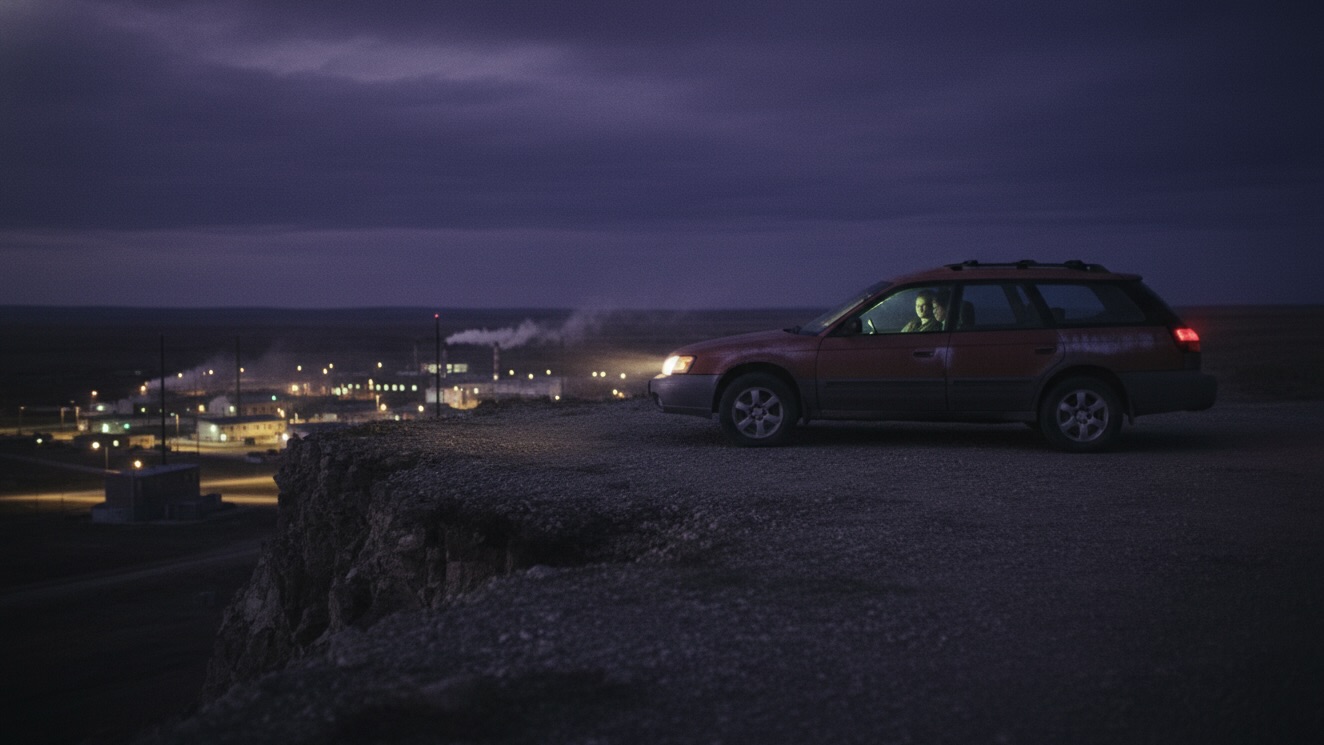
And above them, the sky continued to throb with a light that felt less like a natural phenomenon and more like a warning that the signal was about to be cut.
Share This Story


