The Sub-Level Breach
A claustrophobic, vine-choked basement beneath a ruined cityscape where the laws of physics and biology feel slightly suspended due to the encroachment of 'The Velvet', a bio-weaponized flora.
The heat in the suit was the first thing that always went wrong. The regulators were supposed to cycle the air, pull the humidity off your skin, and recycle it into something drinkable, but mine just blew hot, wet dust into my face. It tasted like copper and dead skin. I was thigh-deep in the Velvet, that purple, iridescent sludge the terraformers had lost control of three years ago. It was officially classified as 'aggressive flora,' but everyone in the unit called it the Creep. It didn’t just grow; it thought. It waited.
My incinerator unit, a heavy, ugly block of stamped steel, hummed against my ribs. The nozzle was still glowing a dull cherry red, popping and hissing as raindrops—acidic and warm—hit the metal. I was alone in Sector Four, which was a breach of protocol, but the comms were down again. The static in my ear wasn't the white noise of empty air; it was the wet, rhythmic thrumming of the Creep interfering with the signal. It sounded like breathing.
"Control," I said, my voice cracking. I swallowed, trying to wet a throat that felt like it was lined with sandpaper. "Control, this is Specialist Javi. I’ve got a structural compromise in Grid Nine. The roots have eaten through the retaining wall. Over."
Nothing. Just the breathing. And then, a sound that didn't belong. A click. Mechanical, precise, and too clean for this rotting world. It wasn't the comms.
I froze. The Creep around my legs was motionless, a sea of violet slime covering the rubble of what used to be a highway. The rain slicked my visor, distorting the grey light of the afternoon. I wiped it with a gauntlet, smearing the grime. The sound came again. Click-whirr.
It was coming from beneath me.
The concrete slab I was standing on groaned. It wasn't the sound of stone breaking; it was the sound of something wet giving way. I tried to step back, to engage the servo-assist in my legs and jump clear, but the suit was sluggish, the battery drained by the heat exchange. The ground simply dissolved. Not fell—dissolved. The rebar snapped with the sound of gunshots, and the world tilted sideways.
I fell into the dark, surrounded by a cascade of wet concrete and writhing purple vines. The impact knocked the wind out of me, a hard, bright flash of pain behind my eyes. My HUD flickered red, screaming warnings about suit integrity and toxic exposure, but I swiped them away, gasping for air that suddenly smelled different. It didn't smell like the sulfur and rot of the surface. It smelled... dry. Like dust and old paper.
I lay there for a moment, listening to the blood rushing in my ears. My left leg was pinned, not by rubble, but by the weight of my own gear. I groaned, rolling onto my side, and the incinerator skittered across the floor, the flashlight attachment sending a wild beam swinging through the dark.
The beam hit a wall. Then a shelf. Then a face.
I scrambled back, my hand dropping to the sidearm holstered at my hip. The holster was jammed with grit, but I yanked the pistol free, leveling it at the shadow. My heart was hammering against my ribs, a frantic, irregular rhythm that made my vision pulse.
"Don't move," I rasped. It was a stupid thing to say. The figure wasn't moving. They were sitting in a chair, legs crossed, watching me with a terrifying calmness.
The beam stabilized. It wasn't a civilian. The armor was angular, matte-black, with the distinct crimson chevron of the Northern Coalition on the shoulder. An enemy. A 'Scythe.' We were told they were genetically modified to feel no pain, that they ate raw meat and slept in shifts of twenty minutes. We were told a lot of things.
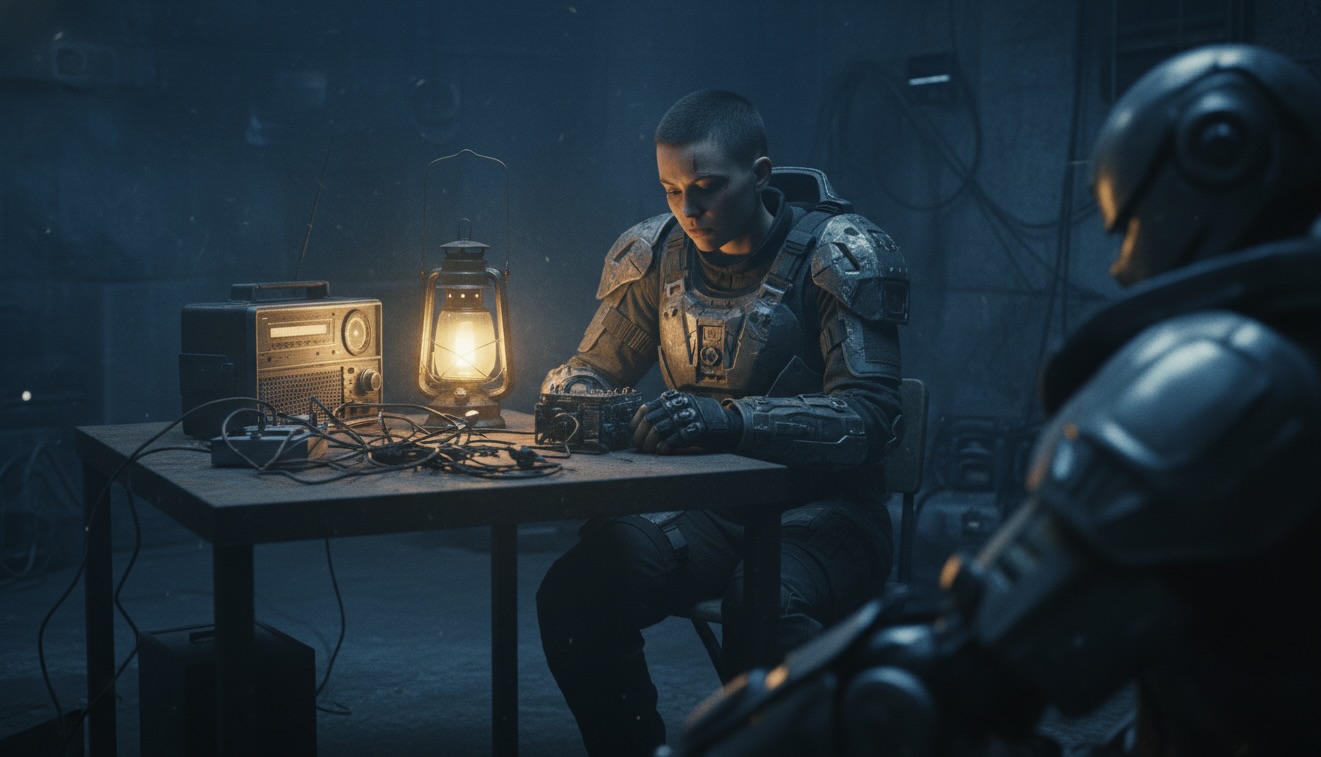
This one looked small. The helmet was off, resting on a knee. The soldier was a woman, maybe my age, maybe younger. Her hair was shaved close to the scalp, revealing a jagged scar that ran from her temple to her ear. Her face was smeared with grease, but her eyes—pale, almost colorless in the harsh light of my tactical lamp—were clear.
She held up a hand, palm open. In the other, she held a screwdriver.
"Your safety is on," she said. Her voice was quiet, raspy, accented with the clipped vowels of the North.
I looked down. The safety was on. I flicked it off, my thumb trembling. "Drop the tool."
She didn't drop it. She set it down on the table next to her, gently, as if it were made of glass. "You fell twenty feet," she said. "You're lucky the vines cushioned the landing. If you shoot that thing in here, the ricochet will kill us both. The walls are reinforced duracrete. We're in a bunker."
I kept the gun trained on her chest. "Hands where I can see them."
She raised her hands slowly. "You're bleeding," she noted, nodding towards my leg.
I glanced down. A piece of rebar had torn through the outer weave of my suit. There was blood, dark and sluggish, mixing with the hydraulic fluid of the exoskeleton. It didn't hurt yet. That was bad. It meant the shock was doing the heavy lifting.
"I'm fine," I lied. I tried to stand, but my leg buckled. I hit the floor hard, grit biting into my palms. I cursed, a sharp, ugly sound that echoed in the small space.
"Sit down," she said. She wasn't commanding me; she sounded bored. "The structural integrity of the ceiling is compromised. If you thrash around, you'll bring the rest of the highway down on our heads."
I dragged myself until my back was against a metal cabinet. I kept the gun up. "Who are you? What are you doing here?"
"My name is irrelevant to you, Javi," she said. She knew my name. It was stenciled on my chest plate. "And I'm doing what you were doing. Getting out of the rain."
She turned back to the table. I tensed, ready to fire, but she just picked up the screwdriver again. She was working on something. A box. It looked like a radio, but older. Analog. A relic from before the Silence.
"Stop moving," I barked.
"I'm fixing the tragic alignment of this coil," she said, not looking up. "If I stop, the solder cools, and I have to start over. Do you have a cigarette?"
The question was so absurd I lowered the gun an inch. "What?"
"A cigarette. Tobacco. Nicotine." She glanced at me. "They stopped issuing them to us six months ago. Said it interfered with the ocular implants. I don't have implants, so I just get the withdrawal."
"I don't smoke," I said. "It kills your lung capacity."
She snorted. "The air up there contains forty parts per million of pulverized asbestos and fungal spores. I think we're past worrying about lung capacity."
I looked around the room. It was a maintenance sub-basement. Pipes ran along the ceiling, sweating condensation. The air was cool here, insulated by the earth. In the corner, a small, battery-operated lantern gave off a warm, yellow glow, totally unlike the harsh blue LEDs of military tech. It felt... lived in. There was a sleeping bag rolled up. A stack of cans. She had been here a while.
"You're a deserter," I said. The realization hit me with a strange lack of anger. In the field, we were taught to hate deserters more than the enemy. Cowardice was a contagion.
"I'm on extended leave," she corrected. She twisted the screwdriver, her tongue poking the corner of her mouth in concentration. "And you're a terrible shot. I've been watching your patrol patterns for three days. You walk with a limp on the left side. Hip injury?"
"Suit malfunction," I muttered. I holstered the gun. It felt heavy, and honestly, if she wanted to kill me, she could have done it while I was unconscious. "Why didn't you kill me?"
She paused. She looked at the screwdriver, then at me. Her expression was unreadable. "I needed a battery. My lantern is dying."
I laughed. It was a dry, hacking sound. "You spared me for a battery?"
"And," she added, "I was bored. It's very quiet down here. The Creep absorbs sound waves. Have you noticed? It's like living inside a cotton ball."
I reached down and disconnected the auxiliary power cell from my thigh armor. It was a small brick, heavy and warm. I tossed it to her. She caught it with one hand, not even looking up from her work.
"Thanks," she said.
"So what is that?" I asked, nodding at the box.
"It's a receiver. Shortwave. I found it in an antique shop three sectors back, before we leveled it." She popped the back of the radio open and jammed my battery into the leads. Sparks showered the table. "The digital frequencies are all encrypted or jammed. But the old analog waves... the atmosphere bounces them differently now. The spore layer acts like a mirror."
"Mirror for what? There's no one broadcasting analog. The stations were gone fifty years ago."
"Not stations," she said. "Echoes. Or maybe ghosts. Or maybe just someone else with a soldering iron and too much time."
She turned a dial. A burst of static filled the room—white noise, harsh and jagged. I flinched. It sounded too much like the comms. But then she turned it again, fingers delicate, adjusting the gain. The static smoothed out. It became a hum.
Then, a voice. Faint. Garbled.
"...precipitation in the valley... moderate winds... expect clear skies by morning..."
I stared at the box. "That's a weather report."
"From 2040," she said softly. "Or maybe 2050. It loops. I think it's bouncing off the ionosphere, trapped in a degradation cycle."
"Why?" I asked. "What's the point?"
She looked at me, and for the first time, she smiled. It wasn't a nice smile—it was sharp, tired, and crooked—but it was real. "Because he says 'clear skies.' Do you remember clear skies, Javi?"
I didn't. I was born in the tunnels. The sky had always been grey, or yellow, or choked with the purple haze of the spores.
"No," I said.
"Listen," she commanded.
She tuned the dial again. The weather report faded. A high-pitched whine took over, then dropped into a rhythmic thumping. Drums. Real drums. Then a bass line, fuzzy and distorted, but undeniable. A saxophone cut through the noise, mournful and slow.
My breath hitched. I knew music—we had the patriotic marches, the synthesized adrenaline tracks they pumped into our helmets during combat drops—but this was different. This was messy. The notes dragged. You could hear the player taking a breath.
"Jazz," she said. "I think."
We sat there in the dim light, two soldiers from armies that wanted to burn the world down, listening to a ghost play a saxophone. The pain in my leg receded into a dull throb. The smell of the room changed; the metallic tang of blood seemed to fade, replaced by the smell of ozone from the radio—no, not ozone. That was a lazy word. It smelled like burning dust and hot copper wire. It smelled like friction.
"I have peaches," she said suddenly.
I blinked. "What?"
She reached under the table and pulled out a pouch. It wasn't military ration trash. It was a civilian preservation pack, the kind that cost a month's pay on the black market. "Real ones. Not the synthesis paste. I found a pantry in a collapsed cellar. The seal was intact."
She tossed me the pouch. I caught it. It felt heavy, liquid.
"I can't," I said. "That's... that's gold."
"Eat it," she said. "I'm allergic to stone fruit. I just like the smell."
I tore the top off. The scent hit me instantly—sweet, floral, acidic. It made my mouth water so hard it hurt. I took a sip. The syrup was thick, sugary, and tasted of summer. I tipped the bag back and let a slice slide into my mouth. It was soft, disintegrating against my tongue.
I closed my eyes. For a second, I wasn't in a hole. I wasn't wearing fifty pounds of ceramite armor. I was just a person eating a peach.
"Good?" she asked.
"My god," I whispered. "It tastes like... like color. Like orange."
She laughed again, softer this time. She leaned back in her chair, closing her eyes, listening to the saxophone struggle through the static. "My name is Senna."
"Javi," I said again, though she already knew.
"Well, Javi. Welcome to the lounge."
We sat like that for an hour. The war was just ten feet above us. I could hear the dull thud of mortar fire walking across the sector, shaking dust from the ceiling. The Creep was probably knitting the hole shut, sealing us in. I didn't care. I drank the peach syrup and listened to the music.
"You know," Senna said, eyes still closed. "If they find us, they'll court-martial us both. Fraternizing with the enemy. Dereliction of duty."
"They won't find us," I said. "The sensors can't penetrate this deep. And the Creep masks thermal signatures."
"We could stay," she said. It wasn't a suggestion, just a thought voiced aloud. "We could just wait. The air scrubbers down here are good for another week. I have water."
I looked at her. She looked tired. Not just sleepy, but worn down to the bone. The scar on her head was pink and angry. We were both just meat for the grinder up there. Down here, we were people.
"A week," I mused. "And then?"
"Then we starve. Or the Creep gets in. Or we shoot each other over the last can of beans."
"Sounds better than the surface," I said.
She opened her eyes and looked at me. The connection was sudden and sharp. It wasn't romance—it was recognition. We were the same thing. Broken tools left on a workbench.
"I have a deck of cards," she said. "Missing the Jack of Diamonds, but it works."
"I know a game," I said. "My grandfather taught me. It's called 'Liar'."
"Appropriate," she murmured.
She shuffled the cards. They were soft with age, the edges fraying. She dealt them onto the metal table. The slap of the cards was loud in the quiet room.
"So," she said, picking up her hand. "Tell me something real, Javi. Not the propaganda. What do you actually miss?"
I looked at my cards. A three, a seven, a Queen. "I miss the silence," I said. "Real silence. Not the waiting-for-a-bomb silence. Just... nothing."
She nodded slowly. "I miss dogs. I saw a picture of one once. It looked soft."
"I think they're extinct," I said.
"I know," she said. "That's why I miss them."
We played. We talked about nothing. We talked about the texture of the synth-meat in the mess hall (rubber), the sound of the rain on a tin roof (shrapnel), the way the sky looked when the orbital bombardments started (beautiful). We laughed at things that weren't funny, because if we didn't laugh, we'd scream.
It was a bubble of time. A glitch in the universe. Unexpected. Impossible.
Then, the radio died. The light on the front panel flickered and went out. The music cut off, replaced by the heavy, oppressive silence of the underground.
Senna sighed. She tapped the battery I had given her. "Yours was almost dead too."
"Standard issue," I said. "Lowest bidder."
The loss of the music felt like a physical blow. The reality of the room rushed back in. The cold. The damp. The pain in my leg, which was returning with a vengeance now that the adrenaline was fading.
"I have to go," I said. The words tasted like ash.
Senna didn't argue. She gathered the cards and put them back in her pocket. "If you stay, the infection in that leg will kill you. You need antibiotics. The real kind."
I struggled to my stand. The suit whined in protest. I checked the HUD. Power was critical. I had enough juice to blow the hatch on the surface and maybe limp back to the perimeter.
"What about you?" I asked.
She picked up the screwdriver. "I have work to do. There's another radio in the back room. Maybe I can get a signal from the moon."
"Senna," I said.
She looked at me.
"Come with me. I can... I can say I took you prisoner. We can get you processed. It's better than starving in a hole."
She smiled that crooked smile again. "Processed. That means a camp. Interrogation. No thanks. I like my lounge."
I nodded. I understood. Freedom was a small room with a broken radio.
I limped to the pile of rubble I had fallen through. The Creep hadn't sealed it yet; a shaft of grey light was filtering down. I engaged the jump-jets. They whined, low and angry.
"Hey," she said.
I turned.
She tossed something at me. I caught it. It was the Jack of Diamonds. She had found it, or maybe she had been hiding it.
"Keep it," she said. "For luck."
"Luck is a statistical anomaly," I said, quoting the manual.
"Get out of here, Javi," she said gently.
I triggered the jets. The suit kicked me upward, a brutal shove against gravity. I burst through the layer of vines and debris, landing hard on the wet asphalt of the surface. The rain was heavier now. The sky was the color of a bruised plum. The smell of rot and sulfur filled my helmet instantly.
I looked down at the hole. The vines were already moving, slithering across the opening, knitting together like a wound healing fast. In seconds, the ground was solid purple again. No trace of the room. No trace of the light.
I stood there for a long time, the rain drumming on my shoulders. My leg burned. My heart felt hollow.
I opened my hand. The playing card was damp, peeling at the corners. A Jack of Diamonds. A soldier with a weapon, looking two ways at once.
"Unexpected," I whispered to the rain.
I tucked the card into the seal of my glove, against my skin. Then I turned and began the long walk back to the war.
I tucked the card into the seal of my glove, against my skin, then turned and began the long walk back to the war.
Share This Story


