A Conversation in Corrosion
The rain didn’t fall so much as it moved in horizontal sheets, slamming against the control room's single pane of reinforced glass with the sound of thrown gravel. Inside, the air was a stale cocktail of hot vacuum tubes, damp wool, and the faint, coppery scent of failing electronics. It was a smell Kenny was coming to associate with his new life: the smell of decay held barely at bay.
The green line on the oscilloscope wavered, a jittery nerve. Every ninety-four seconds, it jumped three pixels to the left. A ghost in the machine. For three days, the ghost had been Kenny’s only real company, and he was growing to hate it with a startling intensity. He tapped the Bakelite casing of the receiver, a foolish, primitive gesture. The green line flickered in protest.
Outside, the wind howled a hollow note through the struts of the dish, a sound that vibrated up through the concrete foundation and into the soles of his boots. It was a constant, physical reminder of his isolation. Six months ago, he'd been calibrating server requests in a climate-controlled room, surrounded by the hum of a thousand fans and the quiet keystrokes of a hundred other people. Now his world was this: one man, one dish, and a drift he couldn’t diagnose.
He scribbled another useless calculation onto a notepad already dense with them. The paper was slightly damp, absorbing moisture from the air. `Bearing friction coefficient vs. wind shear?` It was nonsense. He was guessing. The manuals, leather-bound and smelling of mildew, offered elegant equations for a world without rust, without the sheer bloody-mindedness of a thirty-year-old gearbox exposed to relentless coastal gales.
The door behind him banged open, letting in a swirl of cold air that smelled of wet earth and pine. He didn’t have to look. Only one person came up this track in weather like this.
“You’re burning that thing out,” Shawna said. Her voice was flat, an instrument tuned to the landscape. She set a canvas bag on the floor, the metal clasps clinking. “I can smell the capacitors from the track.”
“It’s fine,” Kenny lied, not turning from the console. The green line jumped again. Punctual as a train.
“Right.” He could hear her shrugging out of her wax jacket, the fabric crinkling. “And I’m the Queen of Sheba. You’ve got that same look your predecessor used to get. Like you’re trying to solve a crossword by eating the newspaper.”
He finally swivelled in the worn chair, which squeaked in protest. Shawna stood by the door, her dark hair plastered to her forehead by the rain. She was wringing out her gloves, her hands chapped and capable. She wasn’t looking at him, but at the array of equipment, her eyes scanning the dials with an unnerving familiarity.
“It’s a tracking drift. Azimuthal. A few arcseconds every cycle.”
“I know what it is,” she said, finally meeting his gaze. Her eyes were the colour of the sea in winter. “It’s the wind. It does it every autumn when the gales come from the east. Puts pressure on the northern bearing.”
Kenny felt a hot flush of irritation. “I’ve compensated for wind load. I’ve written a whole new predictive algorithm. It’s not the wind.”
“Is your algorithm down there with a wrench?” she asked, a flicker of something—not quite amusement—in her eyes. “Or is it just up here, keeping warm?”
He hated that she was probably right. He hated the easy, earned confidence she wore like her jacket. He’d spent fifteen years mastering complex systems, bending intricate code to his will. This place was supposed to be simpler. A retreat. Instead, he felt like a child fumbling with a lock he didn’t have the key for.
“What do you suggest, then?” he said, the words tighter than he intended.
“I suggest you put your coat on.”
---
The wind on the platform was a physical force. It stole the air from his lungs and tried to pry his fingers from the safety rail. Rain, driven to the velocity of ice chips, stung his face. Below them, the valley was a watercolour wash of grey and bruised purple. The dish, a skeletal hand cupped to the sky, groaned under the assault.
Shawna seemed unaffected. She moved with a low, steady centre of gravity, her boots finding purchase on the slick metal grille. She carried a heavy-looking spanner and a grease gun that looked like some kind of medieval weapon.
“There,” she shouted over the gale, pointing towards the massive geared ring that controlled the dish’s rotation. “The housing for the main motor drive. Old Hewitt said you had to bleed the pressure and repack it with grease twice a year. Once after the summer heat, once before the first frost.”
Kenny stared at the hulking metal box. It was streaked with rust, bolts weeping orange stains down the painted grey surface. “That’s not in any of the maintenance logs.”
“Hewitt’s logs were in his head,” she yelled back, already bracing herself against the gearbox. “He didn’t trust paper. Said it rotted. Give me a hand with this.”
For the next hour, they worked in a world of screaming wind and freezing metal. Kenny’s hands, accustomed to the delicate dance of a keyboard, were clumsy and useless. He fumbled a bolt, dropping it with a clang into the machinery below. Shawna shot him a look but said nothing, simply reaching into a pocket and producing another. Her movements were economical and precise. She knew which bolts were stiff, which angles gave the best leverage. She knew the machine not as a diagram, but as a body with aches and pains.
He felt a growing, grudging respect. He was an expert, a specialist flown in to run this place. She ran a smallholding in the valley and delivered groceries. Yet here, he was the novice.
“Right, hold the spanner steady,” she grunted, fitting the nozzle of the grease gun to a valve he hadn’t even noticed. “I’m going to pump. When I tell you, give it a quarter turn. No more.”
He gripped the cold steel, his knuckles white. The wind pushed against him, trying to unbalance him. “Ready.”
Shawna began to work the lever on the grease gun. The mechanism inside the housing gave a low groan. It was the sound of something seized reluctantly giving way.
“Now,” she commanded.
Kenny threw his weight into it. The nut resisted, then turned with a sudden, jarring crack that vibrated up his arms. It moved further than a quarter turn. Maybe a half. A lurch of thick, black grease erupted from the joint.
“I said a quarter turn!”
“It slipped!”
A new sound joined the wind’s howl. A low, powerful hum from the motor. On the control panel beside them, a series of lights flickered from red to green. The dish, all five hundred tonnes of it, began to move.
“What’s happening?” Kenny shouted, scrambling back.
“You’ve released the brake! We’re free-drifting!”
The huge structure was rotating with an unnerving, silent grace, sweeping across the sky, untethered from their control. Shawna was already at an emergency stop panel, slamming her palm against a large red button. Nothing happened.
“It’s not responding! The override is shot!”
The Unintended Audience
Back in the relative quiet of the control room, the chaos was electronic. Alarms blared, a cascade of warnings filling the screens. The main oscilloscope, however, was silent. The wavering green line was gone.
In its place was a new signal.
It wasn’t the gentle, chaotic hiss of deep space. It was a tight, repeating pattern. A series of clean, sharp pulses in a structure so deliberate it was unnerving.
“What is that?” Kenny breathed, leaning over the console. He’d never seen anything like it. It wasn’t a pulsar. It wasn’t a quasar. It wasn’t instrument noise.
Shawna stood behind him, dripping water onto the linoleum floor. “Where’s the dish pointing?”
Kenny’s fingers flew across a keyboard, bringing up a telemetry display. The numbers were still spinning, but he could get a rough idea. It was low on the horizon, pointing northwest, towards a patch of sky that was, for all intents and purposes, empty.
“There’s nothing there,” he muttered, cross-referencing with the star charts. “Just… nothing. No known sources.”
The signal continued its perfect, metronomic beat. A pulse, then a pause. Three pulses, then a longer pause. Then a single pulse. It repeated every 15.7 seconds.
“It’s not from space, is it?” Shawna said. It wasn’t a question. Her voice was low, all the earlier sharpness gone.
Kenny didn’t answer. He was typing, running a diagnostic. Triangulating. The dish was a receiver, but it could also detect signal strength with incredible precision. He could get a location. Not just a direction, but a distance.
He hit enter. A string of code executed. A moment later, the result appeared on the screen.
The signal wasn’t light-years away. It wasn’t even astronomical units away.
Its point of origin was approximately seventy-three kilometres from them, somewhere in the barren, uninhabited expanse of the Black Fell.
The alarms continued to blare, but they had faded into the background. The only thing in the room was the quiet, insistent beat on the screen. A pulse from nowhere. A ghost that was suddenly, terrifyingly real.
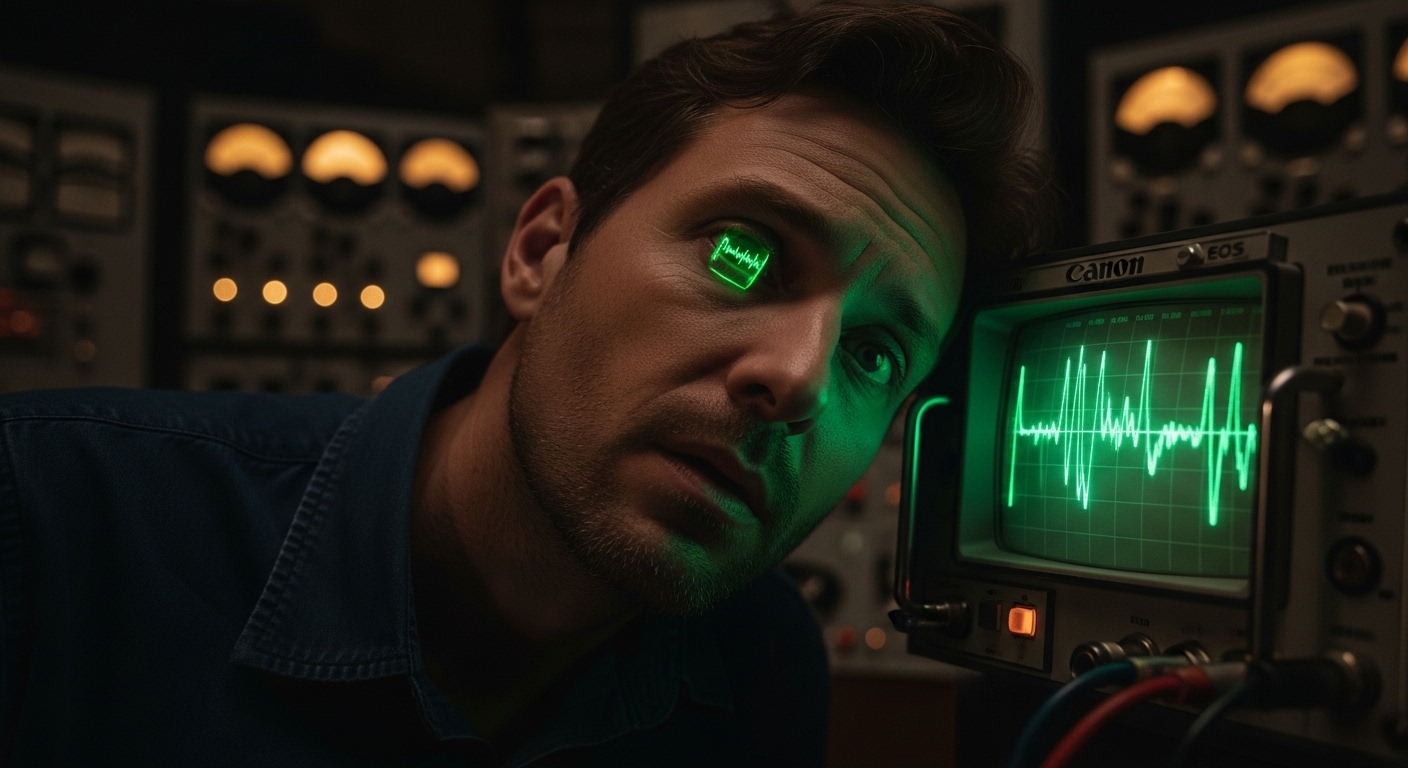
He stared at the coordinates, a location on their own planet. The structured, intelligent signal wasn't a message from the stars. It was a broadcast from the empty heart of the moor.
Share This Story


