The Aisle of Forgotten Things
A cluttered, dusty aisle in an old antique shop in Winnipeg, filled with random historical debris.
The heat on Main Street did not merely exist; it aggressively occupied space. It was a physical weight, a wet wool blanket dropped from the stratosphere, smelling of asphalt, exhaust, and the fried grease of a dozen burger joints. Artie wiped his forehead with a handkerchief that had surrendered to the humidity twenty minutes ago. He was sixty-two, wearing a linen suit that he imagined gave him the air of a colonial administrator but in reality made him look like a melting vanilla ice cream cone.
He ducked into the first door that promised shadow. The sign above peeled in strips of green paint: Curiosities & Remnants. A bell did not ring as he pushed the heavy glass door open. Instead, a dull, wet thud echoed from the ceiling, as if a small animal had just been dropped onto a carpet.
The transition was instant and violent. The roar of Winnipeg traffic—the aggressive revving of trucks, the distant, omnipresent clatter of the railyard—vanished. The silence inside was thick, smelling of old paper, decaying silk, and something sharp, like vinegar or developing fluid.
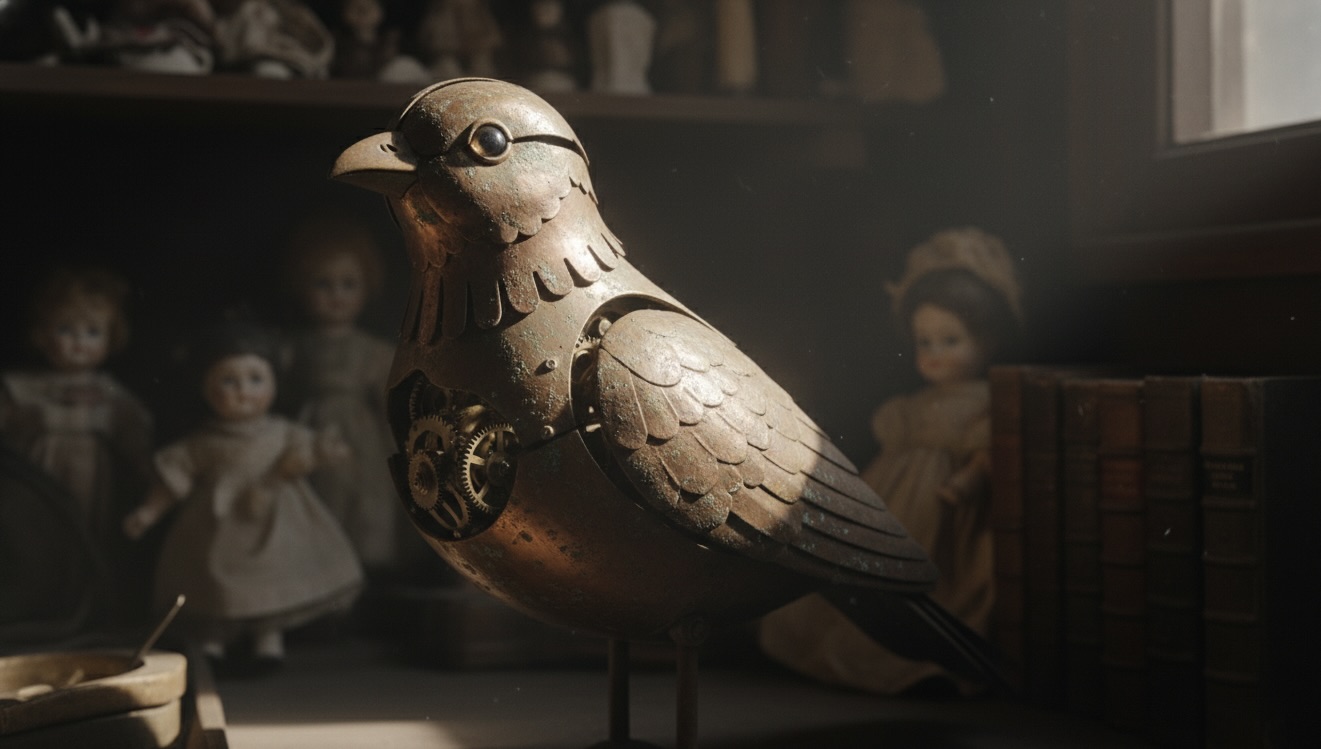
Artie adjusted his spectacles. The shop was a labyrinth of towering shelves, a chaotic geology of discarded lives. Stacks of National Geographics formed unstable pillars. Porcelain dolls with cracked faces stared accusingly at tarnished silverware. It was the sort of place where things came to die, or perhaps, where they came to wait.
He moved deeper into the gloom, his shoes sticking slightly to the linoleum. He was looking for nothing. That was his occupation these days. Looking for nothing and usually finding it.
Then he saw the bird.
It sat in a glass case near the back, resting on a pedestal of velvet that had balded with age. It was constructed of brass and copper, gears exposed in its belly, wings etched with intricate, impossible feathers. It was the size of a crow. Artie leaned in, his breath fogging the glass. It was ugly. It was magnificent. It was a grotesque parody of nature.
And then, the impossible happened. The brass bird blinked.
It was not a mechanical shuttering of lenses. A membrane, grey and wet, slid across the copper eye and retracted. Artie recoil, his heel catching on a warped floorboard. He grabbed a shelf of ceramic cats to steady himself, sending a tremor through the porcelain menagerie.
"It judges, does it not?" a voice said.
Artie turned. Standing on the other side of the aisle, partially obscured by a rack of moth-eaten fur coats, was a woman. She was tall, skeletal, draped in a dress that might have been fashionable in 1970 or perhaps 1890. A wide-brimmed hat cast her eyes in shadow, but he could see the sharp, predatory line of her nose and a mouth painted a severe crimson.
"I beg your pardon?" Artie said, straightening his jacket. He adopted the tone he used for bank tellers and unruly undergraduates.
"The avian construct," the woman said, stepping out from the furs. She moved with a gliding smoothness that suggested she was on wheels. "I have been observing it for eleven minutes. It possesses a gaze of distinct moral superiority. Rare for brass. Common for cats. Unheard of for taxidermy, though this is clearly mechanics."
Artie looked back at the bird. It was perfectly still now. "It blinked," he whispered, feeling foolish the moment the words left his lips.
"Did it?" The woman moved closer, the smell of lavender and old books drifting off her. "Or did the heat outside boil your vitreous humor? It is thirty-five degrees. The brain does peculiar things when it simmers."
"I saw it," Artie insisted, though he wasn't sure. "A nictitating membrane. Biological. Wet."
The woman hummed, a low, skeptical sound. She leaned down, bringing her face level with the glass case. "Curious. If it is alive, it is a prisoner. If it is a machine, it is a masterpiece. I am Betty, by the way. I feel names are necessary when one is hallucinating in a pawn shop."
"Artie," he said. "And I am not hallucinating."
"Of course not, Artie. You are merely observing the surrealism of the mundane. Look at its claw."
Artie looked. The brass talons were gripping a small, polished branch. But where the metal touched the wood, the wood was... bruised. Discolored. As if the metal were hot, or drawing sustenance from the dead timber.
"We are surrounded by debris," Betty announced, turning her back on the bird and sweeping a hand towards the rest of the shop. "Look at this. A toaster from 1950. A wedding dress, size four, yellowed with sweat. A collection of ceramic thimbles. It is a mausoleum of triviality."
Artie felt a sudden, defensive urge. He had a collection of fountain pens at home. "These objects... they have history. Narrative."
"Narrative?" Betty laughed. It was a sharp, barking sound. "Narrative is a lie we tell ourselves to make the clutter bearable. That toaster does not have a story. It toasted bread. Then it broke. Then someone died, and their children, too lazy to throw it out, donated it here for a tax receipt. It is the physics of abandonment."
"You are a cynic, madam."
"I am a realist, Artie. There is a difference. A cynic believes nothing matters. A realist knows that things matter, but usually for the wrong reasons." She picked up a heavy crystal ashtray. "This, for instance. Heavy. Leaded glass. A weapon, in the right hands. Its value is not in its beauty, but in its potential for blunt force trauma."
Artie found himself smiling, a dry cracking of his facial muscles. "And the bird? What is its potential?"
"Surveillance," Betty said immediately. She put the ashtray down. "Look at it. It is not designed to sing. It is designed to record."
As if in response, a sound emerged from the glass case. It was not a chirp. It was the sound of static, followed by a snippet of a voice—a man's voice, tinny and distant, saying, "...bacon, and perhaps the eggs, if you have time..."
Artie froze. The blood drained from his face, pooling somewhere in his socks. "Did you hear that?"
Betty did not look shocked. She looked vindicated. "Breakfast orders. From when? 1930? Yesterday? It is digesting the acoustic history of the room."
"This is absurd," Artie said, backing away slightly. "It's a radio. A receiver hidden in the base."
"Is it?" Betty stepped closer to him, invading his personal space with theatrical disregard. "Artie, consider the setting. We are in Winnipeg. In July. The air is stagnant. The mosquitoes are plotting insurrection. Is it so hard to believe that the heat has fused the timeline? That a brass bird might regurgitate a request for eggs?"
"I... I came in for air conditioning," Artie stammered.
"A noble quest. Failed, obviously. It is stifling in here. But cooler than the inferno."
They stood in silence for a moment, the only sound the distant, rhythmic tick-tick-tick of the bird's internal gears. It was breathing. The brass chest plates expanded and contracted by a fraction of a millimeter. Artie watched it, mesmerized and horrified.
"What is your function, Artie?" Betty asked suddenly.
"My... function?"
"You are wearing a suit that cost six hundred dollars, perhaps seven. You have ink stains on your fingers. You are retired, but you dress like you are late for a board meeting. You are maintaining a facade. Why?"
Artie looked at his hands. She was right about the ink. "I was... in administration. University. I organized things. schedules. Budgets. I ensured that the chaos was contained."
"And now?"
"Now I organize my bookshelf. Alphabetical, then chronological within author."
"A taxonomy of boredom," Betty declared. "I was on the stage. Decades ago. Before my knees betrayed me and the industry decided that women over forty are invisible unless they are playing witches or grandmothers with dementia. I spent my life pretending to be other people. Now, I simply pretend to be myself."
"Is there a difference?" Artie asked. The question surprised him. It was more philosophical than he intended.
Betty’s eyes narrowed, crinkling at the corners. "Bravo, Artie. A hit. A palpable hit. No, I suppose there isn't. We are all just curating our own exhibit, aren't we? Just like this shop. You are the 'Retired Administrator' display. I am the 'Faded Actress.' We are dusting ourselves off, hoping someone buys us before we are moved to the clearance bin."
"That is... incredibly bleak," Artie said.
"It is incredibly liberating!" Betty threw her arms up, nearly knocking over a lamp made from a taxidermied deer leg. "If we are merely inventory, we have no responsibility. We can simply sit on the shelf and gather dust. We don't have to strive. We don't have to improve. We just have to exist and wait for the estate sale."
Artie looked back at the bird. It had turned its head. It was looking directly at him with its single copper eye. "...eggs..." it whispered again, but this time, the voice sounded suspiciously like Artie's own.
A cold shiver walked down Artie's spine, defying the heat. "I think it's mimicking me."
"It is learning," Betty corrected. "It is a parrot of the soul. It reflects what it sees. It sees you, Artie. A man who wants bacon and eggs and order."
"I haven't eaten bacon in ten years. Cholesterol."
"The subconscious desires are the most flavorful," Betty quipped. She tapped the glass case with a long, unpainted fingernail. "Wake up, little monster. Tell us something true."
The bird opened its beak. A sound of grinding metal, screeching gears, and then, clear as a bell, a woman’s voice—Betty’s voice, but younger, vibrant, full of tearful rage: "I never loved him! I only loved the way he looked at me when I was on stage!"
Betty went rigid. Her theatrical posture collapsed for a second, revealing a slump of genuine, ancient exhaustion. The silence that followed was heavy, filled with the dust of a thousand secrets.
Artie didn't know where to look. He studied a cracked tea saucer intently. "A... dramatic reading?" he offered gently.
Betty recovered slowly. She straightened her spine, pulling the invisible strings of her dignity back taut. "Rehearsal," she said, her voice brittle. "From 'The Seagull.' 1982. The Playhouse Theatre."
"Ah. Chekhov. Of course."
"It wasn't Chekhov," she whispered. Then she cleared her throat, loud and harsh. "Well. It seems this item is defective. It plays the wrong tracks. A malfunctioning jukebox of regret."
"We should go," Artie said. The shop felt suddenly smaller. The walls of junk seemed to be leaning in, pressing the air out of the room. The smell of vinegar was stronger now, metallic and acidic.
"Go?" Betty looked around. "Where? Back into the oven? Out there, Artie, you are just an old man in a suit. In here... in here, you are an audience."
"I don't like this place," Artie confessed. "It feels... predatory."
"All commerce is predatory. This is just honest about it. It wants our time. It wants our memories. Look at that clock." She pointed to a grandfather clock in the corner. It had no hands, only a pendulum that swung with a frantic, irregular rhythm. Thump. Thump-thump. Thump.
"It beats," Artie noted.
"Like a heart. A chaotic, arrhythmic heart. We are inside the beast, Artie. We have been swallowed."
"You are enjoying this," Artie accused. "You find this amusing."
"I find it preferable to bingo night," she snapped. "I find it preferable to sitting in my apartment staring at the water stain on the ceiling that looks like Richard Nixon. At least here, the madness is external."
Artie took a step towards the door. The distance seemed greater than he remembered. The aisle of mismatched china stretched out, elongated, the perspective skewed like a surrealist painting. "The door is... further away."
"Space is relative," Betty said, unmoving. She was still watching the bird. The bird was now watching the door.
"Betty, come with me. Let’s get a coffee. An iced coffee. Somewhere with stainless steel counters and no history."
She hesitated. She looked at the bird, then at Artie. For a moment, he saw a flicker of fear in her eyes, quickly masked by disdain. "Coffee is a diuretic. And modern cafes are sterile. They have no soul."
"I have enough soul for one day," Artie said. "I want sterility. I want predictability. I want to pay four dollars for a beverage and know exactly what it will taste like."
"You are a coward, Artie."
"Yes," he agreed readily. "I am. And I am leaving."
He turned and began to walk. It felt like walking through water. The air was gelatinous. He passed a rack of vintage military uniforms. He could have sworn a sleeve reached out to brush his shoulder. He kept his eyes forward.
"Artie!" Betty called out. Her voice sounded far away, distorted, as if coming through a long metal tube.
He stopped. He didn't want to turn around, but the training of a lifetime of politeness forced him. He turned.
Betty was standing next to the glass case. But the glass was gone. The bird was perched on her shoulder. Its brass talons gripped the fabric of her vintage dress. It looked heavy. Betty was sagging under the weight, but she was smiling. A terrified, rictus smile.
"It likes me," she said. Her voice was the bird’s voice. Tinny. Metallic. "It... likes... me..."
"Betty, drop it," Artie commanded, his voice shaking.
"I cannot," she said. "I am part of the collection now. I am the 'Faded Actress with Brass Accessory.' Value: forty dollars. Negotiable."
"This isn't funny."
"It is hilarious," she wept, tears cutting tracks through her powder. "It is the punchline. Run, Artie. Run before you become the 'Man in Linen Suit'."
Artie turned and ran. He ignored the dignity of his age. He ignored the tightness in his chest. He sprinted past the stacks of National Geographics, past the accusing dolls, past the grandfather clock that beat like a dying heart.
He hit the door with his shoulder. It didn't budge. It was locked. He rattled the handle. Through the glass, he could see Main Street. The sun was blindingly bright. People were walking by, oblivious. A bus rumbled past, spewing black smoke. He pounded on the glass.
"Hey!" he shouted. "Let me out!"
No one looked. He was invisible. He was behind glass. He was an exhibit.
He turned back to the shop. The darkness had deepened. The shadows were lengthening, stretching out like fingers. Betty was gone. The aisle was empty.
No. Not empty.
On the velvet pedestal, inside the glass case, there were now two birds. One was large, brass, and ugly. The other was smaller, delicate, made of silver wire and pale silk. It wore a tiny, wide-brimmed hat.
Artie stared at the silver bird. It stared back. It opened its beak and let out a sound. It was a laugh. Betty’s laugh. Sharp, barking, and cut off abruptly by the click of a gear.
From the shadows in the corner, the grandfather clock stopped ticking. The silence that followed was absolute. It was the silence of an object that has finally found its place on the shelf.
Artie backed up until his spine hit the door. He slid down to the floor, the linoleum cool against his legs. He loosened his tie. He adjusted his pocket square. If he was to be here for a while, he should at least look presentable. A customer might come in soon. He had to be ready. He had to be a good example of a 'Retired Administrator'.
He closed his eyes and waited for the price tag to be affixed.
He closed his eyes and waited for the price tag to be affixed.
Share This Story


