A Midday Confab in the Shifting Heat
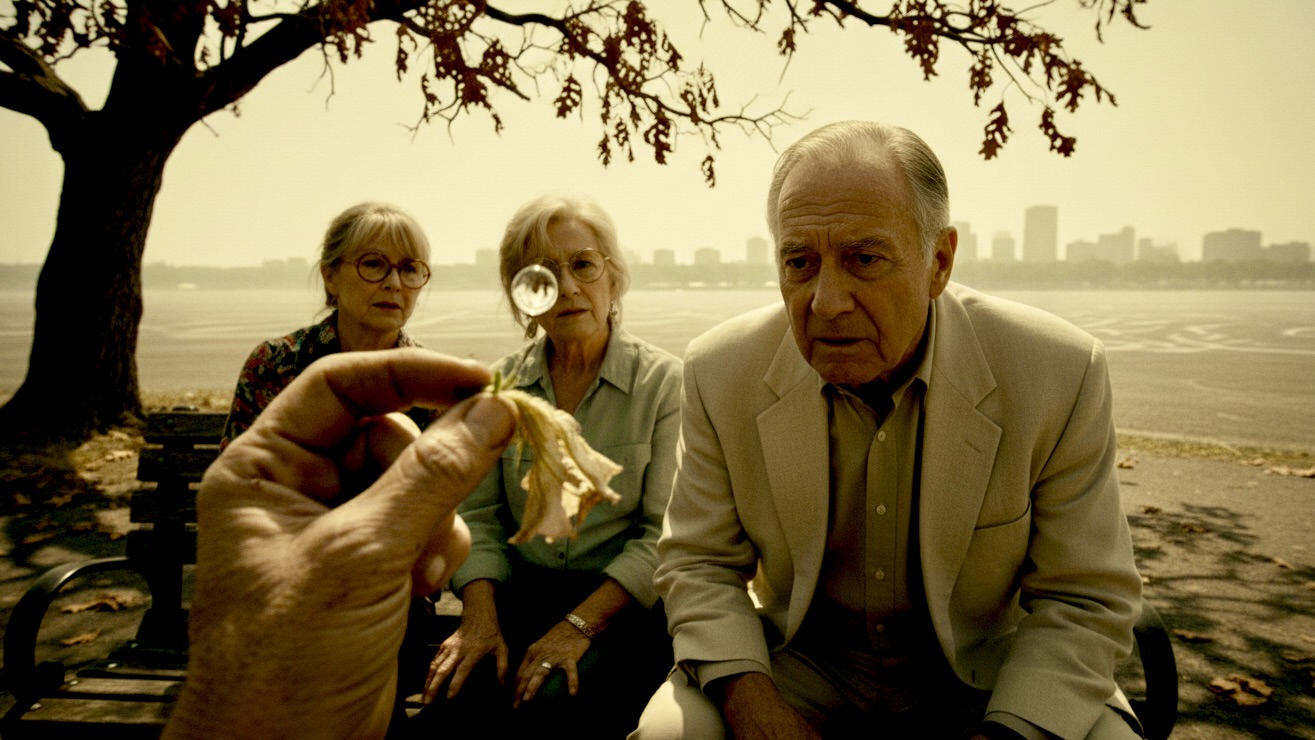
On a sweltering summer afternoon in what was once a bustling urban park, three elderly acquaintances—a retired ambassador, a pragmatic architect, and a contemplative horticulturist—sit under the sparse shade of a wilting oak, discussing the palpable decline of societal kindness amidst pervasive political polarization. The air itself feels heavy and unyielding, mirroring the social climate.
"And there it is, precisely," the former Ambassador declared, his voice, though aged, retaining the resonant timbre of countless diplomatic pronouncements. He gestured with a hand that had once commanded audiences, now merely indicating the shimmering, distorted expanse of heat over the park's asphalt path. "Another skirmish. Another digital fusillade discharged with the precision of a seasoned sniper, yet the indiscriminate cruelty of a child with a pellet gun."
The Architect, whose spectacles perched precariously on a nose etched with the blueprints of decades, merely grunted. Her gaze, however, was not on the Ambassador but fixed on the scraggly patch of petunias bordering the path, their blossoms curled and brittle. "Digital fusillades, as you so grandly term them, have rather corporeal consequences, wouldn't you say? Look at these poor things. They haven't had a proper drink in weeks, nor a moment's peace from the infernal sun. Like everything else, they're simply… giving up."
A silence settled, thick and oppressive, broken only by the distant, almost mournful whine of a sanitation truck. The Horticulturist, a man whose hands bore the permanent grime of earth and whose eyes held the patient wisdom of slow-growing things, sighed, a sound barely audible above the cicadas’ relentless thrum. "It's the air, isn't it?" he murmured, his voice softer, less accustomed to the thrust and parry of debate. "Feels… thinner. Even when it's this thick with heat. Less… receptive. As if the very atmosphere has grown tired of us."
The Ambassador adjusted his linen jacket, a futile attempt to mitigate the humid embrace of the August afternoon. "Receptive? My dear fellow, one might almost imply a sentience to the troposphere itself. A most charming, if utterly unscientific, notion." Yet, a flicker of something – recognition, perhaps, or a nascent doubt – crossed his patrician features. He had always prided himself on his rationalism, his ability to dissect geopolitics into neat, quantifiable segments. But lately, the world had begun to behave less like a chessboard and more like a fever dream.
"Perhaps," the Horticulturist continued, unperturbed, picking at a loose thread on his worn canvas trousers. "But I've noticed it in the soil too. It resists. Doesn't hold water the way it used to, even after a good watering. As if it’s… rejecting the nourishment. And the pollen counts, I tell you, are simply outrageous. It’s as if the plants are angry, desperate to proliferate their seed, to ensure something, anything, survives this… this general unpleasantness."
The Architect tapped a slender finger against her temple. "Unpleasantness. An elegant euphemism for the public square devolving into a perpetual brawl, for every civic discourse becoming a pitched battle. I see it in the structures. Cracks appearing where none should. Materials degrading faster. The mortar in the old library wall, for instance, it’s flaking at an alarming rate. It’s not just the humidity, not merely entropy. It's… accelerated. As if the very foundations of things are weary of holding together the weight of our collective scorn."
"Scorn," the Ambassador echoed, testing the word. "A rather potent force, to be sure. But to attribute physical decay to… to sociological trends? One might as well claim that the rise in interest rates is due to the proliferation of artisanal pickle consumption." He offered a thin, practiced smile that didn’t quite reach his eyes, a relic from countless negotiation tables.
"Oh, do spare us the diplomatic niceties, Arthur," the Architect retorted, her tone sharper than the Ambassador's could ever be. "We are not addressing a hostile delegate in Geneva. We are three old souls watching the world, or at least our corner of it, wither. And for all your erudition, you seem to miss the obvious. This isn't just politics as usual. This is… something else."
Something else. The phrase hung in the shimmering air, tasting of metallic dust and frustrated hope. It was 2025, and the summer had begun with an almost unprecedented heatwave that refused to break. Beyond the oppressive weather, a new kind of civic chill had descended. News feeds were not just divided; they were actively hostile, each faction walled off in its digital echo chamber, lobbing vitriol over the ramparts. The national election, due in the autumn, felt less like a democratic process and more like an impending civil rupture. The air wasn't just hot; it felt charged with a pervasive, corrosive static, a constant hum of unexpressed rage and mutual suspicion.
The Ambassador, for all his sophisticated dismissal, felt a prickle of unease. He recalled an incident just yesterday: a minor fender bender at an intersection, which had immediately escalated into a screaming match, not between the drivers, but between two bystanders, complete strangers, over some obscure, tangential political point. The incident had ended with one man spitting on the other's shoes, the kind of crude aggression he hadn't witnessed since… well, since never. Not in his lifetime, certainly not in the polite, if rigid, society he had navigated.
"But what, precisely, is this 'something else'?" he pressed, leaning forward, his earlier insouciance replaced by a genuine, if reluctant, curiosity. "Are we suggesting a collective psychosis? A mass delusion? Or perhaps a particularly virulent strain of… ill will?" He paused, looking from the wilting petunias to the cracked pavement, then to the Horticulturist, whose face, usually serene, was now etched with a subtle distress.
"Psychosis?" the Horticulturist murmured, finally looking up. "Perhaps. But it feels more… fundamental. Like a shift in the very currents of empathy. When I was tending the rose garden down at the municipal hall last week, there was a young man, no older than thirty, simply walk past an elderly woman who had dropped her groceries. Didn't even glance. Just… kept scrolling on his device. And the woman, bless her, didn't even ask for help. Just slowly, painfully, gathered her scattered produce, her shoulders slumped. No eye contact. No shared moment of human vulnerability, or aid. Just… two discrete universes passing through the same space."
The Architect nodded slowly. "That's what I mean about the structures. The invisible bonds. The social architecture. It's not just breaking down; it's actively repelling. People aren't just ignoring each other; they're almost… physically repulsed by the presence of a perceived 'other'. I saw a woman flinch at a stranger's smile on the metro yesterday. A genuine, unthreatening smile. As if kindness itself had become a suspicious gesture, a prelude to an ambush."
The Ambassador pursed his lips. He remembered reading a highly partisan op-ed, mere days ago, decrying an opposing candidate's 'softness' and 'naivety' for daring to advocate for a return to civility. The author had framed kindness as a weakness, a dangerous vulnerability in the ruthless political arena. The thought had chilled him then, and it chilled him now, even in the blistering heat.
"There is an… an organization," the Ambassador began, choosing his words with unusual care, "that has been rather vocal in the run-up to this election. The 'National Purity Front.' Rather an anachronistic name, one would think, for a modern political advocacy group. But their rhetoric… it traffics in precisely this kind of division. Not merely ideological disagreement, but a systematic demonization of anyone outside their very narrow parameters of 'true' citizenship. They speak of 'cleansing' the public discourse, of 'rooting out' dissent. And their funding, it is… opaque."
The Architect snorted. "Opaque is another word for a bottomless well, Arthur. Their digital footprint, however, is anything but. I've been tracing some of their online activities, purely out of professional curiosity, mind you. They've developed algorithms, or so it appears, that are exceptionally adept at identifying and amplifying existing social fractures. Not just reinforcing biases, mind you, but actively creating new ones, sowing discord where none existed, then harvesting the resulting anger for political leverage. They even have a rather charming little digital mascot, a scowling badger with a tiny, sharp-edged axe."
"A badger?" the Horticulturist asked, a faint frown creasing his brow. "Well, badgers are territorial, certainly. And can be quite fierce. But… an axe? That rather takes the metaphor to a new and rather unsettling level."
"Indeed," the Ambassador concurred, a rare tremor entering his voice. "Their influence is… pervasive. I have heard whispers from my old colleagues, still embedded in the Foreign Service, that the Front's tactics are being studied, and indeed emulated, by similar movements abroad. This is not merely an American malaise, my friends. This 'aridity of apathy,' as I'm beginning to think of it, is a global phenomenon. And the consequences, if allowed to fester, could be… catastrophic."
He paused, looking towards the wilting petunias. "And you suggest, with all due respect for your anecdotal observations, that this… this spiritual drought is somehow manifesting physically? That the very air we breathe grows heavy with our spite, and the plants rebel against our collective unkindness?"
The Horticulturist nodded slowly. "I believe it's a kind of feedback loop. The more we withhold kindness, the more the world seems to desiccate. The more the structures groan under the strain, the more people retreat into themselves, the more hostile the exchanges become. It's a self-fulfilling prophecy of decay. And it's not just plants. I saw a flock of starlings yesterday, flying in perfect unison, suddenly… break formation. Not a predator in sight. Just… scattered. As if the collective consciousness of the flock itself had fractured."
The Architect removed her spectacles, cleaning them meticulously with a corner of her handkerchief. "There are always patterns, Arthur. In the flow of traffic, in the stress on a bridge, in the distribution of seismic activity. And I am beginning to see a pattern in this… this pervasive societal dis-ease. It’s not random. It's too synchronized. Too… efficient."
A glint of something caught her eye, a faint shimmer emanating from the wilting petunias. She leaned closer, her movements stiff but purposeful. "Look," she whispered, pointing. "Just there. A single drop." On a parched, crinkled petal, a tiny bead of water shimmered, defying the sun's relentless assault, defying logic. It was too perfectly spherical, too bright, to be dew. And there was no cloud in the sky.
The Ambassador, intrigued despite himself, peered over her shoulder. It was unmistakable. A teardrop, impossibly perfect, resting on the petal. "A trick of the light," he posited, though his voice lacked conviction. He reached out a finger, intending to touch it, to prove its mundane origin.
Before he could, the Horticulturist, with surprising agility, intercepted his hand. "Don't. It's… fragile." He looked at the Ambassador, his eyes wide. "I've seen it before. Small miracles, little acts of… spontaneous generation. A sudden, inexplicable coolness in the air around someone who offered a genuine compliment. A single, perfect bloom appearing on a dying vine after an unexpected act of generosity. It’s rare, so rare now. But it happens. It's as if the world, the actual, tangible world, is trying to remind us of something."
The Architect straightened, her gaze fixed on the single, defiant drop. "Or," she mused, her voice low, "it's responding to something. A specific resonance. Something that, perhaps, the National Purity Front is actively suppressing. If the absence of kindness causes decay, what if the presence of it… causes growth? What if the collective sentiment isn’t just psychological, but a measurable, energetic force? And what if certain entities understand how to manipulate that force?"
The Ambassador felt a shiver trace its way down his spine, a cold sensation amidst the oppressive heat. The implications were vast, chilling. A political movement that not only exploited division but literally fed off it, that thrived on the emotional desiccation of a populace, and whose machinations could be, however subtly, warping the very fabric of reality. He thought of the endless, vitriolic comments sections, the gleeful mockery, the deliberate misinterpretations. Each cruel word, each dehumanizing meme, a microscopic grain of sand contributing to the collective desertification. And then, he remembered a recent national policy initiative, ostensibly about 'social cohesion,' but which subtly penalized public gatherings and informal community interactions, citing 'security concerns.' It had been pitched as a way to reduce potential flashpoints, but what if it was designed to prevent the opposite? To stifle the small, spontaneous acts of communal kindness that might, somehow, counteract the pervasive desiccation?
He looked at his companions, the Horticulturist still gazing at the single, improbable drop, the Architect now scanning the wilting landscape with a renewed, almost scientific intensity. "A conspiracy," he whispered, the word feeling both absurd and terrifyingly plausible. "Not merely of ideology, but of… of elemental forces. They are not just polarizing our minds. They are… draining the very life from the world around us. And that drop… that singular drop of water… it means someone, somewhere, is still trying. Still resisting this engineered aridity."
The heat shimmered, distorting the world, making the boundaries between reality and the impossible blur. The wilting petunias, the cracked pavement, the air that tasted of dust and despair—it all seemed part of a grander, more sinister design. And the question, stark and cold as a winter wind in this oppressive summer, was how many more drops would appear before the desert fully claimed them all.
And the question, stark and cold as a winter wind in this oppressive summer, was how many more drops would appear before the desert fully claimed them all.
Share This Story


