The Shelf Above the Kettle
The kitchen, shrouded in the bruised light of a January morning, feels colder than usual. Agnes, 78, stands by the counter, a chipped mug waiting for its tea, as a faint, unsettling hum begins to emanate from an unexpected source: a porcelain owl on a dusty shelf.
The January light, a bruised plum colour, barely managed to seep through the kitchen window, already dulled by the thick frost that clung like hardened sugar. Agnes adjusted her spectacles, the old plastic frames digging a familiar groove into the bridge of her nose, and peered at the kettle. It was taking its sweet time, as most things did these days. The ceramic mug, chipped at the rim, sat waiting on the counter, a single, sad tea bag draped over its edge. She’d forgotten to put it in. Again. It didn’t really matter. Bartholomew wouldn't notice. Bartholomew hadn't noticed much of anything for nearly seven years now, save for the distinct, if somewhat repetitive, flavour of the afterlife.
The house itself, a two-up, two-down terraced affair on Elm Street, felt perpetually caught in a sigh. Every floorboard had a story, mostly creaks and groans, and the wind, a steady, mournful bass, played through the eaves, a constant soundtrack to Agnes's solitary days. Winter was her domain, a season of heavy wool cardigans, endless cups of Darjeeling, and the particular, almost comforting, chill that settled deep into the bones. Her world, once bustling with the muted chaos of children and a husband who snored like a freight train, had contracted to the four walls of this kitchen, a worn armchair in the living room, and the occasional, obligatory trip to the Co-op for milk.
She reached for the tea bag, her fingers, stiff with the cold and age, fumbling slightly. That’s when she heard it. Not the familiar clatter of the pipes, or the rumble of a passing bus. This was a low, resonant thrum, a sound that seemed to vibrate just beneath the hum of the old refrigerator, almost too subtle to register. It wasn't quite a buzz, not a whir. More like the internal purr of a well-fed, but slightly anxious, cat. Her brow furrowed, a network of fine lines deepening. The kettle hadn't boiled yet. The fridge was on the other side of the room, doing its usual wheezing impression of a dying walrus.
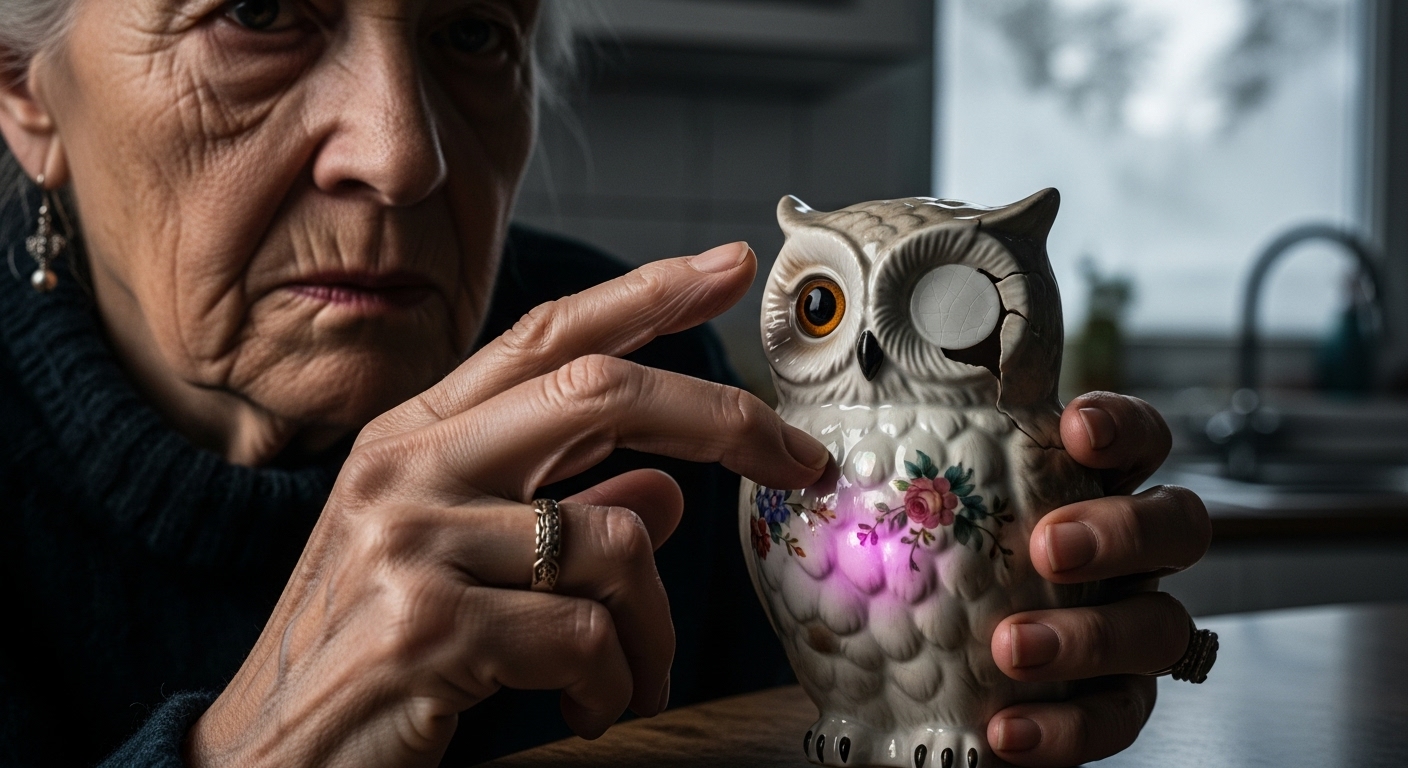
Agnes stood still, a half-used tea bag suspended in her hand, listening. The sound was distinct, and definitely coming from the small, cluttered shelf above the kettle. Her gaze, slow and deliberate, drifted upwards. Among the stack of rarely-used cookbooks, the faded plastic pot of dried basil, and a particularly unflattering photograph of her sister on a holiday to Blackpool, sat the porcelain owl. It was a dreadful thing, really. A wedding present from Bartholomew's Aunt Mildred, who had a penchant for anything vaguely 'olde worlde' and vaguely dusty. It had one good glass eye, a deep, knowing amber, and the other, a smooth, unblemished patch where its original eye had clearly popped out sometime in the mid-nineties. Its wings were painted with a pattern of forget-me-nots, a detail Agnes had always found profoundly depressing.
The hum was definitely coming from the owl.
She blinked, once, twice. "Oh, for heaven's sake," she muttered, her voice a dry rasp in the quiet kitchen. "Not you, too."
It wasn't a question, more of a complaint directed at the universe. First, Bartholomew’s insistence on talking to the garden gnomes for the last decade of his life, then Mrs. Henderson's cat, Mittens, developing a talent for predicting stock market fluctuations, and now a humming porcelain owl. Agnes was 78. She’d seen things. She’d lived through the War, disco, and several truly hideous fashion trends. She was well past the point of surprise, opting instead for a weary acceptance, often laced with a healthy dose of sarcasm.
She reached up, her hand bumping against the precarious pile of cookbooks, which shifted ominously. The porcelain felt cool, smooth, but there was a faint, almost imperceptible tremor beneath her fingertips. The hum intensified slightly, a barely audible 'mmm-mmm-mmm' that resonated in her bones rather than her ears. The single, amber eye of the owl seemed to gleam with a new, unsettling intensity.
"What is it, then?" she asked the owl, pulling her hand back and wiping it on her apron. "Are you getting ideas above your station? Is this a prelude to demanding millet seeds?"
The owl didn't reply, of course. But as she watched, the forget-me-not pattern on its left wing, the one where the sun used to hit, seemed to ripple. Not like paint drying, but like water on a pond. The blue deepened, then bled into a startling, almost violent magenta. The tiny, painted flowers elongated, twisting into something resembling miniature, gnarled roots before shrinking back, only to reappear as small, perfect, emerald green shamrocks. This whole process took perhaps five seconds, before the pattern reverted to its original faded blue forget-me-nots.
Agnes stared. Her lips thinned. "Well, that's just… unnecessary," she declared. "We've had these discussions before, Bartholomew. About the value of sticking to the script. No improvisations." She tapped her foot against the linoleum. The kettle began to whistle, a thin, reedy sound, finally announcing its readiness. She ignored it.
The owl hummed again, a deeper note this time, and the amber eye flared. A shimmer, like heat haze on a summer road, rose from its head. But this wasn't summer heat; it was winter in Agnes's kitchen. The shimmer intensified, forming a hazy, projected image directly in front of her, hovering just above the unboiled kettle. It was small, no bigger than a teacup saucer, and oddly grainy, like an old television struggling for reception.
The image resolved. It was Bartholomew. Younger, perhaps in his late fifties, his hair still more salt than pepper. He was wearing a ridiculous, mustard-coloured tweed jacket she'd hated, and standing in front of a giant, prize-winning cabbage at a village fete. He looked absurdly pleased with himself, his chest puffed out. This was a familiar memory, one that always brought a faint, weary smile to Agnes’s face. But then the image shifted. Bartholomew opened his mouth, not to grin at the cabbage, but to sing. Loudly. And badly. He was warbling 'My Heart Will Go On' at the top of his lungs, the cabbage shimmering slightly in time with his off-key vibrato. A tiny, glittery tiara suddenly appeared on his head.
Agnes scoffed. "Oh, please," she muttered, reaching for the neglected tea bag. "As if. He couldn't carry a tune in a bucket. And a tiara? That's just insulting."
The image flickered, then stabilised again. Now, Bartholomew was in a speedo, standing on a diving board. He was still fifty-something, but his physique was… surprisingly toned. Not the Bartholomew she remembered, who considered a brisk walk to the allotment a marathon. He flexed a bicep, then dove, a perfect, elegant swan dive, into an Olympic-sized swimming pool. He emerged, shaking his head, and a throng of beautiful young women, all in fashionable, minimalist swimwear, rushed forward to drape him in towels and offer him electrolyte drinks.
Agnes took a slow sip of her now lukewarm tea, the taste of cheap black tea doing little to soothe her. "Right," she said, watching the scene unfold. Bartholomew laughed, a rich, confident sound, as one of the women offered him a bunch of grapes. "And I suppose in this version, I'm off on a world tour with a boy band, am I? Living it up in Bali with six-pack abs and a penchant for interpretive dance?"
The owl hummed louder, and the image changed again. This time, it showed Agnes herself. Younger, perhaps forty-five, standing in the exact same kitchen, but with entirely different wallpaper – a lurid floral pattern she’d briefly considered in the late seventies. She was arguing fiercely with a younger Bartholomew, who looked genuinely contrite. "I told you, Bartholomew, it was a mistake!" the younger Agnes was saying, her face red with fury. "You bought a llama farm? A llama farm? Are you mad?"
The real Agnes leaned in closer, a strange, morbid curiosity gripping her. "A llama farm," she mused. "Well, that would have explained the distinct smell of wet hay that permeated his jumpers. And his peculiar affection for chewing cud." She hadn't known about any llama farm. Had he secretly bought one? Was this a glimpse into a life she'd narrowly avoided? The thought sent a shiver down her spine, not from fear, but from the sheer, bewildering pointlessness of it all.
The projected image faded, replaced by another. A small, grey tabby cat, not Mittens, was perched on the owl's head. It winked at Agnes. Just a simple, slow wink, before dissolving into static.
"Oh, for pity's sake," Agnes sighed, a melancholic weight settling over her. She pushed the kettle off the hob. She didn't want any more tea. She wanted a brandy, but it was barely noon. And anyway, she'd finished the last bottle after that particularly scathing documentary about pigeons.
---
A Quiet Absurdity
The owl’s hum softened, became almost a purr again. The shamrocks briefly reappeared on its wing, a flash of startling green against the faded ceramic. Agnes looked at the appliance, then at the calendar on the wall, marking the relentless march of another cold, unremarkable week. The snow outside was falling thicker now, large, lazy flakes drifting past the window like forgotten memories. Her hands, still slightly stiff, rubbed at a faint ache in her knuckles. The house, usually a bastion of predictable sounds – the fridge, the pipes, the wind – now held this new, quiet absurdity, an undercurrent of the bizarre.
She thought about calling someone. Her niece, perhaps. Fiona, always busy with her own brood, would offer a sympathetic ear and then probably suggest Agnes 'cut back on the late-night programmes'. Or worse, 'get out more, Auntie'. As if 'getting out' involved anything more thrilling than negotiating an icy pavement to the post box. Besides, how would one even begin? 'Hello, Fiona, dear. My porcelain owl is showing me alternate realities where your uncle Bartholomew is either a Eurovision contestant or an Olympic diver.' Fiona would arrive with a thermal blanket and a concerned look, and Agnes would have to endure a lecture on sensible living.
No, this was her particular cross to bear. Another notch on the long, bewildering stick of existence. The owl was just another thing, like the persistent drip under the kitchen sink she hadn’t bothered to fix, or the stubborn patch of black ice on the path to the bins. Life, even at 78, continued to throw its curveballs, often in the most mundane, ridiculous ways. And she, Agnes, was simply too tired to be truly alarmed, opting instead for a weary, almost journalistic observation of the unfolding oddities.
She walked over to the window, pressing a palm against the cold glass. The frost made the world outside look blurred, indistinct, as if reality itself was losing focus, much like the images the owl produced. The streetlamps were already flickering on, casting faint, orange halos in the falling snow. Everything felt softer, quieter, swallowed by the vast, white blanket. She remembered Bartholomew once saying winter was the season of truths, when everything was stripped bare. He’d been a romantic, in his own gruff way. She preferred to think of it as the season of layered clothing and hot water bottles.
The hum from the owl continued, a steady, rhythmic pulse in the quiet kitchen. It wasn't menacing, not exactly. More like a persistent, slightly off-key background tune. It felt like the house itself was breathing, a slow, ancient breath, and the owl was its vibrating larynx. She wondered if the house had always hummed this way, a secret vibration she’d only just tuned into. Or if it was, perhaps, reacting to her. Was she the catalyst for this bizarre eruption of alternative histories? The thought was almost… flattering. Almost.
Agnes turned back, looking at the owl. The amber eye, now a dull, steady glow, seemed to follow her. It held no judgment, no malice. Just… possibility. Endless, baffling, sometimes deeply irritating possibility. She felt a faint craving for something sweet, a digestive biscuit perhaps, but the biscuit tin was empty. Another small, immediate crisis in a day full of larger, more philosophical ones.
"So, what's next?" she asked the owl, her voice devoid of urgency, heavy with a resignation that bordered on exhaustion. "Are you going to show me the time Bartholomew accidentally dyed his hair purple trying to impress the Ladies’ Bridge Club? Or perhaps the universe where I actually said 'yes' to that dreadful man from the butcher shop?"
She picked up the porcelain owl, the smooth, cold ceramic a familiar weight in her hands. The hum was still there, faint but present. The single amber eye seemed to hold her gaze, less a knowing stare and more a patient, utterly baffling, emptiness. It offered no answers, only the promise of more absurdities. The air around it felt strangely still, yet charged, like the quiet before a particularly bad punchline. Agnes slowly lowered it back onto the shelf, the faint scent of something metallic, like an old coin, clinging to her fingers. She just stood there, watching the snow fall, and wondered if Bartholomew had ever encountered humming porcelain owls in his afterlife. And if he had, what truly ridiculous scenario they’d been showing him.
The hum persisted, a quiet, unsettling presence in the cold kitchen. Agnes stood, the faint metallic scent from the owl still on her fingers, and wondered if Bartholomew, wherever he was, had also encountered such absurdities.
Share This Story


