Beneath the Aurora's Quiet Hum
The community hall, a patchwork of old lumber and new insulation, shivered against the bite of the late autumn wind. Dust motes danced in the anemic light filtering through the high windows, illuminating the mismatched chairs pulled around a scarred pine table. The air was thick with the scent of lukewarm coffee and the lingering dampness of a building that had seen too many seasons. Outside, the early evening was already a deep, bruised purple, hinting at the aurora that would soon sweep the sky.
The fluorescent hum above them seemed to amplify the silence after Jimmy cleared his throat. Mike, hunched over his mug, watched the steam curl. He tapped a finger against the ceramic, a small, rhythmic tick. Bonita, across from him, had her hands clasped on the table, knuckles white, eyes fixed on a crack in the linoleum near Jimmy’s foot. Lucinda, usually quick with a sardonic comment, was just… still. A fly, late for winter, buzzed erratically against a cold windowpane.
“Right,” Jimmy said, his voice a little too bright, a little too loud in the quiet. He fiddled with the strap of his messenger bag, an unconscious gesture. “So, about the collective. The… Northern Weave Arts Initiative.” He paused, a forced smile on his face, waiting for the customary nods. They didn’t come. He shifted, a sigh barely audible. “Look, I know we’ve kept a lot under wraps. For good reason, honestly. Regulatory, funding streams… it’s complicated.”
Mike finally looked up, his gaze heavy. “Complicated, or… not what you said it was?” His voice, gravelly from years of smoking, cut through the room like cold air. He didn’t raise it, but the weight behind it made Jimmy flinch slightly.
“No, Mike, it is what we said it was. An arts collective. A space for innovation, for… fostering new talent.” Jimmy gestured vaguely at the peeling paint on the walls, a gesture that fell flat. “But it’s also… more.” He leaned forward, elbows on the table, trying for earnestness. “The Winnipeg hub, as you know, has been developing some pretty cutting-edge algorithms. For pattern recognition, primarily. In creative expression.”
Lucinda snorted, a sharp, disbelieving sound. “Pattern recognition. We paint pictures, Jimmy. We sculpt with clay from the riverbed. What patterns are you looking for? The way someone holds a brush?” Her voice was laced with a frustration that had been building for weeks.
“In a way, yes!” Jimmy seized on it, a nervous energy sparking in his eyes. “Think of it, Lucinda. We’re building a dataset. Of creative process. The iterations, the false starts, the moments of… breakthrough. We’ve been using the collective’s output – the digital archives of your work, the collaborative projects – to feed into the AI models.”
Bonita’s head lifted slowly. Her expression, usually placid, now held a bewildered anger. “You mean… our art? My digital embroidery series? The short films the youth group made? You’re feeding that to… to a computer?” Her voice was quiet, almost a whisper, but it resonated with a deeper betrayal.
The Unseen Architect
Jimmy’s face tightened. “It’s anonymized, Bonita, of course. Aggregated data. It’s all part of a larger initiative to understand the nature of human creativity. To perhaps, one day, augment it. To unlock new forms of expression that we can’t even imagine.” He glanced around, desperate for a spark of understanding, of wonder. He found none. Only Mike’s unwavering stare, Lucinda’s narrowed eyes, and Bonita’s quiet hurt.
“Augment it?” Mike repeated, the word sounding alien on his tongue. “We make art to feel, to remember. Not to… make machines smarter. What good is a machine’s smartness to a community like ours, Jimmy? One that’s just trying to keep the roof on, keep the young ones from leaving?”
“That’s exactly it!” Jimmy thumped the table, making the coffee cups jump. “This isn’t just some abstract academic exercise. The Winnipeg hub – our partners – they’re developing applications. Predictive models for community engagement. Resource allocation. Even flood resilience, leveraging the data from the 2022 rebuild here. Imagine, an AI that can forecast community needs, optimize funding, even predict artistic trends specific to a region!” He looked at Mike. “Imagine a system that could help us apply for grants with unprecedented accuracy, tailor programs to truly meet the needs of the youth, based on their evolving creative expressions.”
Lucinda pushed her chair back, the scrape a harsh protest against the linoleum. “You didn’t tell us any of this. Not when we spent hours on those digital portfolios. Not when we signed the waivers for ‘archival purposes’. You just… took it. Used us.” Her voice cracked, a raw edge of frustration. “We trusted you. This was supposed to be a safe space. A place where we could just… create.” She looked down at her hands, then back up, her eyes blazing. “And now you’re telling me my passion is just… input for your robots?”
“Not robots, Lucinda, AI. Algorithms. It’s a tool. A powerful tool.” Jimmy’s voice was losing its forced cheer, a hint of desperation creeping in. “Think of the potential benefits. The Winnipeg branch is massive, interdisciplinary. They have connections to government, to major tech firms. This collective here, in this ‘forgotten’ place, as you say, is the vital human element. The ground truth. The raw data that no lab could ever replicate.”
---
A sudden gust rattled the windows, and for a moment, the hall felt colder, older. Mike finally reached for his mug again, taking a slow, deliberate sip. “Raw data,” he murmured, almost to himself. “We are people, Jimmy. Not numbers. Not… inputs.” He set the mug down with a soft click. “The northern lights, they don’t need an algorithm to be beautiful. The way the river runs, it doesn’t need a prediction model. We live here. We feel. We know.”
Bonita, still quiet, finally spoke, her voice barely above a whisper. “My grandmother… she used to tell stories about the land. About how everything was connected. The trees, the water, us. She said the stories were how we understood. Not… not by breaking it all down into pieces for a machine.” She paused, a shiver running through her. “Are we… are we just pieces, then?”
Jimmy ran a hand through his already dishevelled hair. “No! Of course not. You’re integral. You’re the source. This is about helping you, helping the community flourish.” He leaned across the table, his face a mask of earnest appeal. “We can offer resources, access to technology… things that this community has been denied for decades. A chance to be at the forefront.”
“At the forefront of what, exactly?” Lucinda interjected, her arms crossed tight over her chest. “Being guinea pigs? Letting some city folks in Winnipeg use our lives as a science experiment?”
The air crackled with unspoken accusations, with the profound chasm opening between Jimmy’s technologically driven ambition and the community’s deeply ingrained, human-centric values. The repurposed community hall, a symbol of local resilience, now felt like a cage, or perhaps, a laboratory.
Jimmy opened his mouth, but no words came. His gaze darted from Mike’s stoic disapproval to Lucinda’s seething resentment, then to Bonita, who had retreated into herself, a quiet devastation radiating from her. He saw the flicker of the aurora begin outside the high windows, a pale green ghost against the deepening twilight, and for a moment, it felt like the sky itself was watching, judging.
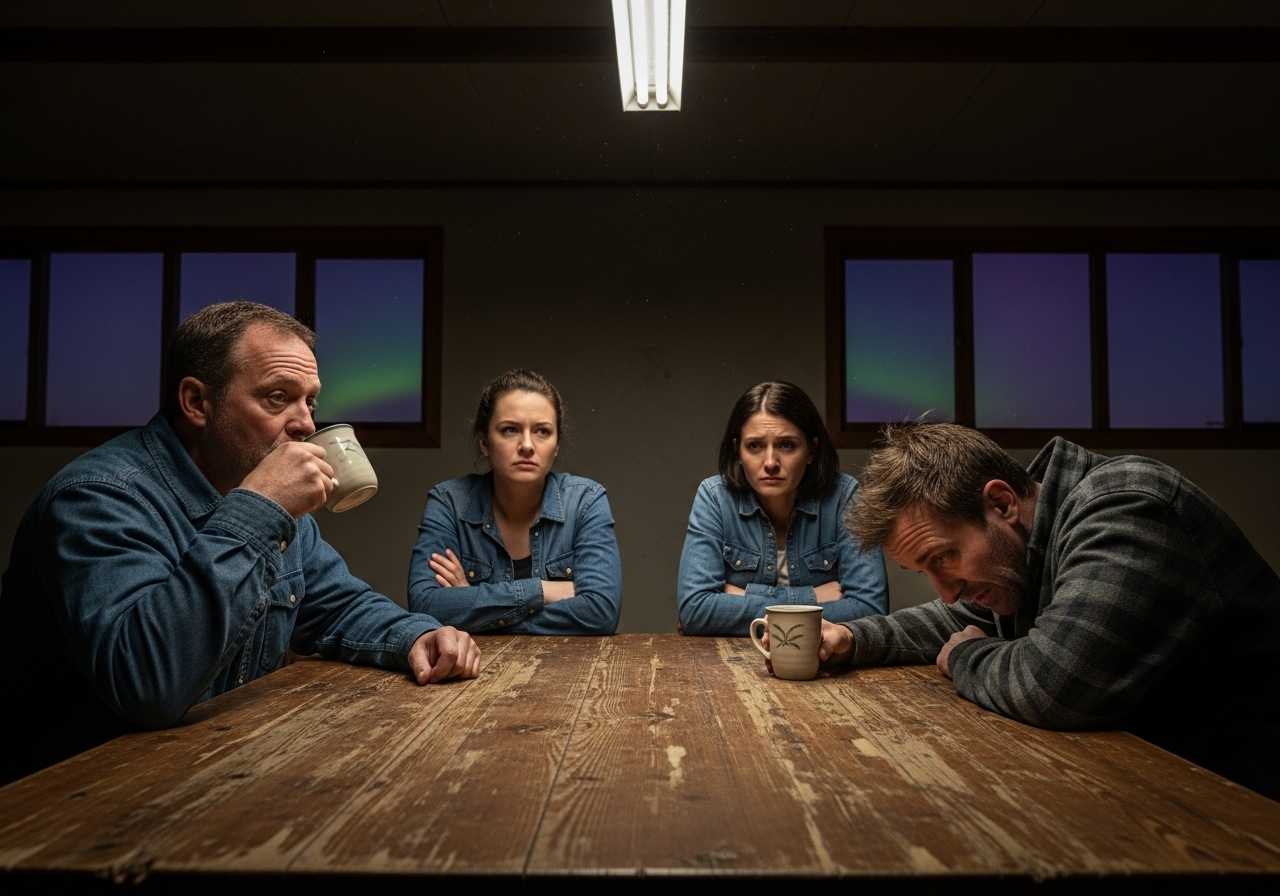
As the spectral glow of the aurora painted the frosty windows, Jimmy realised the chasm he’d opened wasn’t just between data and spirit, but between trust and an irreversible breach that might shatter the very community he claimed to want to save.
Share This Story


