The Hum of a New Project
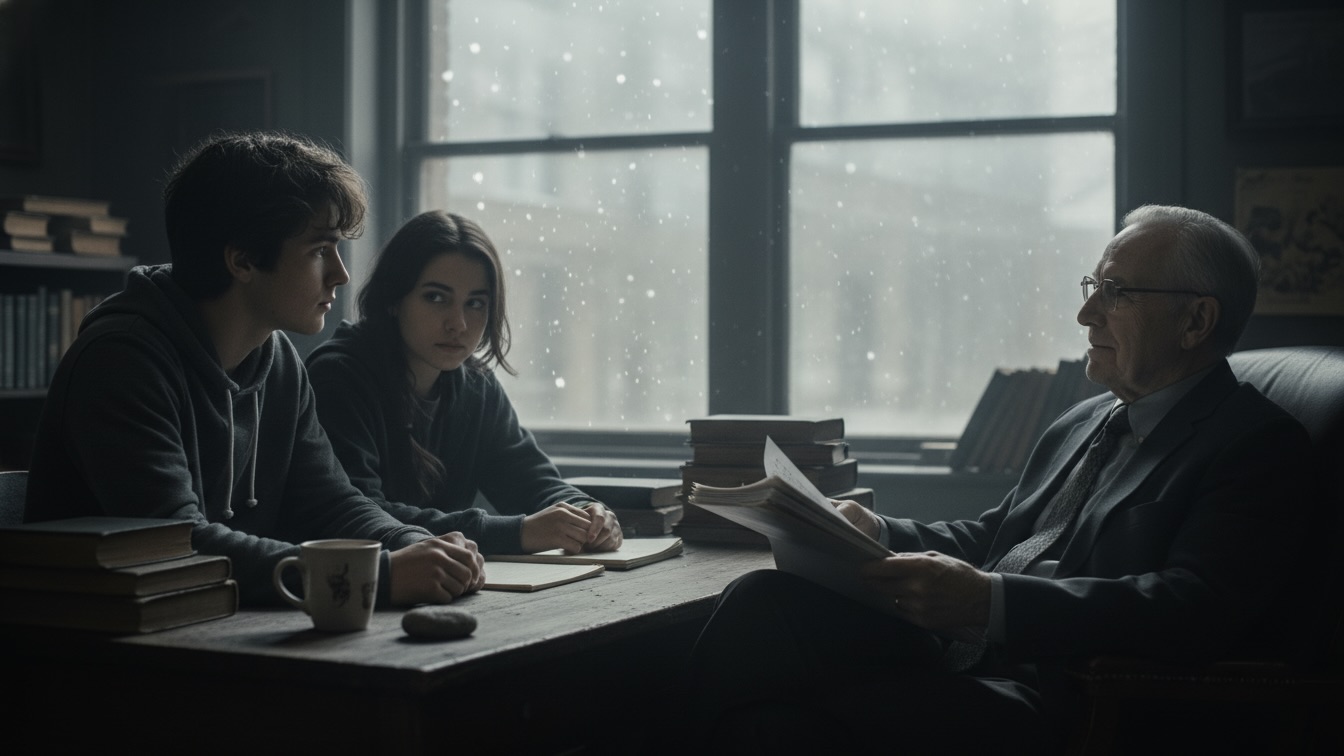
Steven and Jane, two teenagers, are in Professor Sterling's office on a cold winter day. They are engaged in a discussion about the profound impacts of art, transitioning from philosophical debate to the exciting proposition of a new community arts project.
The window pane, already streaked with condensed breath, showed a blur of falling snow. Steven watched it, felt the hum of the old radiator against his calf, a ghost of warmth against the chill radiating from the glass. His own reflection, distorted and pale, flickered in the dark glass, a stranger looking back. He should be listening, really. But Professor Sterling’s voice, a low rumble from behind the desk, had become part of the office’s ambient noise, a constant undercurrent to the soft thud of snowflakes against the building's brick exterior. Jane, across from him, had her chin propped on her hand, her eyes fixed on the professor. He tried not to stare, but the way a stray strand of her dark hair kept falling forward, just brushing her cheekbone, was a magnet for his gaze. He cleared his throat, a dry, small sound that got lost in the quiet.
“...and so, it’s not about grand gestures, is it?” Professor Sterling had been saying, adjusting his glasses, which were perched low on his nose. The office smelled faintly of old books and over-brewed coffee. Steven could still taste the bitter dregs of his own from earlier, a metallic tang on his tongue. “It’s about the incremental shifts. The subtle, almost imperceptible changes that art instigates within us. Or, perhaps, even within society.” He gestured vaguely with a pen, clicking it twice, a sharp sound in the otherwise muted room. The snow outside seemed to fall harder, faster, like tiny white secrets tumbling from the sky.
Jane finally spoke, her voice softer than he expected, a slight crack in it. “But what if… what if those shifts aren’t enough? What if the world keeps… crumbling, despite the art?” She picked at a loose thread on her worn jeans, her fingers quick and nervous. Steven felt a familiar twist in his gut. That question, that raw vulnerability, had been hanging in the air between them for weeks, ever since their last disastrous presentation on the socio-political impact of abstract expressionism. They'd been laughed out of the seminar, practically. It still stung, a dull throb behind his eyes.
Professor Sterling leaned back, his chair groaning under the weight. “Crumbling. A dramatic word, Jane. But perhaps not inaccurate. The world is always, in some sense, crumbling. It rebuilds, it shifts. And art… art is often the mortar, isn't it? Or perhaps the blueprint for the next iteration.” He looked from Jane to Steven, his gaze lingering a moment longer on Steven, as if expecting him to jump in, to provide the counterpoint. Steven just gripped his own knees, the denim rough under his palms. He didn’t have a blueprint. He barely had a chisel.
The silence stretched, punctuated only by the distant wail of a city bus struggling up a snow-covered hill. Steven’s mind drifted. He thought of the half-finished sketch pad in his backpack, charcoal smudged across his fingers from that morning. A portrait of Jane, actually. She wouldn't know. He’d torn it out, crumpled it, shoved it deep in the bottom of his bag. Too vulnerable. Too on the nose. He felt a blush creep up his neck, a heat he hoped wasn’t visible through his thick woolen sweater. God, he was so obvious. He cleared his throat again, this time with more force.
“I mean,” Steven began, his voice surprisingly steady, “it’s hard to see the impact when you’re… stuck in it. Like, we talked about Picasso, Guernica, right? A powerful statement. But did it stop the war? Did it change anything in the moment? Or was it just… a record?” He found himself looking at Jane as he spoke, searching her face for something, a flicker of understanding, a shared frustration. Her eyes, dark and serious, met his for a beat too long, and then she looked away, back to the professor.
Professor Sterling nodded slowly. “An excellent point, Steven. A record, yes. But a record that resonates. A record that changes how we feel about the past, and thus, how we approach the future. Art rarely provides immediate solutions. It provides the framework for us to find them. It shapes our empathy, our anger, our hope. It’s the language of the unspoken, the thing that connects disparate experiences. Think of it as a low-frequency hum. You don't always hear it, but you feel it in your bones, vibrating through the collective consciousness.” He paused, took a sip of cold tea from a chipped mug.
“Collective consciousness,” Jane repeated softly, almost to herself. She ran a hand over the smooth, worn surface of the wooden table. “But what if the hum just… fades? Or gets drowned out by everything else?” Her gaze was still distant, focused on something beyond the window, beyond the falling snow. Steven watched her, the curve of her jaw, the way her shoulders slumped ever so slightly. He wanted to reach out, to smooth the worry from her brow, but his hands felt heavy, glued to his knees. His chest felt tight, a familiar ache he couldn't quite name. It wasn't just about the art discussion; it was about her disappointment, her melancholy. And that made his own feel heavier.
“That’s where we come in, isn’t it?” Professor Sterling said, his voice gentle but firm. “The interpreters. The conduits. The ones who keep the hum audible, even if it's just for a few others. We create, yes. But more importantly, we perceive. We help others to perceive. That act of perception, of truly seeing or hearing or feeling another’s expression, is a radical act. Especially now. In a world that often prioritizes… noise.” He tapped the pen against his desk again, a rhythmic, almost meditative sound.
Steven thought of a time last summer, before everything felt so heavy, before the winter had truly set in. He’d been in a small gallery, a cramped space downtown, looking at a sculpture made of rusted metal and broken glass. It was ugly, really. Sharp edges, jagged lines. But there was something about the way the light caught it, something about the story the artist had left next to it, about loss and reconstruction, that had just… resonated. He hadn’t felt less lost that day, but he had felt seen. And that had been enough, for a little while.
“It's like… a shared loneliness, then?” Steven offered, the words coming out almost before he fully processed them. He risked a glance at Jane. She looked at him, really looked at him, and a small, almost imperceptible nod was all she gave. But it was enough. It was a bridge between them, a recognition. He felt a warmth spread through him, despite the cold outside, despite the melancholic swirl of thoughts. For a second, he wasn’t just talking to the professor; he was talking with Jane, a silent dialogue unfolding beneath the surface.
Professor Sterling smiled, a faint, tired expression. “A shared loneliness, a shared joy, a shared anger. Whatever the emotion, it’s shared. And that sharing, that connection, is perhaps the greatest impact of all. It reminds us we’re not alone, even when we feel utterly solitary. It allows us to process the complexities of our existence, to give form to the formless anxieties.” He leaned forward, his elbows on the desk, his hands clasped. “Consider the weight of the unspoken. The things we carry within us, the things we cannot articulate in everyday language. Art is the channel, the conduit for that release.”
Jane uncrossed her legs, then recrossed them, a rustle of fabric. “So, it’s not about changing the world, necessarily. It’s about changing how we survive the world.” It wasn’t a question, more of a statement, a realization dawning in her eyes. Steven watched her, captivated. He loved that about her – the way her mind worked, the way she distilled complex ideas into something so sharp, so clear. He felt a profound sense of admiration, a quiet hum growing within him that had nothing to do with art and everything to do with her.
“Precisely,” Professor Sterling affirmed, a hint of satisfaction in his voice. “Or perhaps, it’s about providing the courage to attempt change. Because once we feel connected, once we realize our struggles aren't unique, the burden lightens. The despair isn't quite as crushing. And from that lighter place, action becomes possible.” He looked at them both, a flicker of something hopeful in his usually weary eyes. “Think about it. Has there ever been a time in history when art wasn't present, even in the darkest moments?”
Steven thought of cave paintings, of protest songs sung in the streets, of murals on crumbling walls. Art wasn't a luxury; it was a fundamental human need, a desperate cry against the void. He felt a surge of something akin to purpose, a faint spark in the cold, winter air. It wasn't the fiery, passionate conviction he sometimes saw in activists, but a quieter, more resilient belief. A belief that even a crumpled sketch, unseen by anyone but him, held a piece of something vital.
“But the challenge,” Professor Sterling continued, “is making that connection palpable. How do we ensure that the hum doesn’t fade? How do we amplify it for those who need it most, but perhaps aren’t looking for it?” He picked up a small, smooth river stone from his desk, turning it over and over in his fingers. “This isn’t a theoretical question, mind you. This is… pragmatic. Urgent, even.” The shift in his tone was subtle, but Steven caught it. A tightening in the air, a sense of something new emerging from the melancholic reflection.
Jane leaned forward, her earlier slump gone, replaced by a keen intensity. “Are you talking about… outreach? Or something more?” Her eyes, now fully engaged, were fixed on the professor, but Steven could feel the unspoken current between them, a shared curiosity, a renewed energy. He felt his own posture straighten, a readiness he hadn't realized he possessed a moment before. The grey light outside the window hadn't changed, but something inside him had.
“Both, perhaps,” Professor Sterling said, setting the stone down with a soft click. He looked from Jane to Steven, a thoughtful expression on his face. “I’ve been speaking with the university board. There’s a new initiative. A community arts project, focused on engaging with… a less conventional audience. Think of it as an intervention. An injection of that ‘hum’ into places where the silence has grown too loud.” He paused, let his words hang in the air, allowing them to fully settle.
Steven felt his pulse quicken. An initiative. A project. This wasn't just a discussion about the philosophical merits of art; it was a call to action. He immediately thought of his charcoal sketches, of the small, hidden beauty he tried to capture in the mundane. Could that be a part of something larger? Could he be a part of something larger? He felt a sudden, almost overwhelming urge to tell Jane about the crumpled drawing in his bag, about the hundreds of other quick portraits he’d done, trying to capture the transient expressions on people’s faces.
Jane’s gaze met his again, a spark of something he couldn't quite identify in her dark eyes. Excitement? Trepidation? A shared sense of the unknown, perhaps. It felt like standing on the edge of a cliff, the wind whipping past, but with a strange, exhilarating promise on the horizon. He noticed a tiny speck of something on her cheek, a faint smudge he wanted to brush away. The thought was intrusive, distracting, but also… comforting. Real.
“The project needs… fresh perspectives,” Professor Sterling continued, picking up a pen again, this time twirling it thoughtfully between his fingers. “Students who understand both the theoretical and the practical applications. Who aren't afraid to get their hands dirty, so to speak. And who can articulate the intrinsic value of what they’re doing, even to those who might initially dismiss it.” He looked directly at them, one after the other, a challenging, yet encouraging glint in his eyes. “It’s ambitious. It’s untested. And it’s not for the faint of heart.”
Steven felt his heart pound against his ribs. Not for the faint of heart. He wasn't sure if he was faint of heart or not. But he knew, with an almost primal certainty, that he wanted to do this. He wanted to do this with Jane. The idea of collaborating, of spending more time with her, not just in a classroom but on a shared mission, sent a jolt through him that was both terrifying and utterly thrilling. It wasn't exactly a quest for a magical artifact, but it felt just as significant.
He watched Jane, waiting for her reaction. Her brow was furrowed in thought, her gaze fixed on the professor, but Steven could almost hear the gears turning in her mind. He knew she was weighing the risks, the potential for another academic misstep, but also the allure of a genuine challenge. She always gravitated towards the difficult, the meaningful. And he, somehow, always found himself gravitating towards her. This felt like a chance, a real chance, to bridge the gap between his unspoken feelings and their shared purpose.
“What exactly does ‘less conventional audience’ mean?” Jane asked, her voice steady now, devoid of its earlier crack. Practical, always practical. That’s what he loved about her, that groundedness. He, on the other hand, was always floating, always observing, always a little lost in his own head. Maybe they balanced each other. Maybe.
Professor Sterling allowed himself a small, knowing smile. “It means people who typically wouldn’t step foot in a gallery or a concert hall. People who might view art as frivolous, or elite, or simply irrelevant to their daily struggles. We’re talking about a series of workshops, installations, and performances, scattered throughout various community centers and public spaces across the city. Places that are often overlooked, often under-resourced.” He leaned back again, the chair groaning its familiar protest. “A true test of whether art can indeed be that mortar, that blueprint, even in the most neglected corners.”
Steven thought of the dilapidated community center near his apartment, the one with the cracked basketball court and the faded mural that looked like it had been there since the seventies. The idea of bringing something new, something vibrant, something that hummed with life into that space, felt incredibly compelling. He imagined setting up easels, or maybe even a small stage, watching people transform as they engaged with something beautiful, something thought-provoking. The melancholy of the winter day outside seemed to recede, just a fraction, replaced by a nascent flicker of hope. He could do this. They could do this.
He looked at Jane again, and this time, her eyes met his with an open, direct question. Are you in? He didn’t need to say a word. He just gave her a subtle nod, a silent affirmation. He felt the weight of the unspoken between them, a dense, complex tapestry of shared experiences, mutual respect, and a nascent, terrifyingly sweet affection. This project, this challenge, felt like a canvas awaiting their brushstrokes, a melody waiting for their harmonies. It was a chance to prove something, not just to the professor, but to themselves, and maybe, just maybe, to each other.
Professor Sterling watched their silent exchange, a faint, almost imperceptible smile playing on his lips. He knew. He must have known. He handed each of them a thick, stapled packet of papers. “It’s a significant commitment. Weekly meetings, field research, design proposals, and eventually, implementation. Think of it as a semester-long immersion. But if you succeed…” He paused, his gaze sweeping over them both, a quiet challenge in his eyes. “If you succeed, you might just find that the hum grows louder than you ever imagined. For yourselves, and for others.”
Steven took the packet, the smooth, cool paper a tangible weight in his hand. He glanced at the title page: ‘Project Chrysalis: Art as Catalyst.’ A catalyst. That sounded about right. He knew, with a certainty that settled deep in his bones, that this was more than just an academic assignment. This was a beginning. A door had opened in the quiet, melancholic winter, and he and Jane were standing on the threshold, a shared, silent understanding passing between them, ready to step into whatever lay ahead. He just hoped he didn't trip.
He just hoped he didn't trip.
Share This Story


