The Weight of the Past, The Promise of the Brush
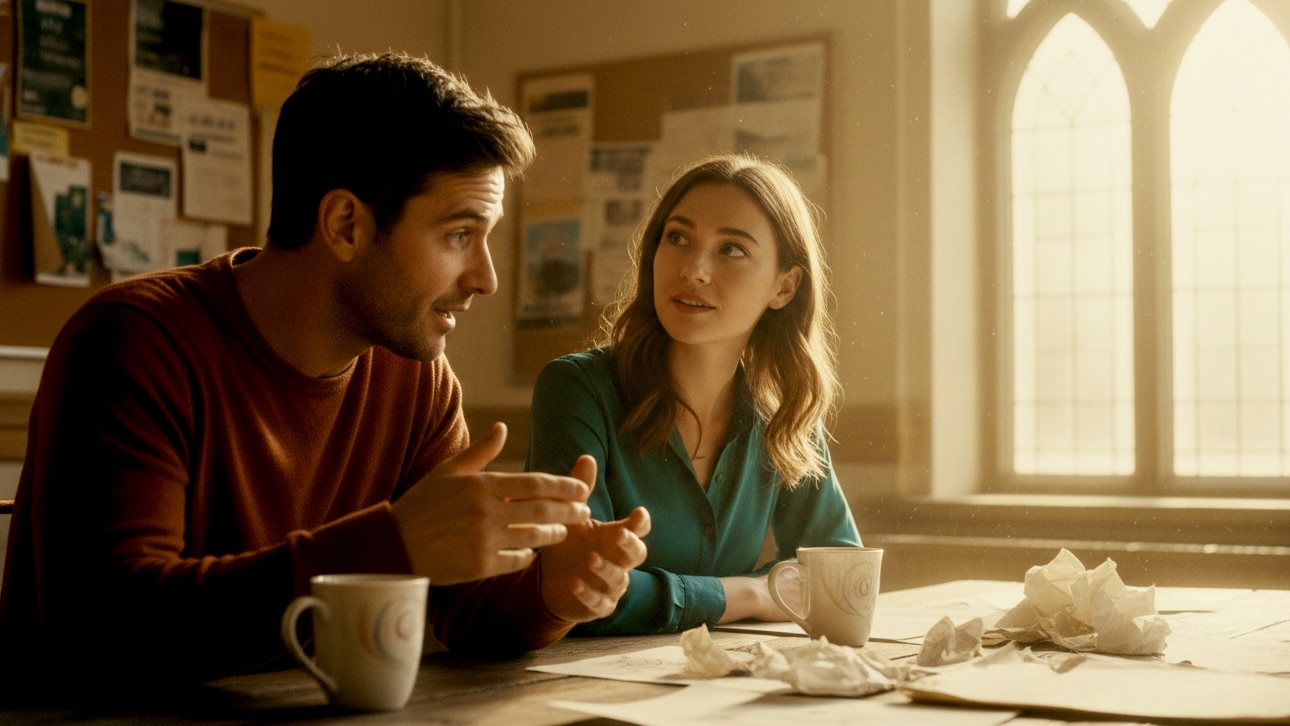
Owen, an artist in his early thirties, sits across from Cassie, a younger contemporary, in a sun-drenched, slightly peeling community hall. They are discussing their roles in curating a summer art exhibit focused on local history. The air hangs heavy with summer heat and unspoken tension.
“No,” I said, the word a flat stone in the humid air. “No more sepia tones.”
Cassie leaned back, scraping her chair against the linoleum. The sound was like fingernails on a blackboard, only slower, deliberate. Her brow, usually smooth, puckered. “Sepia tones are… classic. Evocative. It’s history, Owen. It literally is old photos.” She gestured with a pen, the cap still on, as if jabbing at some unseen archive.
My coffee, lukewarm in its chipped mug, sat between us. A fly buzzed lazily near the window, bumping against the glass, oblivious to our impasse. I watched it for a second, then Cassie. She had that stubborn glint in her eye, the one that meant she’d already mapped out ten counter-arguments in her head. We’d been at this for an hour, picking at the edges of the ‘Riverbend Chronicles’ exhibit concept like two kids sharing one last scoop of ice cream.
“Evocative, yes,” I conceded, trying for calm. My shirt, already damp against my back, was sticking. “But it’s also… tired. Predictable. This town’s history isn’t just faded photographs and forgotten ledgers. It’s got a pulse. Or it did, once. We need to find that.”
She snorted. “A pulse. So, what? We paint a mural of old man Hemlock at the sawmill, but make it neon? Give the town founder a glow-up with glitter?” Her tone was sharp, laced with the kind of playful cynicism I sometimes found grating, sometimes invigorating. Today, mostly grating.
“You’re simplifying,” I countered, a tight knot forming in my stomach. “I’m talking about… texture. The feel of the place. The stories not told in the official plaques. The sweat, the dirt, the quiet hum of the old textile mills before they shut down. The unspoken things.” I ran a hand through my short hair, feeling the faint prickle of sweat.
Cassie traced the rim of her own mug, a plastic promotional thing from the local bank. “And how do you translate the ‘unspoken things’ into an exhibit that draws people in? Especially people under, what, sixty? We’re talking about an audience that scrolls past everything in three seconds. If we just give them dusty facts, they’ll yawn themselves out the door.”
She had a point. I knew she did. The historical society, who were funding this, wanted engagement. New blood. They wanted to prove Riverbend wasn’t just a pit stop on the highway, a town slowly calcifying under the weight of its own past. But to sacrifice authenticity for clicks… it felt wrong. It felt like sanding down the rough edges of something precious.
I looked around the community hall. Fluorescent lights, buzzing faintly overhead, cast a pallor on the worn beige walls. A bulletin board near the entrance displayed faded notices for bingo nights and gardening clubs. This place itself was a relic, a testament to a certain kind of faded communal life. It smelled faintly of stale coffee and polished wood cleaner, a smell that clung to every public building in this town.
“What about the bricklayers?” I offered, shifting gears. “The Irish immigrants who built half these storefronts. The ones whose names aren’t on any monument, but their fingerprints are still on every single brick.” My own grandfather, a generation removed, had worked the quarries just outside town, hands perpetually calloused, smelling of rock dust and damp earth. That felt real. That felt like a pulse.
Cassie leaned forward, intrigued despite herself. “Okay, that’s… something. But how do you show that? A pile of bricks? A historical photo of faceless men covered in dust?”
“No.” My voice was firmer now. “We don’t just show them. We make people feel them. The grit. The heat of the kiln. The exhaustion at the end of a twelve-hour day. Maybe… maybe an installation. A series of large-scale portraits, not of individuals, but of hands. Working hands. Calloused. Raw. Each one different, telling its own story without needing a caption.” I imagined it: deep charcoal, thick impasto, colors muted but powerful. The light catching the raised textures.
She hummed, a low, thoughtful sound. The pen tapped against her mug. “Hands. Okay. But that’s still… very you, Owen. Very traditional media. What about something interactive? Something that puts the viewer in that space, even for a moment?” Her eyes lit up with a familiar spark. Cassie, always pushing boundaries, always looking for the digital edge. She saw the world in layers of code and projected light, where I still saw canvas and pigment.
“Like what?” I asked, bracing myself. I knew where this was going. She’d spent her college years immersed in new media, in virtual realities and augmented experiences. Her last solo show had involved a sprawling projection mapped onto a decaying grain silo, transforming its rough concrete into a pulsing, digital organism. It had been brilliant, yes. But for a history exhibit… I worried about losing the human element.
“Imagine,” she said, her voice picking up speed, “a wall, right? Blank. But as you walk past, sensors pick up your movement. And images, memories, fragments of old interviews with descendants of those bricklayers… they start to bloom on the wall. Not just static images, but almost like ghosts. Fading in, fading out. Whispering their stories. Maybe the sound of hammers, of bricks being laid. You’re not just looking at history; you’re walking through it.” She was almost vibrating with enthusiasm now, her hands moving through the air as if sketching the invisible projection.
It was a powerful image, I had to admit. It had a certain visceral appeal. The idea of ephemeral history, something you almost catch before it vanishes. It definitely wasn't sepia. It wasn't even paint. It was light and shadow, sound and motion. But was it… honest? Did it respect the weight of those lives, or just turn them into a fleeting spectacle?
“It’s… interesting,” I said slowly, weighing my words. “But does it leave room for contemplation? For the quiet dignity of their labor? Or is it just another fast-food history experience?” The criticism felt unfair even as I spoke it, but the thought was there, nagging at me.
Cassie’s shoulders slumped slightly. “You always do this. You assume anything modern automatically cheapens the past. It’s not about fast food, Owen. It’s about accessibility. About making people care. You can paint the most beautiful, nuanced portrait of a bricklayer’s hand, but if no one looks at it, what’s the point?” Her voice had a genuine frustration in it now, a weariness I recognized. We’d had this argument, in various forms, a hundred times.
“And if they look at it, but it’s just a flashy gimmick, what then?” I pushed back, the knot in my stomach tightening further. “Do they really feel anything? Do they understand the weight of that history, the human cost, or do they just walk away impressed by the tech, forgetting the story five minutes later?” I was starting to sound like my father, I realized, shaking my head internally. He, a retired history professor, saw most modern art as an affront to intellectual rigor.
She picked up her phone, swiping through something, her attention drifting. I knew that gesture. It meant she was disengaging, or gathering new ammunition. Probably both. The summer heat was oppressive, pressing down on the old hall, making everything feel sluggish and thick. Outside, I could hear the distant drone of a lawnmower, the sharp cry of a hawk. Life, stubbornly, went on beyond our artistic squabbles.
“Look,” she said, without looking up from her screen. “The curator. She specifically said she wants to bridge the gap. Old and new. We both got chosen for a reason, right? Your reverence for the past, my… my ability to make people pay attention.” She finally met my gaze, a wry half-smile playing on her lips.
“A reverence for accuracy,” I corrected, unwilling to yield that ground. “And your ability to… digitally enhance.”
She chuckled. “Fair enough. But we’re still stuck. Hands. Projections. How do we make them talk to each other?” She finally put her phone down, leaning forward, her earlier frustration giving way to a more familiar, collaborative energy. This was Cassie, at her best: challenging, but ultimately seeking synthesis.
The air conditioner, a relic from the eighties, rattled to life with a wheeze, blowing a weak current of slightly cooler air our way. It smelled metallic, dusty. I pushed my mug aside. My fingers tapped on the scarred wooden table. The problem wasn’t just the medium; it was the narrative. What story were we trying to tell? And why? What did Riverbend, this collection of old brick buildings and forgotten rivers, mean to us now?
“Okay,” I said, sighing. “Let’s step back. Beyond the bricklayers. What’s another… moment? A specific time that feels authentic, but also has a thread we can pull into the present?”
Cassie thought for a moment, chewing on her lip. “The old textile mill fire?” she suggested. “Nineteen forty-eight. Decimated half the workforce. Mostly women. They rebuilt, but the town was never quite the same after that.” She looked at me, gauging my reaction. This was closer to my wheelhouse: real tragedy, real impact, real human stories. Not just bricks, but lives.
“The fire.” I nodded slowly. “That’s… something. The smell of burning linen, smoke clinging to everything. The way the river ran black with soot for days.” My father had told me stories about it, not from memory, but from interviews he’d conducted for a local historical journal. The collective grief, the resilience, the quiet desperation.
“And what about the rebuilding?” Cassie continued, her mind already racing. “The sheer will to start over. The collective effort. Maybe that’s the thread. Not just the tragedy, but the rising from the ashes.” Her eyes were bright again, full of possibility.
“Rising from the ashes,” I repeated, testing the phrase. It felt a little too neat, too heroic for the slow, painful grind of recovery. But it did carry a hopeful undertone. Something tangible. “How would you ‘digitally enhance’ that, then? A wall of flickering flames turning into… what? New steel beams?”
She grinned. “Oh, I could do something with that. Imagine: the gallery dark. You walk in, and you’re surrounded by the roar of the fire. The heat, the light. Then, slowly, the flames recede, revealing ghostly figures working, rebuilding. Their faces, their determination. Maybe you reach out, and your hand breaks through a layer of digital ash to reveal a growing sapling, a new green shoot.” She was practically vibrating with the idea now, her imagination already charting the complex algorithms, the sensor arrays, the layered projections.
It was ambitious. Probably expensive. And, frankly, a little intimidating. But I couldn’t deny the power in it. The way it could grab a viewer, immerse them. It wasn't just spectacle; it had the potential for genuine emotional resonance. If we could ground it, really make those 'ghostly figures' feel like real people, not just pixels. If we could weave in authentic details, the actual faces of the women, the names of the families…
“And your hands installation?” she asked, pulling me back. “Where do the bricklayers fit in with the fire? Or do we pick one?”
“No,” I said, a new thought solidifying in my mind. “They’re not separate. They’re woven together. The bricklayers, they built the original mills. They laid the foundations, literally. And then their descendants, perhaps, worked in those mills, fought those fires, rebuilt the town brick by brick again. It’s a continuous thread. Not just one event, but the echo of generations in the very fabric of the place.”
I looked at her, really looked at her. Her face, flushed with enthusiasm, reflected the light from the window. The heat still pressed, but a current of excitement, something new and fresh, had begun to flow between us. It wasn’t a compromise, not really. It was a synthesis, a way to respect both the past’s quiet dignity and the present’s urgent need for connection.
“So,” Cassie said, a wide grin spreading across her face. “We tell the story of the hands that built Riverbend. The hands that worked, that suffered, that rebuilt. From the first brick laid to the last beam placed after the fire. And we make people feel those hands, not just see them.”
I leaned forward, a surge of adrenaline pushing back the summer lethargy. “Exactly. The texture of it. The weight. And the hope that comes with building, even when it’s from ashes.” My mind was already racing, sketching out charcoal studies, considering palettes, imagining how the rough paper could convey the feeling of brick, of worn skin, of resilience. Maybe I could even incorporate actual samples of brick dust, ground into the paint, to give it that gritty realism.
“Okay,” she said, standing up, the plastic chair scraping again. This time, the sound didn’t grate. It felt like a punctuation mark. “Okay, Owen. I think we have something.” She paused, then added, “But we still need to figure out how to project the brick dust.” She winked.
I laughed, a genuine, full-throated laugh that surprised us both. “We’ll get there. First, we need to find more than just dusty facts. We need the real stories. The personal narratives. The echoes.” The curator had mentioned a trove of old family journals donated by a long-standing Riverbend resident, a descendant of one of the mill owners. They were tucked away in the historical society’s forgotten corners, waiting. Waiting for someone to pull them out, to read between the lines, to give them breath again. Waiting for us.
Waiting for someone to pull them out, to read between the lines, to give them breath again. Waiting for us.
Share This Story


