The Old Guest Room's Secret
A tense conversation between a teenage boy and his aunt about a family secret surrounding a missing cousin from a long-ago Christmas, taking place in a neglected family home in spring. The teen begins his own investigation, discovering a small, unexpected clue.
“You saw what you wanted to see,” his aunt said, her voice thin, brittle, like old parchment catching fire. The morning light, pale and weak through the smudged windowpane, did little to soften the sharp angles of her face. He just stood there, hands shoved deep into the pockets of his worn hoodie, the hem already frayed from nervous picking. The smell of damp earth and something vaguely metallic clung to the air, a scent that had seeped in from the garden after last night’s unexpected downpour. A chill settled in his chest, not from the cold spring air, but from the way she looked at him, like he was a child again, making up stories about monsters under the bed.
He watched a fly buzz sluggishly against the glass, a tiny, insistent thrum that grated on his nerves. “That’s not true. I heard it. You were there. We all were.” He knew he sounded desperate, and the sound just made the knot in his stomach tighten. It was always like this. Every time he tried to bring it up, every time the words stumbled out, half-formed and accusing, the family closed ranks. A wall, silent and unyielding, would rise. His aunt, the matriarch now, the one who held the frayed ends of their lineage, was always the first brick.
Her gaze flickered to the empty fireplace, then back to him. “Childhood memories. They twist, don’t they? Become something… more dramatic than they were.” Her fingers, gnarled with age, picked at a loose thread on her sweater. It wasn’t a nervous tic, more of an ingrained habit, a small, constant act of maintenance that mirrored her attempts to keep their fractured family history intact. He knew what she was doing. She was rewriting the script, blurring the lines, making him doubt his own eyes, his own ears.
“I was thirteen, Aunt. Not five. I remember. The arguments. The quiet. The way she just… wasn’t there the next morning.” He felt the blush crawl up his neck, a familiar heat of frustration and unheard truth. He could still feel the gritty texture of the old carpet beneath his bare feet that morning, the unnatural hush of the house before anyone else was awake. The memory was sharp, vivid, a persistent sliver under his skin. It had happened, he knew it had. But no one else would ever admit it.
The room, once vibrant, now sagged with the weight of forgotten celebrations. Dust motes, though forbidden to use as a cliché, truly did dance in the limited light, making the air feel thick, ancient. He tried to focus on something else, anything to anchor himself. A crack in the plaster above the doorway, shaped like a lightning bolt. The faint, sweet smell of something rotting in the corner, perhaps an old apple forgotten in a fruit bowl. The house itself felt like a living thing, slowly exhaling its last breath, its secrets trapped within its sagging timbers. He ran a hand through his hair, the gesture rough, almost violent. He needed more than just his gut feeling.
His aunt sighed, a long, drawn-out sound that implied exhaustion, not sympathy. “Look, what happened… it was a long time ago. People move on. You should too.” She said it like a decree, a final judgment. But he couldn't. Not when the unease, the nagging doubt, had burrowed itself so deeply into him that it felt like part of his own bone structure. It was Christmas Eve, all those years ago. The house had been packed with too many relatives, too much noise, too much forced cheer. And then… the quiet. The sudden, profound quiet that followed the storm of the arguments. And the woman, his distant cousin, gone. No note, no trace, just an empty bed and a gaping hole in the forced festivities.
He shook his head, a slight movement that was more defiance than anything else. “No one just moves on from that, Aunt. Not when no one knows where she went. Or why.” He felt a tremor in his voice. This wasn't just a memory; it was a scar. A wound that had never properly healed because it had been ignored, plastered over with flimsy excuses and convenient forgetfulness.
“We told the police everything,” she said, her voice rising slightly, the brittle parchment almost cracking. “They found nothing. No foul play. She just… left.” She walked to the window, pulling back the thin, moth-eaten curtain. Outside, the spring morning was attempting a comeback, patches of blue sky pushing through the grey. A robin hopped across the damp lawn, pulling at a worm. Life, insistent and indifferent, carried on. But inside, the air was still heavy with ghosts.
He watched her profile, the sharp jut of her chin, the way her lips pressed into a thin line. She was hiding something, he was sure of it. Or protecting something. Or someone. He remembered the hushed conversations, the way adults would change the subject when he walked into a room. The way his own parents, usually so open, would shut down, their faces becoming masks of vague concern whenever he asked about the missing cousin. It wasn't just about her; it was about the family itself, the veneer of respectability, the unspoken rules.
He needed to go back. Not to that Christmas, not in his head, but to the physical spaces that held the residue of that night. The old guest room where she’d slept, now used for storage. The drawing-room where the final, furious argument had taken place, the one he’d overheard, huddled on the landing, pretending to read. The shed at the back of the garden, where his uncle used to keep his tools, and where, for some inexplicable reason, he remembered seeing his father wiping something off his hands that morning, looking pale and agitated. These fragmented images, like torn photographs, demanded a story.
“I’m going upstairs,” he said, his voice flat, devoid of emotion, a deliberate contrast to his internal turmoil. He didn’t wait for a response. He heard his aunt sigh again behind him, a sound of resignation and irritation. He climbed the grand, creaking staircase, each step a protest against the silence, the weight of the house. The banister was smooth and cold beneath his palm, a silent witness to decades of comings and goings, of secrets whispered and kept.
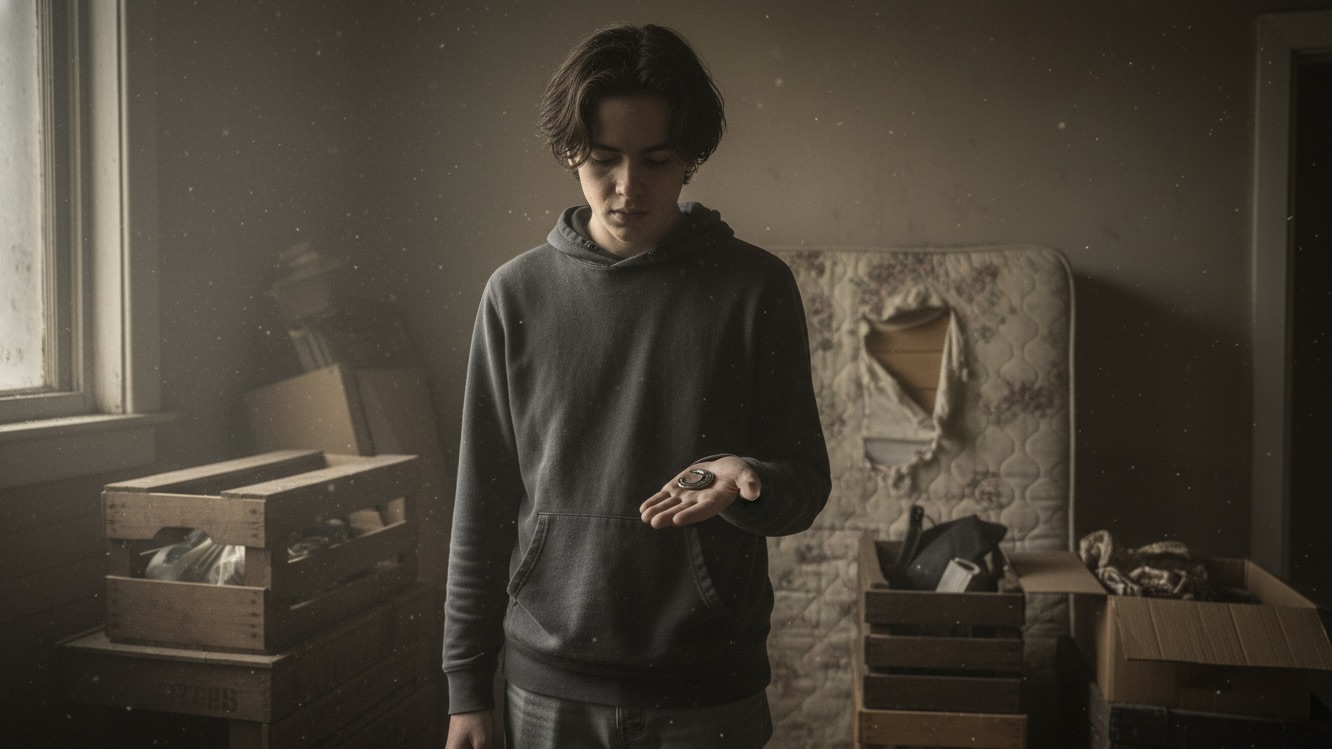
The guest room was crammed with forgotten furniture, boxes of old records, faded photo albums. The air was stale, thick with the scent of mildew and decaying paper. He moved carefully, brushing aside cobwebs, his fingers trailing along the dusty surfaces. The bed where she had supposedly slept was piled high with blankets and ancient winter coats. He started to methodically remove them, one by one. Each item felt heavy, imbued with the dust of time, of neglect.
Underneath it all, the bare mattress. No, not bare. A faint indentation, a ring, as if something small and round had been pressed into the fabric for a long time. He ran his fingers over it, then looked closer. The impression was too precise to be random. He thought back to the few photos he had of the missing cousin. Her hands. Always her hands. And on one finger, a simple silver ring, a family heirloom. He remembered seeing it sparkle that Christmas Eve, catching the flickering lights of the tree.
He reached down, his fingers probing the mattress, feeling for anything loose, any tear. Nothing. He then checked the frame, running his hand under the slats. His fingers brushed against something cold, metallic. He pulled it out. It was small, a dark, tarnished silver earring, the kind that might have come from a cheap Christmas cracker. Not the ring, but a clue nonetheless. It didn't belong to her. He remembered her style – elegant, understated. This was… cheap. And why would it be under the mattress? Did she find it? Was it left by someone else?
A shiver ran down his spine. The room, oppressive moments before, now felt charged, expectant. This was a start. A tangible piece of evidence against the convenient narrative his aunt had offered. He slipped the earring into his pocket, the cold metal pressing against his thigh. He felt a surge of something akin to excitement, a dark thrill of discovery, mixed with the dread of what it might mean. This wasn't just about a missing cousin anymore. This was about the stories they told themselves, the lies they lived by.
He descended the stairs, the small earring a burning coal in his pocket. His aunt was still by the window, now staring out at a patch of daffodils pushing through the dark soil, vibrant and defiant. He cleared his throat. She turned, her expression unreadable. “Aunt,” he began, his voice steadier this time, “Do you remember anything about that Christmas… anyone else who was staying, or who might have dropped by unexpectedly?” He watched her face closely, searching for the flicker, the hesitation, the tell-tale sign of a hidden truth. She just stared at him, her lips a thin, resolute line. He knew this would be a long, slow excavation. He needed to find the old photo albums, the ones his aunt kept tucked away in the attic, the ones filled with faces he barely recognized but who might hold pieces of the puzzle. He needed names. He needed places. He needed to sift through the layers of dust and denial, to find the true ring of frost that had settled over their family that long-ago Christmas.
He needed names. He needed places. He needed to sift through the layers of dust and denial, to find the true ring of frost that had settled over their family that long-ago Christmas.
Share This Story


