Interrogating the Margin
The air in Room 307 was thick, not with anticipation, but with the quiet, desperate hum of concentrated anxiety. The smell of stale coffee from Mr. Harrison’s mug mingled with the faint metallic tang of old radiators, a scent that always clung to exam days, cold and unforgiving. Outside, the sky was a bruised, heavy grey, mirroring the weight settling in Leo’s chest. This wasn't just a test; it was the hinge.
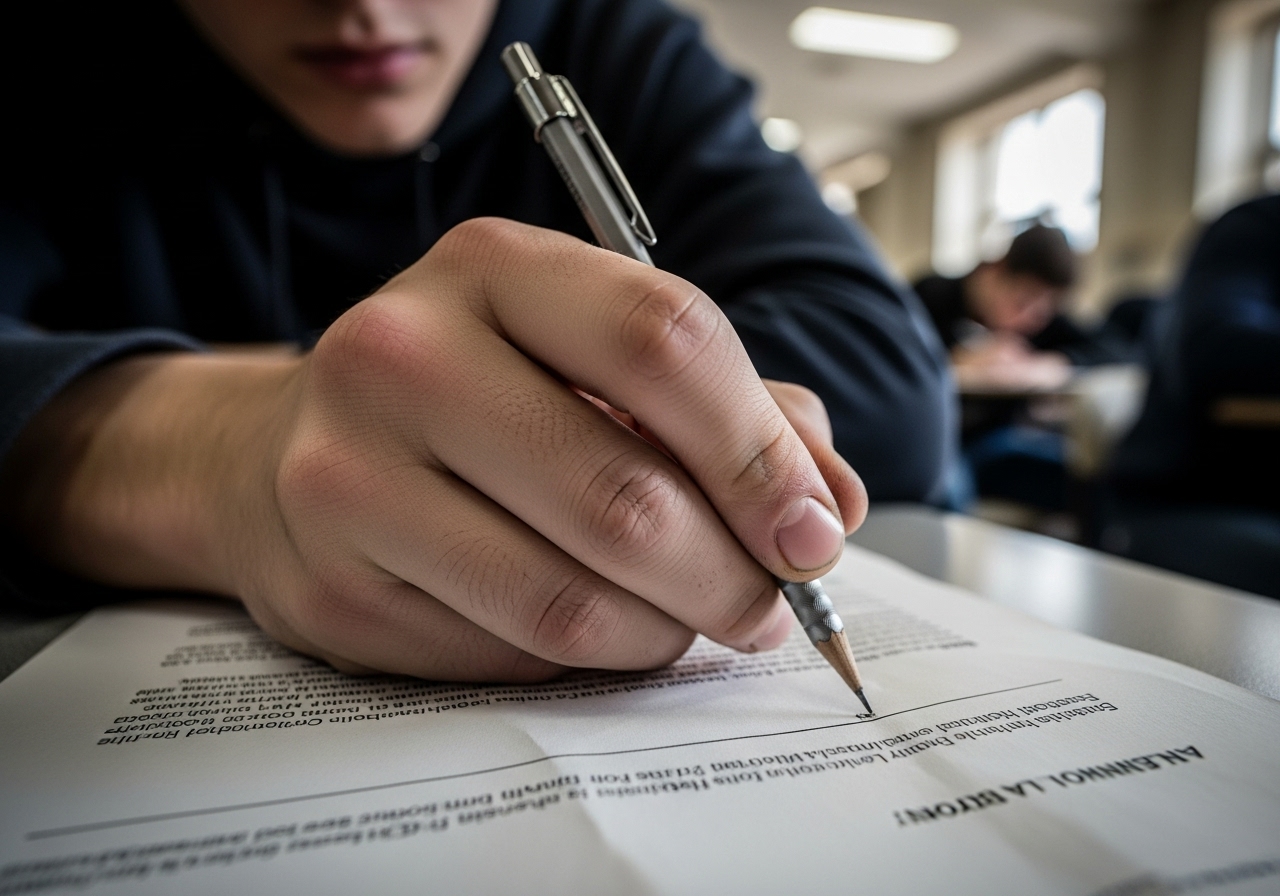
The clock on the wall above Mr. Harrison’s head dragged. Each tick was a tiny hammer blow against Leo’s temples, sharp, insistent, and utterly relentless. He stared at Question Four, the words blurring, then sharpening, then blurring again: 'Analyse the socio-economic impacts of the late 21st-century resource scarcity in the North American seaboard communities.' His cheap mechanical pencil hovered, leaving a sheen of sweat on the thin, recycled paper. The room was thick with the scent of old textbooks and the faint, nervous body odour of twenty-odd teenagers, a concoction that made his stomach clench.
He shifted, the plastic seat groaning a low protest beneath him, its edge digging into his thigh. His knee knocked against the desk leg, a dull thud that felt amplified in the oppressive quiet. Two rows over, Chloe was a blur of focused movement, her pen scratching a confident, steady rhythm. A pang of something unpleasant, envy mixed with a familiar, sickening resignation, twisted in his gut. Her notes, he remembered, were always immaculate, her handwriting precise, even under pressure. Mine, he thought, were a jumble of angry loops and frantic underlining, a map of his own chaotic brain.
The Current's Pull
His own notes for this section were a mess. He’d studied, mostly. Or tried to. But last night… the words just wouldn’t stick. The argument with his step-dad, Mike, still hummed behind his eyes, a low-frequency vibration that rattled his concentration. It had been about the electricity bill again. Always the bills. And his mum, caught in the middle, her voice thin and tight like stretched wire. He could still see her face, pinched with that familiar worry, a shadow that seemed to follow her everywhere these days. It was this, all of it, that made this test feel less like an assessment of historical knowledge and more like a referendum on his entire future.
He pressed the pencil lead harder, and it snapped with a soft tink. A tiny, insignificant sound, yet it felt like a gunshot in the oppressive silence. Mr. Harrison glanced up from his own reading, his eyes, magnified behind thick spectacles, briefly sweeping the room before settling back on his book. Leo felt a flush creep up his neck. Stupid. So stupid. He fumbled in his pouch for another lead, his fingers clumsy, scraping against the bottom, finding only a stray paperclip and a piece of dried-up chewing gum.
The heating vent above his head hummed, a low, irritating drone that seemed to pull at the loose hairs on his arm. He wished for rain, a downpour, anything to break the suffocating quiet, anything to give him an excuse for the blank space on the page. He knew the concepts, vaguely. Resource depletion. Social stratification. But the specific examples, the dates, the economists’ names… they were all a blurry, grey mass, just out of reach, like words remembered in a half-sleep. His mind kept drifting to the crack in the ceiling above the window, shaped like a crooked lightning bolt. Had it always been there?
---
He forced himself to write, scribbling out a few hesitant lines about rising sea levels and displaced coastal populations. He felt a fleeting sense of vague accomplishment, then immediately doubted every word. He crossed out 'significant displacement', replacing it with 'widespread forced migration', then frowned at 'forced migration' too, the pen leaving a dark, smudged streak. His handwriting was getting worse, leaning to the right, a desperate scramble across the page. This wasn't the meticulous, insightful analysis he needed for the scholarship.
Mr. Harrison paced, his soft-soled shoes barely audible on the scuffed linoleum, a phantom presence. The teacher’s slow, deliberate movements were a weight, a constant reminder of the passing time, of expectations. The weak, diffuse autumn sunlight, or what passed for it, struggled to break through the stubbornly overcast sky, throwing a pale, watery rectangle onto the far wall. It offered no comfort, only highlighted the dull grey of everything else. Leo pressed his tongue against the inside of his cheek, a nervous habit, tasting the metallic tang of his own anxiety.
He could almost feel Chloe’s eyes on him at one point, or maybe it was just his paranoia. He didn’t look up. Couldn’t. He just kept staring at the paper, willing the answers to appear, to coalesce from the fog in his brain. The phrase 'North American seaboard communities' echoed in his head, a hollow, mocking sound. He thought of the documentaries he’d half-watched, the news clips playing in the background while he’d tried to finish his history essay last week. The faces of people, weathered and worried, on sinking islands. He could picture them, but he couldn't put their plight into academic prose.
The final frantic push. He scraped together some points, anything, sacrificing coherence for volume. Keywords, that's what Mr. Harrison always said. Scatter enough of them, and something might stick. Climate refugees. Economic disruption. Geopolitical tension. He wrote them down like incantations, hoping they would magically summon a passable grade. His fingers cramped, a sharp, dull ache. He wished he’d brought a water bottle. His mouth felt like sandpaper. He could smell the faintest hint of something sweet from the girl in front of him, chewing gum, probably. Why hadn't he thought of gum?
A deep, resonant voice cut through the quiet, making him jump. 'Five minutes left, everyone.' Mr. Harrison. His heart thudded against his ribs, a frantic bird trying to escape a cage. Five minutes. It wasn't enough. It was never enough. He scribbled a conclusion, something vague about 'unprecedented challenges' and 'resilience in the face of adversity.' It sounded like a textbook summary, exactly the kind of generic phrasing Mr. Harrison always warned against. But what else could he do? The clock seemed to accelerate, its hands blurring.
He slapped the pencil down on the desk, the small clatter echoing, and grabbed his paper. He marched it to the front, avoiding Mr. Harrison's gaze, dropping it onto the already towering stack. The relief was instant, overwhelming, a dizzying rush that almost made him stumble. But it was quickly followed by a cold, creeping dread. He hadn’t done enough. He knew it. This might be it. The end of the scholarship. The start of another round of arguments with Mike.
He practically bolted from the classroom, not waiting for Chloe, needing air, needing to escape the suffocating walls. The corridor was blessedly empty, quiet except for the distant murmur of voices. He reached his locker, fumbling with the combination, his hands still trembling slightly. Tucked into the grimy metal grille, a folded piece of paper. Not a note from Chloe. Not a school announcement. It was a newspaper clipping, a torn corner of a story he hadn’t seen, hastily cut out, with a bold, black headline screaming about new zoning permits and the imminent demolition of the old market district. His mum’s shop. The only thing she had left.
The headline pulsed, a dark promise of upheaval, making the history exam feel suddenly trivial, insignificant against the storm now brewing at home. He stared at the words, the paper trembling in his hand, a cold knot tightening in his stomach.
Share This Story


