The Fading Light and What it Casts
Perched in a borrowed studio above Portage Avenue, a young artist named Leo observes the relentless pulse of rush hour. The late autumn sun bleeds across the cityscape, mirroring the internal turmoil of a mind grappling with a world that feels increasingly fragmented.
I'm looking down from the third-floor window of what Marcus insists is our studio, but it’s really just his, and I’m a grateful squatter. Portage Avenue was a throbbing vein below, a river of steel and exhaust fumes, the late autumn sun bleeding across the glass towers of downtown. Each brake light bloomed a brief, angry crimson before fading into the smeared tail of the car ahead, a phantom echo of rage. It was just after five, the full-throttle exodus, and every single person down there, crammed into their metal cocoons, was rushing somewhere, or away from somewhere. Mostly away, I figured. Away from the fluorescent glare, the cubicle-shaped anxieties, the faint, metallic scent of recycled office air that clung to their clothes.
My sketchbook lay open on the dusty wooden sill, a half-finished pencil drawing of the very scene I was watching. Not exactly original, I knew. A streetscape. But it wasn’t about being original, not today. It was about trying to capture the sheer volume of it. The weight that settled over the city like a blanket made of industrial smog and unspoken worries. The way all these separate lives, each with its own internal scream or whispered prayer, converged into one grinding, indifferent hum. The HB pencil felt too light in my hand, useless. How do you draw a feeling? How do you sketch the collective sigh of a city that was tired, perpetually tired? My knuckles, bony and a little chapped, pressed against the cold glass. The windowpane was colder against my forehead, a faint ache already starting behind my eyes. My breath fogged a small patch, then cleared, leaving a faint condensation ring. I could practically taste the carbon monoxide, even three storeys up. Or maybe that was just my imagination, a phantom flavour from all the grey stories I’d been reading. The news feeds were a constant drone lately. Fires licking at ancient forests. Floods drowning coastal towns. Economies teetering like old men on ice on a Saturday morning pond. It felt like the world was shedding its skin, but the new one wasn’t growing back. Just raw, exposed flesh.
A flock of pigeons, ruffled and grey as the October sky, burst from the grimy cornice of the old brick building across the street, scattering like flung gravel. They arced over the traffic, oblivious, probably looking for dropped fries or something equally mundane. They were free, I thought, in their own way. Free from mortgage payments, from existential dread, from the gnawing question of what next? Their wings beat a soft, rhythmic prayer against the wind.
"Still meditating on the apocalypse, Leo?" Marcus’s voice startled me, his footsteps barely audible on the worn linoleum that stretched through the studio. He always moved like that, quiet, efficient. He was holding two mismatched mugs, steam curling up from the dark liquid like faint question marks. "Thought you might want some of this. My latest brew. Black coffee, extra strong. The nectar of artistic despair, with a hint of desperation."
I grunted, pushing off the sill, the cheap denim of my jeans making a soft shwush sound as my thighs rubbed together. "Thanks," I mumbled, taking one. The ceramic was warm, almost comforting, against my palms, a small anchor in the cold air. "Just… thinking. About the weight of it all." The steam tickled my nose. Tasted bitter already.
He leaned against the doorframe, a lanky silhouette against the brighter, fluorescent light of the hallway. Marcus always seemed to observe more than he reacted, his body language a perpetual question mark. His face, when I finally met his gaze, was a study in careful neutrality, but I could read the slight tilt of his brow. He understood. He always did. He'd seen me like this before. Countless times. "Heavy, huh?" he said, taking a slow sip, the dark liquid clinging to the faint stubble on his upper lip. "Everything seems to be these days. Like gravity decided to crank itself up a notch just for a laugh."
"It’s not just the big stuff," I said, waving a hand vaguely towards the window, then pulling it back, feeling stupid, like I was trying to articulate a cloud. "It’s the small stuff, too. The way the guy in the beat-up red sedan just cut off that number 16 bus, tires squealing a little, like his ten seconds were more important than everyone else’s. And the bus driver, just a flicker of irritation, then resignation."
Marcus nodded slowly, eyes distant, somewhere past the window, past the street, into some internal landscape. "Self-preservation. Or maybe just oblivious self-importance. Same difference on Portage, really." He shifted, the old floorboards groaning under his weight, a deep, resonant sigh from the building itself. "You’ve been up here all afternoon. Anything come of it? Art, I mean. Not just… bleak thoughts."
I glanced at my sketchbook. The half-drawn lines of traffic, the vague, blocky shapes of the buildings, the hurried scribbles of pedestrians on the sidewalk below – it all felt inadequate. A shadow of a shadow. "Not really. Just… a lot of grey." I ran a thumb over the pencil lead, smudging it slightly, making the grey even greyer. "How do you make sense of it, Marcus? All of it? The headlines screaming, the people hustling, the sheer, unrelenting noise? How do you make something beautiful when everything feels like it’s falling apart at the seams?"
He shrugged, a slow, deliberate movement that spoke of long-practiced patience. "You don’t. Not always. Sometimes, you just make something true. Even if that truth is messy and a bit ugly. Art isn't just pretty pictures, Leo. It’s what you do with the grey. It’s what you find in the fraying edges." He pushed off the doorframe, walking to a small, paint-splattered table near his own easel, where a half-finished abstract canvas glowed with unsettling yellows and deep, bruised purples. His work was always more visceral than mine. More direct. Mine tended to be… observational. And currently, just stuck.
"I just feel… stuck," I confessed, the words tasting like ash in my mouth, like I’d swallowed a handful of dry dirt. "Like I’m seeing the seams of the world fraying, and all I can do is watch. Just watch it unravel."
"Then watch," Marcus said, not unkindly, picking up a palette knife. He scraped a dried glob of cerulean blue paint off his wooden palette. The sound was sharp, brittle, like a tiny crack forming. "Watch until you can’t just watch anymore. Until something in you has to move. That’s usually how it works, for me anyway." He looked at me, a direct, unblinking gaze that felt both comforting and challenging. "Or you could try drawing that little old lady downstairs who yells at her houseplants for not growing fast enough. Mrs. Finch. There’s a specific kind of beautiful, exasperated chaos in that, too, isn't there?"
I managed a weak smile, a tightness in my jaw. "Maybe tomorrow. She needs good light. Dramatic light. Maybe a full moon."
The Fading Light and What it Casts
The sun had dipped further now, a slow, deliberate descent, painting the undersides of the low-hanging clouds in streaks of molten copper and bruised plum. The sky was an artist’s forgotten palette, vibrant but fading. The traffic lights, previously just an annoyance, started to assert themselves, glowing fiercely against the encroaching twilight. A red number 11 bus, its engine groaning, lumbered past below, its interior lights revealing a dozen tired faces, each a story, a burden, a small hope. I wondered if any of them ever looked up.
My gaze drifted from the street to the faint, distorted reflection in the window. My own face, thin and a bit shadowed, superimposed over the endless chaos of Portage. I saw the dark circles under my eyes, the slight frown I hadn’t realized I was wearing, the way my hair kept falling over my forehead. It wasn't just the world, was it? It was me. The feeling of being adrift, of seeing too much and feeling too little, or perhaps feeling too much of the wrong things. Like a sponge constantly soaking up dread.
"You ever think," I started, then paused, trying to find the right words, fumbling for them in the dimming light, "You ever think we’re just… footnotes? In a really long, confusing book that no one's actually reading, or if they are, they're skimming past our part?"
Marcus stopped scraping paint. He set the knife down, the click sharp in the sudden quiet that had fallen between us, a quiet filled only by the distant hum of the city. "Every damn day, Leo. But then I remember, footnotes still get printed. They still exist. And sometimes, they hold the most important little bits of information. The stuff the main text glossed over, or actively tried to hide." He picked up a brush, dipped it into a vibrant cadmium yellow, the pigment thick and viscous. "Your job, our job, is to make sure those footnotes are interesting. Or at least, honest. Brutally honest, if necessary."
He turned back to his canvas, his brush moving with a confident, almost furious energy. The yellow slashed across the purple, an unexpected burst of light, a jagged scar across the bruised canvas. I watched him work for a moment, the rhythm of his strokes, the way his body leaned into the effort, a grunt escaping his lips. He wasn't just watching the world fray; he was actively trying to stitch it back together, or at least, make a vivid, undeniable record of the tearing.
I looked at my own blank page, then back at the street. The lights of the cars were becoming more pronounced, blurring into distinct streaks of red and white, a serpent of light and shadow stretching down the avenue, coiling around the centre medians. The city wasn't just noise; it was a complex organism, breathing in and out, a constant flux of energy and despair. And maybe, just maybe, there was a way to capture that, to make something more than just bleakness. To find the specific texture of that despair.
I picked up my pencil again, the graphite cool against my fingers, the rough wood a familiar comfort. I traced the faint outline of a bus, then blurred it deliberately, trying to catch the smear of movement, the ephemeral ghost of its passing. But it still felt flat. Two-dimensional. What was missing? The hum that vibrated through the floorboards, a low, constant drone. The faint, cloying smell of burnt exhaust and wet asphalt. The collective ache of everyone heading home, bundled in their winter coats, heads bowed against the coming cold. It was the feeling. The intangible, the invisible.
"You know," Marcus said, without looking up from his canvas, his voice a low rumble, "There's a new exhibit opening next month at the Plug In ICA. Heard some of the pieces are… challenging. Confrontational. You should come. Get out of your head a bit. See what other people are doing with the grey."
"Maybe," I said, but my attention had already drifted, pulled by an invisible current back to the street below. A flicker of movement caught my eye. Not a car, not a pedestrian on the crosswalk. Something else. Something small, almost insignificant, weaving through the gaps in the gridlock near the old Eaton’s building. A figure. Too fluid, too quick, to be just a person. It couldn’t be right. Everyone else was stuck, inching forward, moving at a snail’s pace. But this… this thing was darting, almost gliding, against the grain of traffic, moving with an impossible speed that seemed to defy the physics of congestion.
My eyes narrowed, trying to pierce the gloom and the distorted reflections of the dying light. Was it a person? A bike messenger on an electric bike? But the speed… the sheer, impossible velocity… it was unnatural. It moved like a ripple in water, a distortion in the fabric of the street, a smudge on the otherwise orderly chaos. My hand, holding the pencil, froze, hovering over the page. My heart gave a strange, lurching thump against my ribs, a cold, sudden skip. It was too far to make out any specific details, but the impression was vivid: something fundamentally wrong about its motion. And then, as quickly as it had appeared, it was gone, swallowed by the river of metal, leaving only the confused thrum of the city and a cold knot in my stomach. What the hell was that? I leaned forward, pressing my face against the glass again, searching, but there was nothing. Just the endless, grinding flow of cars, the orange streetlights beginning to hum to life, and the deepening shadows.
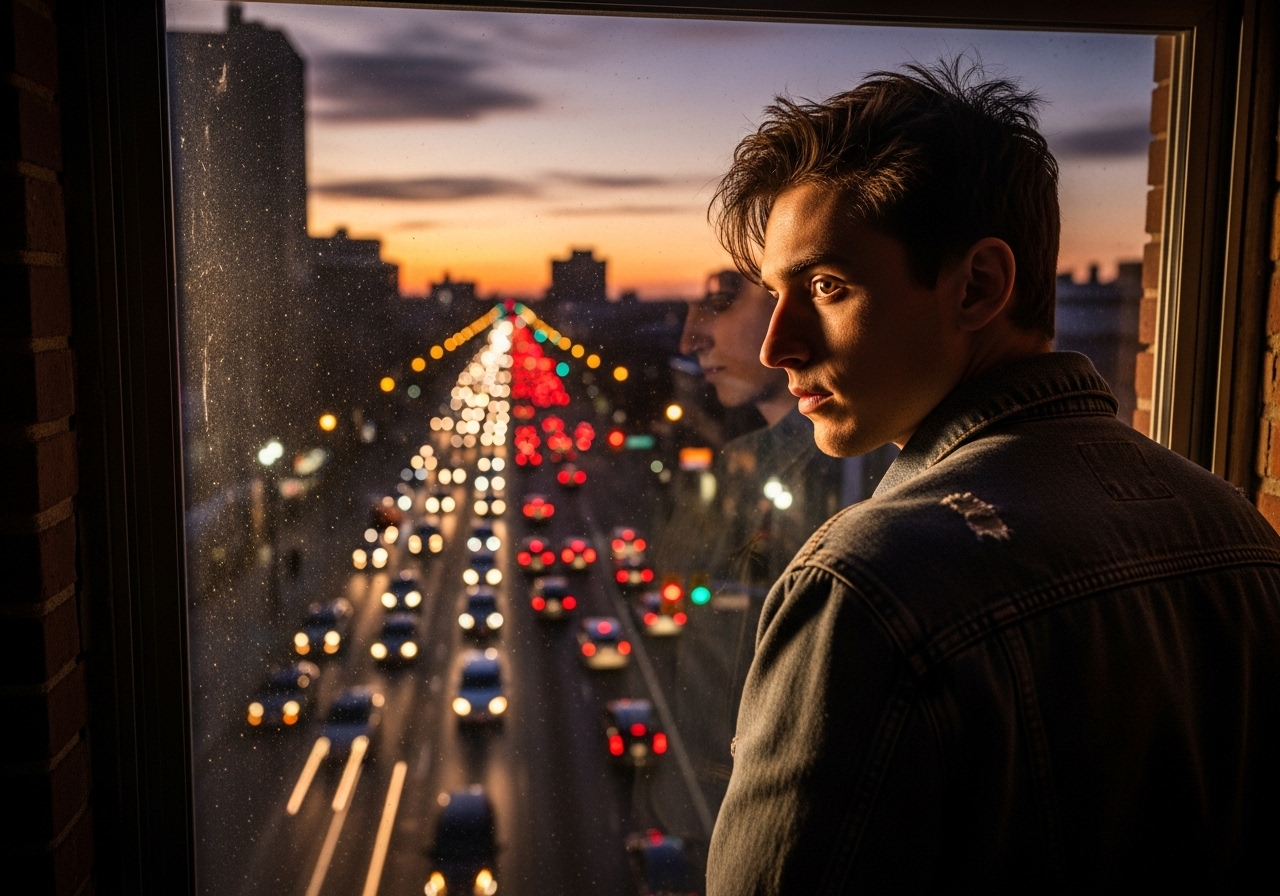
The impossible speed, the ripple-like movement, the sudden disappearance – what I witnessed on Portage Avenue defied every logical explanation, leaving me with a chilling sense that the city’s concrete skin might be thinner than I ever imagined.
Share This Story


