The Hum of Distant Solutions
The mid-summer air hung thick and greasy over downtown Winnipeg, a tangible weight that pressed against the old brick of the art centre. Inside, the recycled air conditioning wheezed a tired protest, a low, mechanical hum that became another layer in the atmospheric soup. Light, diffused through grime-streaked windows, painted the lecture room in shades of sickly yellow and grey, making the faces of the young adults gathered there seem drawn and faintly unwell.
The humidity, even indoors, clung to Patti like a second skin, a constant, slightly itchy presence. It smelled faintly of old paper, the kind you found in forgotten library corners, and the distant, metallic tang of the city’s breath through the barely effective filtration system. Dr. Elms, a woman whose enthusiasm seemed to defy the oppressive summer lethargy, was deep into her presentation, her voice a bright, chirpy counterpoint to the drone of the projector.
Patti’s pen hovered over her notebook, the cheap ballpoint leaving a slight indent on the page without shedding any ink. She’d tried. She really had. 'Mixed-methodological participatory frameworks for climate and creative entrepreneurship.' The words swam before her, neatly packaged, academic, and utterly detached from the beads of sweat gathering on her hairline. They felt like a language designed to keep the true, chaotic urgency of everything at arm’s length. Like trying to describe a drowning by analysing the molecular structure of water.
She shifted in the plastic chair, the material sticking to the backs of her thighs with a faint, disturbing suction. Across the aisle, Ben tapped his fingers against his worn denim jeans, a rhythmic, almost unconscious gesture that Patti found herself tracking. He wasn’t taking notes either. His gaze, however, was fixed on Dr. Elms, a quiet intensity in his posture that suggested absorption, or perhaps a different kind of internal grappling.
“...the integration of qualitative narratives with quantitative data sets,” Dr. Elms chirped, a slide advancing to show an intricate, rainbow-coloured diagram. Arrows pointed everywhere, connecting 'community stakeholders' to 'sustainable economic models' to 'indigenous knowledge systems'. The last phrase, in particular, always pricked at Patti. Not because it was wrong, but because it felt so often like a box to be ticked, a bullet point on a list, rather than the living, breathing, complex reality it represented. She thought of her grandfather’s quiet, practical connection to the land, not some abstract 'knowledge system' for a research grant.
The room felt like a hermetically sealed bubble, filled with earnest intentions and well-meaning jargon, while outside, the city simmered. Patti could almost hear the asphalt softening, the river slowly warming, the persistent, high-pitched whine of summer insects that never quite went away, even in a concrete jungle. Her mind drifted to the news a few days ago: another record-breaking heatwave in Europe, wildfires scarring the Canadian Shield, the kind of news that felt like a low, perpetual fever. And here they were, discussing 'robust scaling mechanisms'.
A small, almost imperceptible sigh escaped her. It was hot. So hot. The air itself felt heavy, thick with the unsaid, the unspoken anxieties that everyone in the room must surely carry but rarely vocalised in this clean, academic space. Ben caught her eye then, just for a second. His fingers paused their drumming. There was a flicker there, a shared recognition of the absurdity, or maybe just the sheer weight of it all. Or maybe it was just her projection.
“Any questions on the proposed methodology?” Dr. Elms asked, her smile unwavering, a testament to her unflagging optimism. The silence stretched, a soft, uncomfortable hum. A few people shifted. Patti felt a prickle of something akin to guilt for not having a question, for only having a vast, formless dread.
“What’s… what’s stupid?” Ben asked, his voice low, slightly rough, interrupting the silence like a small stone dropped into still water. Everyone turned. Patti’s breath hitched, just a fraction.
Dr. Elms’s smile wavered for a microsecond. “I’m sorry, Ben? Could you elaborate?”
He cleared his throat, pushing a strand of dark hair from his forehead. “No, I mean… the words. ‘Mixed-methodological participatory frameworks.’ Do we… do we actually talk like this? To people? When we’re trying to build, you know, a community garden, or help someone start a co-op?” He gestured vaguely, his hand sweeping across the diagram on the screen, a faint flush rising on his cheeks.
A ripple went through the room. Some nervous coughs. Patti felt a strange mix of relief and acute embarrassment on his behalf. He’d said it. The thing hovering unspoken. The disconnect.
Dr. Elms, ever the professional, recovered quickly. “Ah, I see your point. Language is certainly key to accessibility. This is, of course, a conceptual framework. In practice, we adapt our communication to the specific context. We don’t walk into a neighbourhood meeting and immediately launch into jargon.” She chuckled, a sound that felt a little too forced. “But understanding the underlying principles allows us to design more effective, truly participatory approaches.”
Patti tried to take a note. 'Adapt communication to context.' It felt hollow. Like patching a leaking boat with a Post-it note. The gap between the words on the screen and the world outside felt vast, a chasm. She thought of the river, murky and swollen from recent rains, then imagined the pristine, flowing arrows on the diagram. It was two different realities, held apart by the thin pane of the lecture hall window.
---
When the break finally came, Patti practically sprinted for the door, needing air, real air, not the recirculated, anxious kind. The afternoon sun hit her with a physical blow, a dense, humid blanket. Sweat bloomed instantly on her skin. The pavement shimmered with heat, exhaling a faint, dusty warmth that smelled of exhaust fumes and something metallic, almost like old pennies. She pulled her hair up, trying to expose her neck to the nonexistent breeze.
She walked aimlessly for a few blocks, past the usual downtown bustle: the glint of office buildings, the scurry of lunch-hour crowds, the faint, persistent drone of construction. Her eyes caught on a small, fenced-off patch of green between a dusty convenience store and a boarded-up storefront. A community garden, or what was left of one. A few sunflowers, their heads drooping heavily, seemed to wilt under the relentless sun. Tomato plants, mostly leaves, clutched at stakes, and a forlorn-looking row of lettuce was already browning at the edges. A hand-painted sign, faded and peeling, declared 'Green Roots Collective – Growing Together.'
The irony was a bitter taste. Here, the struggle was tangible, visible, not a data point on a graph. No 'robust scaling mechanisms' could mend a wilting tomato plant directly, not with this kind of heat, this kind of neglect. The air around the garden felt still, heavy with the effort of simply existing. It was a testament, she thought, to good intentions, but also to the immense, crushing difficulty of maintaining anything fragile in a world that seemed determined to swallow it whole. The diagram in her head, full of its bright, connecting lines, seemed to mock the tired green leaves, the peeling paint.
A lone bee, lethargic, buzzed past her face, bumping clumsily against her cheek before finding its way to a straggly marigold. Even the insects seemed tired. She leaned against a chipped concrete planter, feeling the rough texture against her arm. Her phone buzzed in her pocket – a notification about a friend's casual beach trip, a picture of impossibly blue water. The contrast felt like a slap.
“Escape artist, eh?” Ben’s voice startled her. He was standing a few feet away, leaning against the convenience store wall, a half-empty bottle of sparkling water in his hand. He looked less intense out here, more relaxed, though a crease still lingered between his brows.
Patti pushed off the planter, a faint scuff of concrete dust on her arm. “Just… needed some real air. Felt a bit… thin in there.” She gestured back towards the art centre, a wry smile playing on her lips. “All those big words. My brain feels like it’s going to melt.”
He nodded, taking a slow sip of his water. “Yeah. Like trying to build a bridge with abstract nouns.” He looked at the garden, his gaze thoughtful. “This place… always reminds me. It’s not just about the theory. It’s about… this.” He swept his hand over the struggling patch, the fading sign.
They stood in silence for a moment, the humid city breathing around them. The muffled clang of a distant streetcar, the faint smell of hot dog water from a vendor cart, the incessant, barely audible whine of the air conditioners battling the summer. Patti looked at the wilting sunflowers again, their solemn, downward-facing heads. They weren't dying dramatically, but slowly, relentlessly, their vibrant yellow fading into a dull, bruised ochre. It wasn't a sudden crisis, but a long, drawn-out decline, a quiet surrender. The sheer, slow inevitability of it all settled over her, a heavier weight than the humid air.
She felt a sudden, visceral understanding of the word 'erosion'. Not just of soil or land, but of hope, of effort, of meaning. The bright, hopeful arrows of Dr. Elms’s diagram seemed to blur and warp in her mind’s eye, becoming less like pathways to solutions and more like tangled, impossible threads. She looked at Ben, then back at the garden. The sunlight, harsh and unforgiving, picked out every imperfection, every blemish on the leaves, every crack in the pavement. It wasn't just a garden, it was a mirror, reflecting something vast and unsettling, something profoundly quiet and utterly unstoppable.
She didn't know if this was supposed to feel… anything. Warm? Comforting? She just… didn’t feel alone, not for a second, standing there with the city’s heat pressing in, witnessing the slow, relentless fade of something intended to be green and thriving. The silence stretched between them, not empty, but thick with the unspoken recognition of a world slowly, irrevocably, bending under its own weight, leaving them to trace the outlines of its decline.
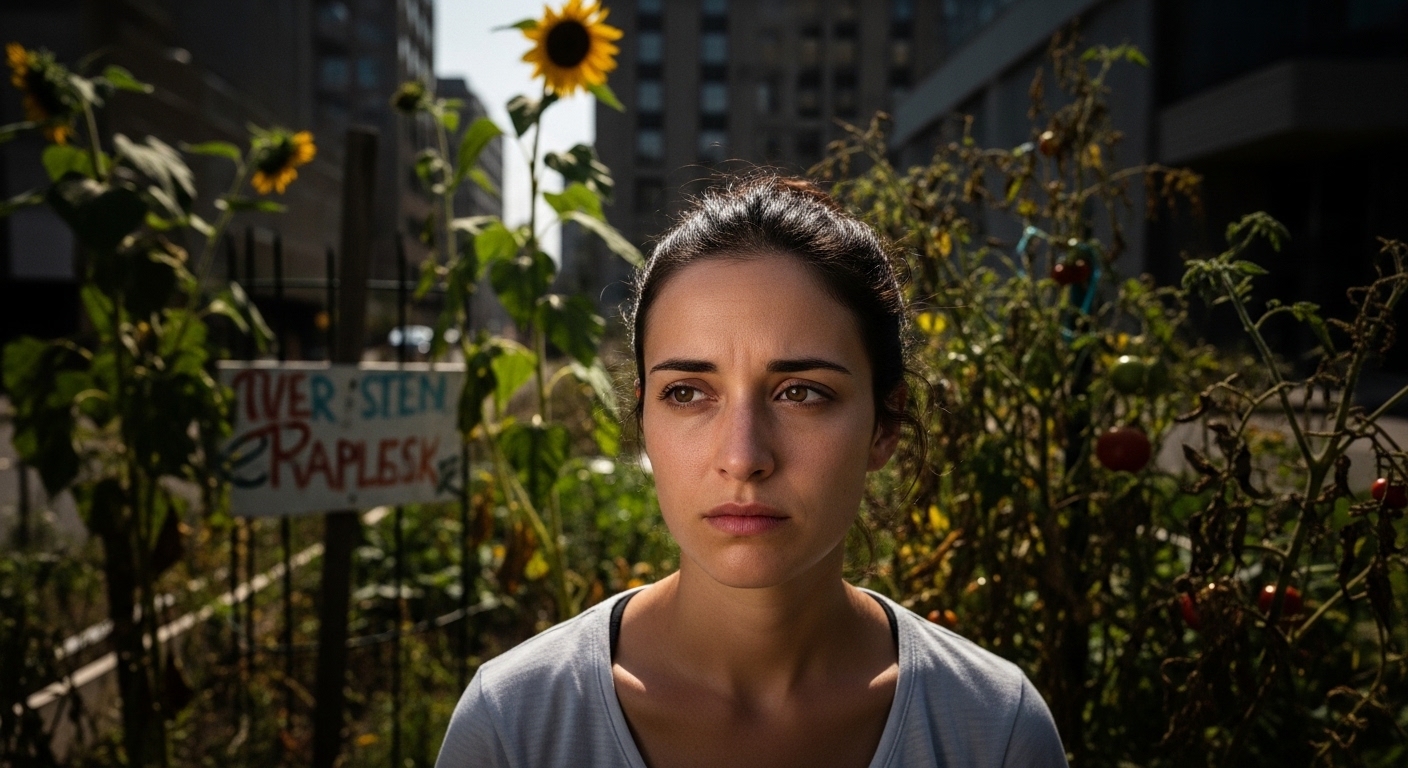
The silence stretched between them, not empty, but thick with the unspoken recognition of a world slowly, irrevocably, bending under its own weight, leaving them to trace the outlines of its decline.
Share This Story


