Bruised Maples and Blue Light
A damp, late October morning in a Canadian city. A young man sits on a park bench, observing the world and his own place within it, before seeking the quiet solace of a university library.
Another Tuesday. Another half-baked plan for... something. Anything. My breath plumed out, a tiny, fleeting cloud against the grey-streaked canvas of the morning. It was late October, pushing November, and the air already carried that distinct, metallic tang of coming snow. Not the first flurry, just the promise, like a whispered threat, clinging to the damp cedar shingles of the old Queen Anne across the street. My old army surplus jacket, bless its worn-out soul, barely held the chill at bay. I hunched deeper into it, the coarse wool of my scarf scratching at my jawline, the faint smell of stale coffee and something vaguely industrial clinging to the fibres.
The park bench was damp, a cold seep that travelled through my jeans, making my knees ache. I’d seen a guy wipe it down with a sleeve earlier, one of those quick, almost subconscious gestures people make in public now, a tiny, invisible shield against… everything. Germs, yes, but also against the general grime, the slow, creeping sense of decay. Or maybe just a habit. Who knew? I didn't bother. My own grime felt more authentic somehow, a testament to existence.
Across the path, a woman in a perfectly tailored beige coat walked her tiny terrier, both of them moving with an almost choreographed precision. The dog, I swear, had a little cashmere sweater on, a ridiculous little garment that shimmered faintly in the weak light. Cashmere. In this economy. It was always the small things that caught you, wasn’t it? Not the flashing headlines about the global energy crunch or the latest digital currency crash, but a dog in cashmere, trotting past a 'For Lease' sign on a once-bustling storefront, already faded to a pale yellow. The dissonance just… vibrated. A dull, constant tremor beneath the city’s veneer.
My phone, a relic I swore I'd upgrade next cycle (a lie, always a lie, the budget wouldn’t stretch), buzzed in my pocket. Probably a reminder from the 'Civic Engagement App' about some town hall I had no intention of attending. They pushed those things hard now, after the 'Great Disconnect' of '23, when everyone just collectively decided to opt out of public life, retreating into their curated digital bubbles. Now it was all about 'rebuilding community trust' through mandatory digital forums and 'thought-sharing' exercises, incentivized by paltry data credits. As if a new interface could fix the fact that half the population felt like they were shouting into a void, or that the other half was too busy hustling three gig jobs just to cover rent for a shared shoebox apartment to care.
I pulled it out anyway, squinting at the dim screen. Notifications from my student loan portal. Always those. They’d shifted the payment schedule again, 'streamlining the process for greater flexibility.' Which meant another deferment option I didn't want, because deferring just meant interest piling up, a slow-motion avalanche I was already buried under. Another year, another twenty grand, another degree I wasn’t sure would even matter beyond being a prerequisite for entry-level positions that paid less than my dad made thirty years ago. Who was it for? This whole system felt like a perpetual motion machine designed to extract youth, then discard it, polished and deeply in debt, utterly exhausted.
A skateboard clattered past, the rider a blur of faded denim and tangled hair. Early twenties, maybe. My age. He carved a clean arc around a puddle, the wheels spitting a fine mist. There was a freedom in that, a sheer, unadulterated velocity, even if it was just for a moment, a momentary defiance against the pull of gravity and expectation. Something I hadn’t felt in… I don’t know when. Maybe that last summer before university, when the future still felt like an open road instead of a series of very expensive, very narrow tunnels leading, inevitably, to more tunnels.
The Algorithmic Hum
It wasn't just the money, not really. It was the constant hum. The data-stream, an invisible river flowing beneath every pavement slab, through every fibre optic cable. Every interaction, every purchase, every casual glance at an advertisement – it all fed the beast. They called it 'optimisation.' My personal feed was a perfectly curated loop of anxieties I never knew I had until the algorithm presented them to me. The best deals on instant noodles, because my credit score flagged me as 'budget-conscious' and 'high-risk for discretionary spending.' Articles on 'mental resilience in a volatile economy,' because my search history included 'anxiety symptoms' and 'cost of living calculator Toronto.' It was like being understood, but in the most profoundly alienating way. Like the universe was listening, but only to sell you something you didn't need, or make you feel worse about something you couldn't control.
I thought about Maria, still in New Brunswick, probably freezing her butt off. She was all in on the 'digital nomad' thing, living out of a revamped van, coding for some start-up while 'experiencing authentic rural Canada.' I saw her posts, of course. Filters smoothing out the rough edges of winter, making the wilderness look like a perfectly lit studio. She swore it was better, that she felt 'unplugged.' But even her van had a Starlink dish bolted to the roof, and her entire income was tied to the very networks she claimed to be escaping. It was a different cage, maybe, a more picturesque one, but a cage nonetheless. Just with better views, and a higher data cap. She'd called me last week, her voice crackling, talking about how 'real' it felt, but I could hear the faint echo of a conference call in the background.
I scraped a boot heel against the rough concrete, dislodging a stubborn, half-rotted maple leaf. The vibrant colours were gone, just a dull, bruised brown now, clinging stubbornly to its brittle stem. Everything felt a bit like that. The promise of something brilliant, slowly, inevitably, fading to something… pragmatic. Something you learned to live with, like the ever-present drone of distant traffic, a collective sigh of modernity.
---
The Unspoken Language of Transit
A bus groaned to a stop at the corner, its hydraulic hiss a familiar urban sigh. A stream of people spilled out, shoulders hunched against the damp cold, faces buried in screens. Headphone wires, or more often, the tiny, near-invisible buds, were ubiquitous, little electronic barriers against the outside world. We were all connected, yet utterly isolated. A nation of individuals, curated and processed, each in their own little bubble of data, shielded from the inconvenience of actual interaction.
I remembered when people used to make eye contact on the bus. Not often, not for long, but enough to acknowledge shared space, shared humanity. Now it was just a quick, nervous flicker, or nothing at all. Everyone was elsewhere. Engaged in a parallel reality, a constantly refreshed feed of information and distraction, a perpetual scroll. Was it really progress, this constant connectivity? Or just a more efficient way to avoid the messy, uncomfortable present, the awkwardness of being truly present in a shared space? The city was full of ghosts, I sometimes thought, each one haunted by the glowing rectangle in their palm.
I stood up, stretching out the kink in my lower back, the cold having stiffened my muscles. My joints popped, a small symphony of complaint. The chill had truly set in. My destination: the campus library, a place that still clung to the anachronism of physical books and hushed reverence. A haven from the digital roar, even if every terminal inside glowed with the same blue light as everywhere else, a silent affirmation of the outside world.
As I walked, I passed a group of high schoolers. Their conversation was a rapid-fire volley of slang and references I barely understood, even at 23. They were fluent in a language I was already forgetting, a dialect of memes and ephemeral trends, constantly evolving, leaving me behind. But their laughter, sharp and clear, cut through the grey morning, momentarily piercing the pervasive hum. That, at least, felt timeless. Unfiltered. Untouched by algorithms, for now.
But even then, I saw it: one kid, mid-laugh, pulled out a wrist-mounted device, flicking through something, his expression instantly flattening, eyes glazing over, a subtle but unmistakable shift. The connection. Always the connection. It was a leash, but one they willingly wore, believing it offered freedom. Maybe it did, in some ways. A different kind of freedom. The freedom to never be bored, never be truly alone, even if it meant never truly being present, never truly connecting with the person beside you. The world was shrinking, even as the data expanded.
Walls of Paper, Windows of Light
The library wasn't busy, not yet. Too early for the serious grinders. The air inside smelled of old paper, dust, and something vaguely metallic, like ozone. A familiar comfort, a specific kind of quiet that wasn’t just a lack of noise, but an active, curated hush. The kind that absorbed sound, rather than just waiting for it to stop. I liked that. I liked the high ceilings, the way the light, even on a dull day, felt amplified, spilling across polished oak tables.
I found a spot near a window, a strategic choice that offered a view of a scraggly oak tree, its last few leaves shivering in the damp breeze. I pulled out my laptop – another relic, running slower each semester – and opened a document for my policy essay. Something about 'economic disparities in post-pandemic Canada.' It felt a bit like rearranging deck chairs on a sinking ship, honestly. The issues were so vast, so systemic, that my 2000 words felt like a futile whisper.
I watched a young woman across from me, her brow furrowed, meticulously highlighting lines in a physical textbook. She had a thermos, probably filled with some artisanal tea. Her phone sat facedown, almost forgotten. A rare sight. A small, almost radical act of defiance against the constant pull of the digital. I envied her focus, that single-mindedness. My own mind was a frantic web browser, too many tabs open, all of them buffering.
My thoughts drifted to the future, that ever-receding horizon. My parents, bless them, still held onto the quaint notion of a 'career path.' A ladder you climbed. But it felt more like a giant, chaotic game of snakes and ladders, rigged against anyone who wasn’t already at the top. The housing market was a joke, a cruel Punch and Judy show, mocking anyone under thirty. Even a down payment on a broom closet felt like a fantasy, a distant, unattainable myth whispered about in hushed tones.
I typed a sentence, then deleted it. The problem wasn’t just economic, or technological. It was existential. How do you find meaning when everything is commodified? When your identity is a data profile, your worth measured in engagement metrics? When art is algorithmically generated, and human connection is a series of emojis? Was this truly the 'better world' they’d promised?
I remembered a documentary I’d watched last night, late, on a streaming service recommended by the algorithm, naturally. It was about Indigenous sovereignty movements in the Canadian North, focusing on communities trying to preserve traditional ways amidst resource extraction and climate change. Not the spiritual stuff, no, but the practical, gritty fight for land rights, for self-determination against corporate and governmental interests. It was a fight against the same global forces I felt pressing down on me, just on a different scale, with different stakes, but the same underlying current of dispossession. They were fighting for something real, something rooted. Whereas my generation often felt like tumbleweeds, blown by invisible currents, trying to find purchase on shifting sands.
The light outside shifted, a weak, diffuse grey giving way to something softer, slightly amber. Golden hour, the artists called it. But it felt more like the quiet, fading light of a long afternoon, a melancholy beauty. I closed my eyes for a moment, listening to the subtle creak of the old building, the rustle of turning pages, the distant hum of the servers. The symphony of the library. It was still there, under everything. A small, fragile pocket of analogue resistance, holding out against the tide. I wasn't sure how long it could last, or if it even mattered in the grand scheme of things, but for now, it was enough. The smell of old paper, the gentle clack of a distant keyboard, the faint scent of someone’s unread book. It wasn't hope, not exactly. It was just… quiet. And in 2025 Canada, that felt like a luxury.
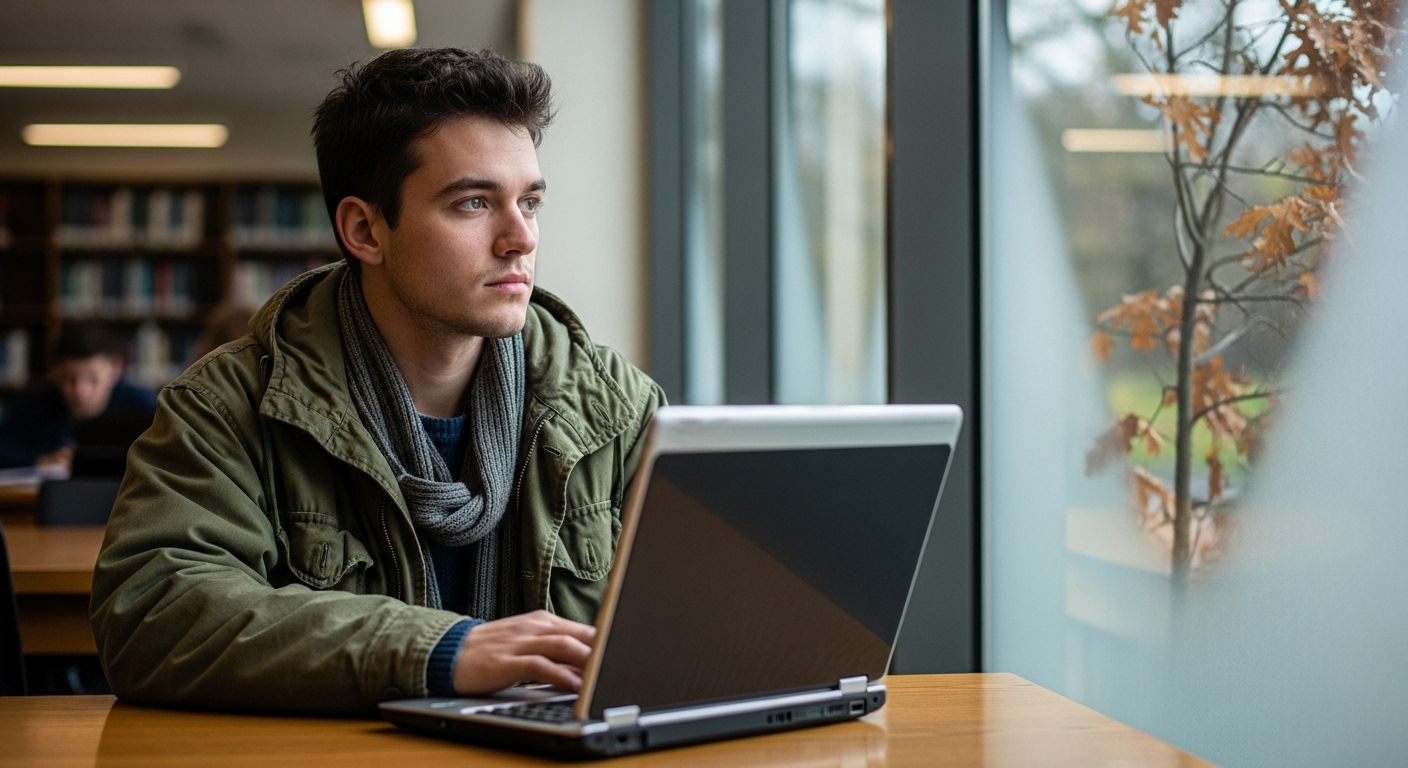
I wasn't sure how long this quiet could last, or if it even mattered in the grand scheme of things, but for now, it was enough. The luxury of unmediated stillness, however brief, felt like a small, desperate victory against the ceaseless hum.
Share This Story


