The Intruder in the Garden
Eddie confronts a researcher trespassing on his property, setting off a chain of events that exposes the flaws in a top-down scientific study.
The movement was subtle at first, a disturbance at the edge of the world as I knew it. A smudge of motion against the riot of burnt orange and decaying crimson that the maples had become. It was just past six in the morning, an hour I had come to claim as my own in the three years since retirement had unmoored me from the tyranny of deadlines. The air held the specific, clean bite of late October, a chill that promised a hard frost and smelled of wet earth and distant woodsmoke. From the kitchen window, I watched, the ceramic of my coffee mug a welcome hearth against palms that had grown unpleasantly familiar with the ache of arthritis.
At first, I’d registered the figure as a deer. They often came down from the wooded conservation land to drink from the creek that marked the true end of my property. But this shape was too upright, too deliberate. It resolved itself into a human form, hunched over the muddy bank where the water slowed to a near standstill before slipping under the old stone culvert. My initial flicker of annoyance—a neighborhood kid looking for a shortcut, maybe—soured into something more focused, more analytical. The intruder wasn’t skipping stones or vandalizing the decorative birdbath I’d long since given up trying to keep clean. They were working.
The figure knelt, a dark silhouette against the bleeding colors of the dawn. I saw the glint of metal, a silvery T-shaped instrument that they plunged into the creek bed with a practiced, rhythmic motion. They twisted it, pulled it free, and examined the dark plug of earth it held. A professional. Not a vandal, but something else. Something clinical.
My first instinct, a vestige of a homeowner’s territorial paranoia, was to check the deadbolt on the back door, maybe grab the heavy iron fireplace poker. But that impulse was a ghost, a flicker from a life I didn’t lead. The instinct that won out, the one that had been honed over thirty-seven years of chasing stories from city hall basements to university laboratories, was different. I didn’t reach for a weapon. I reached for the spiral-bound notebook and the worn felt-tip pen I kept on the counter next to the grocery list.
Old habits. The muscle memory of the science beat. Document first, react second.
I slid the porch door open, wincing as it scraped along its track, and stepped out onto the damp wood of the deck. The screen door, failing to catch on its pneumatic closer, slammed shut behind me. The sound was obscene in the morning quiet, a percussive crack that echoed off the house next door. It had the intended effect.
The figure shot upright, spinning around. In the process, they fumbled with their equipment, nearly dropping a small glass vial into the murky water. Now I could see them clearly. A young man, couldn’t have been more than twenty-eight. He wore a waterproof jacket, dark green, with the circular, slightly pretentious crest of the state university stitched on the breast. His face was a mixture of panic and academic earnestness, his hair sticking up where he’d clearly run his hands through it. He was caught.
“You’re on private property,” I called out. My voice was rough with sleep, but it carried. I didn’t shout; I let the quiet of the morning amplify the statement. I walked down the three deck stairs, my knees complaining with a series of dull clicks. The grass was slick with dew, soaking the cuffs of my flannel pajama pants.
“I—I am so sorry, sir,” he stammered, his eyes wide. He held up his hands in a gesture of placation, one still clutching the soil corer, which dripped mud onto his clean hiking boots. “My apologies. The GPS overlay we were given is… it’s not precise. I didn’t think anyone would be awake. We have a permit for the entire watershed.”
“The watershed is a concept,” I said, stopping about twenty feet from him. The smell of the disturbed creek mud was rich and peaty. “The fence line is a fact. My backyard is a fact. And that instrument in your hand isn’t for testing water, is it? You’re taking soil cores.”
He looked down at the tool as if seeing it for the first time, then back at me. The blush rising on his neck was visible even in the grey morning light. “Yes. We’re tracking heavy metal diffusion from upstream. The data points… we need a precise grid for the model to be accurate.”
“Data points,” I repeated. The phrase landed wrong, tasting of rust and bureaucratic indifference. It tasted like ash. It reminded me of a story I’d covered in the nineties, a chemical spill in a low-income housing project. The officials in their starched shirts kept talking about ‘acceptable risk parameters’ and ‘statistical cohorts’ while mothers showed me the rashes on their children’s arms. People boiled down to numbers on a spreadsheet. “Is that what my yard is to you? A data point?”
He had the decency to look ashamed. “No, sir. Of course not. It’s just… it’s the protocol.”
“Whose protocol?” I pressed, taking another step. “Who’s the principal investigator on this project?”
“Dr. Lin,” he said immediately. “Dr. Evelyn Lin. From the Environmental Science department.”
I made a note of the name. “Tell Dr. Lin her protocol is trespassing. Tell her to look at a plat map next time.” I turned and walked back toward the house, not waiting for another apology. The conversation was over. The investigation, however, was just beginning.
By afternoon, the atmosphere in the cul-de-sac had curdled. The quiet unease that had been simmering for weeks had thickened into a shared, unspoken anxiety. It wasn’t just the student in my yard; it was the larger presence he represented. For the better part of a month, unmarked white vans—Ford Transits, new models, no logos—had become a feature of our suburban landscape. They would park for hours, sometimes moving from one end of the street to the other. Figures in jackets, like the one the young man wore, would emerge, take their samples, their measurements, and then vanish.
This neighborhood was an enclave of the retired. Teachers, engineers, accountants. People who had bought their modest split-level homes when the road was still gravel and the trees were saplings. We were a generation that noticed things. We saw the patterns. A new car, a different mailman, a van that didn’t belong. We had time to watch, and our watching had turned into worrying.
The whispers had started a year ago, after the demolition of the old Northwood Textile Mill two miles upriver. For a century, its brick smokestack had been a landmark. Now it was a field of rubble and rebar, and since then, things had felt… off. The water sometimes had a metallic tang. People’s vegetable gardens, the pride of the neighborhood, were yielding stunted, sickly-looking tomatoes. But the arrival of the university researchers hadn’t brought clarity. It had brought a new kind of silence, the unnerving quiet of being observed.
I found Sarah Jenkins standing at the end of her driveway, ostensibly checking her mail but really just watching. A white van was idling fifty yards away, parked directly across from the community fire hydrant. Sarah had moved in a week after my late wife and I did, fifty-two years ago. She knew the history of every crack in the pavement, could tell you which family planted which oak tree. Her hands, twisted by the same ailment as mine, were clutching a handful of catalogs and bills.
“They don’t talk to us, Eddie,” she said without preamble, her voice low and tight. Her gaze never left the van’s tinted windows. “They just come. They put little flags in the ground, they take their dirt and their water in little bottles, and then they leave. It feels like a raid. It feels like we’re a crime scene.”
“They’re looking for contamination,” I said, though the words felt hollow. I knew that wasn’t the whole problem. The problem was the way they were looking. “But they’re looking with a blindfold on.”
I left her by the mailbox and started walking toward the van. My heart rate ticked up a notch. It was the old feeling, the pre-interview jitters I thought I’d left behind. The pavement felt hard under my worn sneakers. With every step, I felt the eyes of my neighbors on my back, watching from behind their curtains. I had become their reluctant representative.
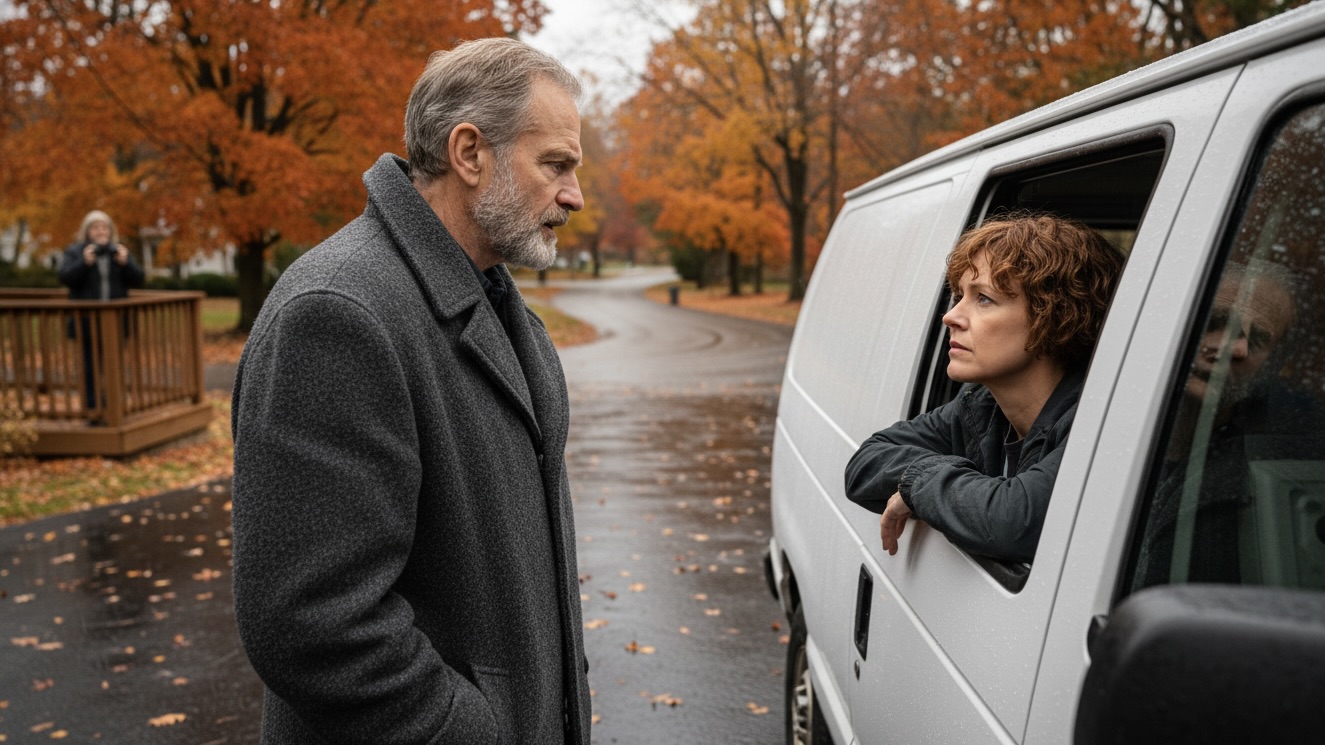
I stopped beside the driver’s side door and waited. For a full thirty seconds, nothing happened. I could see the faint outline of a person inside, a head bent over a glowing screen. They were hoping I’d go away. I rapped my knuckles, twice, on the glass. The sound was sharp.
The window hummed down, revealing a woman who looked exhausted down to her bones. Her dark hair was pulled back in a severe, functional ponytail, but loose strands had escaped to frame a face dominated by intelligent, weary eyes. She wore a simple gray sweater. The van’s interior was a mess of wires, Pelican cases, and the lingering scent of stale coffee. A laptop was mounted to the dash, displaying a complex, color-coded map of our neighborhood. This had to be Dr. Lin.
“We’re busy, sir,” she said, her voice flat, pre-empting any question I might have. It was a verbal wall, built to repel inquiry.
“I know. And you’re failing,” I countered. The bluntness of it caught her off guard. Her focus shifted from her screen to my face. She blinked, a flicker of irritation crossing her features.
“Excuse me?”
“I used to cover public health crises for the Chronicle,” I said, establishing my credentials. “Flint, Hinkley, I’ve seen them all. I know what a stalled investigation looks like. This is it. You have zero community buy-in. You have a dozen anxious residents watching your every move from their windows, and not one of them trusts you. You’re treating this neighborhood like a petri dish, but you seem to have forgotten that the culture in the dish is alive. And it’s watching you back.”
She let out a long, frustrated sigh and rubbed the bridge of her nose, right between her eyes. “We have strict protocols for a reason. Contamination studies require objective, untainted data. We can’t afford to introduce anecdotal evidence or resident testimony until the initial phase of sampling is complete. It compromises the integrity of the findings.”
“That’s your fundamental mistake,” I said, leaning against the doorframe, lowering my voice. “You think the people who live here are a contamination source for your data. But they’re the missing data set. You’re applying a purely extractive model of research to what is, in reality, a complex social and ecological system. You come here with your predetermined questions—‘how much lead is in this soil sample?’, ‘what’s the particulate count in this water?’—but you haven’t bothered to ask the most important question of all.”
She looked at me, a glimmer of genuine curiosity finally breaking through her professional fatigue. “And what question is that?”
“You haven’t asked the people living on the land if you’re even looking in the right place.”
I gestured back toward Sarah, who was now pretending to read her junk mail with intense focus. “That woman over there is Sarah Jenkins. She’s eighty-one years old. She can tell you that the big flood your topographical maps have recorded for 1998 actually happened in the spring of ‘96. And she can tell you that when the creek overflowed its banks, it didn’t just bring water. It brought a tide of black, oily silt from the illegal dump site behind the old auto body shop, a site that was paved over in 2002 and never made it onto any municipal map. Your objective data will never find that, Dr. Lin, because you’re sampling the wrong timeline. You’re off by two years and a hundred yards.”
Dr. Lin’s eyes darted from me to Sarah, and then to the map on her laptop. I saw her fingers move on the trackpad, zooming in on the area I’d described. The rigid, defensive set of her shoulders softened, just a fraction. A crack in the wall.
“It’s called Community-Based Participatory Research,” I said, pressing the advantage. “CBPR. It’s not about collecting anecdotes. It’s about integrating local, contextual knowledge into the scientific framework. Lived expertise. You hire residents. You train them as data collectors. You bring them in as equal partners to help define the scope of the study, to formulate the research questions from the ground up.”
I wasn’t just reciting theory. I’d seen it work. I’d written a whole series on it years ago—a study on asthma rates in West Oakland where community members mapped trucking routes and identified pollution hotspots the EPA’s models had completely missed. The results were groundbreaking.
“You can’t replicate fifty years of daily observation in a lab,” I continued. “Sarah knows which basements flood first. Mr. Henderson in the blue house knows where the construction crews from the seventies used to bury their excess materials. My wife, before she passed, kept a garden journal for forty years, documenting every change in the soil, every season the bees didn’t show up. That’s longitudinal data you’d kill for, but you’ll never get it by sending a grad student to trespass in my backyard at six in the morning. If you want to know why your diffusion models aren’t matching your physical samples, you need to stop extracting and start collaborating. It has to be a partnership. Shared ownership of the questions, shared ownership of the data, shared ownership of the solution.”
The wind picked up, a sudden gust that sent a swirl of dry, brittle leaves skittering across the van’s windshield. They made a sound like tiny claws scratching at the glass. For a long moment, the only sound was the low, steady hum of the engine.
Dr. Lin stared at the screen, but I knew she wasn’t seeing the map anymore. She was seeing the holes in it. She was seeing the invisible landscape of memory and experience that lay superimposed over the one her instruments could measure.
“If I set up a town hall,” she said slowly, the words careful, measured. “Not a lecture where I present our preliminary findings. But a… a listening session. An actual forum. Would people come? Would they talk to us?”
“They’ll come if you’re honest,” I said. “They’ll come if you park the vans, turn off the engines, and meet them face-to-face. They’ll talk if you promise that we aren’t just subjects in your study. They’ll help if you can convince them that the goal isn’t just another paper for your tenure file, but a real, tangible solution for the water we drink and the ground our grandchildren play on. Mutual benefit. That’s the core of it. You need our knowledge to get good data. We need your expertise to find an answer.”
She held my gaze for a few seconds longer, then gave a small, almost imperceptible nod. It wasn’t a surrender; it was a concession. An opening. “Okay,” she said, her voice quiet but firm. “Thursday night. Seven o’clock. The community center.”
“I’ll make sure people are there,” I said.
I stepped back from the van. The window hummed shut, sealing her back inside her world of data and maps. The vehicle pulled away from the curb, and as it passed, the driver—a different young man in the passenger seat—gave a small, hesitant wave. A beginning.
I walked back to Sarah, who was still standing sentinel by her mailbox, her mail forgotten in her hand. The air felt different now, lighter. The oppressive hum of the van was gone, replaced by the rustle of leaves and the distant cry of a blue jay.
“What on earth did you say to them, Eddie?” she asked, her eyes searching my face for answers.
I looked from her worried face toward the creek at the bottom of my yard, where the real secrets were buried in layers of silt and time. “I told them they were trying to read a book by analyzing the chemical composition of the paper,” I said. “I suggested they try opening it and reading the words.”
As the sun dipped below the tree line, I wondered if the bridge we'd just built would be strong enough to carry the weight of what we were about to find.
Share This Story


