The Empty Studio
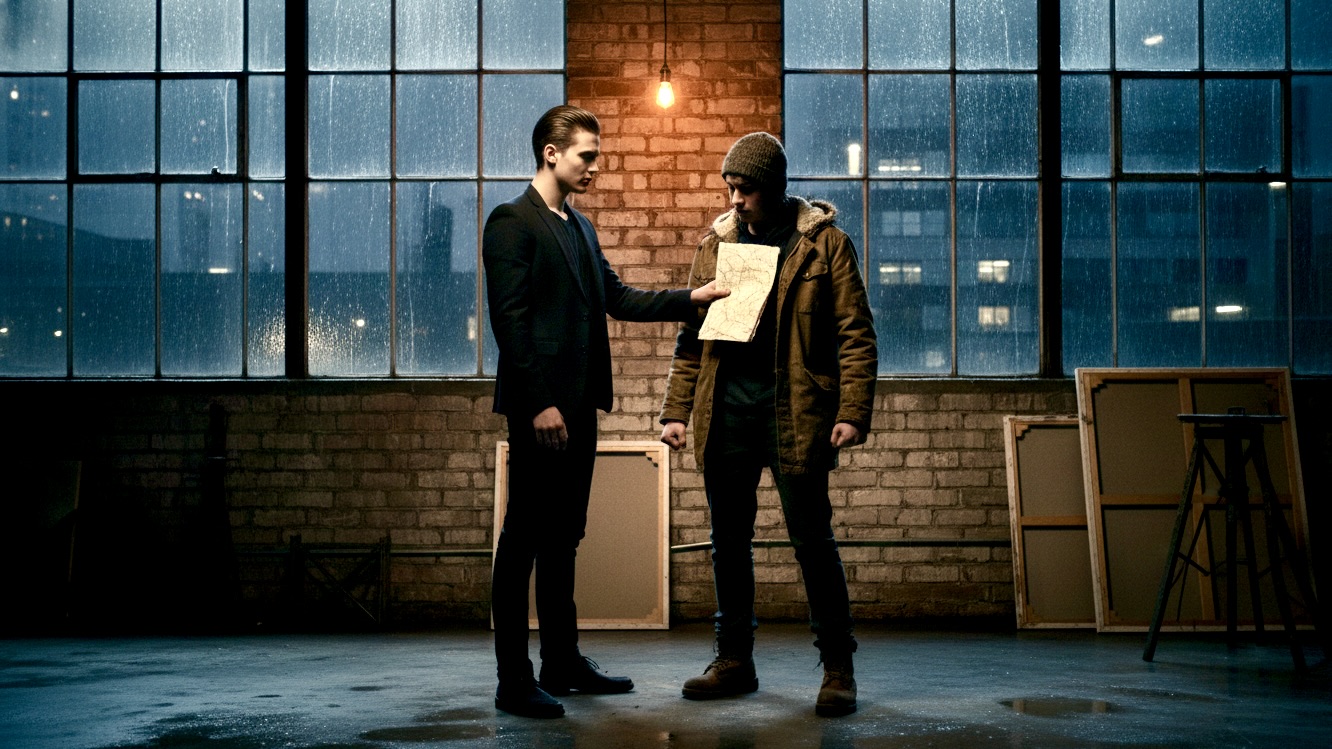
A converted warehouse art studio in Winnipeg's Exchange District during a heavy spring rainstorm. The room smells of turpentine and ozone.
He should not be looking at George like this. Not here.
The thought was a flat, sterile pronouncement in the chaotic archive of Simon’s mind, a librarian’s futile shush against a rising tide. The echo of the kids’ voices—shouting, laughing, arguing about survey methodology with the ferocious sincerity only teenagers possessed—still seemed to cling to the high, dusty rafters of the warehouse. It was an energy that hadn’t dissipated, a residue of their presence that made the subsequent silence feel loud and unnervingly intimate.
Simon stood in the deep shadows cast by the industrial freight elevator, a relic of the building’s past life as a garment factory. Its iron cage was a black skeleton against the far wall. He’d deliberately put the width of the studio between himself and George, a tactical retreat he was losing with every passing second. His mind, trained for pattern recognition and risk assessment, was running frantic, useless calculations. Risk One: The grant. A shoestring budget from a municipal arts and culture fund that was already skeptical of their ‘unorthodox’ methods. A single complaint, a whiff of impropriety, and they’d be shut down before their first report was written. He could still feel the phantom chill of the city hall meeting room, the pinched face of the comptroller peering over his spectacles. ‘A commendable, if… unconventional, approach, Mr. O’Connell.’ Unconventional was code for ‘first on the chopping block.’
Risk Two: The neighborhood. This slice of Winnipeg’s Exchange District was a study in contrasts—restored heritage buildings housing chic design firms abutted half-derelict structures and back lanes that were arteries for the city’s underbelly. They were guests here, academics parachuted in to observe a reality they could only ever theorize about. Their presence was tolerated, not welcomed. One wrong move and that tolerance would evaporate.
And then there was George. George, who was not a risk but a certainty. A volatile, brilliant, infuriating variable that defied every formula Simon tried to apply. He was over by the main drafting table, the one littered with the detritus of the evening’s session. Under the weak yellow cone of a single desklamp, he was wiping a slurry of charcoal dust and sweat from his forearms with a rag that might have once been white. The movement was methodical, practical, yet Simon’s eyes tracked the play of tendons, the faint sheen on his skin. With the charcoal gone, the skin was pale, marked with a few old, faded scars. A cartography of a life lived harder than Simon’s.
Simon felt the pull in his sternum, a familiar, dangerous ache. It was the same magnetic draw he’d felt the first time he’d seen George deliver a guest lecture at the university, railing against the sterile, extractive nature of their entire discipline with a fire that had felt like a physical force. It was unprofessional. It was unsustainable. It was, he was beginning to fear, completely inevitable.
The warehouse studio was vast and cold. The spring storm that had been threatening all day had finally broken, throwing sheets of rain against the tall, arched windows. The glass was old, warped in places, and it fractured the orange glow of the streetlamps into liquid, shifting patterns on the worn floorboards. Each gust of wind made the massive panes shudder in their frames, a low groan that seemed to come from the bones of the building itself. The air inside was thick with the smells of damp brick, linseed oil, and the faint, acidic tang of photographic fixer from the makeshift darkroom in the corner. It was a space that held the ghosts of its past and the anxieties of its present.
“You’re playing a dangerous game,” Simon said. His voice came out rougher than he intended, a rasp of sound that seemed to catch on the heavy silence. He didn’t move from his position by the elevator, unwilling to cede his island of shadow.
George didn’t look up. He tossed the grimy rag onto a stool and meticulously began organizing a stack of surveys, tapping their edges against the scarred wooden surface of the table until they formed a perfect, crisp block. His hands were steady, his focus absolute. It was a deliberate performance of control. “It’s the only game that works, Si. You know that.”
“They’re kids, George. Not research assistants. They’re not… academics.” The word felt flimsy and absurd in this space. He took a step forward, his boot heels making a hollow sound on the floor. He gestured vaguely at the controlled chaos around them—at the massive mood boards propped against the brick walls. They were covered in a collage of news clippings, blurry cell phone pictures of unlit alleyways, scrawled quotes from interviews, and tangled webs of red yarn connecting different points of data. It was raw, visceral, and utterly unpublishable in any peer-reviewed journal Simon could think of.
George finally paused. He placed a heavy, cast-iron hole punch on the neat stack of papers, a paperweight against a non-existent breeze. He turned, and his eyes, magnified slightly by his wire-rimmed glasses, were sharp and unwavering. They always were. He had a way of looking at you that made you feel like he was seeing the core components, stripping away the pretense. He pushed his glasses up the bridge of his nose with one finger, a gesture Simon had come to recognize as a preamble to a lecture, or a fight.
He crossed the room, not with aggression, but with a deliberate, unnerving slowness. He navigated around a paint-spattered stepladder and a pile of discarded canvases, his worn leather boots making barely a sound. He didn’t stop until he was standing directly in front of Simon, well inside the socially acceptable perimeter of personal space. Simon’s back was inches from the cold, rough brick of the wall. He held his ground, a purely instinctual reaction. His pulse, however, betrayed him, kicking up a frantic rhythm against his ribs.
“That is precisely the point,” George said. His voice was lower now, a murmur that wouldn’t carry. It was for Simon alone. “Traditional extraction is a dead model. It’s colonialist garbage. We go in, we take their stories, we build our careers on their trauma, and we leave. Nothing changes for them. We don’t study them anymore, Si. We work with them. We pass the mic.”
“Explain.” The word was a demand, but it felt like a plea. Explain it so the knot of anxiety in my stomach loosens. Explain it so this feeling of standing on a cliff’s edge goes away.
“Youth Participatory Action Research,” George murmured, the academic phrase sounding different here, between them. Not a theory from a textbook, but a confession. A secret shared between conspirators in the shadows of an old building. “YPAR. The old model is a panopticon. It treats them as subjects. Bugs under a glass. We define the problem, we design the questions, we control the narrative. It’s a power dynamic so skewed it’s a joke.”
“And this?” Simon’s gaze flickered to the nearest board. A photo of a broken streetlamp was circled in black marker. Next to it, someone—Mia, he thought, a whip-smart seventeen-year-old with a talent for sharp analysis—had written: ‘They say budget cuts. We say bullshit. It’s been out for 6 months. Ask who lives on this block.’
“This,” George said, his voice resonating with a passion that Simon both admired and feared, “is co-research. This is them, in the driver’s seat.” He was close enough now that Simon could feel the warmth radiating from his chest, could smell the lingering scent of charcoal dust and the damp wool of his sweater. George reached out, not to touch Simon, but to brace a hand on the brick wall just beside his head. The gesture was casual, proprietary. It was a cage made of a single arm. “They aren’t just answering our questions. They’re designing the study. They identified the core problem—not ‘youth crime,’ like the city wants to call it, but a fundamental lack of safety in the public spaces they’re forced to occupy. The back lanes, the underpasses. They’re mapping it. They’re collecting the data. They have the ‘lived experience’ that you and I, with our university salaries and our safe walks home, lost a long time ago. If we ever even had it.”
Simon found himself staring at the hand by his head. George’s fingers were long, the nails short and clean, but there was ink stained deep into the cuticle of his thumb. He forced his gaze up, past the strong line of George’s jaw, to his mouth. He wondered what it would be like to argue with that mouth, to kiss it, to silence it. The thought was a flash of lightning, illuminating everything in stark, terrifying detail before plunging him back into darkness. The air between them was heavy, charged, thick with unspoken things.
“You really think they can analyze it?” Simon’s voice was barely a whisper. “This isn’t just about connecting dots with yarn, George. This is statistical analysis. This is policy.”
“Better than us,” George countered, his own voice dropping another octave, becoming a low rumble. “Because it’s not just statistics to them. It’s the walk home from their shitty job. It’s the corner where their friend got jumped. They see the patterns we miss because we’re trained to look for predictable, sterile data. They see the human cost.” He leaned in a fraction of an inch closer, and his knee brushed against Simon’s thigh. The contact was electric, a jolt that shot straight up Simon’s spine. “This is about agency. Voice. They own the process, so they own the solution. It’s not a research project, Simon. It’s about power redistribution.”
“Power is dangerous,” Simon whispered, the words tasting like ash. He was acutely aware of every point of contact and near-contact between their bodies. The brush of their knees, the heat of George’s arm next to his head, the way George’s breath stirred the air in front of his face.
“So is ignorance,” George replied, his gaze intense, locked on Simon’s. “So is apathy. So is pretending that we, from our ivory towers, have any right to tell these communities how to fix themselves.” He shifted his weight, and the pressure of his knee against Simon’s became more definite, more real. “We act as mentors. We provide the goddamn scaffold. The theory, the ethics clearance, the grant-writing bullshit. But they build the building. If we want to facilitate actual social change in this city, we have to trust the people who are actually living the reality.”
Every carefully constructed wall of Simon’s professional resolve was crumbling. The intellectual rigor of George’s argument was a potent force, as seductive in its own way as the undeniable physical presence of the man himself. He was right. Simon knew he was right, and that was the most terrifying part. This project wasn’t just an academic exercise anymore; it was real, and real things had consequences.
“And what happens,” Simon managed, his throat tight, “if they find something we can’t fix? Something bigger than broken streetlights?”
“Then we face it together,” George said, the conviction in his voice absolute. His eyes, for the first time, flickered down to Simon’s lips, a brief, charged glance that felt more intimate than a touch. He looked back up, meeting Simon’s eyes again, and the intensity there stole the air from Simon’s lungs. “The data they brought in tonight… it’s not just statistics, Simon. They’re onto something.”
A sudden crash of thunder rattled the windows, and the lights in the studio flickered once, twice, before holding steady. In that brief strobe of near-darkness, George’s face was a mask of sharp angles and deep shadows.
“What?” Simon asked, the romantic tension curdling instantly into a cold, sharp dread. “What did they find?”
George’s expression tightened. The fire in his eyes was banked, replaced by something harder, more cautious. He finally dropped his arm from the wall, stepping back and breaking the spell. The sudden cold air rushing into the space he’d occupied was a shock to Simon’s system. He felt unmoored. George turned and walked back to the drafting table, his shoulders tense.
“They started cross-referencing the city’s maintenance logs for the streetlights with the police incident reports they managed to access through a freedom of information request. A brilliant move from Leo, by the way. Kid’s going to be a hell of an investigative journalist.” George ran a hand through his already messy hair. “They found a pattern. It points to something… coordinated. Something corrupt.”
Simon straightened up, pushing himself away from the comforting solidity of the brick wall. His heart was hammering a new, fearful rhythm. “Show me.”
George watched him for a long moment, a flicker of something—hesitation? regret?—in his eyes. Then he reached into the back pocket of his jeans and pulled out a crumpled, folded piece of paper. It wasn’t a clean printout. It was a city planning map, worn at the creases, stained with what looked like coffee. He walked back to Simon, his movements brisk and all business now, the earlier intimacy erased. He unfolded the map, not against the wall, but against Simon’s chest, effectively trapping him again, but this time the context was entirely different. It wasn’t a gesture of intimacy; it was one of urgency.
The paper was cool against Simon’s shirt. George’s fingers brushed his collarbone as he held the map steady. His head was bent low, close to Simon’s, as he pointed to a series of marks on the paper.
“Here,” George said, his voice a low, urgent whisper. He traced a route marked in thick red ink, a jagged line that cut through the downtown core and snaked through the very lanes they were studying. “They tracked the reported power outages for the streetlights over the last six months. See these clusters? They’re not random. And here…” He used a different finger to trace a second, parallel line, this one dotted in blue. “These are the gaps in the police patrol routes. The official, scheduled gaps. They match. They match almost perfectly. Whole sections of the neighborhood go dark at the exact time the patrols are routed blocks away.”
Simon stared down at the map, his mind racing to process the implications. The red and blue lines were a damning indictment. This wasn't about budget cuts or municipal incompetence. This was deliberate. This was creating opportunity. The abstract concepts of ‘data’ and ‘patterns’ suddenly felt terrifyingly concrete. This wasn’t a youth art project anymore. This map, crumpled and coffee-stained, was evidence.
He looked up from the terrifying lines on the paper, up at George’s face, only inches away. He was about to speak, about to warn him. To tell him they needed to stop, to bury this, to protect the kids from whatever hornet’s nest they had just kicked. They weren’t equipped for this. This was a line they should never have crossed.
But before any words could form, a sound from the far end of the studio cut through the drumming of the rain.
A heavy, metallic scrape. The unmistakable sound of a key turning in an old, stiff lock.
They both froze. Simon’s gaze shot past George’s shoulder to the heavy steel service door, the one that opened onto the back lane, the one that was always, always bolted from the inside.
A low, agonized creak followed as the massive door began to swing slowly, ponderously inward, opening a rectangle of deeper, wetter darkness into their sanctuary of dim light.
The heavy steel door at the far end of the studio creaked open.
Share This Story


