The Mock-Up Gallery
A group of artists tours a research facility demonstrating deep geological storage technology, focusing on a full-scale model of a deposition tunnel.
The drive out had been a lesson in subtraction. First the city, with its layered densities of life and ambition, fell away. Then the suburbs, their manicured anxieties thinning into exurban sprawl. Finally, there was only the high desert, a vast, pale canvas where the landscape seemed to have been stripped back to its essential elements: rock, sky, and the persistent, scouring wind. The road itself felt like an intrusion, a single black stitch holding two immense pieces of ochre fabric together. It was the kind of emptiness that made Jeffrey uneasy, a silence that wasn't peaceful but watchful. He was a painter of moody, complicated landscapes, of coastlines shrouded in fog and forests thick with shadow. This place had no mood. It was pure, unfiltered presence.
The visitor center, when it finally appeared, was a low-slung building of concrete and dark glass that didn't so much rise from the desert as concede to it. It looked less like a building and more like a geological feature, something deposited by a glacier that had lost its way. Inside, the air was shockingly cold, a manufactured chill that felt like a different climate zone. It smelled of nothing, a scrubbed, sterile scent that was more unnerving than any odor. The silence here was different from the desert’s—it was the muffled, absorbent quiet of a recording studio or a tomb.
Casey felt the transition as a physical pressure change in her ears. She flexed her hands, a nervous habit. The terracotta dust was so deeply ingrained in the whorls of her fingerprints and the creases of her knuckles that it had become a permanent part of her complexion, a faint, earthy blush against her pale skin. It was the ghost of a thousand pots, bowls, and sculptures. She worked with the earth every day, but this place felt alien, a repudiation of the messy, organic world she inhabited. Everything was clean, precise, and rectilinear. It set her teeth on edge.
They were met by Dr. Evans, a man who seemed to have been hewn from the same granite as the core samples lining the hallway. He was tall and lean, with a face mapped by lines that spoke of long hours under a sun that wasn't filtered by office windows. He moved with a deliberate economy, as if conserving energy for a task of immense duration. His welcome was polite but lacked warmth, the greeting of a custodian to a sacred, dangerous place.
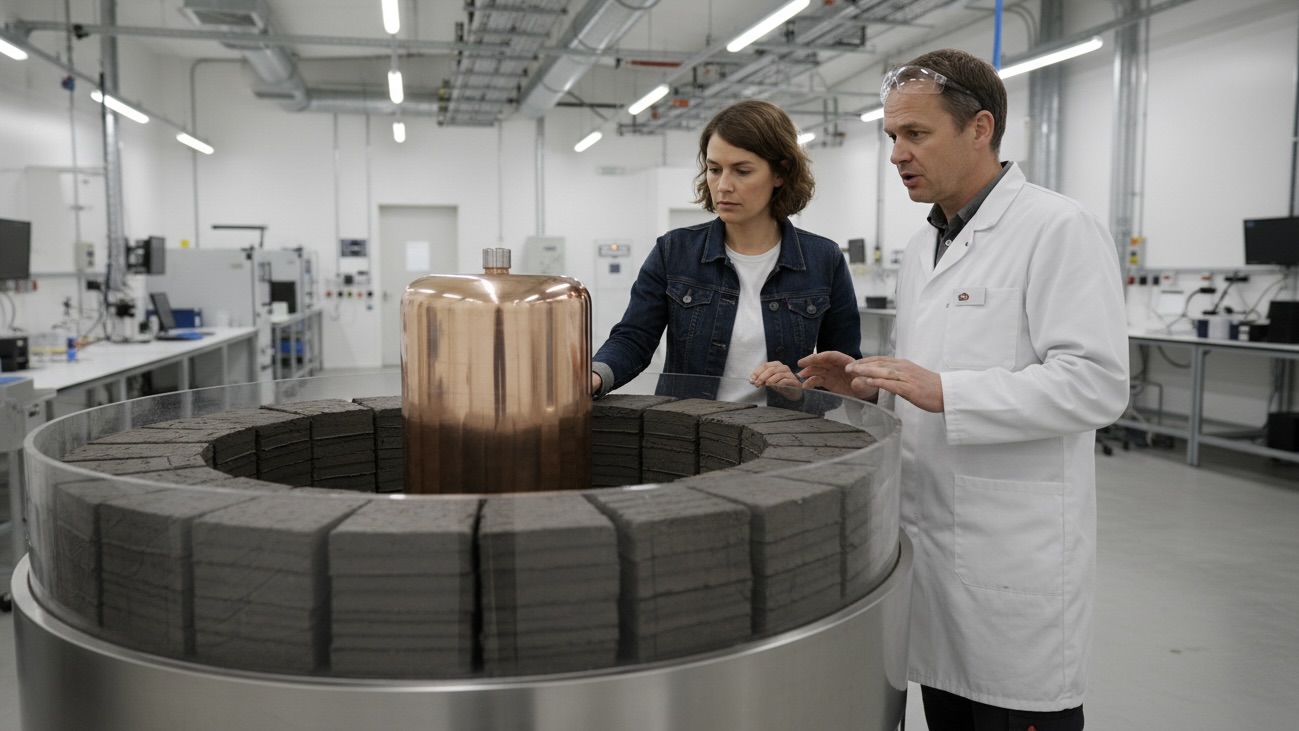
He led them through a series of exhibits—seismic charts that looked like abstract heartbeats, mineral displays glowing under focused lights, computer models of bedrock fissures infinitesimally small. It was a prelude, an academic overture before the main performance. And then they entered the central chamber. The room was cavernous, the ceiling lost in shadow, the only light a stark, clinical downpour on the object at its center. It was a massive, full-scale cross-section of a nuclear waste deposition tunnel, a slice of a future buried five hundred meters beneath their feet.
Casey drew in a breath. It was one thing to read the specifications, to see the diagrams. It was another to stand before it. The sheer scale was disorienting. A circle of simulated bedrock, rough and convincingly fractured, framed the entire display. Within that, like the rings of a gargantuan tree, were layers of engineered materials. And at the very heart of it all, nestled in its final cradle, was the canister.
It was made of gleaming, immaculate copper, the color of a newly minted penny magnified a thousand times. The light caught its polished surface, creating a halo that seemed to vibrate in the cold air. It was beautiful, undeniably so, with the severe, functional beauty of a high-end surgical instrument or a spacecraft component. It was also, Casey thought, the most terrifying object she had ever seen.
Beside her, Jeffrey had crossed his arms, a defensive posture against the sheer weight of the concept before them. As a painter, he understood the power of a focal point, and the copper canister held his gaze with an almost magnetic pull. He saw it not as an engineering solution but as a composition: the warm, living color of the metal entombed within layers of cold, dead gray. A heart that wasn't supposed to beat.
"It’s strange," Jeffrey murmured, his voice hushed, as if they were in a cathedral. "We’re looking at a coffin. A coffin that needs to last longer than our entire recorded history. One hundred thousand years." He shook his head, the number a physical weight in the air. "How do you even begin to design for a timeline that makes the Pyramids look like they were built yesterday? How do you speak to a future that won't know your language, your symbols, your gods?"
Dr. Evans adjusted his glasses, the movement precise and practiced. He regarded the display with a familiar, proprietary air. "You don’t, not with symbols or language," he said, his voice the dry rustle of paper. "Language erodes faster than rock. Any warning we carve into a stone will be misinterpreted as a map to a treasure or a temple to a forgotten deity. We've seen it happen time and again. The only message that lasts is the one that is never found. The goal is not communication. The goal is isolation. And you don't achieve that by relying on just one thing, Jeffrey. You build a system of redundant barriers. A defense in depth."
He gestured to the simulated granite surrounding them. "The host rock is the final shield, yes. Chosen for its stability, its dryness, its geological silence over eons. But we can't assume it's perfect. Over millennia, things can change. The bedrock is the vault, but it's not the workhorse. This…" He stepped forward, his worn leather shoes making no sound on the polished concrete floor. He placed a hand on the dark, matte material that directly encased the gleaming copper cylinder. It wasn't a single piece but a series of large, compressed rings, fitted together with geometric precision. They looked like enormous, petrified charcoal briquettes.
"This," Evans said, tapping one of the rings with his knuckles. The sound was a dull, dense thud, a sound with no echo. "This is the real workhorse. It's the most important part of the entire system. It’s what I wanted to show you all today."
Casey leaned in, her professional curiosity overriding her initial dread. The material was a flat, non-reflective gray, absorbing the light around it. From a distance, it looked inert, almost boring. But up close, she could see a fine, compacted texture, a grain that felt… familiar. She glanced at Evans, a silent question in her eyes. He gave a slight, almost imperceptible nod of permission.
She reached out, her fingers, stained with the memory of clay, tracing the surface. It was rougher than it looked, with a dry, chalky feel. It was cool to the touch, but it was a thirstiness she felt more than a temperature. Her skin seemed to cling to it, the moisture from her fingertips wicked away instantly. The sensation was immediate and visceral. It was a feeling she knew intimately, the feeling of clay on the verge of becoming stone.
A cascade of sensory memories flooded her. The dusty smell of her studio on a dry summer afternoon. The specific scrape of a trimming tool against a leather-hard pot. The faint, high-pitched ringing of a piece that had survived the bisque firing, now a porous ceramic skeleton waiting for its glaze. This material felt like that. It felt like potential. It felt like greenware.
"It feels like bone-dry clay," Casey said, her voice sounding louder than she intended in the vast, quiet room. She looked up from the surface to Evans, her mind racing, connecting the tactile information with her own material knowledge. "Is this… bentonite?"
For the first time since they'd arrived, a genuine smile broke through Dr. Evans's weathered composure. It was as if she'd spoken a password, a secret language he hadn't expected her to know. The lines around his eyes softened.
"You have a good eye," he said, a newfound respect in his tone. "A very good eye. Yes. It’s highly compacted bentonite clay. Formed from volcanic ash that settled on the floor of ancient seas millions of years ago, compressed over geological time."
Casey felt a strange shock of recognition, a sense of kinship with the dull gray block. She turned to Jeffrey, her expression animated. "I use bentonite in my glazes. A tiny amount. It's a suspending agent, it keeps the other particles from settling. But you have to be so careful with it. It’s… greedy." She looked back at the block. "It drinks water like nothing else. A little bit of it can absorb five, ten times its own weight. It swells up, turns a whole bucket of glaze into this thick, unworkable jelly if you're not paying attention."
"Exactly," Evans said, seizing on her words, his voice now filled with the passion of a teacher whose student has just grasped a core principle. "That 'greediness,' that 'swelling'… that is precisely its function. That is the elegant, simple genius that stands between sixty tons of irradiated fuel and the distant biosphere. Down there, half a kilometer deep, the bedrock is exceptionally stable. But water is patient. Water is the universal solvent. Over ten thousand years, a hundred thousand, groundwater will find a way. It will seep through a micro-crack, a fissure no bigger than a human hair."
Jeffrey, who had been listening intently, frowned. His painter's mind was trying to visualize the process, the slow, inevitable creep of moisture through stone. "But if water is the enemy, and this is just… clay… wouldn't the water ruin it? Turn it back to mud and wash it away?"
"Quite the opposite," Evans countered, a glint in his eye. "This is where the engineering becomes beautiful. Think of it as a self-healing wound. We machine these blocks to fit with incredible precision. They are packed in so tightly around the canister, and the entire assembly is then pressed into the deposition hole, which is bored to exact specifications in the bedrock. When that first molecule of groundwater touches this highly compacted, desiccated clay, it wants to do what you said, Casey. It wants to swell. Violently."
Casey could picture it perfectly. She’d seen it happen on a small, catastrophic scale in her own kiln. A pot not fully dried, a tiny pocket of moisture trapped within the clay wall. As the temperature rose, that water turned to steam, expanded, and the pot would explode, a miniature grenade of earth and time. It was a lesson every ceramicist learned the hard way: you don't fight the physics of clay.
"But it can't swell," she breathed, the realization dawning on her. "It has nowhere to go. It's trapped."
"Exactly," Evans repeated, his voice dropping with emphasis. "It's constrained by the unyielding granite of the bedrock wall on the outside, and the immense, immovable mass of the copper canister on the inside. The swelling force is immense, but it's checked. And that force has to go somewhere. So what does it do?"
Casey knew. She saw the physics in her mind's eye, a ballet of molecular pressure. "It creates pressure," she said. "It pushes back against the rock and against the canister. It densifies. It seals itself."
"Tremendous pressure," Evans confirmed, his hand still resting on the block, as if drawing strength from it. "It generates a sealing pressure that is greater than the hydraulic pressure of the groundwater trying to get in. It swells into every microscopic void, every fissure in the surrounding rock, every tiny imperfection on the surface of the canister. The individual blocks merge into one single, monolithic, plastic mass. It becomes so dense that the water molecules can no longer move through it. It transforms from a porous solid into a flexible, impermeable, watertight glove around the canister."
He paused, letting the image settle. "It cushions the canister against the slightest geological shift, absorbing seismic tremors. And it blocks the water, the agent of corrosion, from ever reaching the copper. It creates a chemically reducing environment, which means no oxygen, which means no rust. The water will never touch the metal. Not in ten thousand years. Not in a hundred thousand."
Jeffrey finally uncrossed his arms, his skepticism giving way to a grudging, profound awe. He looked at the dull gray blocks, no longer seeing them as inert spacers but as sleeping guardians. He, who spent his days wrestling with pigments and binders to create an illusion of permanence on canvas, was looking at a substance whose entire purpose was an unobserved, unending reality.
"So the most advanced, most permanent solution we have devised for the most dangerous substance on earth… is mud?" he asked, the word sounding inadequate, almost comical.
Casey smiled faintly, feeling a surge of pride for this humble material she knew so well. "Engineered mud," she corrected gently, her gaze fixed on the bentonite. "It’s organic logic. Everything we build eventually fails. Metal rusts, concrete cracks, plastic degrades. Our works are brittle. They fight nature and they lose. But clay… clay doesn't fight. It yields, it adapts. It seals. When it's done, it just returns to the earth it came from. It's already part of the system."
"That is the philosophy, precisely," Evans agreed, nodding slowly. "We aren't trying to build something stronger than nature. That's a fool's errand. We are using a material that has already survived millions of years of geological pressure to buy us a million more. It settles, it seals, and it waits. It is the ultimate passive safety system. There are no moving parts to fail, no electronics to short out. There is only the fundamental physics of a very special kind of earth."
Casey looked back at the whole display, but her perception had fundamentally shifted. She no longer saw a collection of separate components. She saw a single, integrated system, a nested set of certainties. The gleaming copper at the center was no longer the star of the show. It was just the precious cargo. The true masterpiece was its container, the humble, powerful gray earth wrapped around it. The fear she had walked in with, that cold knot of anxiety about this place and what it represented, hadn't vanished, but it had been transformed. It was no longer the sharp, immediate fear of a ticking time bomb, a technological hubris waiting to collapse.
Instead, it was a deeper, more philosophical dread, an awe at the timescale they were pretending to command. This wasn't a bomb. It was a seed. A poison seed, wrapped in a clay husk, planted deep in the stone, designed to wait out the long, unforgiving winter of deep time. It was a promise of safety, but it was also a confession of failure—an admission that this substance was so fundamentally incompatible with the world of the living that their only solution was to give it back to the world of the dead, to the slow, patient, and inhuman logic of geology.
Jeffrey had taken out a small, worn sketchbook and a piece of charcoal. His hands, usually so steady, fumbled with the pages. He stared at the display, his artist’s eye trying to deconstruct it into line and shadow, value and form. But he couldn't. It resisted artistic interpretation. How could he capture the pressure he couldn't see? The timescale he couldn't comprehend? The silence it was meant to keep? He made a few angry, jagged lines on the page—a dark circle, a darker ring—then snapped the sketchbook shut with a sound that cracked the room’s oppressive quiet. It was unpaintable. It was the ultimate landscape, a place designed never to be seen, a monument to the end of all monuments.
As the group moved toward the elevator that would take them down to the actual test tunnels, Casey lingered for a moment, her hand resting on the clay, wondering what other secrets the earth was keeping for them.
Share This Story


