The Studio
A drafty community center art room in Winnipeg's North End, filled with the smell of acrylics and wet autumn leaves.
The brush was cheap, the bristles already splayed and stiff like an old broom. Nathan didn't care. He jammed it into the blob of red acrylic on his paper plate palette, swirled it until the white plastic vanished, and then faced the canvas.
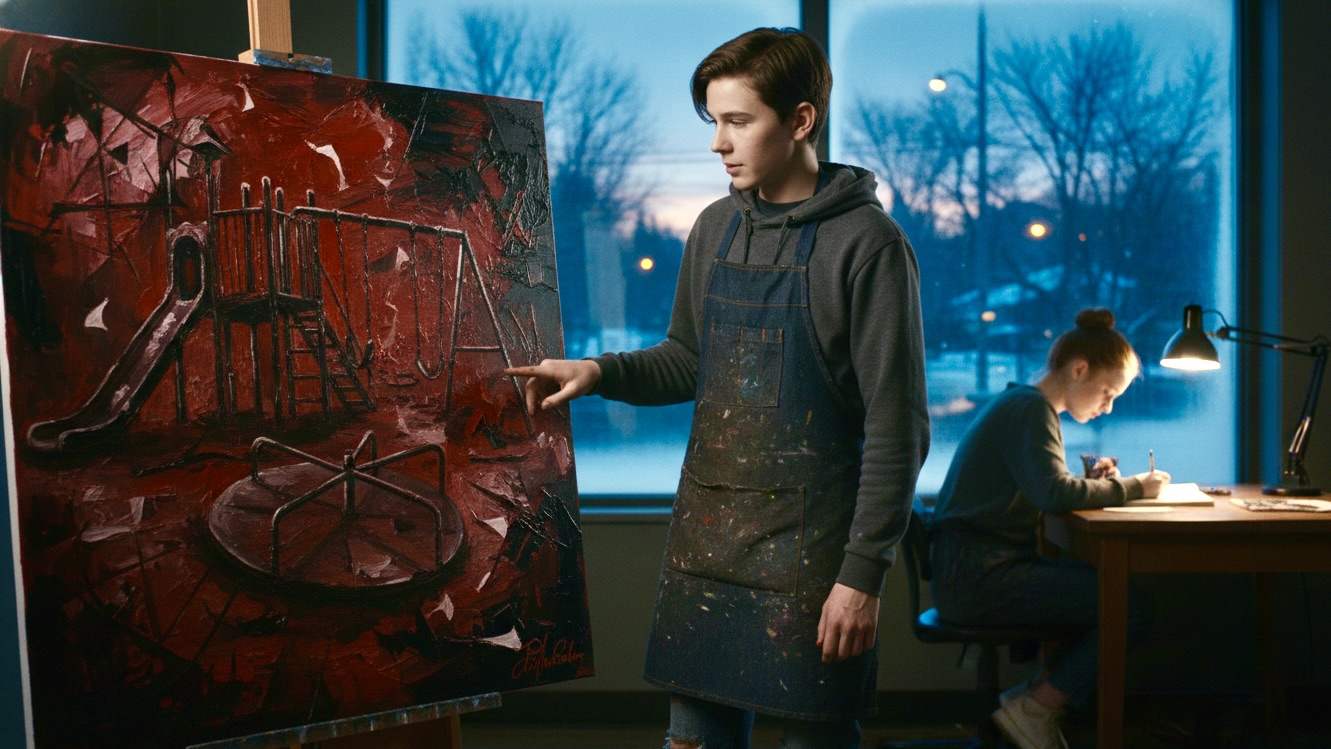
The painting was supposed to be of something that mattered. That was the only rule for the free-art session at the community center. So he had painted the park. Not the park from last summer, all bright greens and the yellow blur of the slide, but the park as it was now. A skeleton of greys and muddy browns under a washed-out October sky.
He held his breath. His wrist, thin and bony inside the sleeve of his hoodie, snapped forward. A thick, wet slash of red appeared, bisecting the two empty A-frames of the swing set. It looked like a wound. Good.
It wasn’t enough. He loaded the brush again, the paint thick and glossy like fresh blood. Whap. Another line, parallel to the first. He jabbed the brush tip into the canvas, leaving a constellation of angry red dots around the base of the rust-eaten slide. He stepped back, his chest tight. The thin plastic art apron he wore over his clothes crinkled with every ragged breath, a cheap, synthetic sound that filled the space around his easel.
“You’re gonna run out of red,” a voice said, dry and unimpressed.
Sarah sat on a stool two easels down, hunched over a sketchbook in her lap. She hadn’t looked up, but she didn’t need to. She had an uncanny ability to know what was happening around her without ever seeming to pay attention. Her pencil moved with a soft, scratchy rhythm, a counterpoint to Nathan's violent brushstrokes.
“It’s supposed to be like that,” Nathan muttered, his voice gravelly. He didn’t know why he felt the need to defend it. “It’s the caution tape. They put it up yesterday.”
“I saw,” she said. The scratching of her pencil stopped for a beat. “It’s ugly.”
“That’s the point.” He glared at the canvas. The grey metal poles of the swingset looked pathetic, stripped of their purpose. He remembered the feeling of pumping his legs, higher and higher, until the chains groaned and for a single, weightless second at the apex of the swing, he felt like he could see the whole city. Now, it was just junk. “The city says the chains are unsafe.”
“So?” Sarah finally glanced over, her eyes dark and serious under a fringe of black hair. She held up her sketchbook. It was a perfect, almost photographic rendering of a pigeon, each feather detailed with meticulous care. “Everything gets old. They’ll fix it in the spring.”
The casual certainty of her words felt like a slap. “They said that last year about the slide,” Nathan shot back, the frustration bubbling up like acid. “They put a cone in front of it and said they’d fix it in the spring. Now it’s just a big orange rust stain with weeds growing through the bottom.”
He slammed the brush into the plastic jar of water on the small table beside him. The clear water instantly clouded, then bled into a swirling, murky pink. It looked like a wound, too. “They don’t ask. They don’t care. They just put up their stupid tape and walk away.”
The art workshop was held in the multipurpose room of the Northwood Community Centre, a tired brick building that smelled of floor wax, damp wool, and something vaguely like boiled vegetables from the seniors’ lunch that had ended an hour ago. Fluorescent lights hummed in the high ceiling, casting a flat, even light that bleached the color out of everything. Outside the huge, frosted-glass windows, the world was turning grey. A real Winnipeg wind was howling down the street, a low, mournful sound that rattled the old window frames. It was tearing the last of the stubborn yellow leaves from the branches of the big elm trees, sending them skittering across the pavement.
Maria, the woman who ran the workshop, moved through the room like a ghost. She was tall and wore a paint-smeared cardigan, and she never seemed to walk so much as drift between the easels, offering a quiet word here, a nod there. She made no sound as she came to a stop behind Nathan’s shoulder. He tensed, expecting a comment about his technique, or the mess he was making.
He watched her reflection in the darkened window. She wasn’t looking at his brushstrokes. She was looking at the feeling behind them. Her gaze was fixed on the angry red lines slashing through the grey landscape. He could feel the weight of her attention, and it made the back of his neck prickle.
“This has a lot of energy,” Maria said finally. Her voice was calm and low, a stark contrast to the buzzing fury inside Nathan’s head. “It’s powerful.”
Nathan’s shoulders hunched. He crossed his arms over the crinkly apron, a defensive posture he didn't even realize he was taking. “It’s just a painting of the park.”
“Is it?” Maria’s eyes met his in the window’s reflection. “Or is it evidence? Is it data?”
He turned around to face her properly, his brow furrowed in confusion. “Data? Data is for math class. Bar graphs and spreadsheets. It’s the boring stuff my dad does for work.”
“Not always.” Maria’s lips curved into a slight, knowing smile. She grabbed a wooden stool from against the wall and dragged it over. The legs screeched horribly against the scuffed green linoleum, making a few of the younger kids at the clay table jump. She sat down, so she was at his level. “Sometimes data is a feeling. Sometimes it’s a story. You know what YPAR is?”
From her stool, Sarah snorted. “Sounds like a noise a pirate would make.”
Maria’s smile widened. She looked over at Sarah, including her in the conversation. “Close. It stands for Youth Participatory Action Research.” She gestured with one long-fingered hand, taking in the whole room—the dozen or so kids smearing paint, rolling clay, cutting up construction paper. “Most of the time, when adults want to know something about kids, they do research on you. They treat you like… like bugs under a magnifying glass. They watch you, they take notes, they write reports about what they think you need or what they think you’re doing.”
Nathan thought of the man from the city who had put up the tape. He’d had a clipboard. He’d made a few checkmarks, shaken his head, and then started unspooling the bright red plastic. He hadn’t spoken to a single kid.
“YPAR is different,” Maria continued, her voice gaining a quiet intensity. “It flips the whole thing over. With YPAR, you aren’t the subjects. You’re not the bugs. You’re the researchers.”
The idea was so strange it barely made sense. Nathan looked from Maria’s earnest face back to his chaotic painting. The red streaks seemed to pulse under the fluorescent lights. “Me? A researcher? I’m eleven.”
“And?” Maria leaned forward, her elbows on her knees. “You live in the neighborhood. You play—or you used to play—in that park.” She pointed a paint-stained finger at his canvas. “You know which swing had the squeaky chain. You know the slide got scorching hot in the sun. You know which kids used it every single day after school because their parents were working. You know who fell and scraped their knee on that broken bit of concrete by the jungle gym. That’s called ‘lived experience.’ It’s a mountain of data that the guy with the clipboard will never have. His data is a checklist. Yours is real life. Which do you think is more valuable?”
The question hung in the air. Nathan had never thought of it like that. All the hours he’d spent at the park weren’t just him goofing around; they were… information. He knew that the third swing from the left was the best one because you could get the highest on it. He knew that the little kids were terrified of the spiderwebs that collected under the slide. He knew that older kids sometimes hung out on the monkey bars at night, because he’d seen the empty soda cans they left behind. It was all just stuff he knew. He never thought it could be important.
Sarah had stopped sketching. She was watching Maria, her pencil held motionless between two fingers. The usual skepticism in her eyes was being replaced by a flicker of curiosity. “So… what? We’d study the playground?”
“You start by identifying the problem,” Maria explained, her gaze shifting between them, making them a team. “Nathan’s already done that.” She nodded at the painting. “The park is falling apart and nobody is fixing it. So, you design the study. How are you going to prove it? How are you going to collect the evidence to show people this is a real issue?”
Nathan’s mind, which a few minutes ago had been a hot swamp of anger, started to clear. A new kind of energy began to bubble up, something colder and sharper. “We could take pictures,” he said, the words coming out faster than he expected. “Of all the broken stuff. The rust, the cracked bench, the garbage can that’s always overflowing.”
“Great,” Maria said, nodding encouragingly. “Photographs are powerful data. What else?”
“We could talk to other kids,” Sarah added, her voice quiet but firm. She’d put her sketchbook down on the floor beside her stool. “Interview them. Ask them where they go now that the park is closed. Ask them how they feel about it.” Her eyes met Nathan’s. “Like, proper interviews. Record them, maybe.”
“Excellent. Testimonials. First-hand accounts.” Maria was beaming now. “You collect all of that. The photos, the stories, the observations. You analyze it. You find the patterns. You build your case.”
“And then what?” Nathan asked, leaning forward. He could feel his heart thumping against his ribs, but it wasn't from anger anymore. It was excitement. “We just… have a bunch of pictures and sad stories?”
“And then comes the best part,” Maria said, her voice dropping to an almost conspiratorial whisper. “The ‘A’. Action. That’s the most important letter in YPAR. You don’t just write a report that some adult files away in a cabinet to gather dust. You use your findings to demand a solution. You take your evidence—your data, your truth—and you present it to the people who make the decisions. The people who buy the rolls of caution tape instead of new swing chains.”
Nathan stared at his painting. The red slashes didn’t look like a messy expression of anger anymore. They looked like evidence markers at a crime scene. A crime of neglect. And he and Sarah were the detectives who were going to solve it.
He reached for a different brush, a finer one. He dipped it in a bit of black and carefully painted the words ‘UNSAFE’ along one of the red strips of tape on his canvas. It was no longer just a feeling. It was a fact.
Sarah was already thinking bigger. Her eyes darted toward the window, looking past their own reflections to the darkening street outside. “We could map it,” she said, a sudden urgency in her voice. “We could make a big map of the whole neighborhood. Mark every single broken thing. The streetlight on the corner that’s been flickering for months. The huge pothole on Elm Street that almost wrecked my mom’s tire. The bus shelter with the shattered glass. Not just the park. Everything.”
“Now you’re talking,” Maria said, clapping her hands together softly. “Now you’re a team of co-researchers. You’re in charge. You lead the project. I’m just here to help with the heavy lifting—like booking a room or figuring out the photocopier.”
Nathan nodded slowly, the idea taking root and sprouting in his mind. It felt huge, almost impossibly huge, but it also felt… right. The frustration that had been coiling in his gut for months began to unwind, replaced by a sharp, clear sense of purpose. He wasn’t just Nathan, the kid who was mad about a broken swing set. He was an investigator. A researcher. And he had a target.
He and Sarah started talking at once, their words tumbling over each other. They’d need notebooks. A camera. Maybe they could borrow one from the centre. They’d have to make a list, a plan. They’d start tomorrow, after school. The playground first, because that was their ground zero. Then the streets, block by block.
The buzz of their planning slowly filled the space around their easels, a bubble of fierce energy. Other kids started packing up around them. The scraping of stools, the clatter of paint jars being collected, the murmur of parents arriving for pickup. The workshop was ending.
Outside, the wind had died down a little, but the sky had bruised to a deep purple. The streetlights flickered on one by one, their orange glow pushing back against the encroaching twilight. They hummed with a low, electric buzz that seemed to vibrate in Nathan’s teeth. He looked out the big window, past Sarah’s reflection, past his own determined face, and saw the street. It looked different now. Not just a way to get home, but a grid. A map of problems to be solved.
And that’s when he noticed the car.
It was parked directly across the street, a dark sedan, maybe a Ford or a Chevy, impossible to tell in the fading light. It was just a big, black shape, idling silently at the curb. All the other cars that pulled up belonged to parents, their headlights cutting bright cones in the dusk as they found a spot, doors opening and closing, voices calling out. This one was different. Its lights were off. Its engine was a low, almost imperceptible rumble, a vibration he could feel more than hear through the soles of his sneakers on the linoleum floor.
There was no one getting in or out. The windows were tinted, reflecting the community center’s lighted doorway in a distorted smear. It was just… sitting there. Watching.
“Hey,” Nathan said, his voice suddenly quiet. “You see that?”
Sarah followed his gaze. “What? The big pothole by the drain? We should mark that down first, it’s a total ankle-breaker.”
“No. The car. The black one.”
She squinted, her focus shifting. “Huh. Weird. Probably waiting for someone.” But her voice lacked its usual conviction. The car felt out of place. It was too still. Too anonymous.
The sun had finally sunk below the low-slung rooftops of the houses down the block, and the last vestiges of daylight were gone. The street was now a world of sharp shadows and isolated pools of orange light. The sedan seemed to melt into the deepest of those shadows, becoming less a car and more a dense block of darkness. A presence.
Maria was calling out final reminders about cleaning brushes. Parents were zipping up kids’ jackets. The ordinary, comforting sounds of the end of the day. But Nathan couldn’t tear his eyes away from the window. The plan, the map, the data—it all felt bright and hopeful and powerful. But that car… that car felt like something else entirely. It was a question mark at the end of their brand-new sentence. A piece of data they hadn’t accounted for.
The engine continued its low, patient rumble, a quiet threat in the cold Winnipeg night.
Across the street, a dark sedan sat idling at the curb, its engine a low rumble that vibrated through the glass, watching the community center doors.
Share This Story


