The Basement Archives
Leo navigates the dimly lit, freezing basement of the Oakridge Tenements to collect water samples, treating the neglect of the building as a crime scene under investigation.
The drip was a metronome counting down to a disaster only Leo could hear. He crouched behind the industrial washing machines in the basement, his breath pluming in the frigid air. It was twenty degrees outside, but somehow colder in here. In his hand, he held a sterilized jam jar, the glass cold against his palm. He wasn't stealing; he was collecting evidence.
He waited for the super, Mr. Henderson, to drag his heavy boots up the concrete stairs. The door slammed. Silence returned, save for the rhythmic plink-plink from the rusted pipe overhead. Leo moved. He positioned the jar under the leak. The liquid that fell wasn't clear. It was a cloudy, amber bruise. He capped it tight, pulled a sharpie from his pocket, and wrote: Sample 4A. 14:00. Turbidity: High.
Upstairs, the apartment was a stifling box of dry heat and silence. His mother, Sarah, sat at the kitchen table, staring at a stack of unpaid bills. She didn't look up when Leo entered. He slid his backpack off, the glass jars clinking softly inside. He went straight to his room, his command center. On the wall, where a poster of a superhero might have been, was a hand-drawn map of the apartment complex. Red pushpins marked the units where the coughing was worst. Blue pins marked the brown water.
This was the heart of the method. In school, they taught him that scientists were old men in white coats who lived far away. But Leo had learned something different online, something called Youth Participatory Action Research. It was a long name for a simple weapon: the people living the nightmare are the best ones to measure it. He wasn't just a victim of the Oakridge Tenements; he was the primary investigator.
He opened his notebook. It was divided into three columns: Observation, Data, Action. Under Observation, he had written: 'The water smells like pennies.' Under Data, he had spent three weeks knocking on doors, pretending to sell chocolate bars. He didn't have chocolate. He had questions. Does your water run clear? Do you have headaches? How long has the heater been broken?
He turned the page to the survey results. Mrs. Gable in 3B: Chronic headaches, brown water. Mr. Diaz in 2C: Skin rash, brown water. The pattern was a snake winding through the building's plumbing, striking specific units while sparing others. The adults called it 'bad luck' or 'old pipes.' Leo called it a dataset. He cross-referenced the complaints with the building's original blueprints he’d found in the public library archives. The affected units all shared a single, unrenovated supply line.
"Leo?" His mother’s voice was sharp, cutting through the wall. "Dinner."
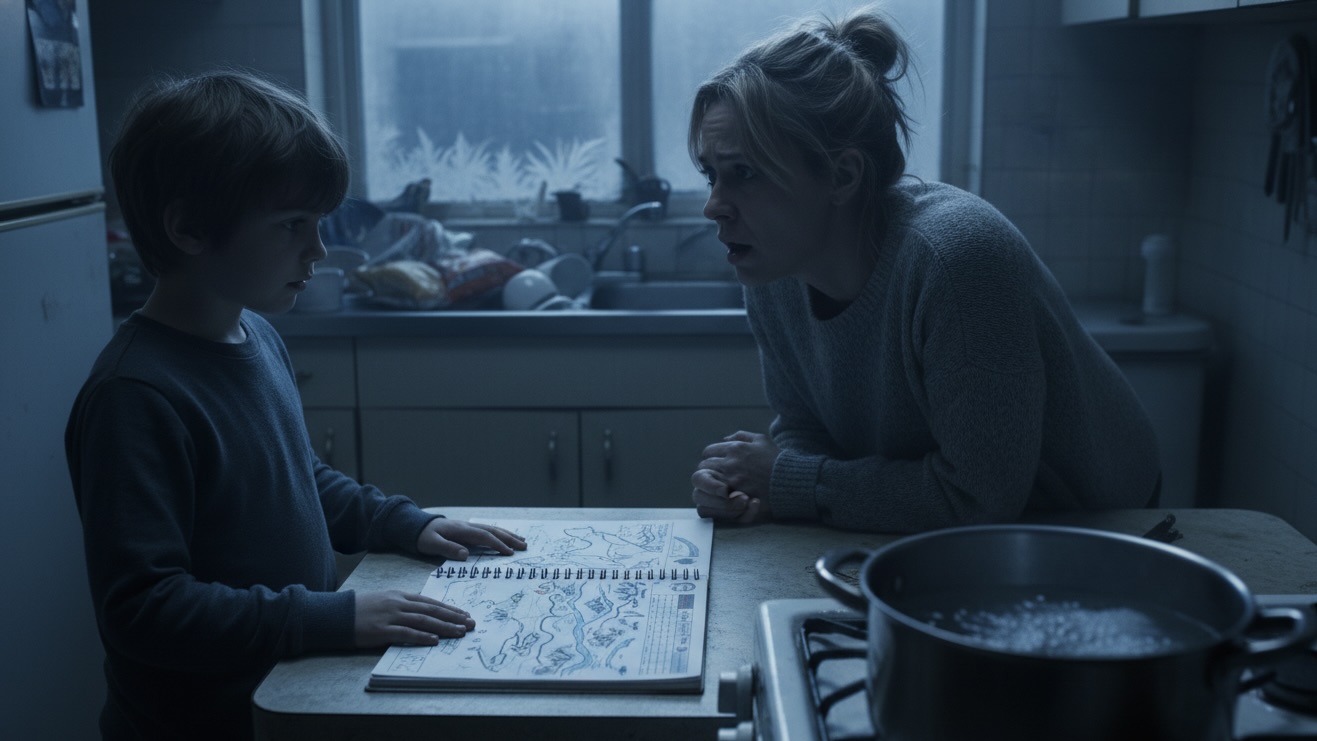
He walked into the kitchen. The tap was running. She was filling a pot for pasta. The water looked clear enough, but Leo knew better. The particulates were microscopic.
"Don't," he said.
Sarah sighed, turning off the tap. "Don't start, Leo. It's safe. The landlord sent a letter."
"The letter is a lie." Leo placed his notebook on the table. He didn't shout. He didn't throw a tantrum. He opened it to the map. The red pins formed a perfect vertical line through the building.
"What is this?" she asked, her eyes scanning the grid.
"Evidence," Leo said. "I asked everyone. Twenty units. Everyone on the north riser is sick. Everyone on the south is fine. It’s not the city water. It’s the building’s north intake valve. It’s corroded."
Sarah touched the paper. She traced the line of red pins. She looked at the column of symptoms Leo had recorded in his neat, small handwriting. It wasn't a child's drawing. It was an indictment. The shift in her eyes was subtle—a move from exhaustion to alarm. This is what the research did. It took a vague feeling of unease and solidified it into a fact that could not be ignored. It shifted the power dynamic. They weren't just tenants complaining; they were experts presenting findings.
"You did this?" she whispered.
"We need to show the Tenants' Association," Leo said. "We don't ask for repairs anymore. We prove negligence."
Sarah looked at the pot of water, then back to her son. The fear was still there, but something else had joined it. Respect. She picked up the pot and poured the water down the drain.
"Get your coat," she said. "Mrs. Gable is the head of the association. We're going to 3B."
Leo grabbed the notebook, the weight of it heavy in his hands, knowing that the research phase was over and the war was just beginning.
Share This Story


