The Listening Room
A drafty community center library on a rainy Tuesday evening, where the smell of old paper mixes with damp wool. The setting is intimate, grounded, and quiet.
The rain wasn't just falling; it was a presence. A weight. It slid down the high, narrow basement windows of the library in thick, wavering sheets, distorting the already gray evening into a watery blur. The world outside was an impressionist painting of smeared headlights and bleeding traffic signals. Down here, the air was a flat, recycled thing, tasting of damp coats, the faint chemical sweetness of old paper, and the dregs of coffee burned hours ago in a pot somewhere upstairs. A low, electric hum from the fluorescent lights overhead was the room’s only pulse.
I was slouched in a plastic chair in the last row, the one with a permanent wobble. On the projector screen at the front of the room, a pie chart glowed in aggressive primary colors. It was supposed to be a picture of my neighborhood. Of us. A slice of cherry red, labeled ‘Chronic Unemployment,’ took up nearly a third of the circle. A man in a crisp, button-down shirt that looked too tight at the collar tapped the red slice with the sharp red dot of a laser pointer. The dot quivered, a nervous insect.
“As the data indicates,” he said, his voice smooth and practiced, the kind of voice that never had to be raised to be heard, “the correlation between single-parent households and truancy rates in this census tract is statistically significant.”
He clicked a button, and the pie chart vanished, replaced by a bar graph. More red. Red for dropout rates. Red for food insecurity. Red for us. They had a color for our failures. I wondered if they had one for the sour knot of anger tightening in my gut. I looked down at my own hands, resting on my knees. The nails were short, bitten down, and the cuticles were stained with the same deep black ink I spent eight hours a day loading into the guts of a massive commercial printer. The ink felt more honest than their charts. It was the residue of work, of making something real—flyers for concerts, menus for the diner down the block, the weekly circular for the grocery store. I printed the announcements for this very meeting, feeding glossy cardstock into the machine, watching their clean, empty words about ‘Community Dialogue’ stack up in perfect, sterile piles.
They didn’t know about the ink. They didn’t know about the smell of the solvent I used to clean my hands, a smell that clung to me no matter how hard I scrubbed. They didn’t know my mom was a single parent because my dad had worked two jobs to the point of a heart attack at forty-seven. They didn’t know my brother, Leo, was late for school half the time because he walked the long way around, avoiding the burned-out streetlights on 4th Avenue, a three-block stretch of darkness that the city had been promising to fix for two years. Their data didn’t show that. Their data showed a red bar, a neatly labeled problem, a specimen in a jar. The man kept talking, his laser dot dancing from one column to the next, dissecting us.
I let my focus drift, my eyes tracing the water stains on the acoustic ceiling tiles. They looked like maps of forgotten continents. I thought about the box of mac and cheese in the cupboard at home, and whether I should add the can of peas to it or save them for tomorrow. This felt more urgent, more real, than the percentage points on the screen. I glanced around the room. Mrs. Gable from two doors down was here, her eyes closed, though I knew she wasn't asleep. She was just resting them. She worked the early shift cleaning rooms at the downtown hotel, and I knew for a fact she’d been on her feet since four-thirty this morning. Mr. Henderson, who ran the corner store, was staring at the screen with a blank, polite expression he usually reserved for people trying to use expired coupons. A few other faces I recognized from the neighborhood were scattered among the twenty or so chairs, all of us listening to a story about our lives told by people who had only driven through.
When the presentation finally wound down, the lights flickered back on, painfully bright. The room blinked and shuffled in a wave of polite, exhausted applause that sounded more like the rustle of dry leaves. It was the sound of endurance, not enthusiasm. I was already on my feet, pulling the hood of my sweatshirt over my head, the worn fleece a familiar shield. My only goal was the door, the rain, the walk home. Anything but this room.
“You didn’t buy it.”
The voice was quiet, calm, and it cut through the low murmur of people gathering their bags. It came from a man leaning against a cart of returned books near the exit. I stopped, my hand hovering over the cold metal push bar of the door. He wasn't one of the presenters. I’d noticed him during the Q&A, sitting off to the side, not taking notes, just watching. Watching the audience, not the screen. His brow was furrowed, his focus intense, like someone trying to solve a puzzle by looking at the shapes of the pieces instead of the picture on the box.
I didn’t turn around right away. “Buy what?” My voice came out rougher than I intended.
“The diagnosis. The whole presentation.” He still hadn’t moved. “You looked… I don’t know. Frustrated.”
“Bored,” I corrected, finally turning to face him. He was younger than the others, maybe thirty. His dark sweater was frayed at the cuffs, and his hair was a mess, like he’d been running his hands through it all evening. He didn't have the glossy, packaged look of the men at the front of the room. He looked tired, but in a different way. A lived-in way.
“Boredom is a form of frustration,” he said with a small shrug. “It’s what happens when your intelligence is being insulted.”
I let my hand drop from the door. “They come every spring, like migratory birds. They count us, they measure the poverty, they write a paper that probably gets them a promotion, and then they leave. Nothing changes. We just stay poor, and they get a new chart for next year’s presentation.”
He nodded slowly, his eyes fixed on me. They were a clear, steady gray. “Extraction. That’s the traditional research model. It’s colonial, really. They treat the community like a data mine. They come in, take the ore—the stories, the numbers, the pain—refine it somewhere else, and then try to sell it back to the community as policy. And they wonder why nobody trusts them.”
The way he said it, so simply, so accurately, threw me off. He wasn’t defending them. He was articulating the very thing I’d been feeling but couldn’t put into clean words. I pulled my hood back slightly, studying him. “And you’re different?” The skepticism was heavy in my tone.
“I’m trying to be. My name is Silas.” He offered a hand. It was a little awkward, reaching across the book cart. I shook it. His grip was firm, his hand calloused.
“Maya,” I said.
“I work with a different framework, Maya. It’s called YPAR.”
I felt the cynicism creep back in, a familiar, protective reflex. “Great. More… letters. An acronym to fix everything.”
He didn’t flinch at my sarcasm. He actually smiled, a faint, wry thing. “Yeah, academia loves its acronyms. I know. It stands for Youth Participatory Action Research. It sounds complicated, but the ‘P’ is the only part that really matters. Participatory. It means I don’t come in with the questions already written down. It means I don’t define the problem. You do.”
The rain hammered against the high windows, a sudden, violent drumming that made the glass shudder. The room was almost empty now. The experts were packing their laptops and laser pointers into sleek, black carrying cases, their voices a low, confident murmur. They were already moving on.
I looked from their retreating backs to Silas. He was still just leaning there, patient, waiting. “Why me? Why are you talking to me?”
“Because of the way you were watching them,” he said. “And because I have a hunch. I bet you know why the streetlights on 4th Avenue haven’t been fixed. And I don’t mean the city budget excuse. I mean the real reason.” His gaze was so direct it felt like he was seeing right through the defensive shell I’d built around myself.
He was right. I knew the official reason was a backlog on work orders. But I also knew that two years ago, a crew had come out, taken one look at the frayed, ancient wiring, and declared it a total system overhaul, not a simple bulb replacement. They’d packed up their truck and never came back. I knew that Mrs. Gable had called the city every month for a year until her voice was hoarse and she just gave up.
“I have the methods,” Silas continued, his voice dropping lower, more serious. “I know how to design a survey that gets real answers, how to code qualitative data, how to run a statistical analysis. I know how to write a grant proposal and how to speak the language of the people who control the budgets. But you… you have the context. The lived expertise.”
I bristled at the phrase. It sounded like more jargon, a prettier label for the same old thing. “Lived expertise. That’s a fancy way of saying I’m poor and I live here.”
“No,” he countered, his voice firm but not aggressive. “It’s a way of saying your experience is valid data. It’s a way of saying that the knowledge you carry in your body, from walking these streets every day, is just as important—more important, actually—than any of the numbers on that screen. That’s the foundation of CBPR—Community-Based Participatory Research. We don’t just observe people. We partner with them. We share ownership of the entire process. From figuring out the very first question to writing the final report and deciding who gets to see it.”
His words hung in the quiet, damp air between us. Co-researchers. Not subjects. Not statistics on a slide. I looked over at the empty rows of chairs where my neighbors had sat, listening in silence as they were described as a collection of deficits. We were always the subjects, the observed, the ones being studied and explained. The idea of holding the clipboard myself, of asking the questions… it felt alien. Impossible.
And yet.
“So, we wouldn’t just be… the red parts of the pie chart?” I asked, the question coming out quieter than I’d intended.
“You would be the researchers,” he said, his intensity unwavering. “We decide what matters. We decide what to investigate. We gather the proof. We build the argument. We present the solution. It’s not about me studying your community. It’s about us, together, studying the systems that are failing it.”
The silence stretched. It wasn't an awkward silence. It felt heavy, filled with a strange potential that was both terrifying and thrilling. I thought about Leo, about the extra twenty minutes his detour added to his walk, about the anxiety that hummed in my chest every winter evening until I heard his key in the lock. I thought about the late-shift jobs at the packaging plant over the bridge, jobs that paid better than my print shop gig, jobs that nobody from our neighborhood could take because the last bus ran at ten and walking home down 4th Avenue in the dark wasn’t an option. It wasn’t just about safety. It was about money. It was about everything. The pie chart was all connected, but not in the ways the experts thought.
I finally broke the silence. My voice was flat, a statement of fact. “The lights on 4th,” I said, looking him straight in the eye. “It's not just that they’re broken. It’s not just that people feel unsafe. It’s that nobody can walk to the bus stop on the corner after dark, so nobody from this neighborhood can take the late-shift jobs at the plant. It costs people money. Real money.”
A slow smile spread across Silas’s face. It wasn’t a triumphant smile, but a small, genuine thing that reached his eyes. It was a smile of recognition. “See? Right there. You just identified an economic impact correlation that every single one of their bar graphs missed. That’s it. That’s the beginning. That’s a hypothesis.”
A tiny spark flickered to life inside me, a warmth in the cold, damp room. A hypothesis. It sounded so official, so powerful. It was my observation, my ‘lived expertise,’ translated into a language they couldn’t ignore.
“And… and we can prove it?” I asked, the word ‘we’ feeling strange and new on my tongue.
“We can build a whole project around it,” he said, his energy rising. He pushed himself off the book cart, finally standing up straight. “We can map the outages, block by block. We can create a survey and go door-to-door, interview residents about their travel patterns, about job opportunities they’ve had to turn down. We can document it all. We can present it to the city council, not as a complaint, but as a rigorous, data-driven community impact study, backed by evidence we collect together. Your evidence.”
I looked at the door again, at the distorted, rainy world outside. For the first time all night, it didn't feel like an escape. It felt like the place where the work was. The place where the real data lived. Then I looked back at Silas. The rain on the windows no longer sounded like a barrier, a constant, oppressive weight. It sounded different now. Sharper. Like a drumbeat. A signal to start.
“Okay,” I said. The word was small, but it felt huge in the empty room.
He blinked, as if surprised I’d agreed so quickly. “Okay?”
I let the hood of my sweatshirt fall back from my head, meeting his gaze without any barriers. The fluorescent light felt less harsh now. “Okay,” I repeated, the word stronger this time. “Teach me the methods. I’ll show you the reality.”
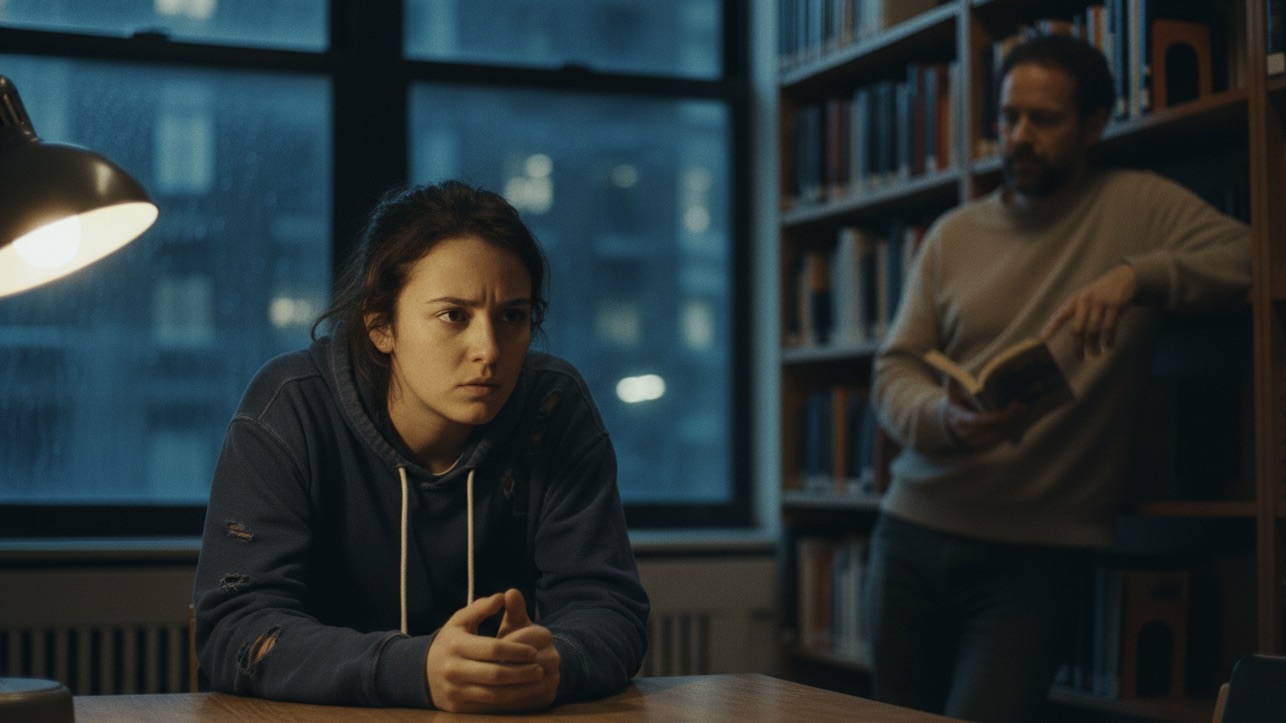
I pulled a chair from the stack, the metal scraping against the linoleum, and sat down to begin the work.
Share This Story


