The Community Center
A tense town hall meeting in a working-class neighborhood where a researcher is trying to present data to skeptical residents.
The fluorescent lights of the Ironwood Community Center hummed with a low, irritating buzz that seemed to harmonize with the tension in the room. Mateo sat in the back row, twisting the strap of his backpack. He had been away at university for only two years, but returning to Ironwood always felt like stepping into a different atmosphere—literally. The air here tasted metallic, a heavy cocktail of diesel and dust that settled in the lungs and refused to leave. It was the reason half the kids on his block, including his little nephew, walked around with inhalers in their pockets.
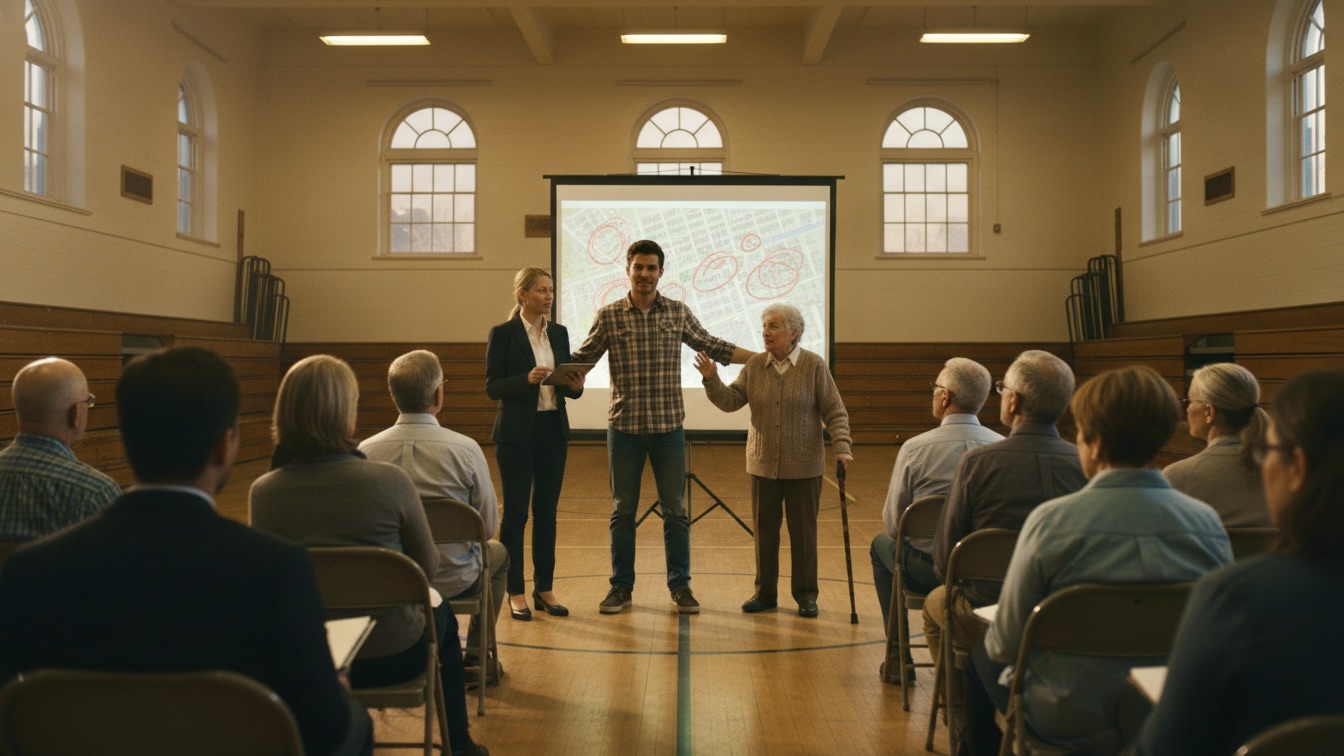
At the front of the room, Dr. Silvia Arthurs pointed to a projection screen filled with complex scatter plots and heat maps. She was brilliant, Mateo knew—a respected epidemiologist from the university downtown—but she was losing them. She spoke of 'particulate matter concentrations' and 'statistical significance,' but the tired faces in the folding chairs stared back with a mixture of confusion and hostility. To them, she was just another outsider with a clipboard, here to treat them like lab rats, extract data, and vanish before the real work began.
"We need to install monitors on the street lamps," Dr. Arthurs was saying, her voice echoing slightly. "To validate the hypothesis regarding peak emission times."
"And then what?" a voice cut through the jargon. It was Mrs. Hawkins, a retired nurse who had lived in Ironwood since the steel mills were still burning bright. She stood up, leaning on her cane. "You get your paper published, you get your tenure, and we still cough up gray phlegm in the morning? We've been studied to death, Doctor. We don't need more study; we need clean air."
The room erupted in murmurs of agreement. Mateo saw Dr. Arthurs flinch. She looked defeated, clutching her laser pointer like a shield. That was the moment Mateo realized the chasm between the science he was studying and the reality he was living. He stood up, his heart hammering against his ribs.
"She's right," Mateo said, his voice cracking before finding its strength. He walked toward the front, bridging the physical gap between the neighborhood elders and the scientist. "But Dr. Arthurs is right, too. We can't force the city to reroute the truck traffic without hard proof. The problem isn't the science. The problem is the process."
He turned to Dr. Arthurs. "You're doing research on this community. But if you want this to work, you need to do research with us. It's called Community-Based Participatory Research. It means Mrs. Hawkins isn't just a subject; she's a co-investigator."
The room went quiet. Dr. Arthurs lowered her hand. "Go on," she said, listening.
"You want to put sensors on the street lamps?" Mateo asked, turning back to the crowd. "Mrs. Hawkins, where do the trucks actually idle? Is it on Main Street where the lamps are?"
Mrs. Hawkins scoffed. "Lord no. They park behind the old loading docks off 4th Street at 5:00 AM to avoid the weigh station. That's where the fumes are thickest. That's where the kids wait for the school bus."
Dr. Arthurs blinked, pulling a notebook from her pocket. "The loading docks? Our satellite data didn't show congestion there."
"Satellites don't smell diesel at dawn," Mateo said gently. "We do."
The dynamic in the room shifted. It was palpable. The skepticism didn't vanish, but it transformed into agency. Over the next hour, the lecture turned into a workshop. Dr. Arthurs stopped presenting and started asking. The residents of Ironwood began mapping their own neighborhood, marking red zones on the map that no algorithm could have predicted. They weren't just providing data points; they were shaping the research question itself. They decided where the sensors would go, how the data would be shared, and crucially, who would own the findings.
By the time the meeting broke up, the sun had set, but the mood was lighter. Mateo stayed behind to help stack chairs. Dr. Arthurs approached him, looking exhausted but energized.
"I thought I had the methodology perfect," she admitted, capping her marker. "I didn't realize I was missing half the picture."
"That's the thing about community based participatory research," Mateo said, opening the door to the cool night air. "It acknowledges that the people living the problem are the experts on it. You bring the tools, but they bring the truth."
As Mateo walked home, watching the streetlights flicker on, he knew the real work was just beginning, but for the first time, Ironwood wasn't fighting alone.
Share This Story


