An Uneasy Truce Shatters
The morning after a tense, rain-soaked encounter, Simon, feeling the weight of the project's escalating danger, confronts George in their makeshift office. The air is thick with unspoken history and professional friction, complicated by the raw, confusing intimacy of the night before.
The rain had stopped, but the world outside Simon’s window still bled a bruised, pewter light. He sat on the edge of the cot, the cheap mattress springs digging into his thighs, a dull ache throbbing behind his eyes. Sleep had been a series of broken images: the glint of something in the trees, the sudden press of George’s shoulder against his in the shelter, the unexpected heat that had flared between them despite the deluge. That last one… it felt like static electricity had woven itself into his nerve endings, and even now, hours later, his skin still prickled with it. It was stupid. All of it. The project, the danger, the way George had looked at him, dark and unreadable, in the driving rain. He scrubbed a hand over his face, the stubble rough under his palm.
His stomach churned, not from hunger, but from a deeper unease. The night before had confirmed it. They’d pushed too far. What started as an ethnographic study, a way to observe and facilitate knowledge exchange between the community elders and the younger generation on resource management, had morphed into something dangerous. It was no longer academic; it was active, a living target. And the kids… the teens they’d enlisted, eager to learn and digitize the ancestral protocols for sustainable harvesting, were now caught in the crosshairs. He saw their faces, bright and earnest, and a cold dread settled in his gut. This wasn't just about data anymore. This was about their safety. He pushed himself up, the floorboards groaning under his weight, and pulled on a faded grey hoodie, the fabric scratchy against his skin. There was no avoiding it. He had to talk to George.
He found George in the main living area, which served as their communal office, kitchen, and sometimes, for George, a late-night workspace. George was already hunched over the old pine table, a mug of something steaming beside a stack of printouts. The scent of burnt sugar from the cheap instant coffee hung heavy in the air. George didn't look up immediately, his brow furrowed in concentration, the light from the single bare bulb above casting sharp shadows across his face. Simon watched him for a beat, the familiar knot of frustration and something else—something warmer, more confusing—tightening in his chest. George always looked like this: intense, driven, utterly absorbed. And utterly oblivious to the chaos he often created in his wake.
“We need to shut it down,” Simon said, his voice clipped, cutting through the silence like a dull knife. George’s head snapped up, eyes narrowed. They were the color of rich earth, and for a fleeting second, Simon remembered the mud clinging to George’s eyelashes last night, the way they’d glistened. He shoved that image down, hard. This wasn’t about that.
George set his mug down with a soft click. “Shut what down, Simon?” His voice was low, measured, a familiar calm that always managed to grate on Simon's already frayed nerves. It was the calm of a predator, Simon always thought, or a man who simply refused to acknowledge obstacles.
“The project, George. All of it. The exchange protocol, the community outreach, the mapping. Everything.” Simon walked closer, stopping on the opposite side of the table, his hands gripping the edge. The wood felt rough, splintery. “Last night. That wasn’t… a coincidence. We’ve been watched before, but that was different. They were sending a message.” He leaned forward, trying to force George to meet his intensity. “A message telling us we’ve stumbled onto something bigger than old harvesting traditions. Something they want to keep buried. And we have teenagers involved, George. Actual kids.”
George finally pushed back from the table, rising slowly. He was taller than Simon, broader across the shoulders, and the subtle shift in his weight often felt like a physical presence, a looming force. Simon refused to back down, gripping the table tighter, knuckles white. “So, your solution is to run?” George asked, his tone flat, devoid of real question. It was an accusation.
“My solution is to prioritize safety,” Simon shot back, heat rising in his cheeks. “We are academics, George. We’re here to observe, to document, to facilitate knowledge, not to instigate a local turf war. We crossed that line last night. We are no longer researchers. We’re targets.” His gaze swept around the small, cramped room, taking in the exposed wires, the haphazard stacks of papers, the worn-out couch. It all felt so temporary, so fragile. The entire operation felt fragile. “We pull out, compile what we have, and we report it. Through official channels. We protect the community, and we protect ourselves.”
George let out a short, humorless laugh, a sound that scraped against Simon’s ears. “Official channels? You still believe in that bureaucracy, Simon? After all this time?” He walked around the table, closer to Simon, and for a terrifying second, Simon thought he might reach out, touch him. He tensed, heart thudding a frantic rhythm against his ribs. Instead, George stopped a few feet away, crossing his arms over his chest, his eyes fixed on Simon’s. “You want to abandon them. To leave the community to fend for itself against the very forces we’ve uncovered. You want to hand a victory to the people who are stripping their land, poisoning their water, and burying their heritage.”
“No, I want to use the system,” Simon insisted, his voice cracking slightly with frustration. “The correct system. We gather the data, we present the evidence, we let the authorities handle it. That’s what we’re trained to do, George. That’s what we promised.”
“And how many times have ‘the authorities’ failed this community, Simon? How many times have they looked the other way?” George’s voice remained calm, almost dangerously so. “No, this isn’t about running. This is about seeing it through. This project, this knowledge translation that you seem so keen to discard, it’s their only leverage. It’s their future. If we walk away now, they lose everything. And we become just another academic team that swooped in, took what it wanted, and left them for dead.”
The words hit Simon hard, a direct blow. He remembered George saying something similar in their graduate school days, about the academic ivory tower, about theory versus praxis. George had always been the one to get his hands dirty, to challenge the established norms, to push against the boundaries of what was considered ‘acceptable’ research. Simon, in contrast, had always preferred the structured approach, the meticulous methodology, the peer-reviewed publications. He’d seen George’s methods as chaotic, reckless, even dangerous. George had seen Simon’s as timid, risk-averse, and ultimately ineffective.
“This isn’t about our philosophies right now,” Simon said, though he knew, even as he said it, that it was exactly what it was about. It had always been about their philosophies. “This is about protecting people. You always get so lost in your grand vision, George, you forget the human cost.”
George’s jaw tightened, a muscle twitching near his ear. “And you always get so lost in your protocols, Simon, you forget that sometimes, to make real change, you have to break a few rules. Or a few bones.” He held Simon’s gaze, unblinking. “You still think the world operates like a perfectly annotated dissertation, don’t you? Neat, tidy, with all your variables controlled.” His eyes flickered down to Simon’s hands, still gripping the table edge. “Life isn’t a peer-reviewed journal, Simon. Sometimes, you have to get messy.”
“Messy isn’t brave, George, it’s irresponsible!” Simon practically yelled, his voice echoing slightly in the small room. He hated this, hated the way George could push him to this edge, make him feel like the rigid, cautious one, when all he wanted was to keep people safe. He hated the way his breath hitched, the way his chest felt tight, the way George’s steady, unwavering gaze held him captive. And he hated, most of all, the way the memory of George’s closeness in the rain, the unexpected, undeniable spark between them, kept trying to worm its way into his frantic thoughts, muddying his resolve.
He remembered George's hands last night, steady as they’d adjusted the tarp, the faint smell of damp earth and something uniquely George—warm, metallic, like static electricity before a storm. The rain had plastered George’s dark hair to his forehead, and Simon had, for a stupid, terrifying moment, wanted to reach out, to brush it back. He clenched his fists, forcing himself back to the present, to the argument. This wasn't about that. This was about right and wrong. Safety and recklessness.
“And what if the ‘right’ system, as you call it, is broken beyond repair?” George countered, his voice still low, but with an edge now, a sharp glint in his eyes that Simon recognized as the precursor to George digging his heels in harder. “What if the bureaucracy you champion is precisely what allows these corrupt forces to operate with impunity? You want to hand them our data, neatly packaged, so they can ignore it. Again.” He took a step closer, reducing the distance between them. Simon felt a jolt, a sudden awareness of the space shrinking, of George’s body heat reaching him. His pulse hammered against his temples. “This community trusts us, Simon. They’ve given us access to knowledge they’ve protected for generations. Because they believe we can help them translate it into something that safeguards their future. Not just document their past.”
“And what if they get hurt?” Simon whispered, the volume leaving his voice along with some of his conviction. The sheer, terrifying vulnerability of the thought made him stumble, his gaze dropping to George’s worn boots, the laces untied. It was such a small detail, but it grounded him, pulled him out of the overwhelming intensity of George’s stare, if only for a second. “What then, George? What good is all your ground-up change if the ground beneath them collapses?”
George didn’t answer immediately. The silence stretched, thick and uncomfortable, punctuated only by the distant drip of water from the eaves. Simon risked a glance up. George’s expression had softened, just barely, the lines around his eyes a little less harsh. There was a flicker there, something akin to regret, or maybe just a deep weariness. “We don’t let them get hurt, Simon,” George said, his voice dropping to a near whisper, almost a promise. “That’s the deal. We protect them by empowering them. By giving them the tools, the knowledge, to fight back. Not by packing up our little academic bags and leaving them to face it alone.”
The sheer audacity of George's conviction, even now, in the face of escalating danger, was infuriating. It was also, Simon grudgingly admitted, one of the things that had always drawn him to George, even when he’d been simultaneously repelled by his recklessness. George truly believed in the power of disruptive change, in the inherent right of communities to self-determine, even if it meant throwing caution, and sometimes Simon’s carefully constructed methodologies, to the wind.
“Empowerment is one thing, George,” Simon said, his voice firmer now, pushing past the vulnerability. “But what we’re doing now… it’s a direct challenge. We are provoking them. And we are not equipped for that.” He gestured vaguely around the room, at their meager setup. “We’re not soldiers. We’re not security. We’re just… us. With a handful of laptops and some very old maps.”
George finally moved, stepping closer still, until Simon could feel the faint warmth radiating off him. It was a subtle invasion of space, deliberate and unsettling. Simon’s breath caught, a dry gasp in his throat. He wanted to step back, to create distance, but his feet felt rooted to the spot. “And that’s exactly why we have to be smart, Simon,” George murmured, his voice softer, closer, almost intimate in the way it cut through the lingering tension. “We have to outthink them, not outfight them. And the key to that is the information. The way we present it, the way we make it irrefutable, undeniable. That’s our weapon.”
Simon’s gaze snagged on George’s lips, on the slight curve of them as he spoke, and a fresh wave of heat, sharp and unwelcome, flooded through him. His mind, already reeling from the argument, felt suddenly fragmented. He could hear George's words, understood their meaning, but they were distant, muffled by the sudden roaring in his ears, by the visceral memory of George's hand on his back in the storm, guiding him. He swallowed hard, trying to regain control. This was professional. This was critical. This was about their lives. And yet, all he could focus on was the way George’s breath stirred the small hairs on his forehead, the faint, earthy scent that clung to him.
“It’s too much,” Simon managed, the words barely a whisper, less an argument now and more a plea. “It’s too big. We can’t… we shouldn’t…” His thoughts trailed off, unable to form a coherent sentence. He felt trapped, caught between his moral compass, his fear, and this infuriating, unsettling magnetic pull that George exerted.
George leaned in a fraction more, his eyes searching Simon’s, dark and intense. “We can, Simon. We have to.” His voice was a low rumble, a gentle counterpoint to Simon’s rising panic. “I know you’re scared. I get it. But walking away… that’s not who we are. Not really.” He paused, and Simon braced himself, half expecting some cutting remark about his perceived weakness. Instead, George’s gaze softened, a hint of something deeper, more personal, entering his eyes. “It’s not who you are. Not the Simon I remember.”
The words hung in the air, thick with unspoken history, with every past argument, every shared late night poring over research papers, every competitive glance across a lecture hall. Simon felt a strange mix of exasperation and a sharp, unexpected pang of something that felt dangerously close to affection. George had always seen through him, past his carefully constructed academic facade, to the messy, anxious core beneath. And he had, against all logic, always trusted George to push him, to challenge him, even when it felt like tearing him apart.
They stood there, caught in the suffocating quiet, the air crackling with the residue of their fight, and the potent, unresolved tension that had simmered between them since the rain. George’s presence was overwhelming, a warm, solid wall. Simon felt a frantic impulse to break eye contact, to step away, to put the table back between them, but he couldn't. His feet wouldn't move. His breath felt shallow, his chest tight. He felt pinned, exposed, and achingly aware of every inch of space, or lack thereof, between them. He could practically feel the quiet thrum of George’s heartbeat, or maybe it was his own, wildly out of control. They were at an impasse, professionally, philosophically, and in every other way imaginable, yet the undeniable charge, a current almost visible in the air, kept them locked in a desperate, fragile orbit, pulling tighter with every shared breath.
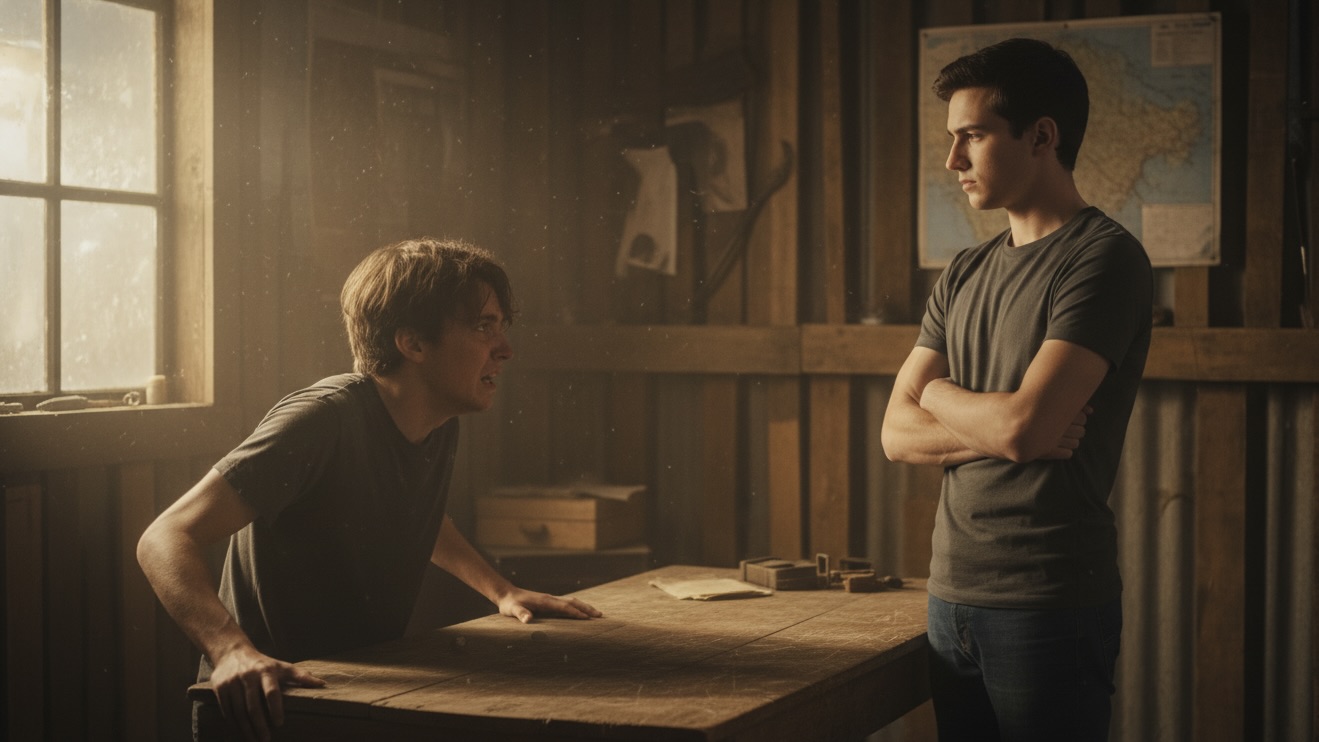
They were at an impasse, professionally, philosophically, and in every other way imaginable, yet the undeniable charge, a current almost visible in the air, kept them locked in a desperate, fragile orbit, pulling tighter with every shared breath.
Share This Story


