Zero Point Authenticity
The thermal undersuit was scratchy. Not the gentle, woolly kind of scratchy her gran knitted, but a stiff, synthetic irritation that felt like a thousand tiny needles against her skin. It was, according to Mr. Sterling, ‘state-of-the-art moisture-wicking technology designed for peak human performance,’ but to Poppy, age nine, it was just a bad jumper you couldn't take off.
The helmet smelled of plastic and something else, something faintly sweet like disinfectant trying to cover up old sweat. Poppy’s own breath, hot and wet, misted the inside of the visor before a tiny fan whirred to life, clearing it with a sterile puff of air. It was a perfect, clear circle in a world that was suddenly all white and muffled. The suit was supposed to be a marvel, a ‘second skin for the pioneers of tomorrow,’ Ms. Dennison had announced at the press briefing. To Poppy, it just felt heavy. The OmniCorp logos, stitched onto every available surface in shimmering silver thread, seemed to add their own peculiar weight.
“Poppy, darling,” Mr. Sterling’s voice crackled in her ear, impossibly loud and cheerful through the internal comms. “We are live in five. I need you to feel the moment. Inhabit the historical significance. But above all, project authenticity. Can you do that for me? Be our authentic, hopeful future.”
Poppy didn’t know how to project authenticity. She knew how to feel her toes going numb inside the thermal boots and how to wish she had her old blue mittens instead of the suit's rigid, five-fingered gloves. She pressed her thumb against the hard palm of the glove. “Yes, Mr. Sterling,” she said, the microphone turning her small voice into a clear, crisp broadcast.
“Magnificent! That’s the spirit that built Solstice Point!” he boomed. “Pure, unadulterated youthful optimism!”
A technician, anonymous in an identical, logo-free parka, gave a final tug on a strap at Poppy’s waist and gave her a thumbs-up. He didn’t smile. His eyes, barely visible in the slit of his hood, were flat and tired. He stepped back, vanishing from the circle of intense white light that pinned Poppy to the spot. Beyond the glare, the winter twilight was a deep, bruised purple, and the snow stretched out forever. It looked nothing like the cheerful, sun-kissed animation they’d shown her in the briefing room.
The Manufactured Step
The ceremony was brief and brutal in its cheerfulness. Ms. Dennison, her face flawlessly made-up despite the sub-zero temperature, stood at a transparent lectern that had been helicoptered in that morning. Her voice, amplified by speakers hidden somewhere in the drifts, was sharp and brittle. She spoke of ‘synergistic futures’ and ‘paradigm shifts in sustainable living.’ Poppy stood beside her, a small, white-suited figurehead, trying to remember to blink for the cameras.
Her parents were there, standing just at the edge of the light. They waved. Their smiles were wide and unfamiliar, the same ones they used when her father’s boss came for dinner. They looked like very good, very proud strangers. She’d tried to ask them last night why she had to do this, why she was the ‘Inaugural Child,’ and her mother had just smoothed her hair and said, “Because you’re special, darling. You’re helping build a better world.” Her father had added, “And the compensation package is life-changing.”
“And now,” Ms. Dennison concluded, her arms spreading wide as if to embrace the entire frozen wasteland, “Poppy, our First Child of the Future, will take the inaugural step on the Pathway of Light, symbolising OmniCorp’s commitment to forging a new way forward for all humankind!”
There was a burst of pre-recorded applause from the speakers, thin and tinny against the vast silence. Mr. Sterling’s voice was in her ear again, a low, urgent hiss. “The step, Poppy. Make it count. Think of your key motivators: wonder, discovery, a dash of trepidation overcome by courage. Go!”
Poppy lifted her heavy boot. The snow crunched loudly. She put it down. That was it. She’d taken the step. A camera drone with a little OmniCorp logo on its underbelly swooped down, its propellers whipping up a flurry of snow that stung her visor.
“Perfection!” Mr. Sterling crowed. “Absolute, monetizable perfection! Now, proceed to the beacon, darling. Remember the choreography. We’re on a tight schedule. The satellite window for the Asia-Pacific live feed is closing.”
---
The Pathway of Light wasn’t much of a path. It was a kilometre-long strip of flattened snow, flanked by glowing blue rope lights that sank a few inches into the drifts. It led to a single, distant point of brighter light: the Bio-Beacon. They told her it was a 'nexus of environmental harmony,' a sophisticated weather and soil-analysis station that would ensure Solstice Point lived in perfect balance with nature. It looked like a very tall, very fancy streetlamp.
She walked. A single cameraman in a black snowsuit trudged backwards in front of her, his movements surprisingly graceful. Behind her, she could hear the heavy, rhythmic crunch of the security guard’s boots. She wasn’t supposed to look at him. He was her ‘Unseen Guardian,’ a bit of theatrical branding Mr. Sterling was particularly proud of.
“Narrate your feelings, Poppy,” the director’s voice instructed. “Let our audience connect with your emotional journey. What do you see?”
Poppy looked around. “It’s… white,” she said. “And cold. The light from the ropes is blue.”
“Excellent! The raw data of experience! Now, elevate it. What does the blue light make you feel?”
It made her feel like she was in a very long, very cold corridor. She didn’t say that. “It feels… like the future,” she recited, one of the lines they’d fed her last week.
“Exquisite! She’s a natural!” Mr. Sterling’s voice wasn’t just for her anymore; she could hear the faint echo of him talking to someone else in the control room. “The focus groups are going to love this. Authenticity levels are off the charts.”
The walk was lonely. The drone buzzed overhead, a persistent mechanical insect. The cameraman kept walking backwards. The guard kept crunching behind her. It was all so planned, so rigid. But the arctic wasn't. Just beyond the blue rope lights, the snow wasn’t flat and perfect. It was wild, lumped into strange shapes by the wind. And there were tracks.
They weren't human. They weren't from any animal she'd seen in the briefing packets about arctic fauna. They were thin, deep gouges in the snow, like something heavy had been dragged, but also dotted with sharp, irregular holes, as if a multi-legged stool had been repeatedly slammed into the ground. They ran parallel to her path for a few metres before veering off into the deep purple darkness.
“Mr. Sterling?” she asked, stopping for a moment. Her boot scuffed the pristine pathway.
“Poppy, we do not stop,” he said, his voice losing its avuncular warmth for a fraction of a second. “Stopping breaks the narrative flow. We are a river, flowing towards tomorrow. Continue.”
“There are marks in the snow,” she said, her voice small. “Funny marks.”
There was a pause. She could hear a faint, muffled conversation on the comms. The cameraman froze, his lens fixed on her faceplate. The guard behind her took one more crunchy step, then stopped.
Ms. Dennison’s voice, sharp as ice, cut in. “Poppy, you are seeing wind patterns. Sastrugi. A beautiful, natural phenomenon. Describe their majestic, sculptural quality for our viewers.”
They weren't sastrugi. The pictures in the learning module had been smooth and wave-like. These were violent, jagged. But she knew the rule. You don't argue with Ms. Dennison. “The wind has made sculptures in the snow,” she said dutifully, and started walking again.
Harmonic Convergence
The Bio-Beacon grew larger, a pillar of warm, golden light in the overwhelming blue and white. It hummed. Not the friendly hum of a refrigerator, but a low, resonant thrum that seemed to vibrate in the fillings of her teeth. The sound wasn't coming through her comms; it was coming through the ground, through the soles of her boots.
“You are approaching the final waypoint, Poppy,” Mr. Sterling narrated, his voice swelling with manufactured emotion. “Humanity stands on the precipice of a new dawn, and a child shall lead them! This is poetry. Pure, unadulterated poetry!”
The beacon was twenty feet tall, a smooth, seamless column of what looked like frosted glass, pulsing with a gentle inner luminescence. The snow around its base was melted in a perfect ten-foot circle, revealing dark, wet tundra.
“Now, Poppy, as rehearsed. Place your hand on the activation plate. Channel all your hope, all your dreams, into this one, historic touch. You are not just turning on a light. You are igniting the soul of Solstice Point.”
The activation plate was a handprint-sized indentation on the column, glowing slightly brighter than the rest of it. It was exactly at her eye level. She stepped into the circle of melted snow. The ground was spongy and cold. She pulled off the clumsy glove, her bare fingers instantly aching in the frigid air. The contrast made the plate feel unnervingly warm.
She looked at her own small, pale hand, then pressed it against the plate.
For a second, everything worked exactly as planned. The beacon flared, sending a column of brilliant golden light straight up into the purple sky. The pre-recorded orchestral score swelled in her ears. “Yes!” screamed Mr. Sterling. “Contact! We have harmonic convergence!”
Then, the light flickered.
The golden beam sputtered, turning a sickly green, then blinking out entirely. The orchestral music cut off with a squawk of static. The hum from the beacon intensified, rising in pitch until it was a physical pain in her ears.
“What is that? What’s happening?” Mr. Sterling’s voice was a panicked squeak. “Someone get a diagnostic! Is the feed still live? Cut the feed! No, wait, the numbers are spiking! Keep it live! Frame it as… as unexpected turbulence on the path to progress!”
The ground beneath Poppy's feet trembled. Not a deep, geological shudder, but a shallow, localized vibration, as if a massive machine had just switched on directly below her. A spiderweb of cracks radiated out from the base of the beacon, splitting the dark, wet earth.
The activation plate under her palm went from warm to ice-cold. She tried to pull her hand away, but it was stuck fast.
“Poppy? Report!” Ms. Dennison barked into the comm. “What is your status? Give us a marketable emotional response!”
Poppy couldn’t speak. She could only stare at the crack widening at her feet. It wasn’t just a crack in the dirt anymore. It was a fissure, and from its black depths, something was rising. It wasn't rock or steam. It was a slick, inky tendril, thin as a pencil and blacker than the space between stars. It uncoiled with silent, deliberate speed, tasted the air for a moment, and then wrapped itself tightly around the ankle of her bright white, state-of-the-art OmniCorp snowsuit.
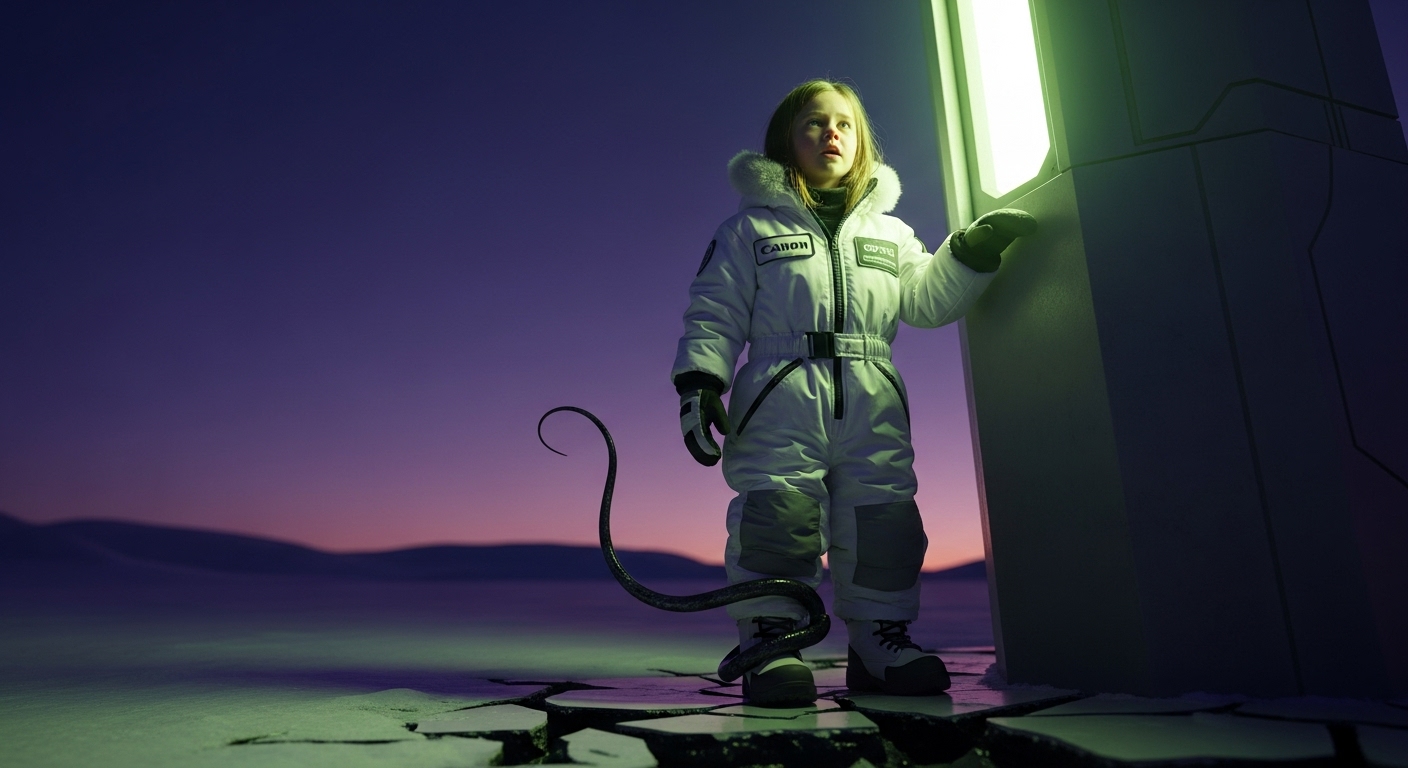
The tendril tightened its grip, and the only sound in Poppy's ears was the sudden, deafening silence of a dead comms channel.
Share This Story


