The Old Hall, New Algorithms
The fluorescent lights hummed a low, persistent note above the scuffed linoleum floor of the community hall. Outside, the early spring wind rattled a loose pane, hinting at the damp chill that still clung to the air despite the promise of green. Inside, the room was a jumble of mismatched chairs and tables, a half-empty coffee urn steaming forgotten in a corner. The air felt charged, thick with the scent of stale coffee and the sharper tang of an argument about to boil over.
Tania’s fingers twitched, a nervous habit she’d picked up from her mother, wanting to smooth the stray curl falling across her eye but knowing it would just spring back. She watched Ed, his brow furrowed, tracing patterns on the condensation of his water glass. The drone of the fluorescent lights above felt louder now, amplifying the uncomfortable quiet that had settled after Lucy’s last point.
"It's appropriation," Lucy had stated, flat, final. "Pure and simple. A machine doesn't understand a story. It just… mimics. Steals patterns. And then we're supposed to feed it our own. Our grandmother's stories? The language we fought to keep alive?" Her voice, usually soft, had taken on an edge, a brittle certainty.
Tania shifted, the hard plastic chair digging into her thighs. She wanted to argue, but the words felt clumsy, unfinished in her mouth. How could she explain the buzzing excitement, the terrifying potential she saw? The fear Lucy felt was real. Tania understood it, intellectually. But her own gut churned with something else – a desperate curiosity. What if this wasn't just theft? What if it was… a key?
David, who usually smoothed over these moments, remained silent, his gaze fixed on a distant point beyond the hall’s dusty windows, where a weak spring sun struggled through patchy cloud cover. A few drops of melted snow still clung to the eaves outside, waiting to fall. The air was cool, even inside.
"It’s not just about mimicry," Ed finally said, his voice quiet, measured. He didn't look at Lucy, but at the table, as if the answers were etched into the grain of the worn wood. "It's a tool. A complicated one. A hammer can build a house or smash a window. The intent… that's us."
Lucy snorted, a short, dismissive sound. "A hammer doesn’t learn. A hammer doesn’t… predict. Don't simplify it, Ed. This is different."
"Of course it's different," Tania blurted, the words escaping before she could properly frame them. She felt a blush creep up her neck. David finally looked over, a small, encouraging nod. "It’s… a new kind of literacy, maybe? Like when the printing press came. Or photography. People worried then too, right? That it would change everything, dilute things." She hated how her voice wavered on the 'right'.
Lucy’s eyes narrowed. "Photography captured reality. It didn't invent it. These programs… they invent." She tapped a finger on the tabletop. "They create stories that aren't ours. Or they take pieces of ours and spit them back, rearranged."
"But what if we train it?" Tania pressed, leaning forward, ignoring the faint tremor in her hands. "What if the 'brain' it has… we build it? We feed it our reality. Our language. Our specific way of seeing the world. So it doesn't just… mimic. It helps us find patterns we might miss. Helps us translate, maybe? To share with people who couldn't otherwise understand." The thought, when she articulated it, sounded bolder, more coherent than it had in her head. A flash of something hopeful.
Ed looked up, a spark in his eyes. "Exactly. It's about data sovereignty, isn't it? About owning the algorithm. Not just being subject to it." He glanced at David, a silent question.
David slowly pushed himself back from the table, the chair scraping loudly across the linoleum, a sound that made Tania flinch. He walked to the window, his back to them, watching the nascent spring outside, the bare branches beginning to bud, a fragile green against the grey sky. "Lucy's right to be cautious," he said, his voice deep, resonating slightly in the quiet room. "The power imbalance is immense. Most of these tools… they're built by corporations, far away. By people who don't know our stories, our history, our land. They don't care about the nuances. Or the sacredness, in some cases." He paused, then turned, his expression serious. "But what if we could build our own loom? To weave our own narratives. Not just be weavers on someone else's factory floor."
Tania felt a jolt. Our own loom. That was it. That was the core of it. Not just consuming, but creating the tools themselves. It felt empowering, terrifyingly complex.
"A loom costs money," Lucy interjected, practical, unyielding. "It takes skill. Expertise we don't have. And time. These big companies… they're already miles ahead. By the time we catch up, what will be left?" Her voice was laced with a frustration that Tania recognized as fear, raw and understandable.
"We start small," Ed suggested, sketching an invisible diagram on the table with his finger. "Prototype. Open source. Collaborate. We learn the language, the code itself. We train our own models with our own data. Curated data. Not just the internet's firehose of noise." He looked at Tania. "Your idea. Specific reality."
Tania nodded, heart thrumming. "Like… we could teach it the patterns of our traditional beadwork. Not to make new designs, but to understand the significance of existing ones. Or to help archive. To cross-reference stories, identify motifs. Not to write them, but to preserve them in a new way. A new, accessible way." She pictured the rows of archival boxes in the small museum down the street, filled with fragile documents, audio tapes, photos. So much history, so hard for everyday people to access, to sort through. A machine could help. If it was their machine.
"Or even," Ed continued, catching her train of thought, "to translate. To preserve oral histories. To make sure that when a new story is told, it's not distorted by an algorithm that only knows mainstream narratives."
"Distortion is the risk," Lucy countered, shaking her head slowly. "Always the risk. Who controls the filters? Who decides what's 'appropriate' data? And if the machine makes a mistake… a cultural misstep… the damage could be immense." Her eyes held a deep weariness, a knowledge of past hurts that Tania, younger, hadn’t fully experienced but felt echo around the room.
David walked back to the table, picking up a pen and fiddling with its clicker. "Lucy's questions are essential. They're the fire in the forge. We don't want to recreate colonial structures, just with silicon instead of paper. The point is not just using AI, it's about sovereignty over AI. Who builds it? Who owns it? Who benefits?"
"So it's not about stopping it," Tania murmured, articulating a thought that had been a silent battle within her for weeks. "It's about redirecting it. Reclaiming it."
"Exactly," Ed affirmed. "We can't put the genie back in the bottle. It's here. So how do we train the genie to serve our community, our stories? To listen to our voice?"
"It sounds… impossible," Lucy whispered, though her gaze had shifted from outright skepticism to a grudging contemplation. "The scale of it. The resources."
"Is it any more impossible than keeping our language alive against generations of suppression?" David asked, his voice soft but firm. "Or rebuilding our community centres? Or revitalizing our arts programmes? We've faced bigger odds. This is just… a different kind of fight. A new frontier." He gestured vaguely towards the window, towards the grey spring landscape. The first green shoots were always the most vulnerable, yet they pushed through.
The Loom of New Stories
Tania's internal world was a kaleidoscope of ideas and anxieties. She imagined lines of code, like intricate beadwork, woven by their own hands. A digital elder, perhaps, trained on decades of local knowledge, able to help search, collate, synthesize – not create – new interpretations, but to help them create. To amplify. To ensure their young people, her peers, would have access to stories that were truly theirs, unfiltered, unappropriated.
She thought about her cousin, who loved video games, but always complained about the lack of stories reflecting their home. What if they could create tools that allowed local artists to easily generate culturally relevant characters, settings, narratives, for interactive experiences? Not a generic "forest," but a specific Northern Ontario boreal forest, with its particular smells of spruce and damp earth, the precise call of the loon, the feel of a rock underfoot near a specific lake.
"We'd need people," Tania said aloud, "who know the tech. And people who know the stories. And people who know both." She glanced at Ed, then David. "Like us. But more. Many more."
"Training," Ed agreed. "Skills development. Workshops. Bringing in people who understand large language models, yes. But also, people who intimately understand our oral traditions, our protocols, our sensitivities. It's a bridge-building exercise, isn't it?"
Lucy still looked unconvinced, but her posture had softened, her shoulders less rigid. "And who funds this bridge? Who guarantees it won't be… corrupted? Or just a waste of time?"
"Those are the questions we solve," David said, his voice firm. "Together. We seek grants. We reach out to Indigenous tech initiatives already doing this work elsewhere. We start small, as Ed said. A pilot project. Focusing on one specific problem. Maybe archiving, like Tania suggested. Or a language revitalization tool."
Tania felt a surge of adrenaline, cold and sharp. This wasn't just abstract theory anymore. It was concrete. It was urgent. The world was moving so fast. If they didn’t grab hold of this, shape it, it would surely shape them, or worse, ignore them completely.
"What about the ethical frameworks?" Tania asked, almost to herself. "How do we make sure it respects traditional knowledge? That it doesn't accidentally expose things that shouldn't be public? Or misinterpret them?"
"That's where the human oversight comes in," Ed explained, leaning forward, his excitement growing. "Ethical guidelines woven into the very fabric of the design. Community review boards. Layered access. It’s not about letting a machine run wild. It’s about building a digital servant. A tool, not a master."
The wind outside picked up, rattling the windows harder this time. Tania could hear the faint sound of rain beginning to patter, mingling with the melting snow. Spring here was always a chaotic mix of ice and nascent warmth, a struggle between what was ending and what was just beginning. It felt like their conversation mirrored it.
"And if it fails?" Lucy asked, a hint of resignation in her voice. "If we invest all this… time, energy, hope… and it just breaks? Or becomes another tool of assimilation?"
David smiled, a rare, almost wistful expression. "Then we learn. We adapt. We always have. But the alternative… doing nothing… that’s a failure we can't afford. Not now. Not with everything changing so fast." He tapped the pen on the table, a rhythmic, insistent sound.
Tania looked at the tablet still sitting on the table, a piece of generic tech that felt profoundly alien and yet full of promise. The glowing screen held the world’s information, its algorithms. Could they truly bend that power to their will? Could they teach it to speak in their voice? To understand the deep, subtle currents of their history and their land? The task felt monumental, almost overwhelming.
"We need to start now," Tania said, the urgency in her own voice surprising her. It felt like a physical ache in her chest. "Before the currents get too strong. Before someone else decides what our stories are worth, or how they should be told."
Ed nodded, his gaze meeting hers, a shared understanding passing between them. "We sketch out a plan. A proposal. Who to talk to. What resources we actually need." He was already pulling a fresh sheet of paper towards him, picking up a different pen, poised to write.
Lucy watched them, her face still etched with doubt, but also a flicker of something else – a grudging curiosity, perhaps even a nascent hope. The hum of the fluorescents, the patter of the rain, the distant sound of a truck on the highway. All blended into a low thrum, a backdrop to the quiet, determined energy that had begun to fill the small, cluttered hall.
Tania felt a wave of conviction, a burning sensation that started in her stomach and spread through her limbs. This was it. This was their moment to seize something, to define something for themselves. She felt a shiver, not from cold, but from the magnitude of the task.
Then, a sudden, sharp bang. The door at the far end of the hall, which had been slightly ajar, burst open with surprising force, slamming against the wall. A harsh gust of wind, carrying the sharp, damp scent of wet earth and melting spring snow, swept through the room, scattering a few loose papers from the table. Tania’s gaze locked onto Ed across the table, the question hanging unspoken between them as a voice she didn't recognise cut through the sudden silence, sharp with something like panic.
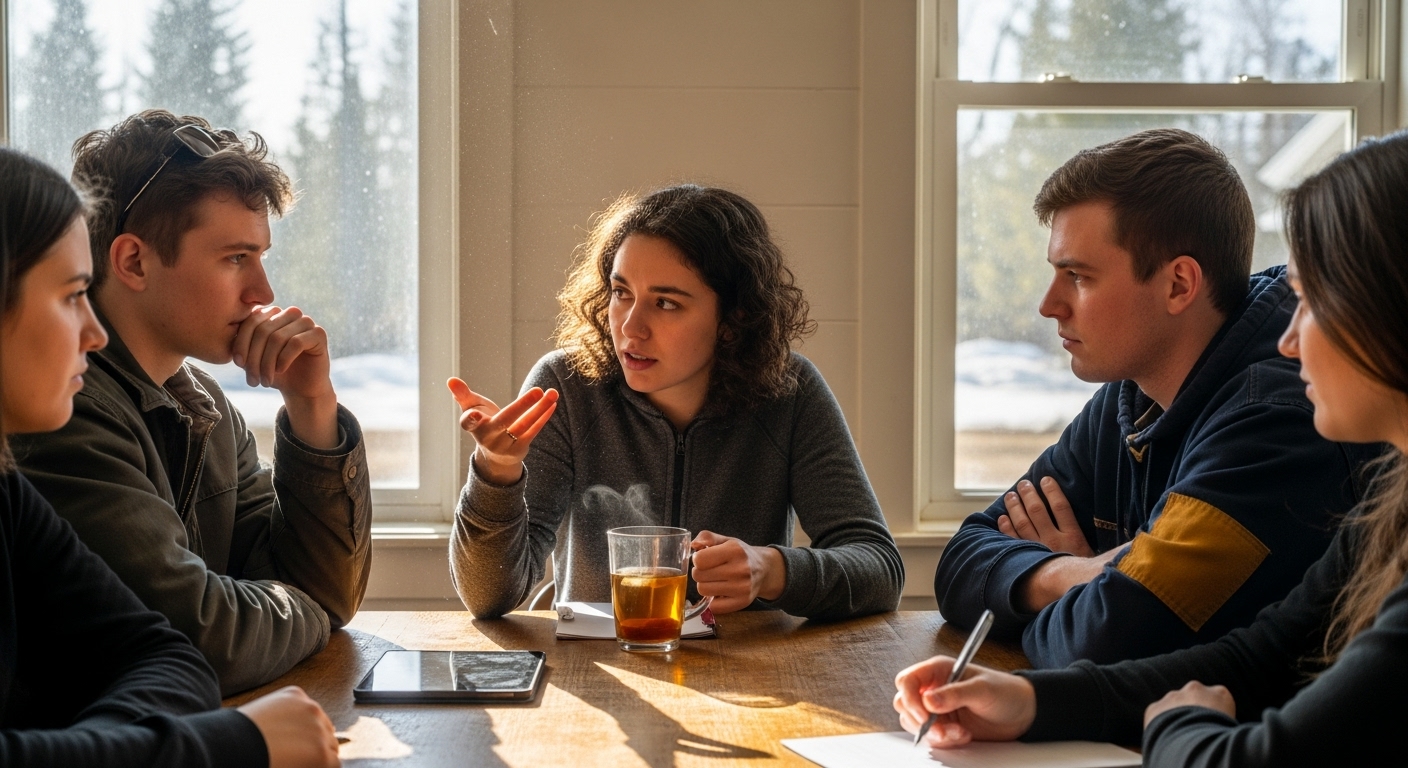
Tania’s gaze locked onto Ed across the table, the question hanging unspoken between them as the door slammed open, a gust of cold, wet spring air sweeping into the hall, carrying with it a voice she didn't recognise, sharp with something like panic.
Share This Story


