The Algorithm's Poem
The air in the small meeting room hung heavy, thick with the scent of old coffee, sun-baked wood, and the faint, metallic tang of new electronics. Outside, a humid summer day pressed against the windows, the lake beyond them a shimmering, indifferent blue. Inside, three figures huddled around a laptop, the bright screen a stark contrast to the quiet tension that had slowly, imperceptibly, built between them.
Masie leaned closer to the laptop, the faint hum of its fan a counterpoint to the distant cry of gulls over Superior. Her elbow dug into the rough-hewn oak table, a splintery surface that probably predated her grandparents. She could feel the damp stickiness of the summer air on her forearms, a slight film, even with the windows cranked open. John, beside her, smelled faintly of lake water and a generic, slightly sweet energy drink. Sarah, perched on the edge of her chair, fiddled with the strap of her canvas bag, her gaze flitting between the screen and the shifting light on the water.
“Alright,” John said, his voice a low murmur, more to the machine than to them. He clicked a few times, his fingers blurring over the trackpad. “So, this is the preliminary run. The new iteration, after we fed it those anonymised oral histories from the youth council, alongside the archival project transcripts from ’72. Looking for, you know, thematic resonance. Recurring motifs across generations.”
Masie nodded, a knot forming just behind her ribs. This project, this attempt to use emerging AI to map the narrative fabric of their community, felt like trying to catch smoke with a sieve. Since the winter of 2025, when the first whispers of truly accessible AI writing tools had swept through every online creative space, a strange mix of fear and possibility had permeated their group. Everyone was talking about disruption, about intellectual property, about the soul of human creativity. But Masie saw another path: agency. The chance for their community, self-determining, to shape these tools, not just be shaped by them.
Sarah sighed, a soft, almost imperceptible sound. “I’m still not convinced this isn’t just… a fancy word cloud generator. Or worse, a hall of mirrors reflecting back what we already think we know.” Her hand, calloused from sketching and carving, traced an invisible pattern on the tabletop.
“It’s more than that, Sarah,” John countered, without looking up. “It’s about identifying hidden connections. We’re not asking it to write our stories, we’re asking it to help us see them differently. To find the currents beneath the surface.”
The screen flickered. A loading bar, green and thin, crept across the bottom. Masie held her breath. The light from the laptop seemed to intensify, momentarily washing out the vibrant greens and blues of the lake outside. The hum of the machine deepened, a low, almost visceral thrum against the quiet. The tension in the small room solidified, became almost palpable.
Then, the screen populated. It wasn’t a graph. It wasn’t a keyword cloud. It was a block of text, stark white against a dark background, framed by a delicate lattice of interconnected nodes that pulsed with a faint, internal light. It looked… unexpected. Almost deliberate. Not like a data output, but a whispered confession.
John cleared his throat, a surprised sound. “Huh. That’s new. It’s… generated a narrative summary. A creative synthesis, not just an analysis.” He leaned back, his eyes wide. “It pulled out a poetic interpretation.”
Masie read the words aloud, her voice hushed, as if speaking them might break a fragile spell: “The water remembers the sky’s sorrow, a hunger etched in the shoreline, where old birch roots cling to sand and rumour. A path lost, then found in the laughter carried on wind, a child’s song echoing the ancestor’s quiet grief. Always the journey, the return to where the light breaks through the spruce, painting shadows that dance like forgotten dreams.”
Silence stretched, taut and thick. The words hung in the air, oddly resonant, yet utterly alien in their origin. Masie felt a strange tremor, a prickle on her skin. It was beautiful, undeniably. But where had it come from? How could an algorithm distill decades of diverse narratives, personal joys and tragedies, into something so… poetic, so human? It felt surreal, like glimpsing a reflection in a distorting mirror that somehow showed a deeper truth.
“That’s… uncanny,” Sarah whispered, her pencil clattering lightly on her notebook. She hadn’t even realised she’d been holding it. “It’s almost… too good. Like it knows.” She shivered, despite the warmth. “It shouldn’t be able to feel the grief or the laughter.”
John rubbed the back of his neck. “It doesn’t feel, Sarah. It’s pattern recognition. It’s identifying emotional language, thematic links, narrative structures. It’s just presenting them in a highly synthesised, anthropomorphised way because that’s what we, as humans, understand.” He tried to sound clinical, but his voice was a shade higher than usual, a nervous tremor betraying his own unease.
Masie stared at the words, a flurry of thoughts colliding in her mind. Anthropomorphised. Yes. But it had stitched together disparate fragments—a story about a elder’s journey from residential school, a youth’s poem about finding solace by the lake, a recollection of a community feast, a lament for lost language—and forged something new. Something that resonated, perhaps not with individual truth, but with a collective, almost subconscious truth. It was a digital echo, a spectral voice humming a forgotten tune.
She thought back to those intense discussions in the community centre last winter. The cold outside, the hot mugs of tea, the passionate arguments. Some saw AI as a threat, a homogenising force, a coloniser of creativity. Others, like her, saw it as raw clay, a tool that could be shaped, imbued with their own intentions, their own protocols. This output, this strange digital poem, only intensified that feeling.
“But what if it is seeing something we missed?” Masie finally said, her voice quiet, almost lost against the backdrop of the words on the screen. “Not feeling, no. But understanding, connecting… in a way our human brains, with all our biases and preconceptions, can’t?”
John leaned forward again, his fingers hovering over the keyboard. “That’s the goal, isn’t it? To augment our capacity. Imagine if this could help us identify gaps in our recorded history, or highlight themes that are fading from memory. Or, for the youth, help them find points of connection to the past in a way that feels… immediate. Real.”
“Or,” Sarah interjected, her voice sharp, “it could create a homogenised, sanitised version of our stories. A ‘best hits’ album of culture, devoid of nuance, of the contradictions that make us real. It’s easy to romanticise the past. This could just… make it easier for others to do that, too. To consume our identity like content.” She picked up her pen again, twisting it between her fingers, a faint click of plastic against metal.
Masie understood Sarah’s apprehension. The fear of external definition, of being reduced to data points. That was the core of it. But what if the community owned the algorithm? What if they were the ones who curated the input, who refined the parameters, who interpreted the output? This wasn't about letting a faceless corporation tell their stories; it was about building their own digital loom. "But what if we feed it our definitions? Our protocols? We train it to understand what's sacred, what's personal, what’s for sharing and what’s not. We teach it to respect the pauses, the silences, the stories that can only be told in person, by firelight."
John nodded vigorously. “Exactly! It's about developing the skills. This isn’t just ‘push button, get poem.’ It’s about understanding the machine, its biases, its capabilities. It's like learning to operate a complex printing press, not just consuming the book. If we teach our young people to analyse, to prompt, to refine, they’re not just users; they’re creators. They become the architects of how these tools interact with our stories.”
A flicker of light from the screen caught Masie's eye. Beneath the poetic summary, a smaller, almost imperceptible scroll bar had appeared. She hadn't noticed it before. She nudged John, pointing. "What's this?"
John squinted. "Oh, that’s… that’s a sub-layer analysis. A deeper dive into the 'hunger etched in the shoreline' motif. It's trying to cross-reference historical events with community health data, looking for… long-term correlations?"
Sarah leaned in, her wariness replaced by a reluctant curiosity. "Correlations between what? Starvation? Resource depletion? What did it find?"
"It's linking narrative elements about traditional food sources and disruptions from settler contact with… current-day statistics on diabetes and food insecurity among youth," John read, a growing disquiet in his voice. "And then, wait… it's also cross-referencing that with patterns of language loss. It's suggesting a direct correlation between the 'path lost' narrative and an increase in specific markers of… cultural disconnect."
Masie felt a cold shiver run down her spine, far colder than any winter wind. The room felt suddenly small, the lake outside vast and unknowable. The AI wasn't just creating pretty poems; it was drawing stark, almost brutal lines between generations of trauma, connecting it to measurable, painful realities. This was the analytical power they'd hoped for, but the implications… they were staggering. And terrifying.
"That's… a lot," Sarah mumbled, her face pale. She looked at John, then at Masie, her eyes wide. "It’s laying bare… everything. Things we whisper about, but never… quantify."
"It’s not just about identity anymore, is it?" Masie said, her voice barely audible. "It’s about… systemic echoes. The things we’ve always felt, now laid bare by an algorithm. But how do we… how do we present that? How do we use a tool that reveals so much, so starkly?" Her fingers trembled as she reached for the trackpad. "There’s another tab here, a 'predictive pattern overlay'… I wonder what it’s…"
She clicked, and the screen transformed again. The poetic text vanished, replaced by a complex, almost three-dimensional holographic map of their region. Bright, pulsating nodes appeared, crisscrossing the digital landscape. Each node seemed to represent a community, a family, a story. And then, slowly, a new, jagged line began to form, weaving through the network, highlighting disparate elements in a way that screamed not of connection, but of something far more troubling. The vibrant colours of the lake outside seemed to dim, receding into the background.
Masie scrolled, the familiar map of the lake appearing, overlaid with new, unsettling data points the AI had just generated. Each glowing node pulsed, marking something – not stories, not themes, but connections between historical events and current social vulnerabilities, patterns too precise, too revealing. The screen flickered, and a single, stark word appeared, superimposed over the map of their home: Fractured. A cold dread, sharp and sudden, gripped her.
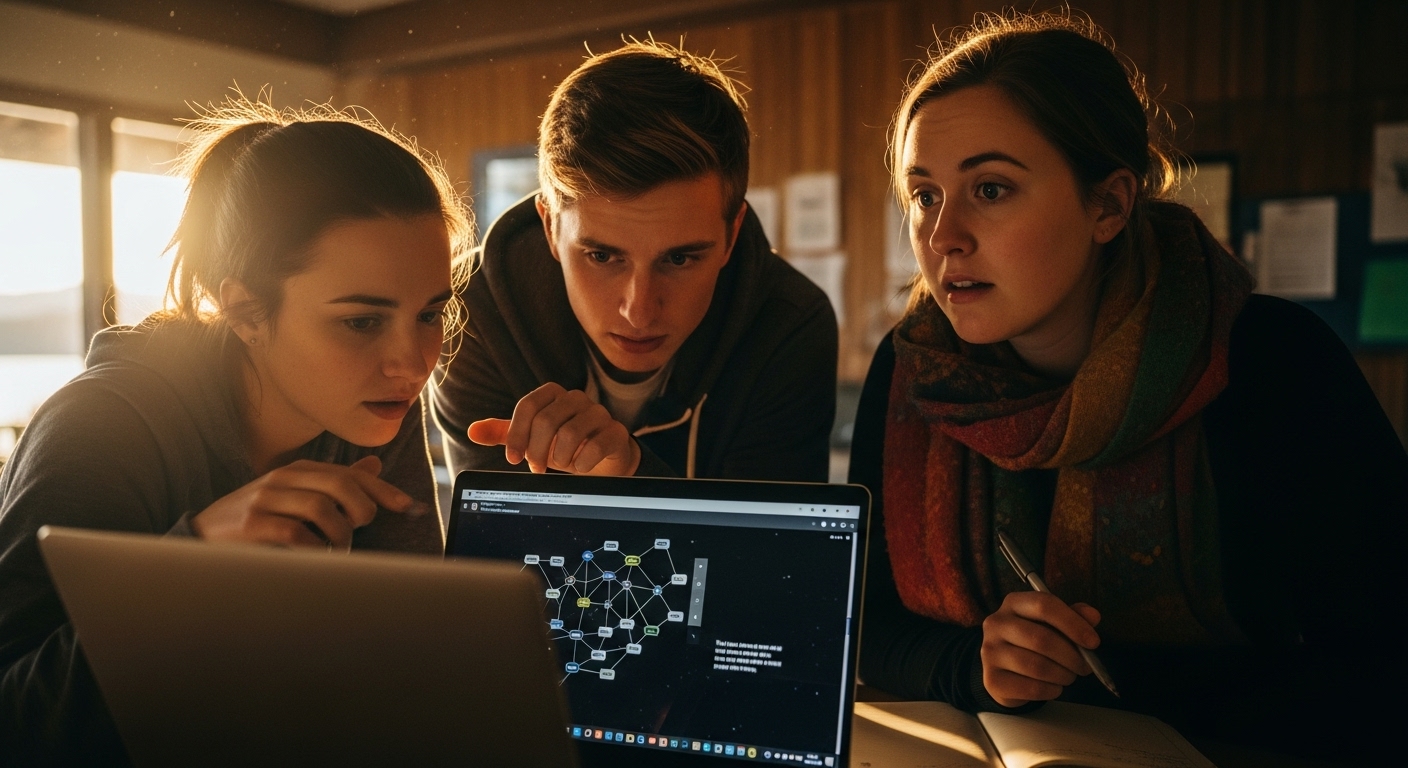
Masie scrolled, the familiar map of the lake appearing, overlaid with new, unsettling data points the AI had just generated. Each glowing node pulsed, marking something – not stories, not themes, but connections between historical events and current social vulnerabilities, patterns too precise, too revealing. The screen flickered, and a single, stark word appeared, superimposed over the map of their home: 2px4px_rgba(0,0,0,0.8)]">Fractured. A cold dread, sharp and sudden, gripped her.
Share This Story


