The Slow Descent of Orange
The prairie spring, usually a vibrant resurgence, felt like a dying gasp this year. Mud clung to everything, a thick, persistent ooze beneath boots. Above, the sky bled a bruised orange, not the gentle blush of a healthy evening, but a permanent, sickly hue that choked the light and painted the city in shades of perpetual twilight.
"So," Darya's voice was a low hum, barely cutting through the distant, persistent thrum of the filtration units. "It truly begins, then. Protocol Omega." Her gaze, usually so sharp and direct, was fixed on the bruised orange expanse beyond the reinforced window, where the last sliver of actual light struggled against the atmospheric shroud. She didn't look at me, and I appreciated it. Eye contact felt like an accusation today.
"It does," I conceded, my own voice a rasp. The word hung between us, heavy and final, like the thick, pollen-choked air. We had anticipated this, modelled it, ran simulations until the processors glowed, but theory rarely prepared one for the blunt force of reality. "The projections indicate full obscuration within forty-eight cycles. Irreversible. Solar penetration below viable levels thereafter."
A sigh, a soft, almost imperceptible expulsion of air from Darya. She was a woman built of stoicism and hard lines, but even she couldn't completely shed the weight of this. "Forty-eight cycles. Just enough time to complete the final relocation. Or to descend into utter chaos. Which do you favour, Eddie?" The question wasn't truly a query; it was an acknowledgement of the razor's edge we balanced upon.
"The people of Winnipeg have proven resilient," I said, a hollow platitude even to my own ears. Resilience, after a decade of slow decay, often morphed into a kind of stubborn, desperate refusal to acknowledge the end. This spring had been particularly brutal, a cruel joke of budding things trying to push through the pervasive layer of ash and industrial dust that coated every surface. The mud, a thick, grey-brown slurry, clung to the treads of my boots, a constant reminder of the planet's failing health. Every breath carried the metallic tang of the filtration systems working overtime, a scent that had replaced fresh air years ago.
"Resilience only stretches so far," Darya countered, her voice retaining that formal, almost theatrical cadence, a performance of control we both maintained for the benefit of, well, ourselves. "When the last of the direct light vanishes, the psychological impact will be… profound. We've managed the gradual dimming, the constant twilight. But this? A final curtain. No more true day. Only the glow of the atmospheric particle cloud, a perpetual, malignant sunset." She turned then, her eyes, the colour of deep winter ice, finally meeting mine. "Are the final shipments secured for the lower sectors? Their air quality will degrade fastest without the thermal currents of solar interaction."
"They are," I confirmed, running a hand over the cool, smooth surface of the control console. The screens glowed with topological maps of the city, thermal readings, resource allocations – a complex, vibrant web of data that simultaneously represented our meticulous planning and the terrifying fragility of our existence. "Though a few sectors are… reluctant. Demanding higher grade filters for the transition phase. Citing historic neglect, et cetera."
Darya’s lips thinned, a barely visible gesture of annoyance. "Negotiate. Remind them of the larger objective. Survival, not comfort. After the full obscuration, their demands will be moot. Resources will be distributed according to need, not grievance." Her tone was firm, yet I detected a flicker of something in her eyes, a fleeting recognition of the injustice, perhaps. We had all seen the disparity grow, the protected zones becoming ever more pristine while the outer rings choked on the emissions from the very machines keeping us alive. It was the price of a 'controlled' collapse.
---
I walked to the window then, pressing my palm against the cool glass. The view from the Central Spire was usually breathtaking, a sprawling panorama of a city still trying to function. Now, it was a study in desolation. Below, the Red River, usually a muddy torrent in spring, flowed sluggish and dark, reflecting the unnatural sky like a wound. The skeletal remains of old elm trees, victims of the Blight decades ago, stood testament to a time when green was a natural colour, not a carefully cultivated, rationed luxury.
A child’s laugh, thin and reedy, drifted up from a lower level, a stark, almost jarring sound in the oppressive quiet of the command centre. A moment later, it was swallowed by the relentless hum. What did a child know of a true sunrise, of a sky that was genuinely blue? Their memories, if they had any, would be of this perpetual twilight, this filtered existence. The thought was a dull ache behind my ribs, a familiar companion.
"The spring crops," I mused aloud, turning from the window to face Darya again. "The last outdoor cultivation cycle, I suppose. The nutrient supplements are holding, but yield is down by thirty percent across the board. The cold is seeping into the soil earlier each cycle."
"The underground farms will compensate, eventually," Darya replied, though her conviction felt forced. "It was always the long-term solution. The surface was a transitional measure, Eddie. We knew this. The atmospheric degradation was inevitable. We merely bought ourselves time. Generations, even. More than anyone predicted."
More than anyone predicted. A chilling thought, really. We hadn't failed outright; we had merely postponed the inevitable, stretching out the twilight, making a slow, drawn-out exit from the light. It was a victory of sorts, a hollow, bitter one. We had mastered the art of managing decline, of making the end as orderly and bureaucratic as possible. And now, the final act.
"I remember the taste of a fresh strawberry," I found myself saying, the words surprising even me. My parents had an old hydroponic unit, a small, illicit thing, tucked away in their old apartment before the Sector Purges. One summer, a single, perfect berry had ripened. The sun, I recalled, had been a vivid, blinding yellow, beating down through the window. The memory felt like something from a dream, impossibly vibrant.
Darya nodded slowly, a ghost of a smile touching her lips. "My grandmother used to tell me about walking through fields of tall grass, smelling clover. I don't think I've ever seen anything truly wild that wasn't encased in a containment unit." Her eyes drifted back to the window, the orange outside deepening, becoming almost crimson as the very last vestiges of direct light vanished behind the thickened atmosphere. For a brief, dizzying moment, it looked almost beautiful, a final, flamboyant gesture.
The Fading Spectacle
The air, already thick, seemed to grow heavier, pressing down on the spire, on the city, on us. The shift was subtle, not a sudden snap into darkness, but a gentle, pervasive deepening of the twilight. The distant city lights, usually mere pinpricks against the vastness, now seemed to pulse with a desperate urgency, defining the sprawling grid of human endeavour against the encroaching gloom. I watched, mesmerized, as the last true curve of the sun's disc, a fleeting promise of warmth and life, finally dipped below the horizon, swallowed not by the Earth, but by the relentless, man-made shroud.
It wasn’t a sunset in the way I remembered from childhood, not a canvas of fiery reds and purples, but a slow, sorrowful exhalation of light. The colours were muted, bruised, as if painted on old canvas, devoid of vibrancy. The wind, when it gusted against the glass, sounded like a sigh, carrying with it the smell of damp earth and something acrid, a metallic tang from the struggling filtration systems.
The silence in the command centre felt profound, broken only by the low hum of the machines and the shallow rhythm of our own breathing. We were witnesses, standing at the precipice of a new, permanent state of being. The sun would still be 'there', an invisible furnace, but its life-giving light would no longer touch the surface. It was like living next to a brilliant star, yet dwelling in its perpetual shadow.
Darya cleared her throat, breaking the spell. "We have thirty minutes before the automated alerts cascade. Best we prepare the final briefing. The lower sectors will need… reassurance."
"Reassurance," I repeated, the word tasting like ash. How does one reassure a populace that the sun is gone for good? That the sky will forever be this sickly, beautiful orange? We had trained for this, prepared for it, but the weight of it, the sheer, crushing finality, settled on me like a physical burden. My shoulders hunched instinctively. I thought of the small, struggling shoots of whatever had tried to grow outside in the brief, deceptive warmth of spring, now destined to wither in the prolonged chill.
We had done our best. We had built the spires, developed the filtration, rationed the water, recycled the nutrients. We had created a new kind of existence, engineered to prolong, to survive. But the cost… The cost was the sky itself, the natural rhythm of day and night, the simple, undeniable warmth of a true sun on one's face. And now, even that manufactured twilight was deepening.
"Eddie," Darya said, her voice softer now, almost empathetic. "This is not our fault. We inherited this." A partial truth, like most reassurances. We had certainly inherited it, but we had also perpetuated it, amplified it, in our desperate attempts to 'manage' the unmanageable.
I just nodded. There was nothing more to say. The last true light had gone. The city outside, in its permanent, ominous orange, began to truly sink into its final, engineered slumber.
---
I stepped away from the window, the image of that fading, bruised sun seared into my mind. The monitors on my console flickered, showing the atmospheric particle count steadily climbing, the ambient light levels dropping, a graph of humanity's retreat from the natural world. My hand lingered over the 'Activate Protocol Omega' button. One touch, and the city's network would officially acknowledge the permanent transition. The finality of it was a dull throb in my temples. We were about to formalise a new epoch, one where the concept of 'day' was a historical footnote, a fading memory for the dwindling few who still remembered. I had seen enough sunsets to know what was truly being lost, even as Darya spoke of the future, of the 'compensated' underground farms and 'reassured' lower sectors. The truth was, we were simply learning to live with less, much less, while pretending it was enough.
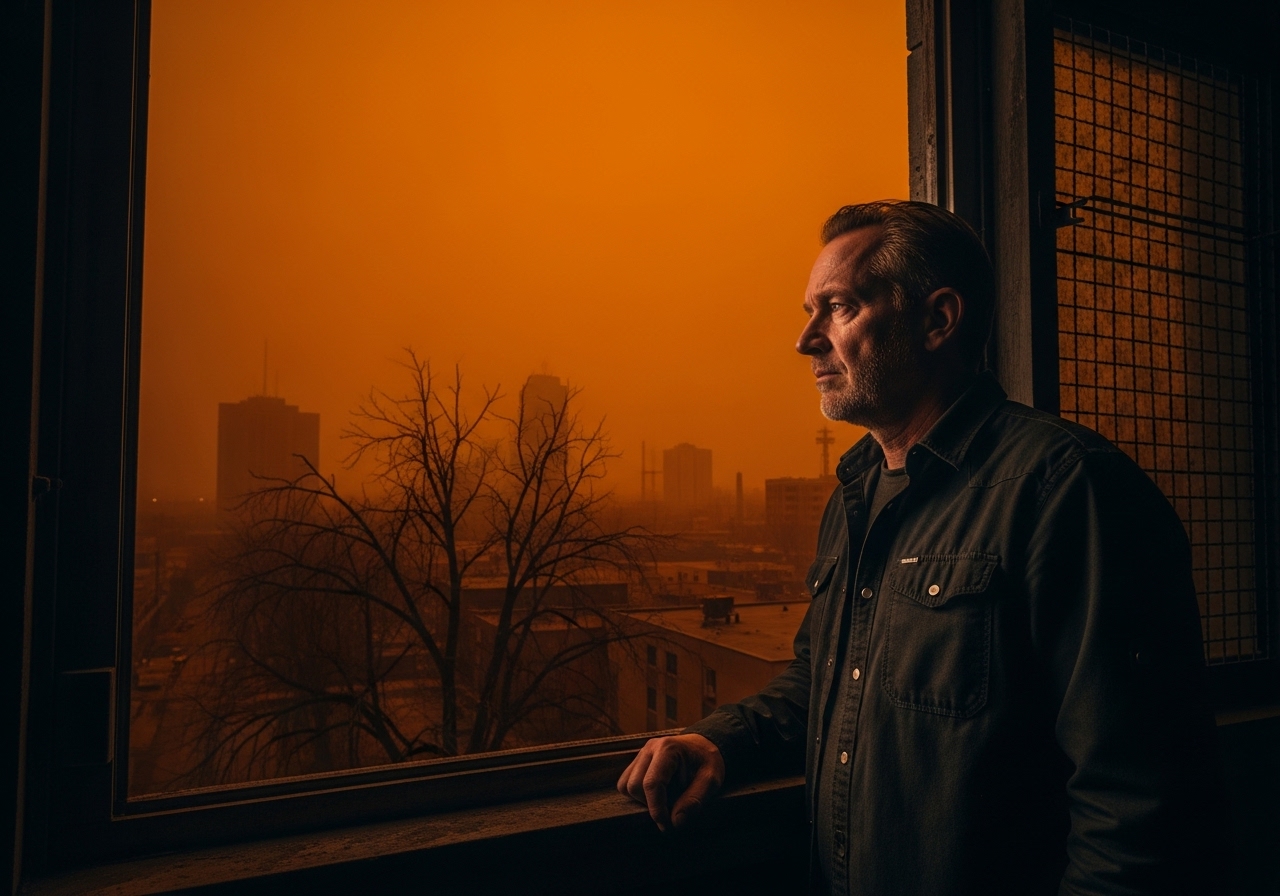
My finger hovered, a silent declaration of surrender or acceptance to a future where the sun was just a story told in hushed tones, its light now a memory, and the world outside was forever cast in the sickly, beautiful glow of a dying star.
Share This Story


