Awakening to Grey Static
The cold was a constant, gnawing presence, even in the deepest parts of sleep. It seeped into everything, a low, thrumming hum beneath the skin. Winter was not just a season here; it was a state of being, a shroud drawn over the city and its inhabitants, chilling bone and spirit alike. For James, every morning began not with light, but with the lingering dread of the night's abstract horrors.
The hum. It was always the hum. Not in my ears, not exactly, but in the marrow of my bones, a low, electric thrum that vibrated through the impossible greyness of the dream. I was a child, or maybe not. My reflection in the polished, obsidian floor was a distortion, a stretched, shifting thing that looked less like me and more like a collection of data points struggling to cohere. Every corner of the vast, featureless room was identical, yet subtly wrong. Like a faulty memory repeating, each iteration just a little more broken than the last. The air itself felt synthesised, metallic, sharp against the tongue, like licking a cold, forgotten battery.
Figures moved at the periphery of my vision, shadows that didn’t quite fit the physics of the space. They weren’t people. They were… projections, perhaps. Or echoes of information, looped and corrupted. Their faces, when I almost caught them, were always just out of focus, a blur of featureless skin or a sudden, jarring shift of pixels. One moment, a human eye; the next, a blank, grey orb. It made my stomach clench, a cold, sickening twist that had nothing to do with hunger, and everything to do with a profound, existential wrongness.
A voice, too. Not a real voice, not really. It was a modulated drone, a flat, even tone that spoke in a language I almost understood but couldn’t quite grasp. It was data, not words, yet the intent bled through: control. Order. Compliance. It seeped into the grey walls, into the cold, cold floor. And the cold… the cold in the dream was worse than the waking world’s winter, a deep, pervasive chill that froze not the skin, but the very essence of self. It hollowed me out, left me hollowed, a vessel waiting to be filled with whatever the hum dictated.
I tried to move, to run, to scream, but my limbs were heavy, weighted down by a thousand invisible anchors. My mouth felt sealed. The effort of a single breath was monumental, a battle against an unseen force that pressed in from all sides. My chest ached, a deep, desperate ache. This was the terrifying part: the helplessness. The knowledge that in this dream-space, I was just another component, another line of code in a larger, incomprehensible system designed to… what? Keep me in line? Erase me? I never knew. But the terror was real, a cold, hard knot that settled in my gut every night.
Then, a crack. A hairline fracture in the obsidian floor, then another, and another. The perfect greyness began to splinter, revealing… not light, but a darker, richer black beneath, like ancient, undisturbed soil. And with the fracturing came a different sound. Not the hum, but something organic, wet. A drip. A sigh. The distorted reflection of my face seemed to warp further, stretching into a grotesque rictus. Panic. Raw, primal panic clawed at my throat.
---
My eyes snapped open. The ceiling of my small room was still there, mercifully solid, albeit patched with damp, flaking paint. No obsidian floors, no grey projections. Just the familiar, stained plaster and the low, constant whine of the antiquated heating unit struggling against the encroaching winter. My breath plumed, a misty cloud in the freezing air, proof that this, at least, was real. My body ached, a dull, pervasive throb in my joints, stiff from the cold and the tension of the nightmare. I tasted copper on my tongue, a residue of the dream’s metallic air.
I pushed myself up, the thin blanket sloughing off. The mattress was a lumpy disgrace, the worn fabric scratching against my skin. My fingers felt like stubs of ice, the nails bruised purple at the cuticles. Outside the frosted window, the world was a study in monochromatic despair. Snow had fallen again, thick and heavy, burying the already grey city under another layer of sterile white. The sky was the colour of old ash, merging seamlessly with the towering, brutalist blocks of the Collective’s processing centres and living units. Another day of winter, another day of cold.
My hands shook slightly as I reached for my data slate on the rickety bedside table. It was an old model, the screen scratched and dull, but it was mine. I thumbed the cracked power button. The familiar, sterile interface flickered to life. Daily directives, ration updates, energy consumption reports. All the usual, mundane trappings of our 'ordered' existence. My dreams always felt like a magnified version of this waking world, only stripped of the thin veneer of practicality, revealing the bare, chilling bones of control. The same oppressive force, just… more abstract, more psychological.
I tried to find something, anything, in the archive section. I typed in 'Pre-Collapse History.' The screen glowed red. 'Access Denied. Query outside permitted parameters.' Of course. History was a luxury, a dangerous thing, especially the parts that didn’t align with the Collective’s narrative. My throat tightened. It was like living in a constant state of engineered amnesia, waking up every day to a world that was both present and deeply, subtly wrong, with no way to access the truth of how it got that way. That was the real horror.
My stomach rumbled, a sharp, empty protest. I slipped out of bed, the cold floorboards biting at my bare feet. I needed to move, to try and shake the lingering dread. My room was small, barely more than a closet, the walls constructed of cheap, grey duraplast. There was a loose brick, though. A small anomaly in the uniform surface, just above my worn-out footlocker. A tiny rebellion in the architecture. I’d noticed it weeks ago, a hairline crack, then a slight give when I’d leaned against it.
I ran my frozen fingers over the coarse texture of the brick. It still gave. Carefully, I worked my nails into the tiny gap, prying. A puff of dust, smelling faintly of stale plaster and something acrid, escaped into the frigid air. The brick came free with a soft click, revealing a small, dark recess. Not much bigger than my fist. I reached inside, my fingers brushing against cold, gritty dust, then something else. Something thin, crinkled. Paper. Real paper. It felt alien in my hand, rough and warm, so different from the smooth, cool surface of my data slate.
I pulled it out. It was a single, yellowed scrap, folded multiple times. It felt ancient, brittle, like it might crumble at any moment. My heart hammered, a frantic drum against my ribs. What was this? Forbidden. Dangerous. Everything outside the Collective’s approved materials was. I unfolded it slowly, carefully. My eyes scanned the faint markings. It wasn’t a map, not a photograph. It was a symbol. A crude, hand-drawn symbol, like three interlocking, jagged loops, with a single, sharp line cutting through the centre. Below it, scrawled in faded ink, were a few words, fragmented, almost illegible:
‘…not forgotten… beyond the static… find… the…’
That was it. The rest of the paper was either torn away or blank. My breath hitched. This was something. Something real. Something that had survived the purges, the control, the endless, grinding winter. It was a whisper from a time before, an echo that the Collective had tried so hard to silence. It spoke to the dreams, the pervasive sense of wrongness, the static that blurred the edges of reality. My mind raced, buzzing with a mix of fear and a dangerous, unfamiliar excitement.
I quickly refolded the paper and tucked it into the inner pocket of my patched-up coat, the one I’d sewn myself. The brick clicked back into place, a silent guardian of a forgotten secret. I had to show this to Beth. She was pragmatic, sometimes infuriatingly so, but she also saw things. Understood the unspoken rules of this broken world better than anyone.
A Conversation in the Cold
Later that morning, the biting wind whipping at the fringes of my hood, I found Beth at our usual spot: a derelict bench outside Sector 7’s food distribution centre. The line for the synthetic protein paste stretched around the block, a grey, shuffling serpent of humanity. Beth was hunched over her data slate, pretending to read the daily news feeds – mostly Collective propaganda – but her eyes darted, observing, always observing. Her worn gloves had holes at the fingertips, her nose was red, and a persistent shiver ran through her thin frame.
"Morning, James," she mumbled, not looking up, her voice a low rasp from the cold. "Another glorious day in paradise, eh?" She nudged her slate towards me, revealing a headline about 'Increased Collective Efficiency in Resource Allocation.' Her sarcasm was a thin shield against the omnipresent despair.
"Something’s up," I said, my voice barely above a whisper. I slid onto the bench beside her, the cold metal seeping through my trousers. A gust of wind carried the acrid scent of burning synth-fuel from a nearby generator. I glanced around. Nobody seemed to be paying us any mind, lost in their own misery and the promise of a meagre meal. The Supervisor Grasse, a hulking figure in a heavy, insulated coat, was patrolling the queue’s beginning, his eyes like tiny, black surveillance cameras.
Beth finally looked at me, her brown eyes sharp, questioning. "What kind of 'up'? Did your heating unit finally blow? Because mine’s been sparking for a week, I swear I’m going to freeze to death and become one of those statues they put in the propaganda posters, 'The Dedicated Citizen's Eternal Rest'."
I reached into my coat pocket, my fingers fumbling for the folded paper. "No, not that kind of up. Something else." I pulled it out, trying to keep my hand steady, and pushed it into her gloved palm. "Look at this."
Her brow furrowed. She unfolded it, her eyes widening slightly as she took in the symbol and the fragmented words. She traced the jagged loops with a gloved finger. "What… where did you find this? This is… old. And hand-drawn. James, this is dangerous. Like, 're-education' dangerous."
"Behind a loose brick in my wall. It was hidden, tucked away." I explained my dream, the grey static, the hum, the fragmented feeling. "It feels connected, somehow. Like… the static in my head, the static on this paper. Like it's trying to break through."
Beth chewed on her lip, a habit she had when she was thinking. Her eyes scanned the street again, a swift, almost imperceptible movement. "'Not forgotten… beyond the static… find…'" she murmured, reading the words aloud, her voice hushed. "The Collective makes sure nothing is 'not forgotten.' They control all the archives, all the memories. Any 'static' is just… noise, usually. Unless…"
"Unless what?" I pressed, leaning closer, my elbows on my knees. The anticipation was a hot, sharp coil in my gut, battling the omnipresent cold.
"Unless it's not noise," she finished, her gaze meeting mine, suddenly serious. "Unless it’s a message. A coded message from… who knows when. Pre-Collapse, maybe. Or from one of the other communities, the ones they say don’t exist anymore, outside the Collective’s reach."
"What could it mean? The symbol?" I asked, gesturing to the paper. "It’s just… loops. And a line."
"It’s not just loops, James," she corrected, her voice low. "It’s… it’s a circuit diagram. Or part of one. A very old one, but still. And the line… a break. Or a connection. It looks almost… organic, though. Like veins, or roots, but also wires."
A tremor ran through me, despite the biting cold. A circuit. Something technical. Not mysticism, not vague prophecy, but something tangible, however abstract. "You think it’s real? That it points to something real?"
Beth looked at the paper again, then tucked it carefully back into my hand. "It’s real enough to have been hidden. And real enough that if Grasse saw it, we’d both be processing nutrient paste for the rest of our miserable lives, probably in Sector Gamma, where the waste heat smells like burning hair. So yes, it’s real. But what it means… that’s a different story."
She shivered, pulling her coat tighter. "Look, James, you can’t just go waving this around. The Collective monitors everything. Every data packet, every conversation, every whisper. Even the dreams, probably. Especially the dreams, if they’re messing with our heads the way you say."
"I know," I said, the paper feeling heavy in my hand, a lead weight. "But it’s… it’s something. I keep seeing that grey static, that hum in my sleep. And then I find this. It feels like… a key. Or part of one."
"A key to what, though?" Beth asked, her gaze distant, fixed on the shuffling line. "More trouble? We’ve got enough of that already, haven’t we? Just surviving through this winter, getting our rations, keeping our heads down. That’s enough of a challenge."
"Maybe. But… what if there’s more? What if there’s something beyond all of this? Beyond the Collective, beyond the snow, beyond the static they feed us?" My voice was barely audible, but I felt a strange surge of conviction. The dream, for all its horror, had woken something in me. A defiance. A stubborn, youthful refusal to just accept the hum.
Beth sighed, a plume of white vapour in the frigid air. "You’re going to look into this, aren’t you? I can see it in your eyes. Always looking for trouble, you are." She didn't sound entirely disapproving, though. A flicker of something, curiosity perhaps, danced in her gaze.
"I have to. Don’t you ever wonder? Truly wonder?" I looked at the symbol again, the three interlocking loops, the sharp line. It felt like a riddle, a challenge. A dangerous, exhilarating challenge in a world starved of anything but cold, controlled predictability. The weight of the paper in my pocket felt less like a burden now, and more like an anchor, pulling me towards an unknown current.
I had to know. I had to understand what the symbol meant, what the message tried to say. The world might be broken, censored, choked by ice and the Collective, but I couldn't just stand by, letting this one small, defiant spark die out. Not when it felt like the first real thing I'd touched in years.
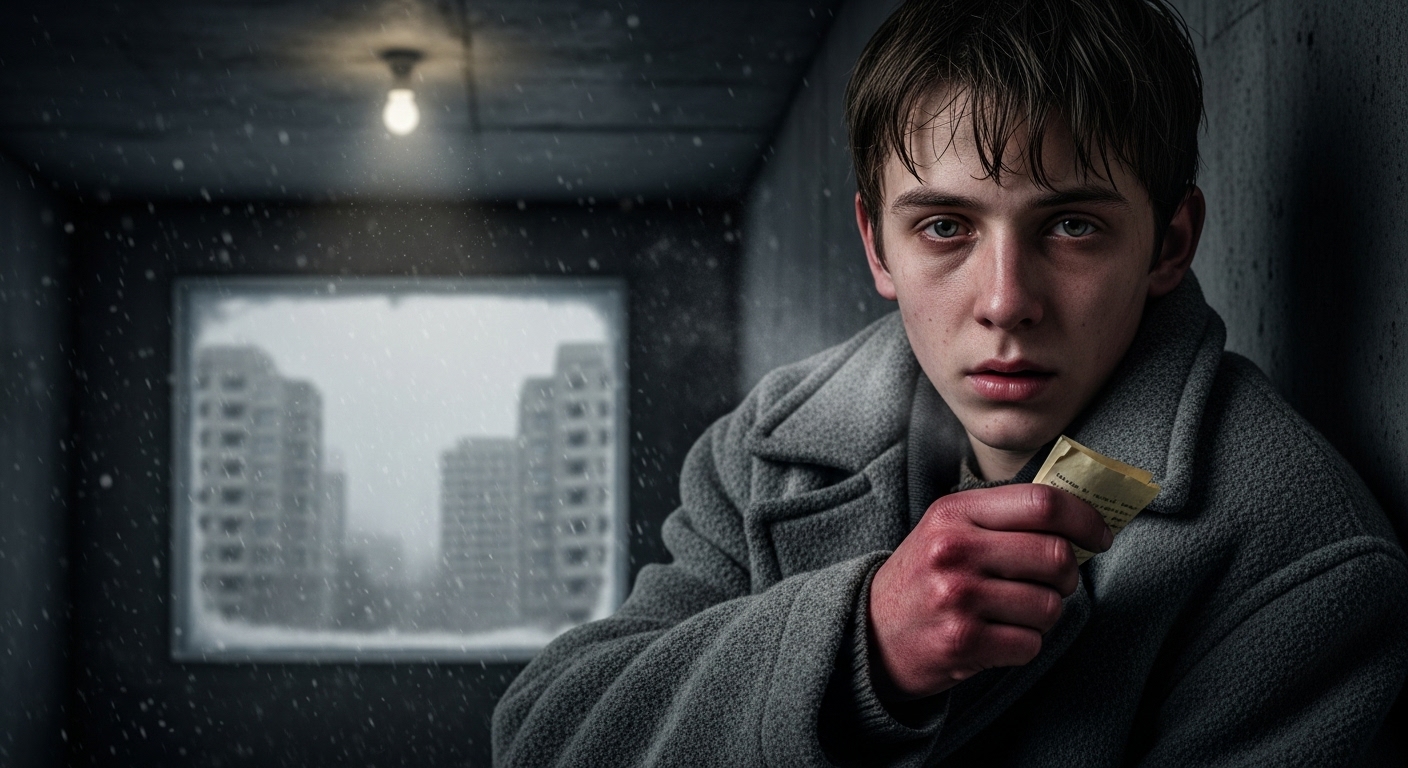
I had to know. I had to understand what the symbol meant, what the message tried to say. The world might be broken, censored, choked by ice and the Collective, but I couldn't just stand by, letting this one small, defiant spark die out. Not when it felt like the first real thing I'd touched in years.
Share This Story


