Sunlight on Diseased Petals
The morning sun, usually a balm, felt like an interrogation lamp today, highlighting every disquieting detail. A strange, almost imperceptible haze still clung to the air, a leftover from the previous night's celestial spectacle. It wasn't smoke, nor fog, but something thinner, more insidious, that seemed to cling to the edges of vision, making the world shimmer faintly, as if seen through old, rippled glass. The birds, usually raucous with the arrival of spring, offered only a few tentative chirps, their songs cut short, as if remembering a tune they no longer quite understood. Beneath the oppressive quiet, a low, persistent hum thrummed just beneath the threshold of hearing, a mechanical pulse that had become the new soundtrack to existence.
It had been, what, five days now? Six? The precise chronology had started to blur, like everything else. My mind, usually a neat archive, felt like a stack of loose papers fluttering in a crosswind. The bright, impossible light had bloomed overhead during what should have been an ordinary Tuesday evening, painting the sky in colours that didn’t exist in any known spectrum. Now, the afterglow, or whatever it was, continued to hang there, a constant, shimmering reminder that the world had changed its rules.
I was sitting on the edge of the fire escape, my legs dangling precariously over three storeys of crumbling brickwork and overflowing bins. Below, the narrow alleyway was eerily quiet, save for the incessant, almost musical drip from a burst pipe. The air, usually thick with the exhaust of ancient diesel engines and the faint, comforting smell of over-fried chips from the corner takeaway, now carried only the damp, sweet scent of newly unfurled leaves and the cloying sweetness of jasmine from Mrs. Davies’s trellis. Spring, always so hopeful, felt like a cruel joke this year, dressing the stage for a tragedy in its brightest finery. My fingers traced the rusted filigree of the railing, cold and gritty under my touch.
"Still playing sentinel, Rory?" Casey’s voice, a familiar rasp, sliced through my thoughts. He appeared in the doorway of our makeshift dwelling, a mug of what I hoped was actual tea steaming gently in his hand. His hair, usually a chaotic mess, seemed even more dishevelled, sticking out at odd angles. He looked tired, but then, didn’t we all? He wore the same faded hoodie he’d been in for days, a small grease stain near the pocket testament to a failed attempt at fixing the old radio.
I pushed a loose strand of hair from my eyes. "Someone has to," I replied, not looking at him. "The world’s not going to un-strange itself because we ignore it." I watched a solitary pigeon peck half-heartedly at something indistinguishable on the asphalt below, its movements jerky, less confident than usual.
He grunted, leaning against the doorframe, sipping his tea. The mug clinked softly against his teeth. "And what have you observed today, oh great oracle of the fire escape? Any new forms of existential dread emerging from the ether?" There was a wry edge to his voice, his usual defence mechanism against… well, against everything, really. It was one of the things I appreciated about him; even facing the end of known reality, he still managed a sardonic quip.
"Just the usual," I said, finally turning to face him, my foot tapping a nervous rhythm against the brick. "Old Mr. Henderson is still sweeping his perfectly clean pavement, back and forth, back and forth. His brush barely touches the ground. It’s a performance, a mime show without an audience." I rubbed my temples, a dull ache blooming there. "And Mrs. Chen from number seven… she’s just staring at her rosebush again. Hasn't moved in hours. Her eyes are wide open, but it’s like there's nobody home, just a light on in an empty house."
Casey sighed, pushing off the doorframe. He came and sat beside me, his elbow accidentally nudging my knee. He didn’t apologise, just stared out at the street with me. "It’s the quietest the city’s ever been, isn’t it? Like everyone’s holding their breath, waiting for the punchline to a really bad joke."
"Or like they've forgotten how to breathe altogether," I muttered, pulling my knees up to my chest. The damp brick was cold against my jeans. "It’s unnerving, Casey. They don’t seem hurt, exactly. Not violent. Just… off. Like their internal clocks got scrambled. Or like they’ve seen something we haven't, something that stripped all the noise out of them."
"They saw the light, Rory, same as us." He took another thoughtful sip. "But maybe they saw more. Maybe we just got lucky with our cranial wiring, eh? Ours short-circuited differently. Less… vacant. More… panicky, in my case."
I allowed myself a small, mirthless chuckle. "Panicky with witty banter, yes. Very dashing." A small fly buzzed erratically near my ear, its wings sounding surprisingly loud in the stillness. I swatted at it, missing.
"It’s a coping mechanism, darling," he said, his tone shifting only slightly, just enough for me to catch the genuine concern beneath the sarcasm. "Better than sweeping imaginary dust or communing with petunias, wouldn’t you say? Besides, we need to talk strategy. We’re down to half a loaf of that mouldy bread and a single tin of questionable chickpeas."
A Pavement of Muted Hues
My stomach rumbled in agreement, a rude interruption to the philosophical dread. "The corner shop, then?" I suggested, already dreading the venture. The thought of navigating the quiet streets, of passing those vacant, repetitive figures, made the skin on my arms prickle. It wasn’t a fear of aggression, not really, but a profound unease, like walking through a house of sleeping giants.
"The corner shop," Casey confirmed, his voice firming up. "It’s the closest. And old Mr. Patel keeps his stock rotated, even if the expiration dates are more suggestions than hard rules these days." He stood up, stretching his arms above his head, his spine cracking audibly. "Let’s be quick. Early afternoon, before the… afternoon wanderers… get into their full stride."
We gathered our meagre supplies: two worn rucksacks, a rusty wrench that served as a last-ditch defensive measure, and a shared bottle of lukewarm water. Before we left, I pulled on a thick, dark hoodie, the fabric familiar and comforting against my skin. It had a stain on the right sleeve from when Casey tried to fix the leaky kitchen tap and swore spectacularly. He tugged at the strings of his own hoodie, adjusting it around his face, a common gesture he had developed since the light appeared.
Stepping onto the street felt like entering a play already in progress, where we were the only ones who hadn’t learned our lines. The air was cool and crisp, but tasted metallic, like rain on old pennies. Magnolia trees, usually a vibrant burst of creamy white and shocking pink, seemed muted under the strange, diffuse light, their petals almost translucent, as if painted on by an amateur hand. I noticed a small crack in the pavement that I’d never seen before, a tiny jagged line running towards the kerb. My eyes lingered on it for a second too long.
Our footsteps echoed loudly, obnoxiously, on the residential street. Every scrape of a shoe, every rustle of our jackets, seemed amplified, like we were shouting in a library. I kept my gaze mostly forward, or focused on the ground, trying to avoid direct eye contact with the few figures we passed. It felt like a childish superstition, but a potent one. I didn’t want to see what was behind their eyes, or worse, see nothing at all.
We saw a woman in a bright yellow raincoat standing perfectly still in the middle of a lawn, holding a watering can, which she then slowly tipped, watering nothing but the air. Her face was slack, a faint, almost invisible smile playing on her lips. Then she straightened, paused, and repeated the motion. Again. And again. The watering can clanked faintly as she lowered it. Casey squeezed my arm lightly, a silent instruction to keep moving, but I could feel his gaze, just like mine, drawn to the bizarre spectacle. It was a macabre dance.
"She's got good posture, at least," Casey muttered under his breath, his voice barely audible, his eyes fixed ahead. It was a terrible joke, but I almost laughed. The absurd humour, a tiny, defiant spark, felt like a vital sign in the silence. My stomach did another nervous flip. The sun was definitely warmer now, a false promise against the cold reality of the situation.
---
The Cadence of Repetition
We rounded the corner onto Northwood Road, the main thoroughfare. Here, the situation was marginally more active, though no less unsettling. Cars sat abandoned at haphazard angles, doors ajar, windows down, as if their drivers had simply evaporated. A bicycle lay on its side, a wheel still spinning slowly, reflecting the odd light from above. The only movement came from scattered individuals, each caught in their own peculiar loop.
A man in a business suit was attempting to open a car door that was already open, his hands fumbling with the handle, his brow furrowed in concentration. He’d try, pause, adjust his grip, and try again. A few metres away, an elderly gentleman was meticulously picking up fallen cherry blossom petals from the pavement, one by one, only to drop them again a moment later. He would gather a small pile, then release them, watching them drift back to the concrete, his expression unreadable. The delicate pink petals were everywhere, a beautiful, innocent splash of colour against the grey, their brief existence a poignant counterpoint to the suspended animation of humanity.
"It’s like a broken record, isn’t it?" I whispered, my voice hoarse. "Or a faulty programme. They’re stuck."
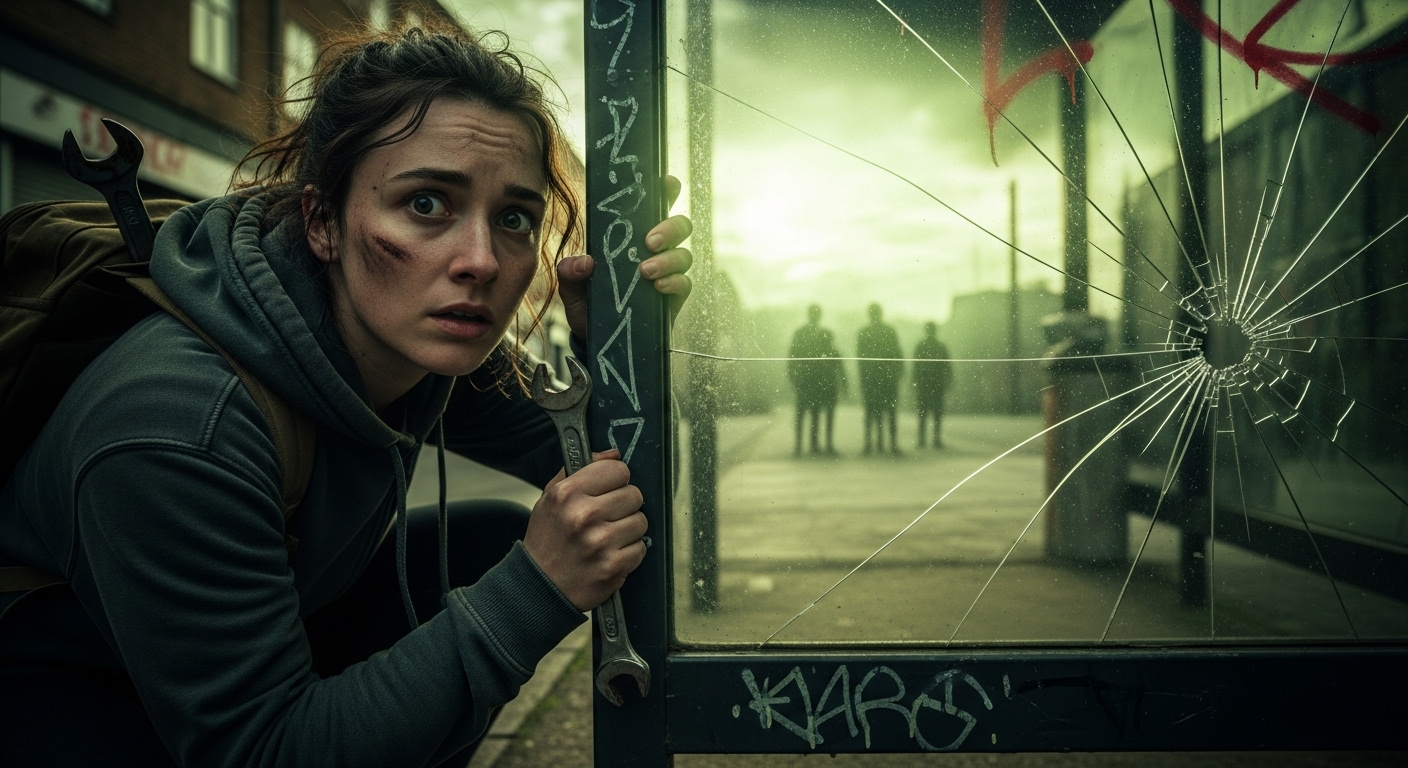
"A very efficient sort of stuck, if you ask me," Casey replied, pulling me gently behind a derelict bus shelter. The fibreglass was cracked, smelling faintly of old rain and vandalism. We crouched, peering through a grimy pane of glass. "No fighting, no screaming. Just… repetitive. It’s almost peaceful. In a deeply disturbing, 'end of everything' kind of way."
I shivered, despite the warmth. "Peaceful for them, maybe. Not for us. We’re still in the full-throttle version of reality."
He nodded, his jaw tight. "Exactly. Which means we need to maintain our full-throttle wits." He pointed with his chin towards the corner shop, its faded 'OPEN' sign still swinging lazily in the breeze, a relic from a different age. "Clear path to the door. Looks like most of the… loopers… are focused elsewhere."
Just as he said it, a low, guttural murmur drifted towards us. It wasn’t a human sound, not exactly, but a collective, almost animalistic hum that seemed to emanate from a cluster of figures further down the street, near the old library. There were maybe seven or eight of them, standing shoulder-to-shoulder, swaying slightly, their arms hanging limp. They weren’t doing anything specific, just being there, their collective presence creating an oppressive weight in the air. Their faces were all turned upwards, towards the sky, towards the lingering shimmer. It was the first time I’d seen them congregate like that, and it sent a cold dread through me. They looked like a morbid, unholy congregation.
My breath caught in my throat. "They’re… watching," I managed, my voice barely a thread. My heart hammered against my ribs, a frantic drumbeat.
Casey swore under his breath, a sharp exhalation. "Alright, new plan. Not so clear a path after all." He tugged me further back into the shadows of the bus shelter, pressing himself against the mouldy fibreglass. I could feel the vibrations of his hurried breathing against my arm. The faint smell of damp plastic and old graffiti was surprisingly vivid.
We waited, crouched low, listening. The hum intensified, a low thrumming that vibrated in my teeth. It felt like the ground itself was singing, a slow, deep vibration. The figures near the library didn’t move, but their collective gaze on the sky felt heavy, accusatory. It was like they were soaking up whatever was left of the light, becoming conduits for it. I found myself gripping the rusty wrench in my rucksack, the metal cold and hard against my palm. My knuckles went white.
"They’re not moving towards us, are they?" I whispered, my eyes darting between the library group and the deserted shop entrance. My throat felt dry, sandpaper rough.
"No, not yet," Casey replied, his voice a low rumble. "Just… existing. But that’s what makes them so bloody unsettling, isn’t it? The sheer lack of malice. Just… blankness."
A small puddle of rainwater had collected in a divot in the asphalt just outside our shelter. It reflected the muted spring sky, a dull, oily sheen. As I watched, a tiny ripple spread across its surface, though there was no breeze, no falling drop. It was subtle, almost imperceptible, but I saw it. The light above, a diffuse, almost sickly yellow now, seemed to pulse faintly, almost like a heartbeat, but a sluggish, dying one. My head throbbed, a dull persistent ache.
"Casey," I said, my voice barely above a breath. "Did you… did you see that? The puddle?"
He didn’t answer immediately. His eyes were still fixed on the library group. After a long moment, he shifted his gaze to the puddle, then back to the sky. "That light… it’s doing something to everything, isn’t it? Not just people. I saw a tree, yesterday, down by the river. Its leaves were growing in reverse. Curling back into buds. Like the season was trying to rewind itself."
The image was grotesque, a natural order violently undone. It made the hair on my arms stand up. "Growing in reverse? That’s… that’s impossible." But then, so was a mysterious light turning people into silent, repetitive automatons. So was the entire sky shimmering like a broken kaleidoscope.
"Impossible is the new normal, Rory," he said, a grim set to his jaw. He leaned back against the wall, pulling his knees up, mimicking my earlier posture. "Remember that old saying? 'Spring is nature's way of saying, Let's Party!' Well, nature seems to be having a much more avant-garde sort of party these days. Lots of performance art. Fewer actual canapés."
I found myself smiling faintly, despite the growing anxiety, a tight, nervous contraction of my facial muscles. It was his way. His dark humour was a lifeline, an anchor in the swirling chaos. It was what stopped me from just curling up into a ball and giving up. "Right," I said, trying to steady my breathing. "Less party, more experimental theatre production with a really vague plot."
"Precisely," he affirmed, a ghost of a smile touching his own lips. "And we, dear Rory, are the unwitting, unenthusiastic protagonists." His eyes met mine, and for a fleeting moment, the shared terror and the bizarre humour connected us in a way words couldn't. It was a fragile, human moment, a flicker of warmth against the creeping cold. I felt a weird mix of fear and comfort. Like maybe, just maybe, everything wouldn't be completely lost, not yet. My leg had started to cramp, a dull ache in my calf, reminding me of my physical presence in this increasingly surreal world.
---
The Unblinking Eye
We waited for another ten minutes, the collective hum from the library group a constant, low thrum against the backdrop of an otherwise silent city. They showed no sign of dispersing, no sign of changing their strange vigil. The sun crept higher, and the shimmering overhead seemed to intensify, making the distant buildings ripple like heat haze. It wasn't the searing heat of summer, but a gentle, pervasive warmth that felt almost artificial. My skin felt… sensitive, like it was absorbing too much light.
"This isn't working," I finally said, pushing myself up cautiously. "We'll have to try another route. Maybe the back alley of the butcher's shop. It usually connects around to the rear of Patel's."
Casey nodded, rising too, his movements stiff from crouching. "Agreed. This 'silent contemplation of the void' society is not conducive to grocery shopping." He stretched again, twisting his torso left then right, his hoodie strings dangling. The worn fabric of his jeans scraped against itself as he moved. A small cough escaped him, dry and rough.
As we began to move, threading our way back through the quieter side streets, I felt a peculiar sensation. A tightness in my chest, not of fear, but of pressure, like something was pushing down from above. I glanced up, squinting against the shimmering sky. The colours weren't right. The blue was too vivid in some patches, too pale in others, and everywhere, a faint, almost translucent green glow seemed to pulse, like a living membrane. It caught my eye, a sudden, almost hypnotic flash, and for a split second, the world seemed to tilt on its axis.
A strange wave of dizziness washed over me, a momentary disassociation. The buildings around me seemed to stretch and warp, the lines of brickwork flowing like water. The scent of jasmine, once sweet, became cloying, sickly. I stumbled, my boot catching on an uneven paving slab. Casey reached out, steadying me with a firm hand on my arm. His touch felt solid, grounding, a physical reassurance in a world that was becoming increasingly fluid.
"Whoa, easy there, Rory," he said, his brow furrowed with concern. "You alright? You look like you just saw a ghost ride a unicycle."
I shook my head, trying to clear the lingering visual echo. "The sky… it just… shifted. Everything warped for a second. Like looking through a broken lens."
He peered up, his gaze intense, then back at me. "You’re not the first. I’ve felt it too. Little flashes. Like the world’s trying to recalibrate, and our eyes are just buffering." He gently squeezed my arm again, his fingers warm. "Come on. Let’s get you inside somewhere, away from that… whatever it is."
We pressed on, quicker now, the bizarre visual incident adding a new layer of urgency. The thought of those congregating figures, unblinking and unresponsive, lingered at the back of my mind. Their silent vigil felt less like a passive observation and more like a slow, deliberate act of absorption, of becoming part of the phenomenon itself. The world was not merely strange; it was actively, subtly, and terrifyingly changing those within it, and I couldn’t shake the feeling that Casey and I, with our fragile grip on 'normalcy,' were merely delaying the inevitable.
The shimmering light above us pulsed with a renewed intensity, a silent, cosmic beacon that seemed to reach not just for the vacant stares of the wanderers, but deep into the very fabric of the city, and perhaps, into the vulnerable core of our own perception.
What fresh horror would dawn with tomorrow's light, and how much longer could we stand against a sky that seemed intent on remaking humanity in its own disquieting image?
The shimmering light above us pulsed with a renewed intensity, a silent, cosmic beacon that seemed to reach not just for the vacant stares of the wanderers, but deep into the very fabric of the city, and perhaps, into the vulnerable core of our own perception. What fresh horror would dawn with tomorrow's light, and how much longer could we stand against a sky that seemed intent on remaking humanity in its own disquieting image?
Share This Story


