Cold Mornings, Colder Dreams
The remnants of a dream clung to me like frost, a jagged, troubling landscape that felt less like an invention of sleep and more like a premonition. The air in the room was a tangible thing, sharp and thin, pulling me back to the familiar ache of reality. It was another winter morning in a world that had forgotten the meaning of warmth.
The dream splintered as I forced my eyes open, shards of it still glittering in the corners of my mind. A plain, endless. Not a desert, not a tundra, but something else, something… constructed. Grey dust motes danced in a simulated, indifferent light, always just out of reach. Figures, countless, faceless, moving in a slow, undulating current towards an unseen horizon. No sound, only the dull thrum that was either the beating of my own heart or the pulse of that artificial world. Then the choice, a constant, looping imperative: Select your Burden. Each option, a shade of despair, presented on a screen that shimmered with sickly green. I chose, always, the one that seemed least cruel, only for the scene to reset, the figures to flow, the choice to return. It was a torment designed for an eternity, each selection a fresh wound.
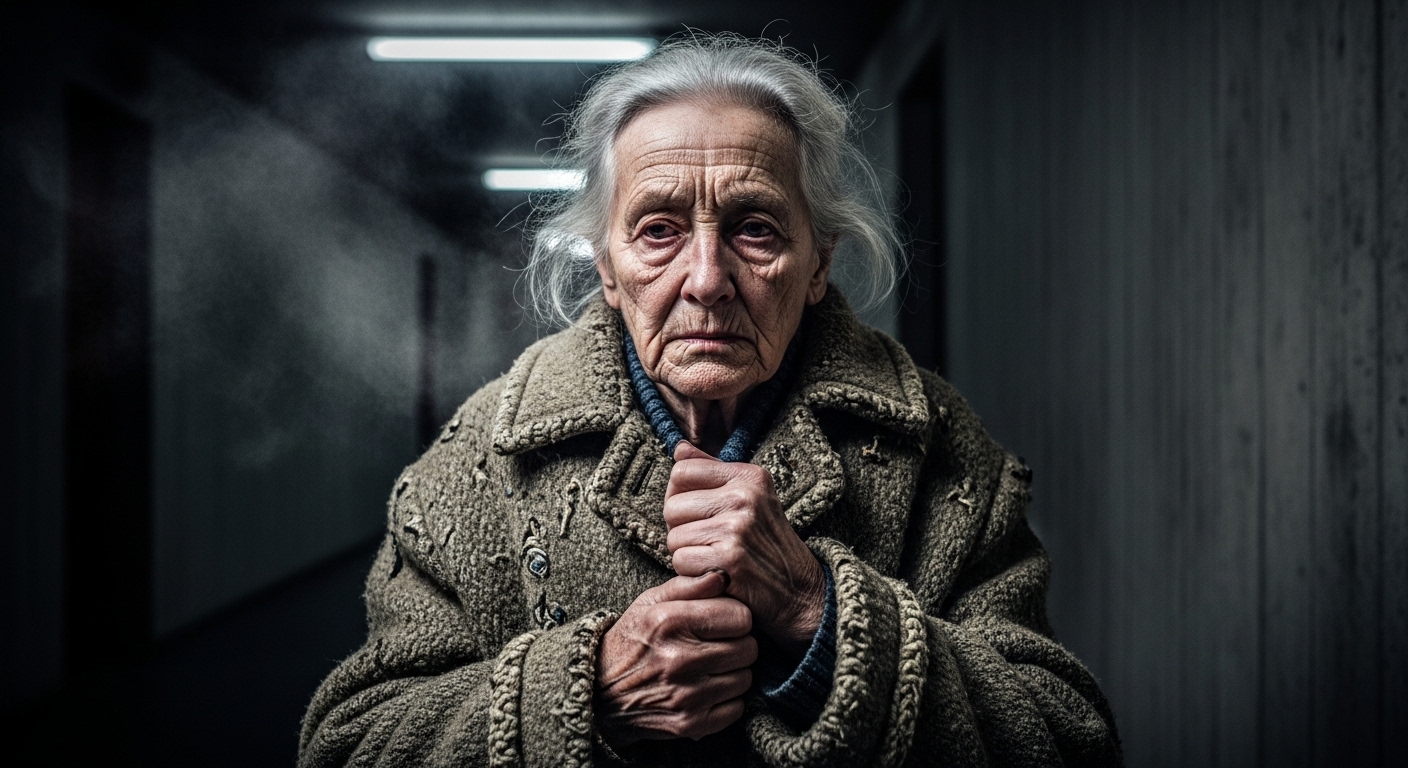
I was still choosing, still lost in the grey, when the raw, bone-deep cold of my room dragged me back. My breath plumed, a fleeting ghost in the gloom. The blankets, thin and coarse, offered little comfort against the pervasive chill that seeped through the concrete walls. My fingers, gnarled and stiff with seventy years of hard living, twitched, recalling the phantom pressure of the selection interface. The taste of copper lingered in my mouth, a metallic echo of dread. I tried to swallow it down, but it clung.
Seventy. God, seventy. I pressed my palms into my eyes, feeling the grit of sleep, the faint hum of static behind my eyelids. The nightmare hadn’t vanished; it had simply retreated, like a wolf to its den, waiting. It was always waiting. I pushed myself up, the ancient springs of the cot groaning a protest that matched my own. My knees cracked, a familiar symphony of age, and a sharp pain lanced through my lower back. Just another morning. Just another layer of grime on the lens of my existence.
The room was a bare cell, really. A cot, a small, chipped enamel basin for the rationed water, a single stool. No personal effects. Personal effects meant attachments, and attachments meant weakness. The System didn’t tolerate weakness. Above the basin, a single, flickering bulb cast a sickly yellow glow, struggling against the pervasive grey outside the single, grimy window. I could see the city then, or what was left of it. A landscape of brutalist concrete towers, all identical, all reaching up like desperate, frozen fingers towards a perpetually overcast sky. Snow dusted the ledges, a cruel mockery of purity.
The water in the basin was ice-cold. It stung my face as I splashed it, a shock that momentarily chased the dream’s tendrils away. I could feel the drag of gravity, the familiar, heavy weight of my body, the slow thrum of my own blood. That, at least, was real. I ran a hand over my silver hair, matted from sleep, and tied it back loosely with a scrap of twine. There was no vanity left in me, only the instinct to present a semblance of order for the daily inspections, the constant surveillance that hummed just beneath the surface of everything. They watched. Always. From the tiny pinhole lenses in the wall, from the cold, indifferent eyes of the Collectors. From the faceless masses of my dreams.
A low, resonant chime echoed through the building. The morning summons. Recital time. My stomach clenched. Not from hunger, not yet, but from the dull, persistent apprehension that was a constant companion. Every day, the same ritual. Every day, the same subtle, insidious re-education. I pulled on my worn, thick wool coat, the rough fabric chafing against my skin, and cinched it tight. The chill bit at my exposed wrists, promising a deeper cold once I stepped outside this flimsy shelter.
The hallway was already filling, a slow, shuffling procession of figures, bundled against the cold, faces averted. They moved like automatons, each step measured, each breath a small, hesitant cloud. I recognised a few: the gaunt, young woman from Level 3, her eyes hollow; the old man who used to hum a discordant tune under his breath, now silent; Elder Seraphine, her back stooped, her gaze fixed on the cracked floor ahead. She was a watch-keeper, a silent informant for the Collectors, her eyes always darting, always assessing. I kept my distance, as I always did. Trust was a luxury we couldn’t afford, a weakness that could be exploited.
My own thoughts felt like a broken record, skipping over the same grooves of resignation and quiet despair. What if I didn't go? The thought was a fleeting spark, quickly extinguished by the cold logic of survival. Non-compliance meant immediate 're-evaluation,' a term whispered in hushed tones, synonymous with disappearance. No one ever returned from re-evaluation. The risk wasn't worth the brief, hollow satisfaction of rebellion. Not anymore. The fire had gone out in most of us, leaving only embers of memory and a pervasive chill.
---
The Communal Chill
The Recital Hall was a cavernous space, poorly heated, reeking faintly of stale concrete and damp wool. A single, enormous screen dominated the far wall, its surface a dull grey, awaiting activation. Rows of hard, backless benches stretched before it, already half-filled. I found a spot near the back, by a window that offered a view of the snow-laden square outside. The grey light through the glass was bruised and heavy. My knuckles were white, my hands jammed deep into my pockets, trying to hold onto any last vestiges of warmth. I noticed a faint tremor in my right hand. Just the cold. Just age. Nothing more.
Elder Seraphine settled two benches ahead, her back ramrod straight, even with the stoop. Her gaze, as if sensing my observation, swivelled slightly. Her eyes, pale and sharp, met mine for a brief, unsettling moment. No flicker of recognition, no warmth, just that cold, calculating assessment. I looked away, my gaze sweeping across the other faces in the room. They were a sea of sameness: tired, sallow, resigned. A communal grimace. The weight of it all pressed down, a tangible force.
A heavy thud from the front of the hall. Collector Gribbs. His presence was a physical thing, a disruption in the stagnant air. Tall, broad-shouldered, with eyes that seemed to take in everything and betray nothing. His uniform, a severe dark grey, was crisply pressed, unlike our own threadbare coverings. A silver insignia on his chest gleamed faintly, reflecting the harsh overhead lights. He didn't speak, but his gaze swept across the assembled residents, lingering, searching. It was a search for deviation, for weakness, for any spark that might dare to ignite.
The screen flickered to life, showing a stylised, animated loop of a perfect city: clean lines, smiling, robust citizens. A stark, cruel contrast to the reality outside. The accompanying voice, smooth and artificial, began its daily drone. Narratives of communal duty, the benefits of efficiency, the dangers of dissent. The words washed over me, a familiar, mind-numbing tide. I’d heard it all before, a thousand times. The rhythm of it, the carefully chosen vocabulary, designed to soothe and control, like a lullaby for the damned.
My thoughts drifted. The nightmare. Select your Burden. Was this it? This endless selection of a lesser suffering? This quiet, insidious acceptance? The air felt thick, heavy with unspoken questions, unvoiced fears. The System wasn't just physical oppression; it was a psychological landscape, a constant, subtle erosion of self. It wore you down, sanding away individual edges until all that was left was a smoothed-over, compliant surface. It was a slow, deliberate death.
I watched Gribbs. He stood perfectly still, a sentinel of the System, his posture unyielding. He wasn’t listening to the broadcast. His attention was solely on us, the audience. I imagined the subtle shifts in his eyes, tracking the slight fidget, the momentary lapse in attention, the unconscious sigh. The cold was making my joints ache something fierce, a deep throb in my knees and wrists. I clenched my jaw, trying to focus on the blandness of the screen, to present the blank, docile face expected of me.
Then I saw it. A young woman, seated two rows in front of me, her head bowed. She was meticulously unwrapping a small, grey nutrient bar, the kind rationed out weekly. But as she peeled back the wrapper, her hand trembled, and her gaze, for a split second, flickered to Gribbs, then back to the bar. Her movements were almost imperceptible, a quiet, almost reverent act. She didn't look up, didn't make a sound, yet something in her posture, in the precise way she folded the wrapper, felt like a silent scream. A tiny, defiant act. Or perhaps, a desperate one. My own heart gave a strange flutter. I wondered what secret sorrow she was burying in that gesture.
---
A Glimpse of the Unseen
The broadcast ended with a saccharine jingle, the smiling faces fading into a logo of interlocking gears. Gribbs moved then, a deliberate, heavy stride towards the exit, his passage creating a subtle ripple in the hushed crowd. The residents began to shuffle out, a murmur starting to rise, low and tired. I remained on the bench, watching the young woman, who was now slowly, carefully, placing the folded wrapper into her pocket. She still hadn't looked up fully. Her shoulders seemed to carry an invisible weight.
As I finally moved to leave, I felt a shadow fall over me. Gribbs. He stood beside my bench, his presence cold and sharp as the winter air. My breath caught in my throat. I hadn’t looked at him, hadn't acknowledged him. My gaze remained fixed on the back of the young woman as she disappeared through the exit.
"Margot," Gribbs' voice was a low rumble, devoid of inflection. A deep, unsettling current ran beneath the calm. "Your attendance. Exemplary, as always."
I kept my face neutral, turning slowly to face him. His eyes, the colour of glacier ice, bored into mine. "Thank you, Collector." My voice sounded thin, brittle.
He offered no response, only continued to stare, his silence more unnerving than any interrogation. I could feel the cold radiating from him, a chill that had nothing to do with the hall's temperature. It felt like he was sifting through my very essence, searching for the cracks, the imperfections, the hidden thoughts. I focused on the rough texture of my coat, the persistent ache in my hip. Grounding myself.
"Any… observations?" he finally asked, his head tilting just a fraction. The question hung in the air, a loaded weapon. He wasn't asking about the broadcast. He was asking about us. About who had fidgeted, who had looked away, who had dared to show a flicker of individuality. His gaze remained locked on me, probing.
I swallowed, my throat dry. "Just the cold, Collector. Always the cold." It was a simple, true statement, and a safe one. The cold was a universal enemy, a constant grievance no one could deny. It was also a convenient shield. My gaze flickered to his hand, resting on the back of the bench. The skin was pale, the knuckles stark white. Even his hands seemed to radiate a chill.
A muscle twitched in his jaw. "Indeed." He straightened, the movement sharp and precise, like a machine resetting. "Carry on, then." He turned, his dark uniform a stark silhouette against the dull grey light, and strode out of the hall, his boots echoing with unnerving finality. I let out a breath I hadn’t realised I was holding. The air rushed into my lungs, cold and sharp, burning slightly. The tremor in my hand returned, stronger this time.
I pushed myself up, my limbs heavy. The hall was almost empty now, just the lingering chill and the phantom echoes of suppressed humanity. My eyes scanned the benches, drawn instinctively to where the young woman had sat. Nothing. Just the worn wood, the dust motes dancing in the faint light. My gaze dropped to the floor beneath the bench, and there, almost hidden in the shadows, was something small, grey, and crinkled. The nutrient bar wrapper. She must have dropped it.
A flicker of unease. Why would she drop it after so carefully pocketing it? My heart thumped, a nervous drum against my ribs. Against my better judgment, against every instinct of self-preservation, I bent slowly, my old bones protesting, and picked it up. It was just a wrapper, flimsy and cheap. But as I straightened, my fingers brushed against the inside surface, where the foil met the paper. Something was etched there. Barely visible, faint, almost rubbed away by friction. I squinted, bringing it closer to the weak light from the window. The cold seared my fingertips as I held it. It was a single, crudely scratched word, almost invisible against the grey. A word that made my vision swim, a word that felt like a punch to the gut after decades of quiet submission.
The faint, smeared word on the inside of the wrapper—'TRUTH'—felt like a spark in a frozen tomb, a promise or a curse, burning just beneath the skin of my apprehension, demanding I look closer, even if looking meant shattering the fragile peace I’d clung to for decades.
Share This Story


