The Unsettling Bloom
The spring air, thick with the scent of wet earth and early blossom, hung heavy and humid around the abandoned glasshouse. Rain, a soft drizzle all morning, had just lifted, leaving the world slick and glistening. New growth, an unruly emerald tide, pushed relentlessly through cracked concrete and ancient, buckling asphalt. The sycamore trees, still sparse with infant leaves, wept condensation onto the ground, their shadows stretching long and distorted in the weak, watery light filtering through the cloud cover. It was a place where beauty and decay wrestled in a slow, suffocating embrace, and today, the decay seemed to be winning.
The hinge on the rusted gate groaned, a sound like a tortured throat, echoing too loudly in the sudden quiet. Abe, his trench coat a damp, heavy second skin, pushed it open a fraction further, enough to squeeze his wiry frame through. He didn't bother to close it, the metal resisting anyway, fixed in its perpetual state of slow surrender. His boots, scuffed and worn, crunched over a carpet of last year’s desiccated leaves, still holding the ghost of their former lives, now merely brittle husks. The air, despite the recent rain, felt oppressive, humid, tasting faintly of damp soil and something else – something acrid, almost like ozone or spoiled fruit, buried deep beneath the pleasant veneer of spring’s new ambition.
He’d seen enough of these forgotten places in his sixty-seven years to recognise the particular scent of neglect, the way a building slowly breathes out its own dying. This one, a sprawling network of glasshouses and overgrown nurseries, felt different. The rumours, whispered in the back rooms of city pubs and etched onto obscure online forums, were certainly different. They spoke of grotesque displays, of a creeping madness that bloomed with the first crocuses. Abe, a man who believed only in the quantifiable rot of the human condition, had come to see for himself, a morbid curiosity that age had done little to dull.
The Sculptures of Decay
A vast pane of glass, shattered from some long-past act of vandalism or perhaps just weather, leaned precariously against a sagging brick wall, its jagged edge reflecting the grey sky in a thousand fragmented pieces. Inside, the main greenhouse was a cathedral of broken light and rampant growth. Vines, thick as his wrist, snaked up the skeletal steel framework, pulling it lower, threatening to collapse the entire structure. The glass ceiling, once pristine, was now a patchwork of missing panes and algae-stained survivors, distorting the world outside into a watery, impressionistic smear. Abe pulled a damp, rumpled handkerchief from his pocket and wiped his spectacles, the gesture habitual, offering more comfort than actual clarity.
And then he saw them. First, a flash of faded yellow, then a grotesque smear of purple, peeking from behind a particularly aggressive clump of nettles. They were figures, crudely assembled, leaning against the damp, moss-coated concrete benches that once held rows of tender seedlings. Not scarecrows, not exactly. Too… deliberate. Too cruel. One, barely torso-high, was made from what looked like a child’s oversized clown costume, its material faded and stiff with mildew. Its 'head' was a swollen, misshapen gourd, painted with a simplistic, terrifying grin in peeling red and black. Two wide, vacant eyeholes stared out from its face, filled with shadow. Around its neck, a ruff of dried, curling leaves, almost like a grotesque, organic collar.
Abe felt a familiar chill, not of fear, but of profound disgust. It was the same feeling he got whenever he encountered the raw, inexplicable malevolence of humanity – the pointless cruelty, the utter lack of reason. He adjusted his grip on his worn leather satchel, its strap digging into his shoulder. The cynicism was a comfort, a shield against the unsettling reality of these things. He knew about the cults, the pranksters, the desperate artists seeking 'edginess'. But this… this felt different. Not human.
He moved closer, his boots squelching lightly in a puddle that had collected on the uneven floor. The air here was colder, damper, heavy with the smell of wet soil and, unmistakably now, something else – a sickly sweet, almost metallic odour, like old blood mixed with jasmine. The figures were arranged in a macabre tableau, seven of them scattered among the rampant greenery. Each was unique, yet shared a common, disturbing aesthetic. Another wore a stained, oversized polka-dot shirt, its 'face' a gnarled knot of tree root, daubed with white paint and two unsettling black circles for eyes. This one’s hands, if you could call them that, were bundles of withered branches, tipped with surprisingly sharp thorns. One 'hand' was reaching out, as if in a grotesque plea or a silent threat.
---
Abe knelt, wincing as his knees protested against the damp concrete. He pulled out a small, magnifying glass, its brass casing dulled with age and use. He peered at the nearest effigy, the one with the gourd head. The 'grin' wasn't just paint. Beneath the flaking red pigment, the gourd itself seemed to have… puckered, its natural contours twisted into a fixed, rictus smile. And the eyes. They weren't just holes. Fine, hair-thin tendrils, almost like fungal filaments, had begun to sprout from the inner rim of the eyeholes, weaving intricate, spiderweb-like patterns. They were a dark, sickly green, contrasting sharply with the pallor of the gourd.
He touched one of the dried leaves forming the collar, its texture surprisingly tough, almost leathery. This wasn’t just a child’s costume thrown together. This was… cultivated. The more he looked, the more he saw. What he’d initially dismissed as mere decay, the usual crumbling of fabric and plastic, now appeared to be a purposeful, living transformation. The fabric of the polka-dot shirt on the other figure wasn’t simply faded; patches of it were stiff, interwoven with fine, thread-like roots, drawing moisture from the perpetual damp. A small beetle, iridescent green, crawled sluggishly across a crudely stitched button, oblivious to the unnatural tableau.
He stood, brushing the grit from his trousers. His eyes scanned the entire scene. The figures weren’t just standing; they were growing. Not fast, not with violent movement, but with the insidious, slow patience of rot and fungi. He noticed a faint tremor in the air, a vibration that hummed just beneath the threshold of hearing, like a distant, massive generator. Or perhaps it was just the spring wind sighing through the broken glass, playing tricks on his aging ears.
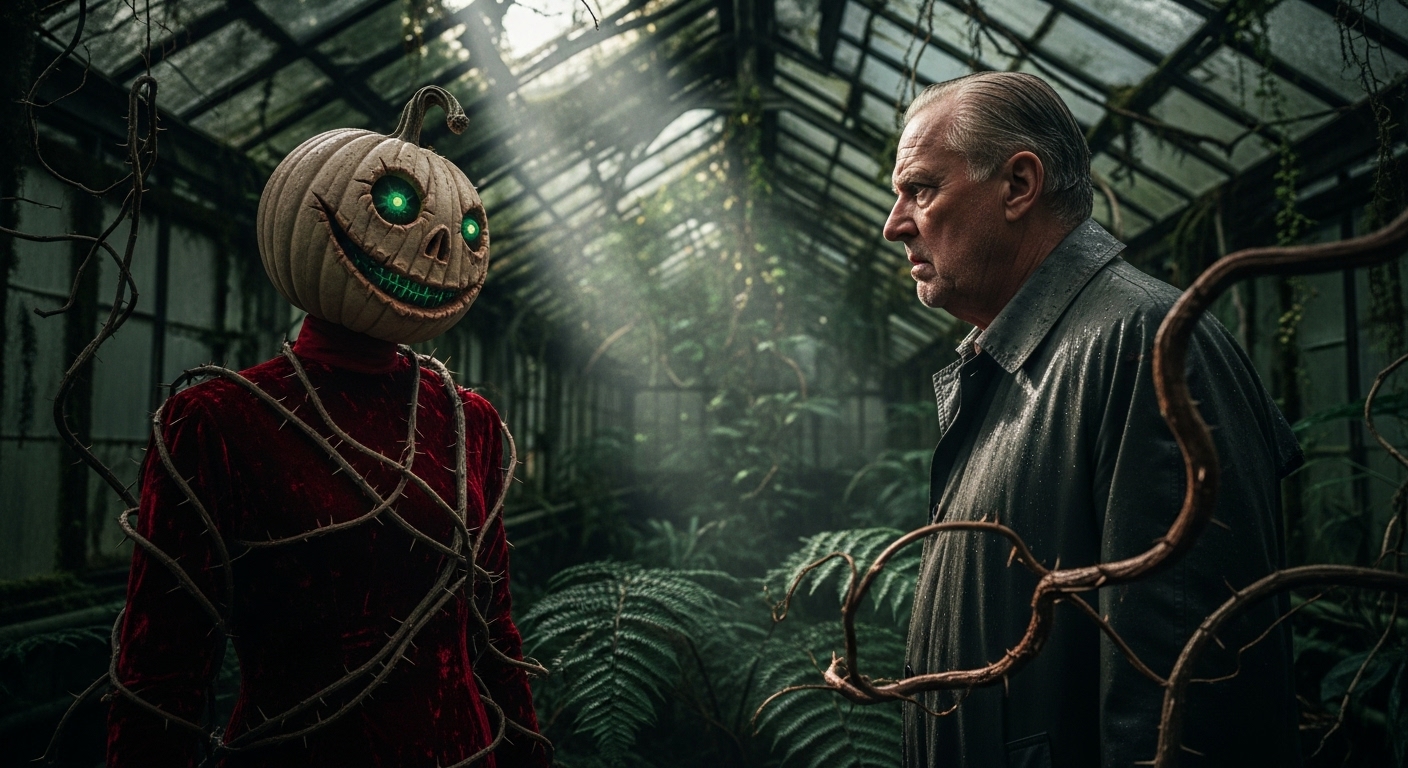
He moved deeper into the complex, ducking under a sagging beam, pushing aside a curtain of dripping ivy. The air here was even heavier, the sickly sweet smell more potent. He found a small, walled-off section, a kind of inner sanctum, where the light was almost entirely extinguished by the dense growth of ferns and mosses. A single, weak beam of sunlight, like a spotlight on a stage, pierced a gap in the overhead foliage, illuminating the centre of the space. There, on a pedestal of stacked, broken terracotta pots, was the largest of them all.
The Perennial Spectacle
This one was taller than Abe, its form more substantial, almost human-like in its proportions. It wore a full, heavy costume of deep crimson velvet, now stained black in places with mildew and earth. The material was interwoven with living vines, thick and thorny, that seemed to grow from the fabric itself, not merely wrap around it. Its head was a truly monstrous thing, a large, desiccated pumpkin, perfectly spherical and unnaturally smooth. On its surface, a smile had been carved – wide, stretching from ear to ear, exposing rows of blunt, yellowed teeth that looked disturbingly like human molars. The eyes were hollow, but inside, two pinpricks of bioluminescent green light pulsed faintly, like tiny, diseased embers.
Abe felt his breath catch, a rare occurrence for a man of his constitution. This wasn't prank art. This wasn't some disturbed individual's hobby. This was… alive. Or at least, being animated by something that blurred the line between the organic and the inanimate. He felt a sudden, inexplicable dread, cold and sharp, pierce through his carefully constructed cynicism. The world shifted. The faint hum grew louder, a low thrumming that resonated in his chest. The green lights in the pumpkin's eyes seemed to brighten, to fix on him.
He heard a faint rustle, not from the wind, but from behind the crimson figure. He froze, every muscle in his body taut. He hadn't seen anyone else, hadn't heard a footstep. But something was there. A shadow detached itself from the deeper gloom behind the figure, indistinct, elongated. It was fast, too fast, slipping between the dense ferns. Abe spun around, fumbling inside his satchel for the small, heavy flashlight he always carried. His fingers, usually steady, trembled slightly, betraying the sudden, visceral fear that had begun to blossom in his gut.
His gaze snapped back to the pumpkin-headed figure. The faint green lights in its eyes were now burning with an intense, steady glow, and the carved smile seemed to widen impossibly, stretching the dry skin of the pumpkin further. He could almost hear it, a dry, rasping laugh, like leaves skittering across forgotten pavement. It was too still. Too perfect. The hum pulsed, vibrating through the soles of his boots. He stepped back, slowly, deliberately, his heart thudding against his ribs like a trapped bird. The figures, the mundane decay of a forgotten place, the sweet, sickly smell – it all coalesced into a single, overwhelming sensation of wrongness. The spring, with its promise of renewal, felt like a terrible, beautiful lie.
He backed out of the inner sanctum, his eyes fixed on the crimson figure, and as he reached the entrance, stepping into the slightly brighter, but no less menacing, main greenhouse, he glanced over his shoulder. The pumpkin-headed effigy hadn't moved. But one of its thorny, vine-like arms, which he swore had been resting against its side, was now raised, its withered branch-fingers pointing directly at him, as if in a silent, mocking farewell. A single, thick vine, dark green and glistening with moisture, snaked out from the base of the pedestal, creeping across the floor towards the very spot where Abe had been standing moments before, its tendrils reaching, reaching.
---
He stumbled back, bumping into a cold, wet pane of glass, which shuddered but held. His old lungs burned. His mind, usually sharp, felt muddled, overwhelmed by the sheer, impossible reality of what he’d witnessed. He gripped the edge of a rusty workbench, knuckles white, trying to steady himself. The hum was everywhere now, a low frequency rumble that vibrated his teeth. The sickly sweet smell of jasmine and metal was almost suffocating. He turned, pushing through the thick, living curtain of ivy, desperate for the relatively open space of the main greenhouse, his eyes darting from one grotesque figure to the next.
They were all watching him. Not moving, not overtly. But the way the light caught their painted eyes, the way their organic limbs seemed to settle into slightly different postures. He was being observed. Hunted, perhaps, in a slow, patient, horticultural way. The plants themselves seemed more vibrant, more sinister than before, their leaves an impossibly dark green, their tendrils thicker, more aggressive. The entire place felt like a single, malignant organism, and he, Abe, was merely an inconvenient intrusion.
The Seed of Dread
He finally burst through the main gate, back onto the crumbling asphalt path. The rain had started again, heavier now, a cold, drumming cascade that seemed to cleanse nothing, only deepen the gloom. He didn’t stop to close the gate, didn’t spare a glance back. His breath came in ragged gasps, his chest aching. He fumbled in his pocket for his car keys, his fingers numb. He had to get out, had to think. But even as he reached his old saloon, the familiar, comforting hum of its engine felt inadequate, fragile, against the deeper, more ancient hum that still resonated in his bones. The spring was bursting forth, full of life, but what kind of life? What grotesque seeds had been planted in the forgotten corners of the world, waiting for the warmth and wet earth to truly bloom?
The rain plastered his thinning grey hair to his forehead as he drove, the wipers struggling to clear the deluge from the windscreen. He gripped the steering wheel so tightly his knuckles ached. He thought of the unnerving, patient grin on the pumpkin, the thorny arm pointing, the creeping vine. It wasn't over. It was just beginning. The season of rebirth, a time for blossoming, was revealing something far more sinister, a slow, insidious creep of dread that had only just begun to unfurl its petals.
Abe drove faster, a cold, hard knot of fear tightening in his stomach. He wasn't just investigating anymore. He was running. And the things he had seen, the things that were growing, they weren't confined to one derelict greenhouse. He knew that now, with a chilling certainty. They were just the first, ugly flowers in a much larger, far more pervasive garden.
He glanced in his rearview mirror, seeing only the blurring grey curtain of rain and the faint outline of the old sycamore trees, swaying in the wind. But for a split second, he thought he saw it. A flash of faded polka-dots, a brief, impossible smear of red and black against the backdrop of the emerging green. A grin, wide and unyielding, staring back from the deepening gloom of the abandoned glasshouse. A promise of a perpetual carnival, one that had finally found its footing in the fertile, unsuspecting ground of spring.
Abe gripped the wheel, the hum of the car engine a frantic drum against the deeper, ancient thrum that resonated in his bones. He knew, with a cold, sickening certainty, that this was only the first garden, and the seeds of this grotesque spectacle were already scattered far beyond the shattered glass of the greenhouse, waiting for more innocent springs to bloom.
Share This Story


