Cross-Examination on a Rainy Spring Day
The chapter opens in a tense courtroom during a cross-examination, then moves to the city streets and a jail cell, before concluding in a dark, historical alleyway in a small industrial town during a rainy spring.
“You claim, Mrs. Morden,” Thomas began, his voice surprisingly steady, despite the tremor in his hands gripping the oak railing, “that you observed the altercation from your kitchen window. Is that correct?”
The courtroom air was thick, a humid spring afternoon pressing against the tall, arched windows that offered only a hazy view of rain-streaked brick. A single, stubborn fly buzzed against the glass above Judge Jenkins’s bench. Mrs. Morden, a woman whose face was etched with a lifetime of hard labor and suspicion, shifted on the witness stand, her cheap cotton dress rustling like dry leaves. She clutched a worn handkerchief. “That’s what I said, ain’t it? Clear as day.” Her voice was a flat, unyielding drone, accustomed to being ignored.
Thomas let a moment of silence hang, long enough for the buzz of the fly to become almost irritatingly loud. He’d spent the last three nights hunched over yellowed legal pads, the smell of stale coffee and ink staining his fingers, trying to find the crack in her story. This entire case, Mr. Taylor’s freedom, it all hinged on discrediting her, on proving that what she saw wasn't 'clear as day' at all. The melancholy settled in his gut like cold iron. He was twenty-two, barely a year out of law school, and the weight of another man's life was a physical thing, pressing down.
“And what time, precisely, was this ‘clear as day’ observation made?” Thomas’s tone remained formal, almost theatrical, a carefully constructed facade against his own mounting anxiety. He glanced at Mr. Sampson, the prosecutor, a man whose silver hair and polished suit seemed to absorb all light, radiating an air of untouchable authority. Sampson merely watched, a faint, almost imperceptible smirk playing on his lips.
Mrs. Morden hesitated, her eyes flicking toward the judge, then back to Thomas. “Past eight. Near nine. Sun was down, but there was still light.” She wrung the handkerchief tighter. A bead of sweat traced a path down her temple, a tiny river through the dust of her skin.
“Indeed. The sun was down.” Thomas walked a slow, deliberate circle in the small space before the jury box. The floorboards creaked under his scuffed leather shoes. The scent of damp wool and old paper filled his nostrils. “Yet, earlier, you testified that the streetlamp on Elm Street had not yet been lit. Do you recall stating that?”
“Well, it wasn’t,” she retorted, her voice rising slightly. “They don’t light ‘em till the lamplighter comes around. He’s usually late.”
“So, no streetlamp. And the moon?” Thomas stopped, turning to face her fully, his gaze unwavering. He knew the almanac by heart for that night, a frantic study session fueled by more coffee than sleep. He could still feel the phantom ache in his temples.
She blinked. “Moon? Don’t recollect no moon.”
“Yet, Mrs. Morden, on the evening of April 14th, the moon was in its first quarter, a thin crescent, barely visible, set to dip below the horizon shortly after sunset. Not much light from that, would you agree?” Thomas’s voice was a low hum, drawing the jury in, making them lean forward almost imperceptibly. He felt a small, fleeting surge of something akin to power, or maybe just desperation. He ran a hand over his chin, feeling the slight stubble he’d missed that morning.
Sampson finally stirred, adjusting his spectacles. Judge Jenkins, a stoic man whose face usually betrayed nothing, watched Thomas intently. The courtroom fell silent again, save for the insistent tapping of Mrs. Morden’s foot against the leg of the witness stand.
“And your kitchen window,” Thomas pressed on, “faces north, correct? Overlooking the alleyway and then Elm Street?”
“Yes. Always has.” Her voice was sharper now, a hint of defiance. She was being cornered, and Thomas could almost taste the sour tang of her resentment.
“Meaning,” Thomas continued, pulling a small, crude drawing from his papers, a layout he’d sketched himself, tracing it with his finger, “that the light from the setting sun, which would have been in the west, would have been at your back. And the streetlamp, unlit, provided no illumination. The moon, a mere sliver, also offered little. What then, Mrs. Morden, illuminated this ‘clear as day’ altercation you observed?” He pushed the sketch towards the jury box, then laid a larger, more detailed architectural rendering on the stand beside her, a map of shadows and angles.
She stared at the drawing, her brow furrowed, a faint redness creeping up her neck. Her fingers still clutched the handkerchief, now a crumpled ball. “There was… it was… I could see fine.”
“Could you, Mrs. Morden?” Thomas asked, his voice softening, but the question was a blunt instrument. “Or did the shadows play tricks? Did the failing light obscure details? Did the distance, across an alleyway and a street, perhaps distort your perception?” He gestured towards the large courtroom clock, its hands ticking with a solemn, relentless rhythm. He imagined the same clock in her kitchen, ticking away the seconds, minutes, the fading light.
“I saw what I saw,” she insisted, her voice tight, a thin wire stretched to breaking. “That man… Mr. Taylor… he was there. He done it.” She pointed a trembling finger at Thomas’s client, a gaunt, hollow-eyed figure sitting beside Thomas, hands clasped, knuckles white.
Thomas turned to the jury, his gaze sweeping across their faces, trying to gauge their reactions. Some looked confused, others skeptical. He paused, letting the implication sink in. Then he turned back to Mrs. Morden, his face a mask of regret. “No further questions, your Honor.”
He returned to his seat, a sense of exhaustion washing over him. The air seemed to deflate. He could hear the faint patter of rain against the glass again. Mr. Sampson rose, a predator sensing weakness. “Redirect, your Honor.” Sampson’s voice was deep, resonant, filling the space Thomas had just vacated. “Mrs. Morden, are you absolutely certain of what you saw?”
“Absolutely.” Her answer was immediate, firm. A sudden defiance. Thomas flinched. He’d barely scratched the surface of her conviction. It was like chipping at granite with a spoon. He glanced at Mr. Taylor, whose shoulders slumped further, a defeated sigh escaping his lips. A knot tightened in Thomas’s chest. This wasn't just a legal battle; it was a battle against deeply ingrained belief, against a narrative that had already taken root.
The afternoon dragged, a slow, grinding torture. Sampson hammered home Mrs. Morden’s certainty, rebuilding her testimony piece by painstaking piece, making Thomas’s efforts feel like mere quibbles. When Judge Jenkins finally declared a recess, Thomas felt as though he’d been run over by a carriage. His back ached. His head throbbed. The world outside the courtroom was still grey, bruised by the continuous drizzle.
He pushed through the heavy double doors, the sudden roar of the city street a jarring contrast to the quiet solemnity of the court. Horse-drawn carriages clattered over cobblestones, motorcars sputtered, and newsboys yelled headlines he couldn’t decipher over the din. The smell of wet asphalt mingled with exhaust fumes and the faint, sweet scent of blooming lilacs from a nearby park. He ignored it all. He just needed air.
A hand clapped him on the shoulder. “A valiant effort, young man.” It was Sampson, standing beside him, a sardonic smile on his face. He didn’t look tired, not a single hair out of place. “But conviction, you see, is a powerful thing. Facts sometimes bend to it.”
“And justice?” Thomas asked, turning to face him, the rain beginning to dampen his suit jacket. Sampson merely chuckled, a dry, humorless sound. “Justice is what the jury believes.” He tipped his hat, then strode off, disappearing into the crowd, leaving Thomas with the bitter taste of inadequacy.
He walked, not knowing where, until he found himself at the county jail, the grim, grey stone edifice looming against the dreary sky. The air here was heavy with a different kind of dampness, a pervasive chill that seemed to seep into the bones. He showed his identification to the guard, a burly man with a perpetually bored expression, and was led through a maze of echoing corridors that smelled faintly of disinfectant and despair.
Mr. Taylor sat on a narrow cot in a small, cell-like interview room, his hands still clasped, though now they were shaking slightly. His eyes, sunken and shadowed, met Thomas’s. “It’s no good, is it, lawyer? She still got them to believe her.” His voice was raspy, defeated.
“We still have tomorrow, Mr. Taylor.” Thomas pulled up a metal chair, its legs scraping loudly on the concrete floor. He kept his own fatigue from his voice. He had to. He pulled out his notes, the pages damp from the rain that had started to seep through his pocket. “Tell me again. Everything you did that night. Every single detail, no matter how small. Think about the alleyway. The garbage cans. The puddles. Anything.”
Taylor sighed, running a hand over his face. “Same as always. I was coming home from my shift at the mill. Took the alley shortcut. Heard the shouting, saw the… what happened. I swear, I tried to help.” He spoke in a monotone, the story rehearsed, worn smooth by repetition.
Thomas listened, flipping through his notes. He’d heard this story a dozen times. Each time, it sounded plausible, innocent. But Mrs. Morden’s conviction was a wall, and Thomas had only chipped a piece of mortar. “The alley. Was it particularly dark that night?”
“Dark as a grave, I reckon. Always is. They never fixed that lamp at the corner of Elm and Maple after the last storm.” Taylor paused, his eyes narrowing slightly, as if recalling something distant. “There was… a flash. Just for a second. Like a spark. Made me jump.”
“A spark?” Thomas leaned forward, a sudden flicker of interest cutting through his weariness. “Where? What kind of spark?”
Taylor shrugged, the movement causing his thin frame to shiver. “Don’t know. Just… a quick flash. Maybe someone striking a match for a cigarette, or… I don’t know. But it lit up the corner for a split second. Saw the faces clear as day then.” His eyes widened. “That’s what it was. That’s how I saw it. Just a quick flash.”
Thomas felt a jolt. Mrs. Morden hadn’t mentioned a flash. No one had. “Did you see who struck the match? Or what caused it?”
“No. It was gone as quick as it came. But that’s how I knew it was them. The men who were fighting. And the one who got hit. Not me. Not me with the knife.” He pleaded, his voice cracking, looking at Thomas with a desperate hope.
Thomas chewed on his lip, his mind racing. A spark. In an otherwise dark alley, a brief, intense burst of light could indeed illuminate faces. But it would also cast sharp, shifting shadows, distorting shapes, making perception unreliable in a different way. If Mrs. Morden saw the fight from her window, and the streetlamp was out, what light had she seen by? Could it have been this same flash, misinterpreted? He had to know if anyone else saw it.
He stood, a new energy coursing through him. “Mr. Taylor, I need to go.”
Taylor looked up, a flicker of something in his eyes. “You got something?”
“Maybe.” Thomas gripped the cold metal door handle. “Just maybe. Don’t lose hope.”
Leaving the jail, Thomas walked faster now, the rain a forgotten annoyance. The setting sun, finally breaking through the heavy clouds, cast long, distorted shadows across the wet streets. He knew exactly where he needed to go: back to the alley, to that specific corner of Elm and Maple. He needed to find out if there was any evidence of a spark, any debris, any specific kind of industrial residue that might have caused it. More importantly, he needed to find someone else who was in the vicinity, someone who might have also witnessed that fleeting flash of light.
He arrived at the alley, the scent of damp brick and refuse heavy in the air. The light was fading fast. He meticulously scoured the ground, his eyes darting over every discarded bottle, every loose brick, every stain. Nothing immediately obvious. He looked up at the buildings, at the darkened windows overlooking the narrow passage. Most were factory buildings, abandoned for the night, their windows like dead eyes. But one, a small, grimy apartment building, had a light on in a second-story window. A laundry line stretched between it and the building opposite, a lone white sheet hanging like a ghost.
He knocked on the heavy, paint-peeling door of the apartment building. After a long moment, the door creaked open, revealing a stooped old woman, her face a roadmap of wrinkles, her eyes watery and suspicious. She clutched a worn shawl to her chest. “What do you want, young man? It’s late.” Her voice was thin, reedy, like a broken instrument.
“My apologies, ma’am. My name is Thomas, I’m a lawyer. I’m investigating something that happened in the alleyway behind your building a few weeks ago. The night of April 14th.” He spoke quickly, trying to convey urgency without alarm. “Specifically, I’m trying to find out if anyone saw a flash of light, a spark, near the corner of Elm and Maple, sometime between eight and nine that evening.”
The old woman squinted at him, her gaze unsettlingly sharp despite the wateriness. “A spark, you say?” Her voice was barely a whisper. She looked past him, down the darkened alley, a shiver running through her thin frame. “Aye. I remember a spark. A bright one. Thought the wires were coming down. Scared my cat right off the windowsill.” She coughed, a dry, rattling sound. “It was after that… after that there was all the screaming. And then the police.”
Thomas’s heart leaped. “You saw it? You saw the spark?”
“Saw it clear as day,” she rasped, echoing Mrs. Morden’s earlier words, but with an entirely different context. “Woke me right up. Then I heard the fuss.” She pulled her shawl tighter. “But I didn’t see no fight. Just the flash. And the fuss after.”
“Thank you, ma’am. This is very important.” Thomas felt a surge of adrenaline, a desperate hope. He had a witness. A confirmation. Now he just needed to find the source of that flash, prove it wasn’t a mere match, and use it to undermine Mrs. Morden’s testimony completely. He imagined the scene, the sudden, brilliant light, then the plunging darkness, the confusion. It would explain the discrepancies. It could free Mr. Taylor. He thanked her again, turning to leave, a plan already forming in his mind for tomorrow’s cross-examination.
As he stepped back into the alley, the last vestiges of daylight were fading, plunging the narrow passage into an even deeper gloom. The air grew colder, the spring chill settling heavy. He looked towards the corner of Elm and Maple, the precise spot Taylor had described. The unlit lamppost stood like a skeletal sentinel. He needed to be absolutely certain. He needed to find the truth, not just poke holes in a story. He needed concrete, undeniable evidence of what had caused that spark.
He began to scan the ground again, this time with a renewed intensity, his eyes searching for anything. A glint of metal, a patch of scorched earth, anything. He bent low, almost crawling, his fingers tracing the rough surface of the bricks, the gritty dirt. His fingers brushed against something cold, small, and metallic, half-buried in the damp soil near a rusted fire escape. He dug it out. It was a shard, jagged and dark, the size of his thumbnail. It glinted faintly, reflecting the distant streetlights. It felt strangely heavy, dense, and when he brought it closer, he could see a faint, almost iridescent sheen to it, like oil on water. And then, as he turned it over, he saw something else. A faint, almost imperceptible etching on its surface, a small, barely visible symbol, a mark that suddenly made his blood run cold, because he recognized it. It was the mark of the old mill, the very place Mr. Taylor had worked. The mark was on the specific type of machinery that had been recently installed, machinery known for its occasional, volatile sparks.
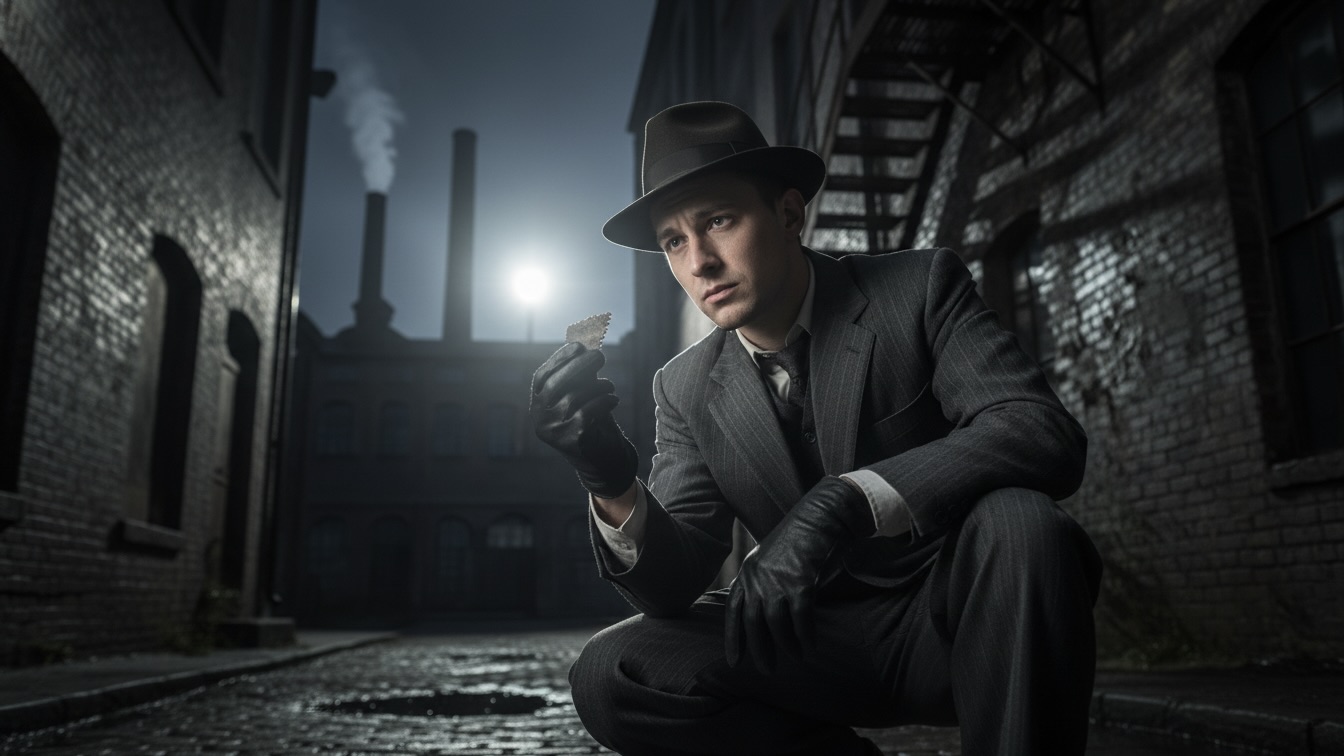
And then, as he turned it over, he saw something else. A faint, almost imperceptible etching on its surface, a small, barely visible symbol, a mark that suddenly made his blood run cold, because he recognized it. It was the mark of the old mill, the very place Mr. Taylor had worked. The mark was on the specific type of machinery that had been recently installed, machinery known for its occasional, volatile sparks.
Share This Story


