The Crimson Bluster of Elmwood
The air in Elmwood hung thick with the damp perfume of decaying autumn leaves and the faint, unsettling whiff of desperation. Rain slicked the pavement, mirroring the dull sheen on the faces of those who seemed destined to remain, eternally caught in the slow, grinding machinery of small-town life. This was the landscape of ordinary absurdities, now punctuated by the highly exaggerated crisis of a missing municipal eyesore, and the reluctant protagonist caught in its surreal wake.
“No, no, that’s not… you’ve got it all wrong.” I pulled at the collar of my too-tight hoodie, the fabric scratchy against my Adam’s apple. The fluorescent hum above was doing a number on my already frayed nerves, making the cheap particleboard desk seem to throb with its own sickly light. Outside the grimy window, a single red maple leaf, fat and wet, clung stubbornly to the glass, distorting the already blurry streetscape of Elmwood’s main drag. It was barely nine in the morning, a Tuesday in late October, and I was already considering faking my own death. Anything to get out of this room. Anything to get away from… this.
Detective Leonard, a man who seemed to have confused 'police work' with 'community theatre', leaned across the table. His breath smelled faintly of stale coffee and triumph. “William, let’s be quite clear. This isn’t a misunderstanding. This is the theft of the town’s most treasured historical artefact. The—the Bronze Potato.” He paused, expecting, I suppose, a gasp. I stifled a yawn instead. He cleared his throat, a theatrical rumble. “And we have reason to believe you were… involved.”
“Involved? I just… I was walking home. From Cassandra’s. Like I always do.” The words felt thin and reedy, even to me. They always did. Leonard’s eyes, magnified by his cheap reading spectacles, narrowed to slits. He had a way of looking at you that suggested he knew your deepest, most embarrassing secrets, like that time I tried to make sourdough and it exploded in the oven.
“Walking home. At 03:17 a.m.” He consulted a notebook filled with frantic, tiny handwriting. “And you ‘happened’ to be passing the Elmwood Town Centre, where the monument to Founder Gregory P. Elmwood was… liberated.” He practically hissed the last word, as if the bust itself had mounted a daring prison break.
“Look, I told you, I heard a sound. A sort of… wet thud? And then I saw… something.” I waved a hand, trying to capture the ethereal absurdity of it. “It was big. And… wobbly. Like someone was trying to roll a giant, lumpy pumpkin down the street. In the dark.”
Leonard snorted, a surprisingly delicate sound for a man of his bulk. “A giant, lumpy pumpkin. A likely story, Mr. William. Our forensic team, limited though they are to a single intern named Brenda and a magnifying glass borrowed from the library, have confirmed no pumpkin residue at the scene. Only… shoe prints.” He tapped the desk with a pen, the plastic a dull percussion.
“Well, yeah, it was raining. There’d be shoe prints. Mine. And… well, probably whoever took the thing.” I shifted, the metal chair digging into my thigh. This was my life. Arguing over a bronze bust that looked less like a town founder and more like a melted potato that had lost a fight with a badger. The sculptor, God bless their soul, had clearly had an ‘abstract’ phase.
“And why were you out at that ungodly hour, William? Your mother states you were ‘fast asleep in your bed, as any good boy should be’.” Leonard adopted a high-pitched, mocking voice for my mother’s quote, which made my cheeks burn.
“I was at Cassandra’s. We were… studying. For history.” It was a lie, of course. We were watching a terrible B-movie about sentient garden gnomes and consuming questionable amounts of fizzy pop. But telling Leonard that felt like admitting to a felony in itself. He’d probably try to tie the gnomes to the bust.
“Studying, were we? History. Interesting. Because Mr. Henderson, a pillar of our community, a man who has witnessed seventeen Elmwood Fall Festivals, claims he saw a young man matching your description, acting… suspiciously.” Leonard leaned back, his eyes gleaming with what he probably thought was cunning.
“Mr. Henderson is ninety-four and thinks the local squirrels are government spies.” I muttered, then regretted it immediately. Leonard’s frown deepened, causing a ripple effect across his forehead that made him look like a disappointed prune.
“A respected elder. Unlike some young individuals who prefer to… loiter.” The word 'loiter' stretched out, a judgemental accusation. “Now, this suspicious activity. Mr. Henderson reported seeing you, and I quote, ‘crouched by the Elmwood Centre, making peculiar hooting noises at the statue, almost as if you were communicating with it’.”
I blinked. “Hooting noises? What in the… I absolutely did not hoot at the Potato. I might have… muttered. Something about how hideous it was. But no hooting.” The sheer, unadulterated nonsense of it was starting to make me dizzy. This was why I wanted to go away from here. This was exactly why.
The Indelible Impression of a Wet Boot
Leonard cleared his throat again, a sign, I’d learnt, that he was about to drop another ‘bombshell’. “We found this, William.” He pulled out a clear plastic evidence bag. Inside, nestled on a crumpled paper towel, was a single, muddy footprint. It was undeniably a footprint, clear as a bell, except it was encased in a thick, almost grotesque layer of something shiny and dark.
“What… is that?” My voice was barely a whisper. It looked like someone had stepped in crude oil and then walked through a particularly enthusiastic badger convention.
“Crushed black licorice, to be precise. And a surprisingly high concentration of… glitter.” Leonard announced, as if presenting a Nobel Prize-winning discovery. “The entire scene was covered in it. The pedestals, the surrounding flowerbeds, even a few unfortunate marigolds.”
I stared at him, then at the footprint. “Licorice and glitter? What kind of… criminal uses licorice and glitter?” The surrealism was dialling up to eleven. This wasn’t just a stolen bust; it was a performance art piece gone horribly, absurdly wrong.
“A very particular kind, William. A criminal who leaves an impression. An indelible, sticky impression.” Leonard seemed proud of this observation. “And this print… matches a size 9 men’s boot. A boot not dissimilar to the one you are currently wearing.” He gestured vaguely at my feet.
I looked down at my scuffed, mud-splattered work boots. They were old, comfortable, and definitely a size 9. But they had never, to my knowledge, been acquainted with licorice and glitter. Unless Cassandra had been experimenting with confectionery-based footwear again. Which, knowing Cassandra, wasn't entirely out of the question.
“I… I don’t know anything about licorice and glitter. I swear. I was just walking home. It was dark. And then I saw… a blur. A big, dark blur. And I heard… a sort of wheezing. Like a deflating accordion.” My internal monologue was already writing my epitaph: 'Here lies William, who died defending himself against accusations of accordion-wheezing and confectionery-based crimes.'
---
Leonard looked unconvinced. “A deflating accordion. Your story gets stranger with every retelling, William. Perhaps you’d like to call someone? Someone who can corroborate your… studying alibi?” He pushed an ancient rotary phone across the desk. It smelled faintly of mothballs and despair.
I sighed, running a hand through my perpetually messy hair. “Fine. I’ll call Cassandra.” I dialled her number, the slow, satisfying click of the rotary reminding me of my grandmother’s kitchen. It rang once, twice, then her groggy voice answered, full of static and resentment.
“What. The. Actual. Hell, William? It’s before noon. Are you on fire? Because that’s the only acceptable reason.” Her voice, even through the crackling line, had a definite edge. I could picture her, tangled in her favourite band t-shirt, probably with cereal crumbs in her hair.
“Cassandra, hey. Uh, big favour. You remember last night? After the gnome movie? You remember me walking home, right? From your place?” I tried to keep my voice casual, but the urgency leaked through, a desperate sheen.
A pause. A very long, very meaningful pause. “Walking home? William, you fell asleep on my beanbag chair. Snoring like a broken vacuum cleaner. I covered you with a blanket and then I went to bed. You were still there when I left for my morning shift at the coffee shop, like, half an hour ago.”
My heart sank, a leaden weight. “I… what? But I woke up and just… left.” The memory was hazy, a blurry scramble in the pre-dawn dark. I remembered pulling on my boots, stumbling out the door, the chill autumn air a shock against my face. Had I been sleepwalking? Drunk on fizzy pop and bad cinema?
“Nope. You were there. Definitely there. Look, I gotta go, some guy just tried to pay with a handful of lint. Text me if you escape.” The line went dead. I slowly replaced the receiver, the plastic cold against my palm. Leonard, of course, had been listening to the entire one-sided conversation with an increasingly smug expression.
“Sleepwalking, were we, William? How convenient.” He tapped his pen on the table again. “Perhaps you sleepwalked your way to the Elmwood Centre and, in a fit of nocturnal passion, liberated the Bronze Potato?” The satire in his voice was so thick, I could almost taste it.
“I wouldn’t touch that thing awake, let alone asleep.” I mumbled, defeated. The prospect of explaining this to my mother was worse than any jail sentence.
---
The Unlikely Footprint in the Rotting Leaves
Leonard, apparently bored of the interrogation room’s cramped confines, decided a visit to the ‘scene of the crime’ was in order. We drove in his battered police cruiser, the suspension groaning with every pothole, through streets lined with maples shedding their final, desperate explosions of orange and yellow. The air, crisp and biting, carried the acrid scent of bonfires and decay. Autumn in Elmwood always felt like the world was taking a deep, melancholic breath before a long, cold sleep.
The Elmwood Centre was less a ‘centre’ and more a vaguely circular patch of grass in the middle of a crossroads, dominated by the empty pedestal where the Bronze Potato once stood. Now, only a gaping, lichen-encrusted concrete block remained, adorned with a few lingering bits of black licorice and a faint shimmer of iridescent glitter. A yellow police tape, barely holding on in the wind, fluttered forlornly around the perimeter. Brenda, the forensic intern, was meticulously bagging a single, half-eaten lollipop.
“Remarkable work, Brenda!” Leonard boomed, making the young woman jump, nearly dropping her evidence. “The integrity of the scene must be preserved!”
“Yes, Detective,” Brenda mumbled, her face flushing. She looked about my age, maybe a year younger, with wide, terrified eyes. She gave me a quick, sympathetic glance, clearly thinking: poor guy, stuck with this loon.
I walked towards the pedestal, my boots crunching on the wet leaves. The wind picked up, swirling a vortex of crimson and gold around my ankles. It smelt of earth and rain, but also, disturbingly, a faint sweetness, like burnt sugar. The ground was soft, mushy in places, the soil dark and rich.
“So, no clues here, then, other than the sticky residue?” I asked, kicking at a particularly stubborn clump of leaves. Brenda flinched. Leonard shot me a disapproving look.
“On the contrary, William. Every detail is a clue. The absence of the Potato itself is a clue. Its sheer mass, its… historic significance.” Leonard gestured grandly at the empty space. “Someone went to considerable effort for this.”
I squatted down, brushing away a layer of damp, decaying oak leaves near the edge of the police tape. Below, pressed into the soft earth, was another footprint. Not a boot print. This one was smaller, daintier. And it had five distinct, widely spaced toes. Almost like… a human foot, but… not quite. And then I saw it, embedded in the heel impression: a tiny, tarnished silver earring, shaped like a miniature trowel.
“Hey, Detective,” I called out, my voice catching slightly. “I think I found something.”
Leonard sauntered over, his brow furrowed with suspicion, as if I’d just planted evidence. “What is it now, William? Another ‘wet thud’?”
“No. Look.” I pointed to the print. He squinted, adjusted his glasses. Brenda, curious, peered over his shoulder. The silver trowel glinted faintly in the weak autumn light.
“A bare foot print?” Leonard muttered, clearly confused. “And… a gardening tool? What in the name of… Elmwood is going on?”
Just then, his radio crackled to life, a burst of static. “Detective Leonard, we’ve found it. Or… part of it. And a note.” The voice was crackly, urgent. Leonard grabbed the radio, his eyes wide. “Found what? Where?”
“The Potato, sir. Or… its head. It was discovered by Mrs. Gable in her prize-winning petunia patch. And there’s a note, sir. Tucked right into its… bronze earhole.”
Leonard's head snapped up, his gaze locking onto mine. “Its earhole? What does it say?” He demanded into the radio, his voice rising. “Read it, officer! Now!” A beat of static, then the voice again, sounding hesitant. “It says… ‘I can no longer tolerate its insolence. Its gaze is a judgment. It must see the sky. For now, only the sky. P.S. The glitter was for dramatic effect. And the licorice. Very important.’ ” Leonard lowered the radio, his face a mask of bewildered rage. “Dramatic effect? Insolence? What in blazes…” He looked at me, then back at the empty pedestal, then at the sky. A flicker of something, a strange, almost manic glint, entered his eyes. “William,” he said slowly, his voice laced with an unnerving calm. “I think our Bronze Potato just ran away from home. And I think you know exactly who helped it.”
I opened my mouth to protest, to say something, anything, but the words caught in my throat. Mrs. Gable. Petunias. A trowel. Glitter. Licorice. And a note. Oh, this was just… beginning.
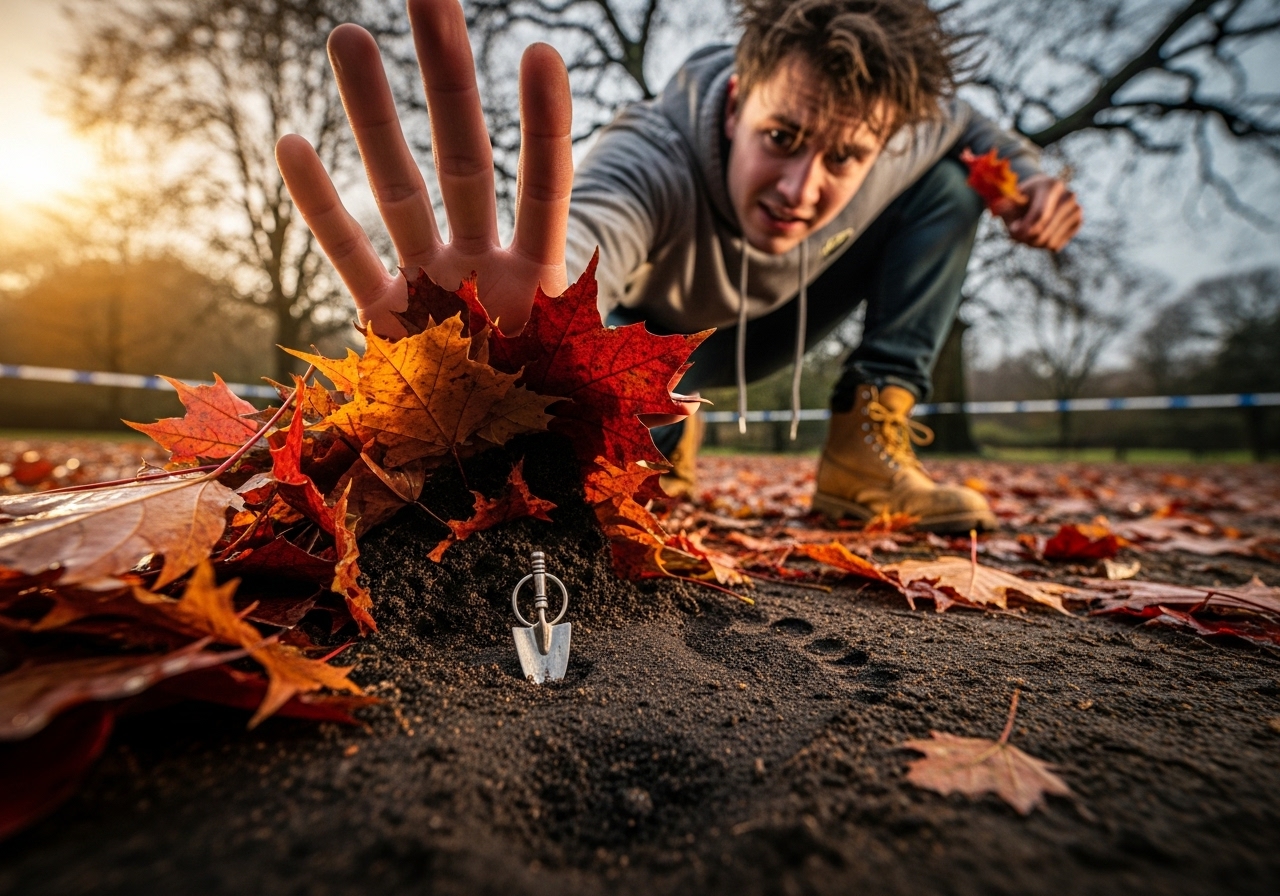
Leonard's eyes, wide and unnervingly calm, locked onto mine, the implication clear: he believed I was somehow complicit in the baffling, confectionery-laced escape of the Bronze Potato. And with the discovery of the note, I knew, with a sinking certainty, that my small-town nightmare was only just beginning, and that getting away from here was suddenly a much more complicated, and sticky, proposition.
Share This Story


